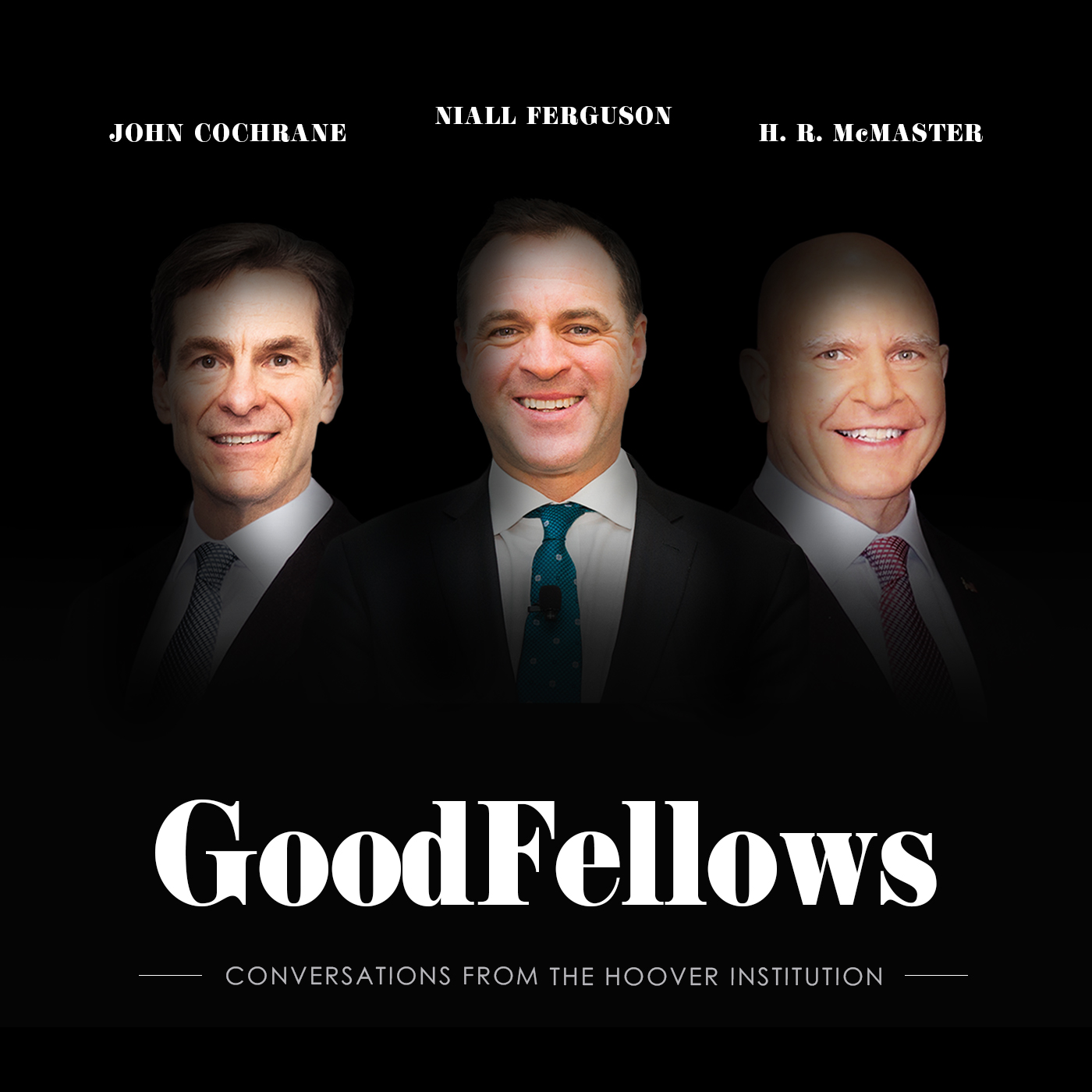
GoodFellows: Conversations on Economics, History & Geopolitics
<p dir="ltr" class="p1"><span><b>GoodFellows: Conversations on Economics, History, & Geopolitics</b> is a flagship videocast from the Hoover Institution where senior fellows John Cochrane, Niall Ferguson, and H.R. McMaster cut through the noise, challenge conventional wisdom, and explain what’s driving markets, power, and public policy. Drawing on rigorous economic analysis, deep historical perspective, and national security leadership at the highest levels, these leading thinkers deliver clear, trusted insight into the challenges facing the United States while debating the forces shaping the modern world.</span></p>
The note was deleted
The note was saved
On paper, it was a mismatch: a fledgling republic seeking freedom from the world’s mightiest empire. And yet the American Revolution ended with the upstart colonists’ victory over the mighty British military. Rick Atkinson, a military historian and author of a “Revolutionary Trilogy” on the fight for America’s independence, discusses the military tactics, geopolitical shifts, and economic conditions that factored into the war’s outcome. After that, the fellows discuss why serving as the British prime minister has become a game of musical chairs and how Labour lost its way, as well as the rise of “democratic socialism” and the appeal of class warfare and expansive government in the US – most notably, a California ballot initiative that imposes a “wealth tax” on the state’s billionaires. Finally, in the “lighting round”, John's thoughts on the passing of former Federal Reserve chair Alan Greenspan; H.R.’s take on the Pentagon putting its generals out to pasture; and Niall reflecting on European World Cup fans descending upon the US, only to discover a land of abundance (i.e., plenty of ranch dressing even if there’s not enough beer to go around). Subscribe to GoodFellows for clarity on today’s biggest social, economic, and geostrategic shifts — only on GoodFellows.
As the US and Iran prepare to sign a memorandum of understanding halting hostilities in the Middle East, will the agreement hold up for long given fundamental differences over Iran’s nuclear ambitions (another 60 days of negotiating), its funding of terrorist proxies across the region, plus Israel’s actions in Lebanon? If he succeeds in putting Iran in the rear-view window, does President Trump turn his attention to brokering a peace deal between Russia and Ukraine (that war now approaching four years and four months of fighting) as well as ending Cuba’s communist dictatorship? Finally, speaking of invasions, GoodFellows’ resident Scotsman explains the joy of his countrymen’s “Tartan Army” coming to Boston – thousands of kilt-wearing lads and lasses singing, marching and pub-crawling their way through Beantown whilst rooting on a Scottish national team making its first World Cup appearance in this century. Subscribe to GoodFellows for clarity on today’s biggest social, economic, and geostrategic shifts — only on GoodFellows.
In a special “mailbag” episode, Hoover senior fellows Sir Niall Ferguson, John Cochrane, and H.R. McMaster answer audience questions. Among the topics (after a brief opening segment devoted to the latest in the Iran-US impasse – aka, “Schrödinger’s ceasefire”): who are today’s great leaders; is “the American experiment” doomed, as some intellectuals posit; China’s move to gold from dollar-denominated securities; the futures of the European Union and the UK’s Reform movement; North Korea’s relative silence; the cooled-down rhetoric of climate change; whether our PhD-wielding historians bother with televised historical dramas; thoughts on gentlemen-scholars’ sartorial style (“buy [clothes] when you’re a graduate student and wear them until they fall apart”); plus managerial lessons to be drawn from the recent successes of Sir Niall’s beloved Arsenal football club. Subscribe to GoodFellows for clarity on today’s biggest social, economic, and geostrategic shifts — only on GoodFellows.
Is it time to rethink the configuration of the US Supreme Court – not nine justices divided along lockstep ideological lines, but three groups of three justices, each clique with a different approach to jurisprudence? So argues court watcher and legal analyst Sarah Isgur, who discusses her new book, Last Branch Standing: A Potentially Surprising, Occasionally Witty Journey Inside Today's Supreme Court, and explains where the justices stand on a series of contentious issues (“birthright citizenship”, the administrative state, abortion, the court’s relationship with an antagonistic president on matters like tariffs and executive authority, plus maintaining a semblance of impartiality in a polarized Washington). After that: the three fellows discuss what’s next in Iran with peace negotiations seemingly at an impasse, what to expect from this week’s US-China summit in Beijing, plus what challenges lie ahead for Hoover fellow Kevin Warsh as he takes over as the Federal Reserve’s new chair. Subscribe to GoodFellows for clarity on today’s biggest social, economic, and geostrategic shifts — only on GoodFellows.
As part of the Hoover Institution’s ongoing USA@250 celebration of the founding of the American republic, a live GoodFellows episode recorded on the campus of Stanford University focusing on the US Constitution – in tech terms, America’s “operating system”. Goodfellows regulars Sir Niall Ferguson, John Cochrane and Lt. Gen. H.R. McMaster discuss the root causes of the American Revolution (taxation without representation, though the Scottish-born panelist contends the colonists in fact had a “fantastic deal”), the Constitution’s underlying principles (recognizing but not granting rights), why a document that’s more “machinery” than “visionary” in its design has stood the test of time, plus whether several provisions within the original framework and its 27 amendments (presidential eligibility, gun rights, “birthright citizenship”) need updating a world the Founding Fathers couldn’t imagine. Subscribe to GoodFellows for clarity on today’s biggest social, economic, and geostrategic shifts — only on GoodFellows.
Hoover Institution research fellow and Iran scholar Abbas Milani joins the GoodFellows to discuss life within the beleaguered theocracy: who’s in charge, and will added economic pressure in the form of a blockade of the Strait of Hormuz, and a halt on Iran’s oil trade bring about an end to the regime. After that: the fellows’ thoughts on Hungary’s election, Iran war “winners and losers”, America’s woeful tax code, and the Artemis II space mission. Subscribe to GoodFellows for clarity on today’s biggest social, economic, and geostrategic shifts — only on GoodFellows.
If unexpected wars and oil shocks have been big features of recent history, so too are economic recessions – another downturn perhaps ahead in 2026. Tyler Goodspeed, a former Hoover Institution fellow and author of the forthcoming book, Recession: The Real Reasons Economies Shrink and What To Do About It, joins GoodFellows regulars Sir Niall Ferguson, John Cochrane, and Lt. Gen. H.R. McMaster for a tutorial on economic conditions and lessons past and present. After that: The three fellows discuss the latest in the Iran conflict including the feasibility of a peace agreement by week’s end as demanded by President Trump, the odds of land forces entering the equation in the near future, plus possible economic hardship ahead should the fighting linger. Finally, in the “lightning round”: why the late Stanford biologist Paul Erlich was so amiss in predicting a doomed planet (not unlike climate alarmists) and H.R.’s favorite Chuck Norris jokes in honor of the recent passing of the famed Hollywood tough guy. Subscribe to GoodFellows for clarity on today’s biggest social, economic, and geostrategic shifts — only on GoodFellows.
Does the current conflict in the Middle East suggest that America has learned from its recent past wars? Hoover Institution Director and former US Secretary of State Condoleezza Rice joins GoodFellows regulars Sir Niall Ferguson, John Cochrane and Lt. Gen. H.R. McMaster to discuss the prospects of an oil “shock” prompted by a prolonged closure of the Strait of Hormuz as well as a political “shock” back in the US when voters go to the polls in November, China and Russia’s losses in terms of stature and friendly regimes, plus what the Anthropic-Pentagon legal kerfuffle suggests about the role of emerging technology in history’s first AI-enabled war and the problems in being portrayed as a societal menace. Afterwards: the fellows reflect on the 250th anniversary of Adam Smith’s The Wealth of Nations, billionaires in the crosshairs of the “affordability” debate, and why they won’t be watching the upcoming Academy Awards. Subscribe to GoodFellows for clarity on today’s biggest social, economic, and geostrategic shifts — only on GoodFellows.
A week into US and Israeli military operations against Iran, where does the conflict stand? GoodFellows regulars Niall Ferguson, John Cochrane and H.R. McMaster discuss the odds of hostilities expanding, what the aftermath of “regime alteration” might resemble, a possible economic backlash should energy prices spike, plus a geopolitical shock felt in Beijing and Moscow. Subscribe to GoodFellows for clarity on today’s biggest social, economic, and geostrategic shifts — only on GoodFellows.
As his self-proclaimed 10-day window for dealing with Iran approaches its end, what are President Trump’s options? GoodFellows regulars Niall Ferguson, John Cochrane, and H.R. McMaster weigh the merits of a US military strike versus an interim diplomatic solution. They also probe the Epstein scandal’s impact on the British landscape and the Supreme Court’s ruling against the Trump administration’s use of emergency powers for tariff implementation. Later, in the “lightning round”: why US Secretary of State Marco Rubio was warmly received at the Munich Security Conference; the Pentagon’s desire to sever academic ties with Harvard University; Barack Obama’s suggesting that aliens exist; plus H.R.’s remembrance of film great Robert Duvall, aka Apocalypse Now’s Lt. Col. Bill “I Love the Smell of Napalm in the Morning” Kilgore. Subscribe to GoodFellows for clarity on today’s biggest social, economic, and geostrategic shifts — only on GoodFellows.
Unlike the romanticized tale the Chinese Communist Party tells of itself—long marches and a long game of outlasting and outwitting its foes—the early years of the CCP were ones of unrepentant violence and a rise to power made possible only with external help. Frank Dikötter, the Hoover Institution’s Milias Senior Fellow and author of the forthcoming book, Red Dawn over China: How Communism Conquered a Quarter of Humanity, joins GoodFellows regulars Niall Ferguson, John Cochrane and H.R. McMaster to discuss what shaped the CCP from the years 1921–1949, plus parallels between Xi Jinping and Mao Zedong in terms of amassing power, purging rivals, and practicing economics and geopolitics. After that: the fellows debate the assertion by a New York Times columnist that Donald Trump has “lost the country,” as well as how much faith to put in economic indicators, plus songstress Billie Eilish’s belief that “no one is illegal on stolen land.” Subscribe to GoodFellows for clarity on today’s biggest social, economic, and geostrategic shifts — only on GoodFellows.
Donald Trump’s drop-in at the World Economic Forum and the ensuing kerfuffle between the American president and the attending globalist elites raises the question: Who is winning on the world stage, Trump or his foes—or do they have more in common than is commonly recognized? Tyler Cowen, an economist, blogger, and Free Press columnist, joins GoodFellows regulars Niall Ferguson, John Cochrane, and H.R. McMaster to discuss Trump’s third presidential visit to the Davos, Switzerland, lion’s den, plus the rise of “democratic socialism” and “affordability politics” embodied in the ethos of New York Mayor Zohran Mamdani. After that: the three fellows discuss lessons from Minneapolis in the aftermath of two protestors shot to death by federal immigration agents; the odds of American military strikes against Iran; the significance of China’s latest military purge; plus whether the show’s resident historians are comfortable with the (over)use of phrase “the right side of history.” Subscribe to GoodFellows for clarity on today’s biggest social, economic, and geostrategic shifts — only on GoodFellows.
As Iran’s theocracy teeters on the brink, the question turns to what the Trump administration’s abiding interest in other bad regimes (Venezuela, Cuba, Colombia) and its appetite for land acquisitions (greenbacks for Greenland?) say about the American president’s worldview. GoodFellows regulars Niall Ferguson, John Cochrane, and H.R. McMaster discuss policy options for Iran now that protests have turned tragic; the relative silence from the same campus leftists who fervently protested the war in Gaza; Nixonian echoes in Trump’s foreign policy; plus Secretary of State Marco Rubio’s emergence as a geopolitical jack-of-all-trades. In the second segment, John weighs in on the significance of the Justice Department’s criminal investigation into Federal Reserve chair Jerome Powell; H.R. contends America’s designs on Greenland are no laughing matter; and Sir Niall previews what to expect from Trump’s appearance at the upcoming World Economic Forum in Davos. Finally, GoodFellows’ resident “Deadhead” bids a fond farewell to the late Bob Weir, guitarist and cofounder of the Grateful Dead. Subscribe to GoodFellows for clarity on today’s biggest social, economic, and geostrategic shifts — only on GoodFellows.
American special forces capture Venezuela’s president and his wife in a daring nighttime operation, returning the deposed first couple to the US to stand trial for alleged narcoterrorism. Meanwhile, protests in Iran over worsening living conditions, coupled with a cratered economy, threaten that theocracy’s future. GoodFellows regulars Niall Ferguson, John Cochrane, and H.R. McMaster kick off 2026 by discussing both the precedent and the consequences of the move on Maduro, whether other nations (i.e. China) will invoke their own “Monroe Doctrines” to justify regional power grabs, plus the chances of similar fates awaiting Greenland, Colombia, or Cuba. After that: the panel’s thoughts on whether Iran’s regime is in its dying days as conditions on the ground deteriorate; and the chances of political transformation spreading worldwide in 2026—a là the end of the first Cold War—potential signposts of freedom as America celebrates 250 years of individual liberty. Finally, the fellows send their best wishes to a pair of GoodFellows guests—former Nebraska Senator Ben Sasse and Hoover’s Victor Davis Hanson—as the two gentlemen do battle with cancer. Subscribe to GoodFellows for clarity on today’s biggest social, economic, and geostrategic shifts — only on GoodFellows.
Nearly a century ago, after years of investors on a champagne high and warning signs ignored, a stock market crash led to a descent into a global depression. Andrew Ross Sorkin, a New York Times financial journalist and author of the bestseller 1929: Inside the Greatest Crash in Wall Street History—and How It Shattered a Nation, joins GoodFellows regulars Niall Ferguson, John Cochrane, and H.R. McMaster to discuss how the events of 1929 resonate to this day, what’s misunderstood about the fabled crash, whether Herbert Hoover (only seven months into his presidency when disaster struck) gets a fair shake, plus what the future holds for Federal Reserve independence, the bidding war for Warner Bros. Discovery, and Wall Street’s relationship with Washington. After that: The three fellows look back on 2025 with their choices for individual of the year, the most significant or ignored stories, what they learned in 2025, plus predictions and resolutions for the new year. Finally, a surprise visit by Hoover Institution visiting fellow Kris Kringle, who asks the panel for its holiday wishes (oddly enough, H.R. is never around when jolly old St. Nick shows up). Subscribe to GoodFellows for clarity on today’s biggest social, economic, and geostrategic shifts — only on GoodFellows.
Two institutional sectors are in both steady and rapid decline in terms of public trust: Congress and academia. Ben Sasse, former US senator from Nebraska and president of two universities, joins GoodFellows regulars Niall Ferguson, John Cochrane, and H.R. McMaster to discuss what ails Congress and how to fix it (based on his eight years in the Senate), plus how America’s educational system has set a low bar for readying students for higher learning and life after college. Next the three fellows weigh the merits of the Trump administration’s new National Security Strategy and what strategy there is (or isn’t) regarding Venezuela and drug trafficking; the shortcomings of fuel-efficiency standards; whether they’d buy an American-made “tiny car” (no way, says our resident former tank driver); and, with the World Cup coming to America in 2026, how to clear up the confusion between US-brand “football” and the international “beautiful game” that goes by the same name (Sir Niall’s solution: Change US football to “armored rugby”). Subscribe to GoodFellows for clarity on today’s biggest social, economic, and geostrategic shifts — only on GoodFellows.
Is the bitter war in Ukraine soon to wind down now that a peace settlement is being negotiated (think a Panmunjom-style compromise, not Munich-style appeasement), and how should America prepare for economic and military parity with China? In an episode devoted solely to viewers’ questions, Hoover senior fellows Sir Niall Ferguson, John Cochrane and H.R. McMaster delve into matters ranging from those somber (allaying twenty-somethings’ climate alarmism, “ideal” interest rates, the future of tank warfare as well as AI’s redesign of future workforces) to those more lighthearted (H.R.’s service nickname, the artist behind John’s wall hangings, and how the fellows would ride out a future pandemic). Finally, on the eve of America’s Thanksgiving holiday, the fellows count their blessings – especially “Papa” Ferguson, who recently joined John (aka, “Blah-Blah” to his grandchildren) and H.R. (likewise, his grandkids’ “Papa”) as a first-time grandfather. Subscribe to GoodFellows for clarity on today’s biggest social, economic, and geostrategic shifts — only on GoodFellows.
Will future wars be decided by who controls space—cyber and outer—and which superpower has better paired geostrategic thinking with emerging technologies? Anne Neuberger, the Hoover Institution’s William C. Edwards Distinguished Visiting Fellow and a former White House and Pentagon cyber policy advisor, joins GoodFellows regulars Sir Niall Ferguson, John H. Cochrane, and Lt. Gen. H.R. McMaster to discuss what she sees as a “cyber gap” between China and America, the need for the US to rethink traditional weapons platforms (hello, drones), plus how Dwight Eisenhower’s warning of a “military industry complex” is being redefined by the tech sector’s growing role in present-day and future warfare. After that: the three fellows weigh the significance of a utopian socialist recently elected mayor of a very capitalist New York City, a new “algocracy” (algorithms running the government) in Albania, the UK’s fabled BBC in hot water over alleged editorial bias, plus whether the “war of the tomorrow” may be in . . . Venezuela? Subscribe to GoodFellows for clarity on today’s biggest social, economic, and geostrategic shifts — only on GoodFellows.
At a time of “hot wars” across the globe, there’s also an ideological “cold war” featuring two foes: those who embrace freedom and those who oppress it. Michael McFaul, the Hoover Institution’s Peter and Helen Bing Senior Fellow and author of the newly released Autocrats vs. Democrats: China, America, Russia and the New Global Disorder, joins GoodFellows regulars John Cochrane and Lt. Gen. H.R. McMaster to discuss where he departs from the Trump administration on its approach to Russia and China (one autocracy economically dwarfing the other), his suggestions for course change, and why he holds “guarded” optimism for America’s future. After that: John and H.R. go “trick-or-treating”—weighing the pros (“treats”) and cons (“tricks”) of a new White House ballroom, a Chinese military purge, the latest inflation numbers and gold prices that no longer glitter, a CEO’s tariff worries, New York City on a non-hallowed eve of “democratic socialism,” plus a new and tougher American citizenship test (could Sir Niall Ferguson pass it?). Finally, as Halloween approaches, John and H.R. give us their go-to candies. Subscribe to GoodFellows for clarity on today’s biggest social, economic, and geostrategic shifts — only on GoodFellows.
A hostage return and the signing of a cease-fire agreement signal a new chapter in the long-running dream of peace in the Middle East. Did it matter that the key negotiators, on the US side, were financiers and real-estate developers rather than scions of America’s diplomatic corps? Russell Berman, a Hoover Institution senior fellow and codirector of Hoover’s Working Group on the Middle East and the Islamic World, joins GoodFellows regulars Niall Ferguson and John Cochrane to discuss the sturdiness of the Trump White House’s 20-point peace plan, the futures of Hamas and the Abraham Accords, the likelihood of Israeli Prime Minister Benjamin Netanyahu’s reliving Winston Churchill’s fate (a successful wartime leader rejected by a war-weary electorate), plus whether the “real estate-ism” approach to diplomacy is applicable to President Trump’s upcoming meetings with his Russian and Chinese counterparts. After that, Niall and John reflect on the likelihood of a market crash (it is October, after all), the chances of a full-fledged tariff war with China, the merits of a US-Argentina currency swap, plus an ominous warning from the International Monetary Fund regarding global debt. Finally, the fellows salute the legendary economist Thomas Sowell, the subject of a Hoover Institution tribute later this month. Subscribe to GoodFellows for clarity on today’s biggest social, economic, and geostrategic shifts — only on GoodFellows.
One great power (China) has a relentless thirst to build that comes with a terrible human cost, while its main rival (America) is a more lawyerly and free society that’s prone to stifling ideas both good and bad. On the 76th anniversary of the founding of the People’s Republic of China, Dan Wang, a Hoover Institution research fellow and author of the bestseller Breakneck: China’s Quest to Engineer the Future, joins GoodFellows regulars Niall Ferguson and H.R. McMaster to discuss what the future holds for the two Cold War 2 rivals, plus Wang’s firsthand experiences witnessing China’s engineering boom and enduring its draconian pandemic policies. After that, the fellows weigh in on President Trump’s recent United Nations address and the state of that institution, the likelihood of Trump’s Gaza peace plan coming to fruition, the provision of long-range Tomahawk missiles to Ukraine, plus the merits of a US military strike inside Venezuela to counter narco-terrorism. In the lightning round: why America’s military brass gathered at Quantico; National Guard troops head to Portland, Oregon; Scotland’s frustration with illegal immigration; and the feasibility of the US regaining Afghanistan’s Bagram Air Base. Subscribe to GoodFellows for clarity on today’s biggest social, economic, and geostrategic shifts — only on GoodFellows.
As a seemingly interminable conflict in Ukraine concludes its 43rd month of ground combat, aerial drone strikes, and stalemate, America’s culture war enters a new phase with the assassination of conservative activist and Turning Point USA founder Charlie Kirk, followed by the suspension of late-night television host Jimmy Kimmel for an on-air comment made in the aftermath of Kirk’s murder. GoodFellows regulars Niall Ferguson, John Cochrane, and H.R. McMaster discuss the current state of affairs in Ukraine (Sir Niall fresh off a visit to Kyiv), Kirk’s murder as a watershed moment in a potential new cycle of political violence, plus whether America has reached a tipping point regarding free speech and government meddling for partisan benefit (our resident “grumpy economist” calling for the elimination of the Federal Communications Commission). Finally, a little sunshine (as in the Sundance Kid): the three fellows offering their favorite Robert Redford movies in honor of the recently deceased (and Scottish?) screen legend. Subscribe to GoodFellows for clarity on today’s biggest social, economic, and geostrategic shifts — only on GoodFellows.
Is Indian Prime Minister Narendra Modi’s embrace of his Russian and Chinese peers a mere signal of his displeasure with American tariff policy, or the beginning of a deeper geopolitical realignment? Hoover senior fellows Niall Ferguson, John Cochrane, and H.R. McMaster discuss the significance of Modi’s summitry with Vladimir Putin and Xi Jinping. This leads into a broader conversation about Ukraine’s durability (with Niall soon to visit Kyiv), as its conflict with Russia becomes a predominantly drone war. Also discussed: the question of power-wielding in Washington—the American president derided as a modern-day fascist for his use of executive authority; the differences between Trump Derangement Syndrome in the past versus the present; the Federal Reserve’s independence (and sprawl); plus the merits of the federal government taking a 10% equity stake in chip manufacturer Intel. Finally, some bad news for our London fans: While the GoodFellows will be gathering in the UK’s capital city, there are no plans for a rooftop concert à la the Beatles atop their Apple Corps building. Subscribe to GoodFellows for clarity on today’s biggest social, economic, and geostrategic shifts — only on GoodFellows.
What inspires a young boy to dream about a career in the US Army and then, after graduating from West Point, manage to prepare for—and survive—combat? In a “solo” installment of GoodFellows, Lt. Gen. H.R. McMaster, Hoover’s Fouad and Michelle Ajami Senior Fellow, a former national security advisor to the president, and a highly honored combat veteran, discusses his childhood in Philadelphia, the inspiring figures he encountered during his Army years, his roundabout journey to becoming an armor officer, lessons from tank battles in the Middle East, and the importance of faith. He also describes a post-service life in California, where, ironically, an Army man makes sense of world affairs while chillaxing on a paddleboard. Also joining the show: Katie McMaster, who recounts how she and her husband met (it was love at first sight), the challenges of being a military spouse, the day H.R. said goodbye to his head of hair (he shaved his head at her insistence), plus her ongoing campaign to spare her Orange County neighbors from the blare of H.R.’s favorite tunes. Subscribe to GoodFellows for clarity on today’s biggest social, economic, and geostrategic shifts — only on GoodFellows.
What to expect from this week’s Putin–Trump summit in Alaska? Hoover Institution Director and former US Secretary of State Condoleezza Rice—no stranger, she, to engaging in statecraft with Russia’s enigmatic president—joins GoodFellows regulars Niall Ferguson, John Cochrane, and H.R. McMaster for a spirited conversation about Vladimir Putin’s motives (is the summit only for domestic Russian consumption?), how to characterize the present US-Sino competition (Secretary Rice tossing cold water on “Cold War 2”), plus the sensibility of the Trump administration’s threats to withhold federal research funds from leading universities in order to change campus cultures. Following that, Sir Niall recounts his recent sit-down with Argentinian president Javier Milei (is that nation’s “vibe shift” real or contrived?); and tariff-agnostic John Cochrane assesses the progress of the Trump administration’s ever-evolving trade strategy. Finally, the three panelists discuss the recent 80th anniversary of the only wartime use of atomic weapons and the importance of its annual remembrance.
How does a young Scotsman go from struggling actor and failed politician to internationally acclaimed (and knighted) historian? In a solo installment of GoodFellows, Sir Niall Ferguson, Hoover’s Milbank Family Senior Fellow, discusses his academic journey, fellow historians he admires, keys to successfully multi-tasking through life, plus how he and his spouse, Hoover Research Fellow Ayaan Hirsi Ali (who also appears in this episode), are raising their two sons. Also discussed: Sir Niall’s newfound passion for sailing, his non-Scottish attitude toward golf and fishing, why he doesn’t see retirement as a viable lifestyle, plus the pride he takes in a music legend recently lauding him as the “Jimi Hendrix” of his profession. Recorded on July 30, 2025. Subscribe for clarity on today’s biggest social, economic, and geostrategic shifts — only on GoodFellows.
In contrast to the 20th-century bosses of industry who ran America’s big cities, New York City seems poised to elect an unabashed socialist with dreams of government-run bodegas, rent freezes, and wealth redistribution. Rick Caruso, noted Los Angeles real estate developer and possible political candidate in 2026, joins GoodFellows regulars and Hoover senior fellows Niall Ferguson, John Cochrane, and H.R. McMaster to discuss the future of America’s big cities—whether his other major cities will follow Gotham’s lead, plus how to bring needed change to municipalities notoriously averse to innovation (and in LA’s case, a city perhaps unprepared for the 2028 Summer Olympics). The three fellows next reflect on the Ukraine-Russia conflict, now entering its 42nd month with no end in sight, then engage in a “lightning round” that touches on Harvard’s reported desire to create a Hoover Institution of its own; Hunter Biden’s skewed take on illegal immigration; the Epstein scandal’s effect on the MAGA movement; plus a “heated” debate over why Sir Niall and his countrymen choose to live without air conditioning. Recorded on July 22, 2025. Subscribe for clarity on today’s biggest social, economic, and geostrategic shifts — only on GoodFellows.
How does a promising young scholar go from dreams of designing glider planes to the study of physics and then on to a celebrated career as one of the world’s foremost monetary economists? In a “solo” installment of GoodFellows, John Cochrane—Hoover’s Rose-Marie and Jack Anderson senior fellow and coauthor of the newly released Crisis Cycle: Challenges, Evolution, and Future of the Euro—discusses his academic journey, his mentors, and the fellow economists who’ve inspired him along the way; his ongoing concerns with inflation and debt; plus his interest in penning a follow-up to Milton Friedman’s Free to Choose. Later, John takes part in a “Herbert Hoover Questionnaire,” in which he details proper airplane etiquette (if you occupy the window seat, raise the shade!), describes the virtues of his beloved family dog, and extols the culinary skills of his wife (author Elizabeth Fama, who makes a cameo appearance at the show’s end for the couple’s 39th wedding anniversary).
US forces launched bomb and missile strikes against Iranian nuclear facilities, followed soon by an Iran-Israel ceasefire and the beginning of what could be a diplomatic realignment across the Middle East. The GoodFellows regulars and Hoover Senior Fellows Niall Ferguson, John Cochrane, and former White House National Security Advisor H.R. McMaster discuss the collateral impact of the Trump administration’s move against the Iranian regime. The fallout includes: a possible expansion of Abraham Accords participants (as the Gulf States help Iran pursue a more peaceful nuclear program); NATO members willing to invest more in military readiness; the media’s second-guessing the effectiveness and wisdom of the B2 sorties; plus what message Trump’s use of military might—as opposed to revolving-door diplomacy—sends to the world’s various mischief-making capitals (Beijing, Moscow, and Pyongyang). Recorded on June 27, 2025.
Israel launches air attacks intended to destroy Iranian nuclear and ballistic missile capabilities, Iran retaliates with missile strikes on Israeli cities, and the world waits to see what comes next – a return to the status quo, neighboring countries drawn into the conflict, or an end to the Iranian theocracy? GoodFellows regulars and Hoover senior fellows Sir Niall Ferguson and former White House national security advisor Lt. Gen. H.R. McMaster discuss whether the Israeli goal of ending Iran’s nuclear ambitions is possible without U.S. assistance, how President Trump might respond if asked to directly engage, if the conflict will expand beyond the present bilateral exchanges, plus the outcome of regime change in a culturally diverse Iran (a peaceful transition or Libya 2.0?). After that: in honor of the 250th birthday of the United States Army, H.R. shares the thoughts of a fellow American general tasked with winning a war for liberty.
Is China hell-bent on a move against Taiwan, or does its saber-rattling not square with a military capability that’s perhaps overestimated? Frank Dikötter, a Hoover senior fellow specializing in the history of modern China, joins Hoover senior fellows Niall Ferguson, John Cochrane, and Lt. Gen. H.R. McMaster to discuss his reading of China’s desire and ability to project power, including its manufacturing capability and its suppression of individual liberties, plus the durability of Xi Jinping’s rule. Recorded on May 23, 2025.
America and China take a 90-day time-out in their dispute over tariffs; President Trump’s tour of the Middle East—the first overseas trip of his second term—raises unsettling questions about both his regional strategy and his family’s business dealings; and hostilities between nuclear-armed India and Pakistan raise questions of behind-the-scenes great-power machinations amidst “Cold War 2.” Hoover senior fellows Niall Ferguson, John Cochrane, and Lt. Gen. H.R. McMaster discuss what’s at stake in these various parts of the globe. After that: the three fellows debate the severity of Chinese espionage in America’s universities; and how AI’s ability to shortcut the learning process will impact the future of higher education. Recorded on May 14, 2025.
Harvard University and the Trump administration do battle over civil rights, funding, and tax status. Europe confronts unpleasant realities as it honors the 80th anniversary of VE Day. And the Pentagon contemplates how new weaponry and technology will change the future of warfare. It’s all part of a special “bring your own topic” episode of GoodFellows, which also examines the recent White House national security shakeup; the merits of a June 14 parade to celebrate the US Army’s 250th anniversary (it’s also President Trump’s 79th birthday); and the legacy of legendary “value investor” Warren Buffett as he steps down as Berkshire Hathaway’s CEO. Finally, with Mother’s Day approaching, the fellows reflect on the remarkable women who brought them into the world. Recorded on May 6, 2025.
Rejected by voters last November, the Democratic Party is perhaps afforded new life given President Trump’s decline in popularity and economic uncertainty ahead. What is the party’s message? Rep. Ro Khanna, a prominent progressive voice whose California district includes parts of Silicon Valley, joins Hoover senior fellows Niall Ferguson, John Cochrane, and H.R. McMaster to discuss tariffs and the use of executive power, “blue state” mismanagement, the feasibility of a “Marshall Plan” for economically downtrodden parts of America, plus the chances of Democrats parting ways with their “old guard.” After that: the three fellows weigh in on the Trump presidency at the 100-day mark, the future of Catholicism after the death of Pope Francis, tax exemption for universities, their go-to takeout food (pizza yes; haggis, no), plus two April landmarks—the 250th anniversary of the Battle of Lexington and the 50th anniversary of the fall of Saigon. Recorded on April 28, 2025.
What are the economic and geopolitical effects of President Trump's imposition of tariffs on America's trading friends and foes? In an episode devoted solely to viewers' questions, Hoover senior fellows Sir Niall Ferguson, John Cochrane, and Lt. Gen. H.R. McMaster delve into the certain volatility (and uncertain logic) of Trump's tariff maneuvers, what the future holds for the European Union, institutional decline within the U.S., plus what if any parallels between historical periods past and present (do all roads lead to Rome or Richard Nixon?). Also discussed: the uniqueness of a hybrid American republic/empire, "sleeper" nations that might emerge as powerhouses by 2050, and recommended biographies for secondary-school readers. Finally, as this month marks GoodFellows' fifth anniversary, the three fellows reflect on what they've learned over the course of gathering online and in-person for 150-plus shows. Recorded on April 10, 2025.
Does America have a plan for winning the competition of the future—mastering artificial intelligence, biotechnology, and space, plus other material and developmental sciences? Amy Zegart, the Hoover Institution’s Morris Arnold and Nona Cox Senior Fellow and cochair of the Stanford Emerging Technology Review (SETR), explains how this one-of-a-kind partnership between the Hoover Institution and Stanford University’s School of Engineering gives policymakers the tools they need to better address the challenges facing cutting-edge industries. Also discussed: the Trump national security team’s inelegant use of a chat app while prepping for a military strike in Yemen, plus the significance (or lack thereof) of Trump’s nemeses caving in to his demands—and whether other entities (Canada, Panama, Greenland, Venezuela’s trade partners) will follow suit. Recorded on March 26, 2025. Download the SETR report here: Stanford Emerging Technology Review 2025
US and Ukrainian officials will meet on March 12 to talk peace in Eastern Europe; a new US approach to China may or may not be in the works; and the Trump administration’s gas-brake approach to imposing tariffs on trade partners has a Hoover economist baffled. Arkansas senator Tom Cotton, chair of the Senate Intelligence Committee and author of Seven Things You Can’t Say About China, joins Hoover senior fellows John Cochrane and H.R. McMaster to discuss the latest in Ukraine and his concerns over China’s military, economic, and cultural hegemony. After that: The fellows dig deeper into the economic and strategic ramifications of Trump’s tariff ploys, followed by a “lightning round,” including the merits of a US “crypto strategic reserve”; the renaming an army fort in Georgia (H.R. having known the late general whose name was removed); the creator of Hamilton refusing to play a “Trumpier” Kennedy Center; plus what the two would give up for Lent if so inclined. Recorded on March 7, 2025.
A one-week window into the Trump administration’s worldview—the president blaming Ukraine for Russia’s invasion; his vice president taking to social media to accuse a Hoover scholar of “historical illiteracy”; the US then refusing to join other UN members in condemning Russian aggression—raises the question: Is the Trump brand of confusion and controversy mere happenstance or a calculated means to an end? American Enterprise Institute scholar, author, and columnist Matthew Continetti joins Hoover senior fellows John Cochrane, H.R. McMaster, and Niall Ferguson (the subject of the vice president’s lashing on X) to discuss Trump’s unorthodox style, the showcasing of executive orders, and his chances of success at home and overseas. Also discussed: the significance of Trump’s firing top military brass, a $5 million “gold card” for US residency, the Washington Post’s editorial shift to “personal liberties and free markets,” Scotland’s rugby disappointment at the hands (and legs) of England, plus the late Gene Hackman’s best performances. Recorded on February 27, 2025.
Three weeks into the nascent Trump presidency, the question of “power” arises: how the leader of the free world uses unique words, deeds, and threats to advance America’s interests globally, through a blend of grandiose promises (rebuilding Gaza), economic saber-rattling (tariffs on imported goods), and a “vibe shift” (woke bureaucracy under attack). Hoover Kleinheinz Senior Fellow Stephen Kotkin joins GoodFellows regulars Niall Ferguson and John Cochrane to discuss what such expressions of American power portend for a republic/empire showing signs of wear and tear—potentially crippling debt, a military perhaps unable to engage in multiple-theater conflicts, and more. Recorded on February 10, 2025.
A week into Donald Trump’s “second first term,” the GoodFellows drink from the proverbial fire hose trying to keep up with the news: a flurry of presidential executive orders; a freezing of US foreign aid; policy spats with multiple nations; at Davos, the world’s globalists contending with MAGA; a Chinese advancement in artificial intelligence that prompted a market selloff and evokes memories of the Cold War’s space race. Hoover senior fellows Niall Ferguson, John Cochrane, and H.R. McMaster discuss the significance of the aid freeze; what Colombia’s agreement to accept deportees after threats of a tariff war portends for Trump-brand foreign policy; how the times have changed at Davos’s annual World Economic Forum; plus whether the emergence of China’s DeepSeek app will trigger a modern-day “moonshot” within the AI sector. Next, the fellows discuss matters they deem neglected (are Russia and Iran’s regimes on the ropes?), a DEI executive order, whether Trump’s revoking of security clearances and dignitary protection was justified or vindictive, plus the three fellows’ Super Bowl plans. Recorded on January 28, 2025.
Donald Trump’s “second first term”—an oddity of winning nonconsecutive presidential elections—begins with talk of dramatic policy shifts at home and abroad. Hoover senior fellows Niall Ferguson and “Trump 45” veteran H.R. McMaster discuss the odds of a successful second Trump presidency; whether the man himself has changed; the most salient questions to ask Pentagon and State Department secretary-designates; whether Elon Musk’s government reform will be more DOGE or dog; what America’s allies and adversaries are thinking; plus the seriousness of acquiring Greenland or other Trump-speculated land grabs (Canada, the Panama Canal). After that: the fellows opine on where the Biden presidency went off the rails (are historians to blame?), followed by a look at LA’s devastating wildfires and California’s shifting political landscape (the conflagration straight out of the pages of Niall’s 2021 book Doom: The Politics of Catastrophe), plus what prompted Mark Zuckerberg to abandon Meta’s fact-checking and DEI programs. Recorded on January 15, 2025.
An eventful election year concludes with the curtain soon to rise on a second Trump presidency and the possibility of dramatic changes to how Washington conducts itself. Kimberley Strassel, the Wall Street Journal’s “Potomac Watch” columnist, joins Hoover senior fellows Niall Ferguson, John Cochrane, and H.R. McMaster for a temperature check on Trump’s comeback: the odds of his ending lawfare and weeding out recalcitrant bureaucracy while also extending his 2017 tax cuts; plus whether Elon Musk’s DOGE initiative will indeed make the federal government more efficient. Later, the fellows offer their choices of 2024’s winners and losers, and what they got right and wrong this past year, as well as something big to expect in 2025. Finally, Sir Niall reflects on the emotional pull of knighthood, having recently been on the kneeling side of his investiture ceremony at Windsor Castle.
In a special “mailbag” episode, Hoover senior fellows Sir Niall Ferguson, John Cochrane, and H.R. McMaster answer audience questions ranging from current geopolitics quandaries and viable economic models to career and parenting advice, plus their personal choices of dream guests. Among the topics: a neglected African continent; Russia’s military and economic sustainability and related policy options that the incoming Trump administration will face; parallels between Taiwan and pre–World War I Europe; rating Javier Milei’s performance in Argentina; job options for aspiring PhD candidates; plus the panel’s recommendations for foundational books to instill honor and patriotism in children (spoiler alert: Niall talking Tolkien). Submit your questions for our next mailbag episode at Hoover.org/AskGoodFellows and see if your question gets selected and answered!
After a “change” election that returned Donald Trump to the presidency, what can Americans expect in the way of foreign policy and national security departures from the current administration? Former US secretary of state and CIA director Mike Pompeo joins Hoover senior fellows Niall Ferguson, John Cochrane, and H.R. McMaster to discuss possible new directions for America’s national security apparatus. Also discussed: the Biden administration’s allowing Ukraine to fire long-range missiles into Russia; how to counter Chinese threats to Taiwan’s independence; Israeli prime minister Benjamin Netanyahu’s being declared a “war criminal” subject to arrest; plus the likelihood that Elon Musk’s Department of Government Efficiency can reshape the federal government. Recorded on November 22, 2024.
Donald Trump will return to the Oval Office in a manner few saw coming – he won America’s popular vote; his coattails may lead to Republican control of Congress – while progressive institutions (legacy media, Hollywood, wokeism, and a tired Democratic playbook) take a beating. New York Times opinion columnist Bret Stephens joins Hoover senior fellows Niall Ferguson, John Cochrane, and H.R. McMaster to discuss an American election that defied conventional wisdom – and how Trump should proceed in the weeks ahead (key cabinet appointments, foreign and economic policies) given the surprise gift of an Election Night mandate. Recorded on November 7, 2024.
Imagine an alternate universe in which the American Revolution fails or where Russia rejects Leninism in its infant stage. Live from the Hoover Institution’s Fall Retreat, Lord Andrew Roberts, renowned historian and the Hoover Institution’s Bonnie and Tom McCloskey Distinguished Visiting Fellow, joins Hoover senior fellows Niall Ferguson, John Cochrane, and H.R. McMaster to discuss various historical counterfactuals, including British forces winning the pivotal Battle of Saratoga in 1777; Vladimir Lenin being assassinated before Communism takes root in Russia; John F. Kennedy surviving his motorcade through Dallas; plus China rejecting economic reforms and instead refashioning itself as a second North Korea. Recorded on October 17, 2024.
Why has Israel repeatedly disregarded and gone the opposite way from the White House’s entreaties regarding the Middle East? And does the West fully fathom that Ukraine is losing its war of attrition with Russia? Walter Russell Mead, “Global View” columnist for the Wall Street Journal, joins Hoover senior fellows Niall Ferguson, John Cochrane, and H.R. McMaster to discuss the latest developments in those two combat theaters. Next, the fellows choose policies they feel have gone neglected in America’s presidential election, weigh in on one pundit’s assessment that the US is headed for “the greatest mental health crisis in the history of the country” should Donald Trump prevail, and reflect on the passing of Grateful Dead founding member Phil Lesh. Recorded on October 28, 2024.
Hot-wiring pagers and walkie-talkies to take out Hezbollah operatives: Was Israel’s tactic—like something from an Ian Fleming novel—a justifiable act of national security or a violation of international law? Victor Davis Hanson, the Hoover Institution’s Martin and Illie Anderson Senior Fellow and a military historian and classicist, joins GoodFellows regulars John Cochrane and H.R. McMaster to discuss the latest in the Middle East, as well as whether it was wise for Ukrainian president Volodymyr Zelenskyy to tour a munitions factory in the battleground state of Pennsylvania on the verge of America’s national election. Next, the three Baby Boomer panelists reflect on their generation’s legacy, plus which singer deserves a statue in the US Capitol alongside country music legend Johnny Cash. Recorded on September 24, 2024. RELATED RESOURCES: The Secret History of the Shadow Campaign That Saved the 2020 Election by Molly Ball The Second World Wars: How the First Global Conflict Was Fought and Won by Victor Davis Hanson The Year That Broke Politics: Collusion and Chaos in the Presidential Election of 1968 by Luke A. Nichter Basic Economics by Thomas Sowell Free to Choose: A Personal Statement by Milton Friedman and Rose Friedman With the Old Breed: At Peleliu and Okinawa by E. B. Sledge Memoirs of General William Tecumseh Sherman by William Tecumseth Sherman
What was it like to navigate America’s national security apparatus all the while coping with a mercurial commander-in-chief? Hoover senior fellow H.R. McMaster tells all in his new best-seller At War with Ourselves: My Tour of Duty in the White House – with additional insights provided by Hoover senior fellow Niall Ferguson, whose forthcoming biography of Henry Kissinger likewise will touch on national security and White House intrigue. After that: Niall and H.R. dissect the previous night’s presidential debate, assess the impact of Taylor Swift’s endorsement of Kamala Harris (spoiler alert: boy-dad Niall’s not a “Swiftie”), and offer thoughts on the perils of non-historians peddling “anti-history” and where the two fellows were 23 years ago during the 9/11 attacks on America. Recorded on September 11, 2024.
In a topsy-turvy election year, does America’s 2024 presidential contest summon ghosts from 1968 — or, is a late-breaking 1980-style landslide in the cards? Historian Niall Ferguson, the Hoover Institution’s Milbank Family Senior Fellow, appears solo on this “mini” edition of GoodFellows (or is it GoodFellow?) to discuss the current political landscape, what roles an aging electorate and the “gender gap” will play in America’s election, plus a fondness for tariffs shared by two very different Republicans: Donald Trump and William McKinley (aka “the tariff king”). Niall also discusses the challenges in raising two young sons in the Information Age, and his renewed appreciation for the works of Kurt Vonnegut.
John Cochrane, the Hoover Institution’s Rose-Marie and Jack Anderson Senior Fellow and the author of The Fiscal Theory of Price Level (2023), discusses misconceptions around how the Federal Reserve goes about its business; why economic policy factors into the great-power competition with China; his fascination with Calvin Coolidge; plus why (in John’s opinion) Portuguese Water Dogs are the kings of all canines.
In a special mini version of GoodFellows (just one wise man, not the usual three), Lt. Gen. H.R. McMaster, the Hoover Institution’s Fouad and Michelle Ajami Senior Fellow and author of the soon-to-be-released At War with Ourselves: My Tour of Duty in the Trump White House, discusses a possible sea change in American foreign policy and the view from other world capitals. On the 40th anniversary of his commissioning as a US Army second lieutenant, McMaster reflects on the challenges that tested his West Point Class of 1984 (motto: “The Best of the Corps”) versus those awaiting the Class of 2024 (“Like None Before”).
Is a regional war across the Middle East about to erupt? And what to make of a Venezuelan regime that doesn’t honor election results? Matthew Kroenig, Vice President and Senior Director of the Atlantic Council’s Scowcroft Center for Strategy and Security and coauthor of the book We Win They Lose: Republican Foreign Policy and the New Cold War, joins Hoover senior fellows John Cochrane and H.R. McMaster to discuss lessons from deterrence (or a lack thereof) past, present, and future. Next, John explains how a market meltdown underscores a fragile world economy, followed by a discussion of two historical milestones: 50 years since Richard Nixon’s resignation (with public trust in government today significantly lower than in Watergate’s heyday); and Herbert Hoover’s 150th birthday (as to his humanitarian pursuits, where would our fellows be without Hoover’s namesake institution?).
An already surreal political year becomes all the more quizzical as former president Donald Trump literally dodges an assassin’s bullet soon before making a surprise pick of Ohio senator J. D. Vance as his running mate; followed by President Biden unexpectedly ending his reelection bid and Vice President Kamala Harris swiftly becoming the Democratic Party’s presumptive presidential nominee. Hoover senior fellows Niall Ferguson, John Cochrane, and H.R. McMaster do their best to make sense of these summertime blockbusters, including whether Harris alters her party’s course (triangulate or double down on the past four years?); the pros and cons of Trump-brand nationalism and that philosophy’s hold over a restyled Republican Party; Vance’s qualifications for national office; plus cautionary tales from Biden’s lone presidential term and the chances of more surprises to come before Election Day in America.
The Dispatch’s Jonah Goldberg joins Good Fellows to discuss his differences with Niall Ferguson’s Soviet America essay, the Biden/Trump gerontocracy, and the European elections. Also, can someone help Niall choose a dog?
How do a historian, an economist, and a geostrategist make the best use of their summers? In an abbreviated GoodFellows, Hoover senior fellows Niall Ferguson, John Cochrane, and H.R. McMaster reveal a few of their summertime preferences: favorite leisurely pursuits (land, air, and sea), their go-to foods and drinks, family gatherings (all three are grandparents), recommended books and movies, plus what research and writing lies ahead (plenty of writing and travel). Among the revelations: summer aficionados they are, streaming “vidiots” they’re not; plus, on a conflicting Fourth of July, a dual citizen’s “special relationship” with his native UK and adopted America.
A new “cold war” presents a familiar challenge for America: how to curb a rival great power’s ambitions. Matt Pottinger, a Hoover Institution visiting fellow and editor of the forthcoming book The Boiling Moat: Urgent Steps to Defend Taiwan, joins Hoover senior fellows Niall Ferguson, John Cochrane, and H.R. McMaster to discuss how best to discourage China from moving on its island neighbor. After that: the fellows debate the wisdom of the UK’s fast-tracked national election; plus what, if anything, has surprised them during this year’s round of episodes (spoiler alert: plenty of chickens—bad policies, poorly run universities—came home to roost).
Historians differ over the need to explore “counterfactuals”—the study of scenarios that never happened—and what they can tell us about historical causation. Stephen Kotkin, the Hoover Institution’s Kleinheinz Senior Fellow and noted historian of Russia, joins Hoover senior fellows Niall Ferguson and John Cochrane to discuss alternative historical outcomes: Stalin not surviving a two-front invasion in World War II and Churchill dying well beforehand; the American Revolution failing; the Beatles never spearheading pop music’s British Invasion; a Trump victory in 2020 and its potential effect on the current state of affairs in Ukraine and the Middle East; plus a world in which COVID never happened (spoiler alert: it might have impacted John and Niall’s book sales).
Did Israel’s failure to anticipate Hamas’s surprise attack in October 2023 stem from an overreliance on technical rather than human intelligence gathering? And is TikTok really a national security threat to America? Amy Zegart, the Hoover Institution’s Morris Arnold and Nona Jean Cox Senior Fellow and author of Spies, Lies, and Algorithms: The History and Future of American Intelligence, joins Hoover senior fellows Niall Ferguson, John Cochrane, and H.R. McMaster to discuss Israel’s intel failure, whether TikTok is the menace it’s portrayed to be, plus how spy films (wrongly) shape the public’s view on espionage. Next the fellows discuss the driving forces behind campus unrest across the US and how long the movement will last, followed by a series of other discussions: rebutting anti-American sentiment; the best fast-food burger; the popularity of “Austrian school” economics in South America; and the likely winner were Niall, John, and H.R. to slug it out in a UFC octagon (spoiler alert: Niall and John don’t like their chances).
Nearly 40 years since the nation last saw comprehensive reform on the matter, the consensus is that America’s immigration system is sorely in need of updating to 21st-century realities. Reihan Salam, Manhattan Institute president and author of the book Melting Pot or Civil War?, joins Hoover senior fellows Niall Ferguson, John Cochrane, and H.R. McMaster to discuss a smarter approach to welcoming newcomers to America. After that: the fellows discuss the ramifications of Iran’s not-so-surprise missile assault on Israel and what the coming months portend for those warring nations. Finally, John and H.R. (and a few surprise guests) welcome Niall to his “swinging 60s”—Hoover’s “international man of history” officially a sexagenarian on the same day this show was recorded.
As the six-month anniversary of Hamas’s attack on Israel approaches, what to expect next in that struggle—and is the American president and Israeli prime minister’s working relationship beyond repair? New York Times columnist Bret Stephens joins Hoover senior fellows Niall Ferguson, John Cochrane, and H.R. McMaster to discuss the war’s possible expansion into southern Lebanon and Stephens’s vision of a rebuilt Gaza as a Mediterranean version of Dubai. After that, a celebration of four years since GoodFellows’ “shelter-in place” debut, including a little boasting (they saw inflation coming), a little contrition (they didn’t see Trump rebounding), and some big takeaways on geopolitics, economics, and the pandemic’s legacy.
Facing hot wars in Eastern Europe and the Middle East and a prolonged cold war in East Asia, how does America adapt its military strategy and resources—and in which direction? Elbridge Colby, former Defense Department assistant secretary and cofounder of the Marathon Initiative, which studies great-power competition, joins Hoover senior fellows Niall Ferguson and H.R. McMaster to discuss his contention that rearming America’s military in anticipation of an eventual Chinese move on Taiwan takes priority over conflicts in Ukraine and Israel. Following that: the fellows weigh in on the merits of a forced sale of TikTok by its Chinese owners, Senate Majority Leader Chuck Schumer’s calling for an early election in Israel, plus how to find one’s soulmate offline (plot spoiler: try attending an intellectual “slap up” dinner, or getting concussed in a rugby match).
Following Super Tuesday’s results, with the US presidential election still the better part of eight months away, a rematch between Joe Biden and Donald Trump is all but certain. Victor Davis Hanson, the Hoover Institution’s Martin and Illie Anderson Senior Fellow and author of the soon-to-be-released book The End of Everything: How Wars Descend into Annihilation, joins Hoover senior fellows John Cochrane and H.R. McMaster to discuss where Biden and Trump stand on “shrinkflation” and the US economy, America’s involvement in overseas conflicts, plus the likelihood of Democrats replacing a struggling Biden at their August national convention and Trump running a disciplined campaign despite his legal travails.
Why did Vladimir Putin call for an “inter-Palestinian meeting” in Moscow? And has Israel drawn a red line regarding a hostage release and an assault on the Gazan city of Rafah? Dan Senor, host of the Call Me Back podcast and author of two books on Israel, joins Hoover senior fellows Niall Ferguson (live from Jerusalem) and John Cochrane to discuss the moving parts and global ramifications of the Israel-Hamas conflict. Following that: remembering the late Alexei Navalny and what the future holds for Russian political opposition amid Putin-brand fascism; America’s “trust” credit rating as it reneges on promises to friends and allies; plus George Washington’s recent demotion to third-greatest of all US presidents.
While the American reprisal against Iranian proxies across the Middle East is impressive in its harnessing of firepower, technology, and intelligence, does it advance the goals of deterrence and de-escalation? Hoover senior fellows Niall Ferguson, John Cochrane, and H.R. McMaster discuss the pros and cons of the current US strategy and their concerns over the lack of an apparent end game. Following that: a conversation about Donald Trump’s appeal to voters and his detractors’ inability to understand his populist resonance (the subject of a recent John Cochrane Wall Street Journal op-ed); how best to revitalize African nations; plus Niall’s annual abhorrence of Super Bowl Sunday (spoiler alert: he’s not a “Swiftie”).
This installment of GoodFellows is devoted to audience questions—viewers and listeners putting Hoover senior fellows Niall Ferguson, John Cochrane, and H.R. McMaster through their intellectual paces. Among the topics broached: a possible re-embrace of Western heritage; the same pre–World War I mentality that dismissed the likelihood of a global conflict potentially enabling a third world war; India and Pakistan’s economic and geostrategic outlooks; Donald Trump’s second-term objectives, should he be reelected; and Argentinian president Javier Milei’s pro-market “shock therapy” and his World Economic Forum “special address” dressing down Davos attendees. Viewers also asked: Why not a fellows’ blues band? Might Niall consider adding a little profanity to his profundity?
The new year begins with a continuation of three topics that figured prominently in 2023: escalating hostilities in the Middle East; a possible return to more traditional higher education after shake-ups at several elite American universities; plus the uncertainty of certain economic assumptions (in 2023, a much-prophesied recession that never materialized). Hoover senior fellows Niall Ferguson, H.R. McMaster, and John Cochrane also discuss the odds of Cold War 2 morphing into World War III; whether economic conditions will overshadow fearmongering in a grim Trump-Biden referendum (in Niall’s words: the choice of “empire or republic”); the best use of this leap year’s spare day; plus why King Charles III would choose to break with tradition by spending a “dry” January in a very wet Scotland.
Failing to unequivocally denounce students’ calls for Jewish genocide has cost one university president her job and raises questions as to whether the current levels of anti-Semitic vitriol and political activism inside America’s elite schools suggests parallels to Nazi Germany. Bari Weiss, founder of the Free Press and host of the Honestly podcast, joins Hoover senior fellows Niall Ferguson, H.R. McMaster, and John Cochrane to discuss when and why America’s universities went astray and how to separate scholarship from political agendas.
As the US prepares for a presidential vote (Iowans caucusing in fewer than 50 days) and a temporary truce halts the Israel-Hamas conflict, long-term uncertainty seems the order of the day. Karl Rove, Wall Street Journal political columnist and the “architect” behind George W. Bush’s presidential runs, joins Hoover senior fellows Niall Ferguson. H.R. McMaster, and John Cochrane to discuss the odds of a Biden-Trump rematch. Next the three fellows analyze the latest in the Middle East, including the peril of a broader regional conflict and the potential for eradicating Hamas. Finally, a “lightning round“ explores Vladimir Putin’s peace overtures, Sam Altman’s return to OpenAI, an ascendant Right on two continents, plus the legacy of the soon-to-be-touring Rolling Stones (Niall having no sympathy for any devil who doesn’t recognize the Stones as the greatest rock band).
Two conflicts present two challenges: a Ukrainian counteroffensive turned stalemate; and Israel’s survival as it confronts Hamas (and possibly Hezbollah and Iran). Russ Roberts, Hoover’s John and Jean De Nault Research Fellow and president of Jerusalem’s Shalem College, joins Hoover senior fellows Niall Ferguson. H.R. McMaster, and John Cochrane to discuss Israel’s morale and strategic choices amid a month-long wartime crisis. Then Lt. Gen. Ben Hodges, former commanding general of US Army Europe, makes the case for anticipating a positive outcome—Ukraine expelling Russian forces, winning back its land—in a war nearing its 21-month mark.
Ian Rowe, an American Enterprise Institute senior fellow and cofounder of the Bronx-based Vertex Partnership Academies, joins Hoover senior fellows Niall Ferguson and John Cochrane to discuss the future of public education and charter schools’ role in the quest for better outcomes. What lessons does a virtues-based public charter high school in New York City offer to the ideal of education as a path to life success? Ian Rowe, an American Enterprise Institute senior fellow and cofounder of the Bronx-based Vertex Partnership Academies, joins Hoover senior fellows Niall Ferguson and John Cochrane to discuss the future of public education and charter schools’ role in the quest for better outcomes. After that: Niall and John weigh in on the potential for economic turmoil in a time of global instability; a hypothetical outsider as House Speaker; plus their like and dislike of the Olympic Games.
As Israel and Ukraine struggle for survival, a newer “axis of ill will”—formed by Russia, China and Iran—sows discord around the globe. Stephen Kotkin, the Hoover Institution’s Kleinheinz Senior Fellow and a vaunted historian, joins Hoover senior fellows Niall Ferguson and John Cochrane to assess options abroad and parallels to the past (are we reliving the 1930s, the 1970s, or both?). The trio then dons their speechwriters’ hats to suggest how President Biden can capture the moral high ground. The trio then discusses how President Biden can capture the moral high ground when he makes public statements about the crisis and America’s response to it.
Recorded live at the Hoover Institution’s fall retreat: Hoover senior fellows Niall Ferguson, H.R. McMaster, and John Cochrane discuss unfolding events in the Middle East—Israel’s response, failures in intelligence gathering, plus America’s strategic choices vis-à-vis a complicit Iran. The trio then reflects on what an anti-Israeli backlash on the campuses of America’s elite universities—students and faculty denouncing the initial victims as aggressors, university leaders offering only lackluster “word salads”—says about the current state of higher education in the United States.
The US Supreme Court seems headed for a showdown with social media platforms over content and censorship; the United Nations’ 78th General Assembly underscores that body’s inability to curb totalitarian aggression. Eugene Volokh, a soon-to-be Hoover Institution senior fellow and a First Amendment law professor at UCLA, joins Hoover senior fellows Niall Ferguson and John Cochrane to discuss free speech in the Information Age and what comes next for universities following the court’s rebuke of race-factored admissions. This is followed by Niall and John discussing whether 20th-century international agencies remain true to their charters. On a lighter note, John and Niall also weigh in on government-run groceries, dress codes, and tipping servers (waiters yes, baristas no).
In a special “mailbag” episode, Hoover senior fellows Niall Ferguson, John Cochrane, and H.R. McMaster answer viewers’ questions, ranging from global geopolitics to American domestic affairs. Among the topics: Is China headed for an economic or military tipping point? What do the commentariat make of doomsaying Cassandras? And would two of the GoodFellows follow their colleague to the White House?
Former president Donald Trump faces at least four criminal trials that could overshadow the Republicans’ presidential nominating process—and maybe fatally wound him in a general election—while a legal cloud hangs over President Biden due to an ongoing investigation into his son’s business affairs. Andrew McCarthy, a National Review contributing editor and former federal prosecutor, joins Hoover senior fellows Niall Ferguson, John Cochrane, and H.R. McMaster to discuss how “lawfare” became a weaponized part of American politics and the corrosive effects it’s having on national elections and institutional trust.
On the 78th anniversary of the only wartime use of nuclear weapons, is the human race at another moral crossroads, fearing what artificial intelligence (AI) breakthroughs might unleash? Fei-Fei Li, co-director of Stanford University’s Institute for Human-Centered AI, joins Hoover senior fellows Niall Ferguson, John Cochrane, and H.R. McMaster to discuss AI’s promise and peril, followed by the three “GoodFellows” revisiting Harry Truman’s decision to drop the bombs in 1945. Just as crucial to mankind’s future: they debate the likely winner in an as-yet-unscheduled MMA bout pitting Facebook’s Mark Zuckerberg against X’s Elon Musk.
This week, the self-moderating GoodFellows (Bill Whalen is on vacation) ponder why the much predicted recession hasn’t materialized—at least not yet. The Fellows also discuss the national security implications of a recession and why some economists may be a little too optimistic about economic conditions in the near future. Then, we check back in on the war in Ukraine and close with some thoughts about summer, featuring a cameo appearance from General Funkenstein himself.
A tumultuous 24 hours in Russia—ordinarily pro-Russia armed mercenaries marching on Moscow, Vladimir Putin’s whereabouts unknown—reveals the fragility of that wartime autocracy. Dmitri Alperovitch, founder of the Washington, DC–based think tank Silverado Policy Accelerator and host of the Geopolitics Decanted podcast, joins Hoover senior fellows Niall Ferguson and H.R. McMaster to discuss the reasons behind the Wagner Group mutiny, Vladimir Putin’s job security, and the impact the insurrection will have on the prosecution of the now 16-month war in Ukraine.
California weighs reparations for slavery’s descendants as America approaches the three-year anniversary of the murder of George Floyd—a Black man killed by a White police officer—in Minneapolis. Coleman Hughes, a columnist and podcaster who specializes in issues related to race and public policy, joins Hoover senior fellows Niall Ferguson and H.R. McMaster to discuss the legacy of Floyd’s death, the historical teaching of race, and the feasibility of a “color-blind” society. Plus, Niall and H.R. handicap the odds of a second Trump presidency and what that would portend for “Cold War 2” and the war in Ukraine. Also, General Funkenstein is in ‘da house!
Does the Shakespearean adage “uneasy lies the head that wears a crown” still apply to today’s United Kingdom? British author and journalist Douglas Murray joins Hoover senior fellows Niall Ferguson, H.R. McMaster, and John Cochrane to discuss King Charles III’s coronation and the monarch’s relevancy in modern times, plus the fragile state of the West given unbalanced alliances, threats to free markets, and strained social fabrics. But before that: the three “Goodfellows” remember the recently deceased John Raisian, director of the Hoover Institution from 1990 to 2015.
Is artificial intelligence a global killer or an emerging technology which, if properly harnessed, can improve mankind? And what’s the significance of a low-level National Guard member being able to expose US military secrets? Hoover senior fellows Niall Ferguson, H.R. McMaster, and John Cochrane discuss the promise and perils of ever-improving AI and what if any damage came from the so-called “Geeky Leaks” scandal, plus their views on marijuana legalization as the world braces for the annual “420 Day” celebration.
In this second installment of audience questions, viewers and listeners from nearly three dozen nations spanning six continents ask Hoover senior fellows Niall Ferguson, H. R. McMaster and John Cochrane about the durability of America’s “empire,” Putin’s war crimes, Henry Kissinger’s worldview, and the future of Western universities. Preceding all of that: an on-the-ground report from Cochrane in Tokyo, who is amazed that “it’s possible to run a city that is not a zombie apocalypse.”
The first of two episodes devoted solely to questions from the audience—viewers and listeners from nearly three dozen nations spanning six continents—who ask Hoover senior fellows Niall Ferguson, H. R. McMaster, and John Cochrane whether a protracted war favors Russia or Ukraine; what is China’s geopolitical interest in the conflict; what are financial risks associated with Silicon Valley Bank’s travails; plus each GoodFellow’s first act if they were elected president of the United States.
What do long-term demographic trends suggest about the world moving forward? American Enterprise Institute fellow Nicholas Eberstadt joins Hoover senior fellows Niall Ferguson, H. R. McMaster, and John Cochrane for a conversation about shifting populations and societal behavior, followed by the three “GoodFellows” addressing the fallout from Silicon Valley Bank’s implosion and All Quiet on the Western Front’s strong showing at the 95th Academy Awards.
While erratic weather and apocalyptic prophecies keep climate change in the headlines, a set of arguably more pressing global concerns goes less noticed. Bjorn Lomborg, a Hoover visiting fellow and president of the Copenhagen Consensus Center, discusses what his cost-benefit analysis says about curbing HIV/AIDS, malaria, and hunger, and the role of free trade and economic development in improving living conditions in Africa and impoverished lands.
A Chinese “civilian airship” wafts across the US heartland. Vladimir Putin ramps up the saber-rattling as the one-year anniversary of his Ukraine invasion nears. And could a single platinum coin be America’s debt elixir? Victor Davis Hanson, the Hoover Institution’s Martin and Illie Anderson Senior Fellow, joins Hoover senior fellows Niall Ferguson, H. R. McMaster, and John Cochrane to discuss “eyes in the sky,” ground warfare, plus one soccer-and-rugby-loving fellow’s super disgust with the super-sized spectacle that is the Super Bowl.
GoodFellows celebrates its 100th episode with Hoover senior fellows Niall Ferguson, H. R. McMaster, and John Cochrane reflecting on social, economic, and geopolitical lessons learned since their first conversation nearly three years ago. Also debated: the merits of the World Economic Forum in Davos, the spectacle of climate-change bloviation, plus the strategic implications of sending American heavy tanks to Ukraine (Lt. Gen. McMaster knowing a thing or two about the topic, having led armored cavalry regiments into combat).
Is the United States in a new “cold war” with China, and if so, what steps should be taken to get the attention of the government in Beijing (a military buildup? banning TikTok in the US)? Wisconsin congressman Mike Gallagher, chair of the newly created House Select Committee on China, joins Hoover senior fellows Niall Ferguson, H. R. McMaster, and John Cochrane for a look at US-Sino relations.
What did the GoodFellows learn in 2022, and what do they anticipate for 2023? Hoover senior fellows Niall Ferguson, H. R. McMaster, and John Cochrane reflect on the war in Ukraine, cryptocurrency’s fall and inflation’s rise, ChatGPT’s upending of essay writing and other academic pursuits, plus whether Elon Musk’s takeover of Twitter could prove to be his undoing—much like that of a 19th-century French emperor.
A post-holiday Goodfellows features the panelists bringing their own curiosities to the table. Hoover senior fellows Niall Ferguson, H. R. McMaster, and John Cochrane discuss China’s COVID-restriction protests and restoring academic freedom of college campuses. Plus two “Goodfellows” weigh in with differing views on American “football” vs. the more global “futbal.”
A week after America’s midterm election, Washington faces the prospect of divided government for the next two years. Kimberly Strassel, the Wall Street Journal’s “Potomac Watch” columnist, joins Hoover senior fellows H. R. McMaster and John Cochrane for a reading of the midterm tea leaves and thoughts on what comes next in terms of congressional agendas, the war in Ukraine, the future oversight of cryptocurrency, and Elon Musk’s Twitter overhaul.
A world where artificial intelligence completes your work and thoughts? And what’s the wiser bet: “short Meta” or “long Twitter”? Tyler Cowen, a George Mason University economist and coauthor of the Marginal Revolution blog, joins Hoover senior fellows Niall Ferguson and John Cochrane to discuss whether technological advancements will improve the human condition.
Can China’s current authoritarian model hold without destroying its economy, and what’s the near-term outlook for the war in Ukraine? Stephen Kotkin, the Hoover Institution’s Kleinheinz Senior Fellow and an authority on geopolitics and authoritarian regimes (and a Joe Pesci soundalike) joins Hoover senior fellows Niall Ferguson, H. R. McMaster, and John Cochrane to discuss the latest in Xi Jinping’s China and Vladimir Putin’s Russia.
With the US election approaching and apparently tilting Republicans’ way, the question is: What to do with their newfound power on Capitol Hill? Hoover senior fellows Niall Ferguson, H. R. McMaster, and John Cochrane discuss how a 118th Congress under new management might address aid to Ukraine, the China “Cold War 2.0” dilemma, plus America’s economic, energy, and health concerns.
Recorded on October 18, 2022 The British prime minister’s days seem numbered (yet again), as might those of Iran’s theocracy—and what to make of Chinese president Xi Jinping’s growing cult of personality? In a “bring your own topic” edition of GoodFellows, Hoover senior fellows Niall Ferguson, H. R. McMaster, and John Cochrane discuss these worldly matters as well the coming clash between a wintry COVID spike and pandemic-weary populations. ABOUT THE SERIES GoodFellows, a weekly Hoover Institution broadcast, features senior fellows John Cochrane, Niall Ferguson, and H.R. McMaster discussing the social, economic, and geostrategic ramifications of this changed world. They can’t banter over lunch these days, but they continue their spirited conversation online about what comes next, as we look forward to an end to the crisis. For more in this series visit, https://www.hoover.org/goodfellows
Is history repeating itself, with America reliving the political rancor and upheaval of the late 19th-century Gilded Age? Karl Rove, political strategist and the “architect” of George W. Bush’s presidential campaigns, joins Hoover senior fellows Niall Ferguson, H. R. McMaster, and John Cochrane to discuss the impact of economics, world events, and cultural concerns on this year’s midterm vote.
Britain’s new prime minister unveils a tax-cutting Rx for her ailing nation; Italy’s choice of a hard-right prime minister sends the media into a “fascist” tizzy; Iranians take to the street to protest a woman’s being killed after arrested for breaking that theocracy’s hijab law; and Vladimir Putin insists he’s “not bluffing” in threatening to go nuclear in Ukraine. Hoover senior fellows Niall Ferguson, H. R. McMaster, and John Cochrane discuss the latest overseas news, including how to help Iranian resistors (send in Elon Musk’s Starlink) and Ukrainian warriors (send over more tanks).
This week’s episode is devoted to audience questions – viewers and listeners from nearly thirty nations spanning six continents asking Hoover senior fellows Niall Ferguson, H.R. McMaster and John Cochrane for their thoughts on the war in Ukraine, future Napoleons, plus where they turn to for intellectual inspiration.
GoodFellows presents an abbreviated episode, with Hoover senior fellow Niall Ferguson on the ground in Ukraine (but not sporting an olive-green tee) as he joins senior fellow John Cochrane to discuss the war’s progress, the outlook for Zelenskyy and Putin, plus what the future holds for Britain’s national identity and the House of Windsor in the aftermath of Queen Elizabeth II’s passing. Recorded on September 10, 2022
Is this the “Chinese Century? Not necessarily, given that nation’s long-term demographic challenges (an aging population overtaking a contracting workforce). Hoover senior fellows Niall Ferguson, H.R. McMaster and John Cochrane discuss the geopolitical consequences of a China in decline – if it accelerates a move against Taiwan; should America be engaging in détente or a military buildup? Recorded on August 24, 2022
House Speaker Nancy Pelosi heads a congressional delegation to Taiwan, prompting an angry backlash from Beijing and an escalation of tensions. In an abbreviated version of GoodFellows, Hoover senior fellows Niall Ferguson, H. R. McMaster, and John Cochrane discuss what, if any, impact the Speaker’s visit will have on US–Sino strategy and relations and the global balance of power moving forward. Recorded August 3, 2022
As promised, the GoodFellows (that’s John H. Cochrane, Niall Ferguson, and H. R. McMaster) take a break from their summer hiatus to discuss what has transpired in the world since their last appearance on YouTube. Topics covered include the war in Ukraine, the economy and inflation, and the hot topic of the moment: the climate and Europe’s search for reliable energy. Also, the GoodFellows make some summer reading suggestions! Recorded July 12, 2022
Recorded June 1, 2022 As the Russia–Ukraine conflict approaches the 100-day mark, is any kind of resolution in sight? Condoleezza Rice, former US secretary of state and the Hoover Institution’s Tad and Dianne Taube Director, joins Hoover senior fellows Niall Ferguson, H. R. McMaster, and John Cochrane for a conversation encompassing the war in Eastern Europe, its impact on US-Sino policy, plus what the scourge of gun violence says about America’s social and cultural divides.
As the fighting in Ukraine continues, what’s the wisest strategy for the United States—keep sending weapons, help the Ukrainians broaden their operations, or advocate for a peaceful settlement? Victor Davis Hanson, the Hoover Institution’s Martin and Illie Anderson Senior Fellow, joins senior fellows John Cochrane, Niall Ferguson, and H. R. McMaster for a spirited debate regarding the breadth of American involvement overseas, Donald Trump’s sway over election outcomes, plus California’s drought and its impact on Victor’s farm in the San Joaquin Valley. Recorded May 20, 2022
As the war in Ukraine passes the 70-day mark, questions abound as to whether Russia will soon escalate the brutality, how far Ukrainian forces intend to take the fight, plus the West’s long-term appetite for supplying arms and aid. Lt. Gen. Ben Hodges, former commanding general, US Army Europe, joins Hoover senior fellows H. R. McMaster and John Cochrane to discuss what to expect next in Eastern Europe’s war zone. Recorded May 3, 2022
A “potluck” edition of GoodFellows this time around, with Hoover senior fellows Niall Ferguson, H. R. McMaster, and John Cochrane “bringing their own” topics for group discussion. These include an examination of an anticipated tank battle in Ukraine’s Donbas that’s yet to materialize, China’s disastrous “zero COVID” policy, what a post-Ukraine economic and military order might resemble, plus Elon Musk’s takeover of Twitter and Florida governor Ron DeSantis’s takedown of Disney and university faculty in the Sunshine State. For more information on the Hoover publications mentioned in this video, please visit the links below: Strategika: https://www.hoover.org/Strategika China’s Global Sharp Power Weekly Alert: hoover.org/CGSPWeeklyAlert Recorded April 26, 2022
The GoodFellows return to economics this week, coinciding with news of America’s worst inflation in over 40 years. Lawrence Summers, former US Treasury secretary and Harvard University president emeritus, joins Hoover senior fellows Niall Ferguson, H. R. McMaster, and John Cochrane to discuss Federal Reserve policy, government spending, and the war in Europe as contributors to America’s economic woes. They also cover the soaring national debt, a possible supply-chain crisis, economic competition with China, plus academic freedom under fire in elite universities. Recorded April 12, 2022
The war continues in Ukraine while peace talks go forward in Istanbul – the outcome of both endeavors anyone’s guess. Michael McFaul, a Hoover senior fellow and former U.S. Ambassador to Russia, joins Hoover senior fellows Niall Ferguson, H.R. McMaster and John Cochrane to discuss the chances of a settlement that’s mutually beneficial to the two warring parties and the West, Vladimir Putin, plus the possibility of hostilities escalating. Recorded April 4, 2022
This week, H .R. McMaster mans the moderator chair for Bill Whalen, and our guest is Matt Pottinger, the former deputy national security advisor and current distinguished visiting fellow at the Hoover Institution. We cover President Biden’s call with Chinese president Xi Jinping; discuss what lessons China may be taking from Russia’s experience in Ukraine with regards to its own ambitions in Taiwan; and debate what the end game may look like between Russia and Ukraine and when we might expect that to play out. Recorded March 22, 2022
This week’s episode is devoted to audience questions—viewers and listeners from over two dozen nations and five continents asking Hoover senior fellows Niall Ferguson, H. R. McMaster, and John Cochrane for their thoughts on the war in Ukraine, America’s future involvement in Eastern Europe and the Middle East, China’s plans for Taiwan, plus the impact of Russia’s acts of aggression on oil prices and global economics. Recorded March 15, 2022
Have “false flags” given way to false hope in Ukraine? Despite the images of bold resistance, will Russian military setbacks eventually lead to a bad outcome for the citizens of that nation? Rep. Mike Gallagher, a member of the Armed Services and Intelligence committees, joins Hoover senior fellows Niall Ferguson, H. R. McMaster, and John Cochrane to discuss the latest news in Eastern Europe, US strategic choices, the war’s economic ramifications, plus China’s short-term (as peacemaker?) and long-term (to absorb Taiwan) aspirations. Recorded March 8, 2022
Russia’s invasion of Ukraine produces a ripple effect across the globe militarily, diplomatically, and economically. Hoover senior fellows Niall Ferguson, H.R. McMaster, and John Cochrane discuss a vaunted Russian war machine that’s seemingly slipped a cog, an altered geopolitical landscape, plus the effectiveness of economic sanctions in ending both Russia’s presence in Ukraine and Vladimir Putin’s tsarist ambitions. Recorded March 3, 2022
Drug overdoses kill more Americans annually than vehicle crashes and gun deaths combined, with the intake of synthetic opioids such as fentanyl rampant across social and economic lines. Retired army major General Barrye Price, president and CEO of the Community Anti-Drug Coalitions of America, joins Hoover senior fellows H. R. McMaster and John Cochrane to discuss how the US can kick its drug habit, plus a few thoughts on Critical Race Theory and better avenues to equality of opportunity as the nation celebrates Black History Month. Recorded February 22, 2022
Your message was sent