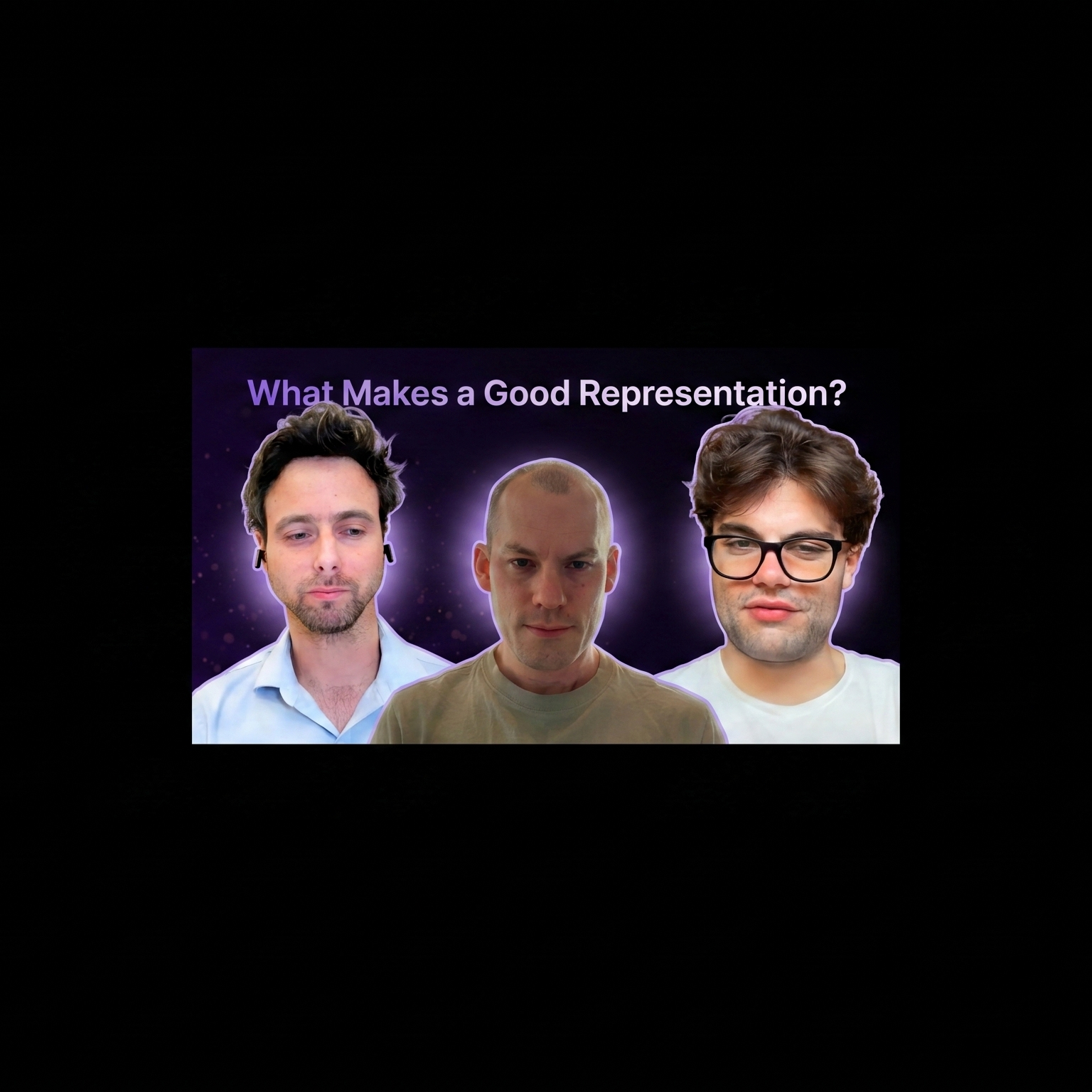
Why All Models Learn the Same Thing with Phillip Isola (MIT)
Podcast: The Information BottleneckPublished On: Thu Jul 02 2026
Description: Phillip Isola, professor at MIT, joins us to talk about representation learning: what makes a representation good, why different models seem to converge on similar representations, and whether pre-training is really over.We discuss the platonic representation hypothesis and its limits, why clustering structure matters more than global geometry, and Phillip's new neural thickets paper arguing that post-training is easier than people think because pre-trained weights already sit near solutions to downstream tasks. Phillip also explains why he thinks LLMs are already world models, why he's betting on RNNs making a comeback, and why his most exciting current direction is artificial life: putting LLM agents in open environments with no fixed task and studying them like new organisms.Timeline:00:00 Intro song00:13 Intro01:05 What is representation learning and why it matters04:09 What makes a representation good: minimality and sufficiency10:03 How cross entropy and contrastive learning shape representations14:35 Dimensionality reduction and why dimension isn't the right complexity measure16:35 Compression and geometric clustering during training19:27 The platonic representation hypothesis and what actually converges22:53 Local neighborhoods vs global structure: the Aristotelian follow-up24:33 When convergence is strong: truth vs the space of possibility28:09 Is there true similarity in the world? The Bouba-Kiki effect30:56 World models vs autoregressive LLMs32:14 Diffusion LLMs as a special case of autoregressive models33:42 What architectures win in five years: the case for RNNs36:11 Grad student descent, or do we actually have principles?40:51 Feathers and wings: what to take from biology43:17 How close are we to brain-like models? Marr's three levels47:01 Are better models becoming less human-like?49:38 Is pre-training all you need? The neural thickets paper54:18 LoRA, low rank fine-tuning, and why post-training is easier than we thought56:01 RL environments and what our benchmarks actually test1:01:11 Artificial life: LLM agents as new organisms1:07:20 What's overlooked in AI research right now1:08:36 Why stay in academia, and doing science in the age of OpusMusic:"Kid Kodi" - Blue Dot Sessions - via Free Music Archive - CC BY-NC 4.0.About: The Information Bottleneck is hosted by Ravid Shwartz-Ziv and Allen Roush, featuring in-depth conversations with leading AI researchers about the ideas shaping the future of machine learning.
The note was deleted
The note was saved
Your message was sent