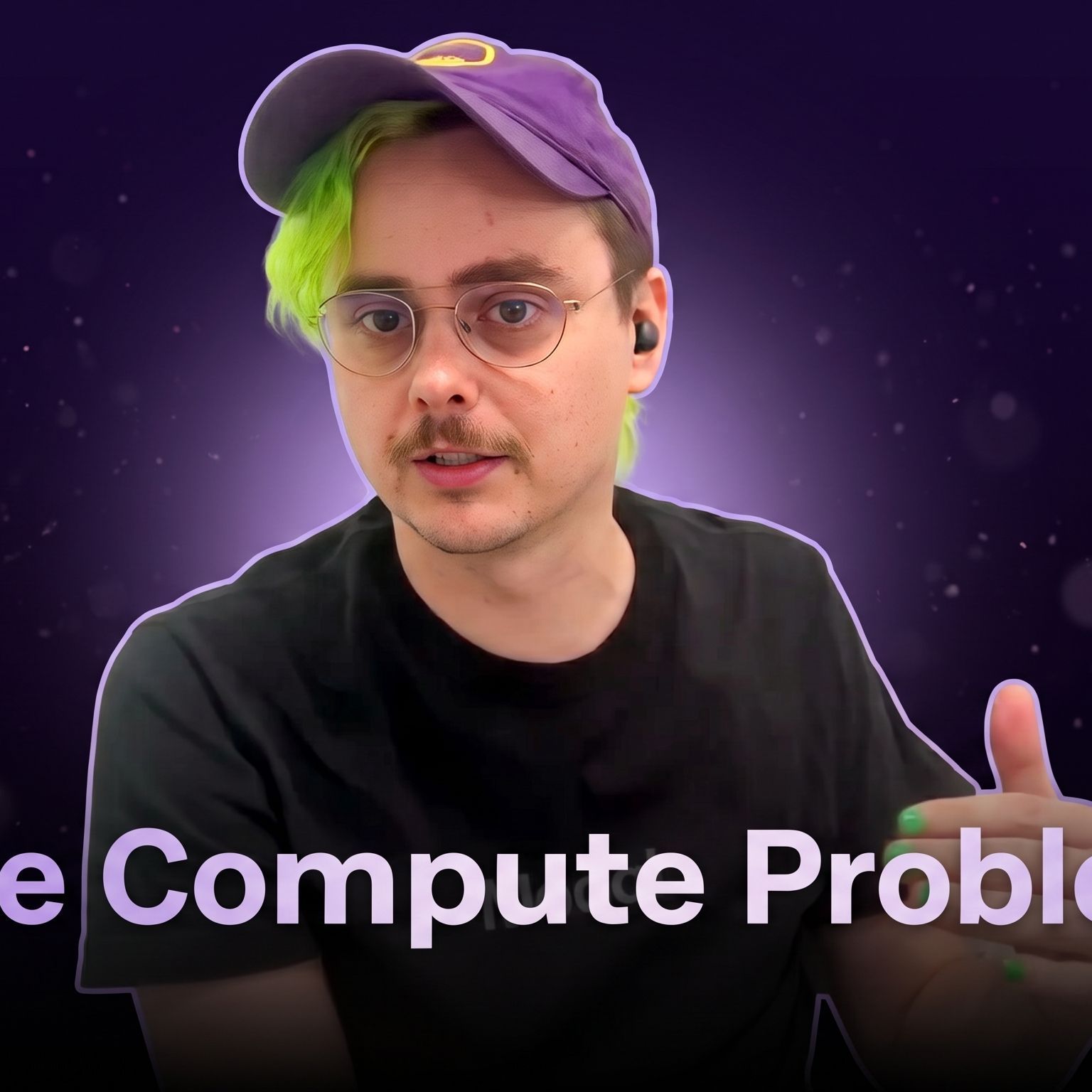
Why You Can't Just Rent 1,000 GPUs | Charles Frye (Modal)
Podcast: The Information BottleneckPublished On: Tue Sep 01 2026
Description: Charles Frye (Modal, ex-Weights & Biases, Berkeley PhD) joins Ravid and Allen to explain why modern AI research is bottlenecked by compute, and why simply buying more GPUs doesn't solve it. We cover the three problems every lab hits (underutilization, saturation, resource sharing), when companies should actually train their own models, why inference is a "bad algorithm" for today's hardware, NVIDIA's monopoly, the OpenAI/Hugging Face hack and what it says about open models, and whether we're in a compute bubble.Key topicsAI infrastructure challenges and when to train your own modelsGPU resource management and virtualizationInference optimization and speculative decodingThe economics and future of AI hardwareAgents, sandboxing, and open-model securityChapters00:00 Intro01:03 Why AI needs special-purpose compute03:22 Buying vs renting GPUs: the three problems07:15 Modal's approach, and doing more with less compute09:46 Do we actually need to spend more? The conflict-of-interest question13:08 Should companies train their own models?14:47 Efficient fine-tuning and prompts as fast weights17:37 Are we in a compute bubble?20:21 Why inference will dominate compute (the SQLite analogy)22:42 Speculative decoding26:44 Why scaling inference is hard, and neuromorphic hardware28:36 Why NVIDIA's monopoly persists33:09 Inference chip startups and the hardware lottery35:24 How Modal stays hardware-agnostic (GPU snapshot restore)38:45 Will agentic coding erode CUDA's moat?41:18 Running one agent vs thousands: sandboxing at scale46:27 The OpenAI/Hugging Face hack and open models as defenders52:28 Rogue AI, self-replication, and fast takeoff56:09 What's next: evals, embodiment, edge inference1:00:27 Modal is hiring (modal.jobs)Music"Kid Kodi" - Blue Dot Sessions - via Free Music Archive - CC BY-NC 4.0
The note was deleted
The note was saved
Your message was sent