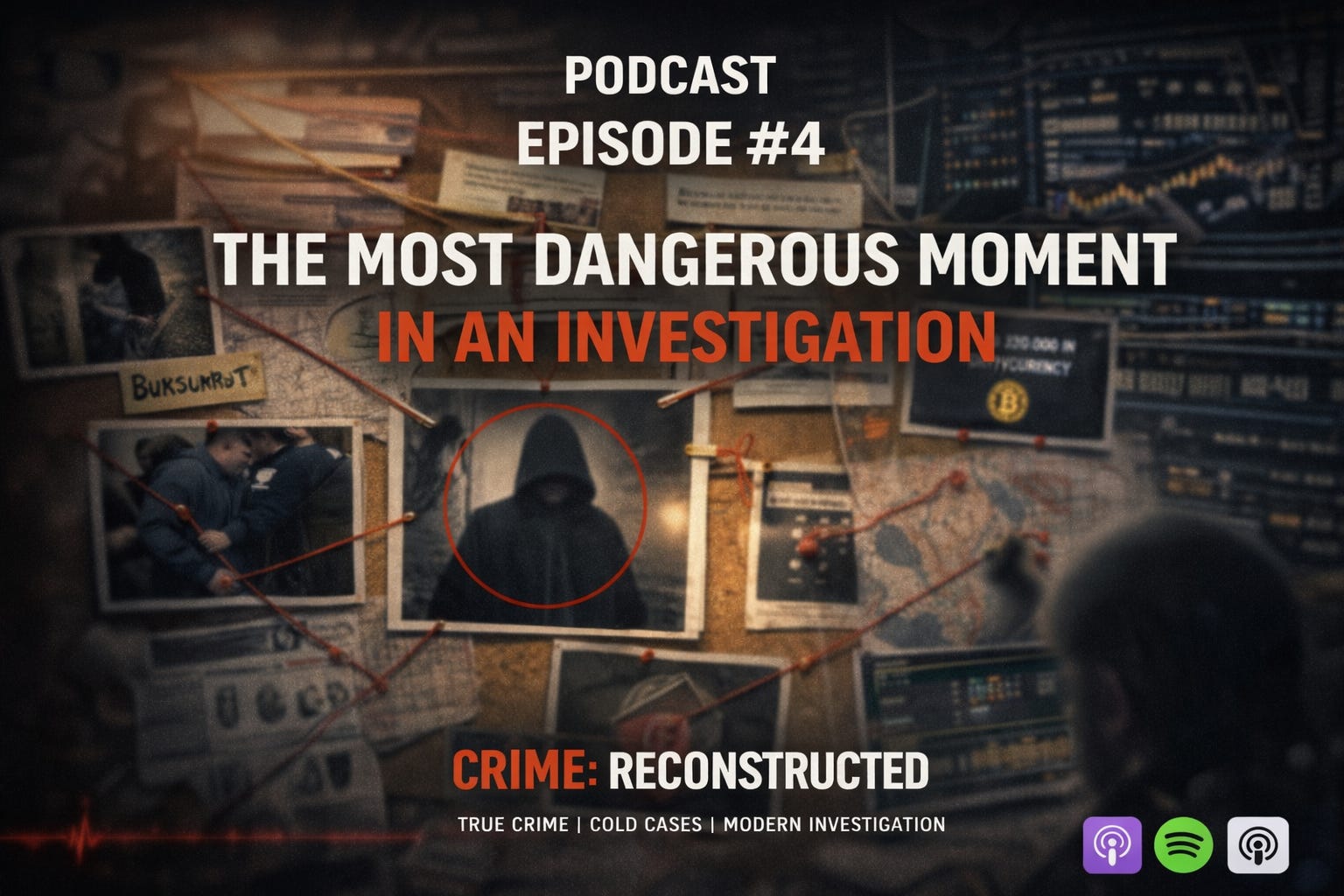
Episode 4 – The Most Dangerous Moment in an Investigation
Podcast: Crime: Reconstructed PodcastPublished On: Thu Feb 19 2026
Description: Every investigation has a breaking point.It isn’t the arrival of the first patrol unit.It isn’t the execution of a search warrant.It isn’t even the public detention of a suspect.The most dangerous moment in any investigation is the instant a theory feels right.In this episode of Crime: Reconstructed, Morgan Wright examines how premature coherence reshapes evidence, narrows hypothesis space too early, and quietly distorts outcomes. Using structural elements from the Nancy Guthrie case — the reported burglary, electronic ransom communication, cryptocurrency demand, detentions, and surveillance imagery — this episode dissects how narrative gravity forms and why disciplined constraint-mapping is essential.From a First Principles perspective, investigations are not stories. They are physics problems.This episode covers:- Why evidence is inert — and interpretation is active- The three distortions that follow early theory adoption- The danger of binary collapse (“burglary gone wrong” vs. “never a burglary”)- How ransom communications function as strategic artifacts- Why detentions create the illusion of confirmation- How informational entropy accelerates narrative driftThe tape goes up quickly.The truth takes longer.And the most dangerous moment is when certainty arrives too soon.Key Concepts Covered- First Principles investigation methodology- Constraint mapping (physical, temporal, behavioral, technological)- Confirmation bias in high-profile cases- Informational entropy- Hypothesis discipline- Narrative smoothing This is a public episode. If you would like to discuss this with other subscribers or get access to bonus episodes, visit crimereconstructed.substack.com
The note was deleted
The note was saved
Your message was sent