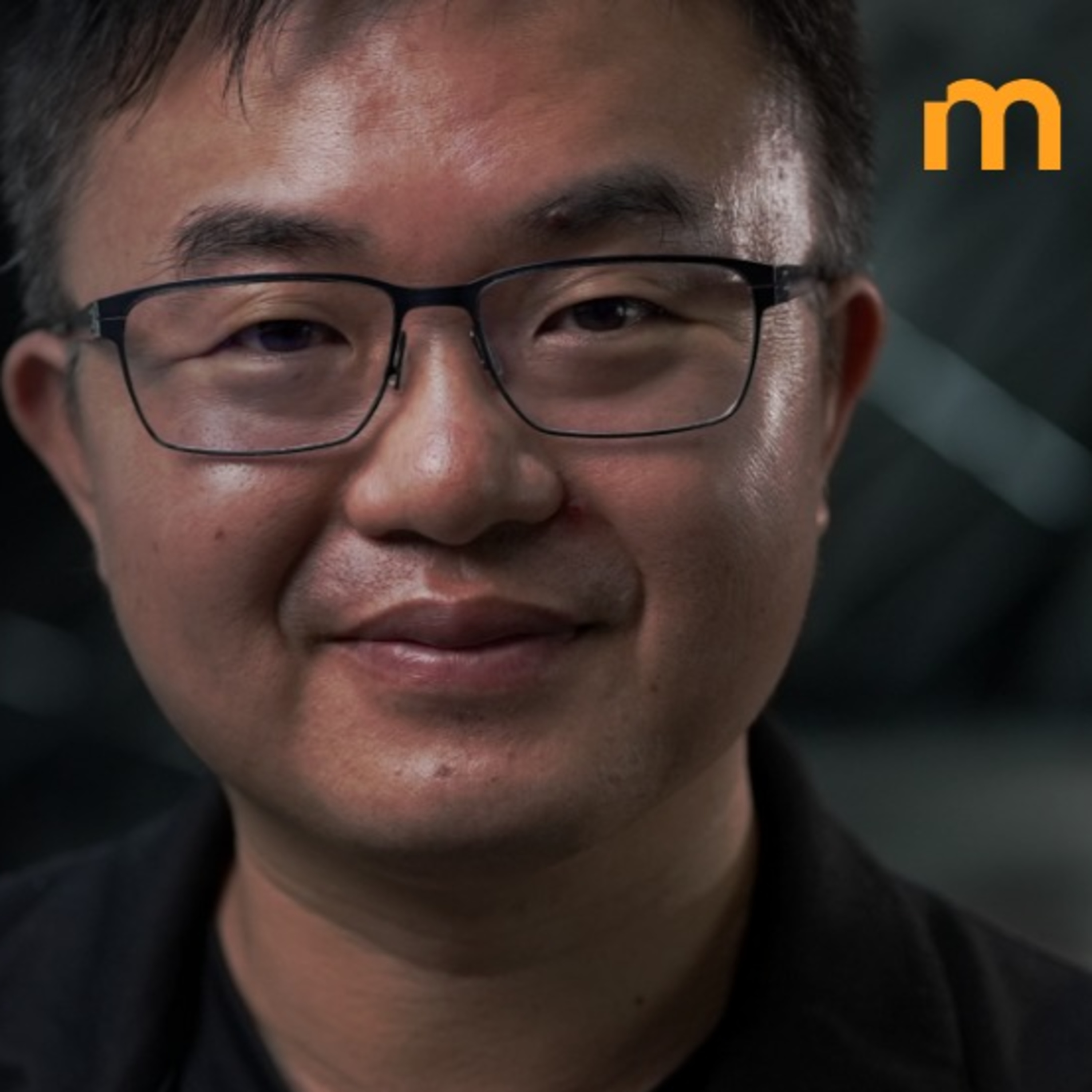
How Physical AI Learns Across Language, Video and Action — Ming-Yu Liu
Podcast: Machine Learning Street Talk (MLST)Published On: Tue Sep 15 2026
Description: The car making a left turn at the start of this episode was never filmed. Cosmos 3 generated it. Ming-Yu Liu, who leads the Cosmos research at NVIDIA, explains how one model can describe a video, generate one, and produce robot actions.He walks Tim through the architecture. A vision language model reasons one token at a time; its weights then initialise a bidirectional diffusion generator for video, audio and action, and a shared temporal position scheme lines up signals that run at different rates. Ming-Yu treats "world model" as a set of tools, not one definition: forward dynamics, inverse dynamics and policy, trained together under a capacity limit so that each helps the others. He also explains why plentiful first-person human video carries over to robots, which have far less data of their own, and why a Cosmos model post-trained on the DROID dataset is a good starting point for pick-and-place policies.The most practical thread is testing. A neural simulator does not need accurate success rates. It only needs to rank policy A above policy B the way the real world would, so a team can narrow down which checkpoints deserve a real trial. Cosmos Dreams applies that closed-loop idea to driving and robotics, and Ming-Yu argues that humanoids around children and pets make safety matter even more than it does for cars. The conversation ends on the Super, Nano and Edge sizes (Edge targets Jetson Thor, Orin and DGX Spark) and where to find the open weights, code and data.This episode is a paid partnership with NVIDIA.Learn more about Cosmos: https://nvda.ws/4cJoY1SExplore Cosmos Lab: https://research.nvidia.com/labs/cosmos-lab/cosmos3/---TIMESTAMPS:00:00:00 A road that was never filmed00:02:28 Inside Cosmos 3: reasoning and generator towers00:05:02 World models: dynamics, policy and one clock00:08:59 Learning robot skills from human video00:11:06 Ambiguous tasks and system 2 planning00:12:53 Neural simulators for policy verification00:16:41 Cosmos as a starting point for robot policies00:19:00 Cosmos Dreams and robot safety00:22:04 Super, Nano and Edge model sizes00:24:24 Open models, the Cosmos repo and feedback---REFERENCES:tool:[00:00:13] Cosmos 3 (NVIDIA Cosmos Lab project page)https://research.nvidia.com/labs/cosmos-lab/cosmos3/[00:18:27] NVIDIA Cosmos GitHub repositoryhttps://github.com/NVIDIA/cosmos[00:22:05] Cosmos3-Edge model cardhttps://huggingface.co/nvidia/Cosmos3-Edge[00:22:15] Cosmos3-Super model cardhttps://huggingface.co/nvidia/Cosmos3-Super[00:22:16] Cosmos3-Nano model cardhttps://huggingface.co/nvidia/Cosmos3-Nano[00:22:50] NVIDIA Jetson Thorhttps://www.nvidia.com/en-us/autonomous-machines/embedded-systems/jetson-thor/[00:22:52] NVIDIA Jetson Orinhttps://www.nvidia.com/en-us/autonomous-machines/embedded-systems/jetson-orin/[00:22:53] NVIDIA DGX Sparkhttps://www.nvidia.com/en-us/products/workstations/dgx-spark/[00:24:42] Cosmos 3 collection on Hugging Facehttps://huggingface.co/collections/nvidia/cosmos3other:[00:01:07] Cosmos-Dreams closed-loop simulators (NVIDIA SIGGRAPH 2026 blog)https://blogs.nvidia.com/blog/siggraph-news-2026/paper:[00:08:54] Cosmos 3: Omnimodal World Models for Physical AIhttps://arxiv.org/abs/2606.02800[00:17:43] DROID: A Large-Scale In-The-Wild Robot Manipulation Datasethttps://arxiv.org/abs/2403.12945---RESCRIPT: https://app.rescript.info/share/e2385948cf465f0d6a2c0930150fc3ab
The note was deleted
The note was saved
Your message was sent