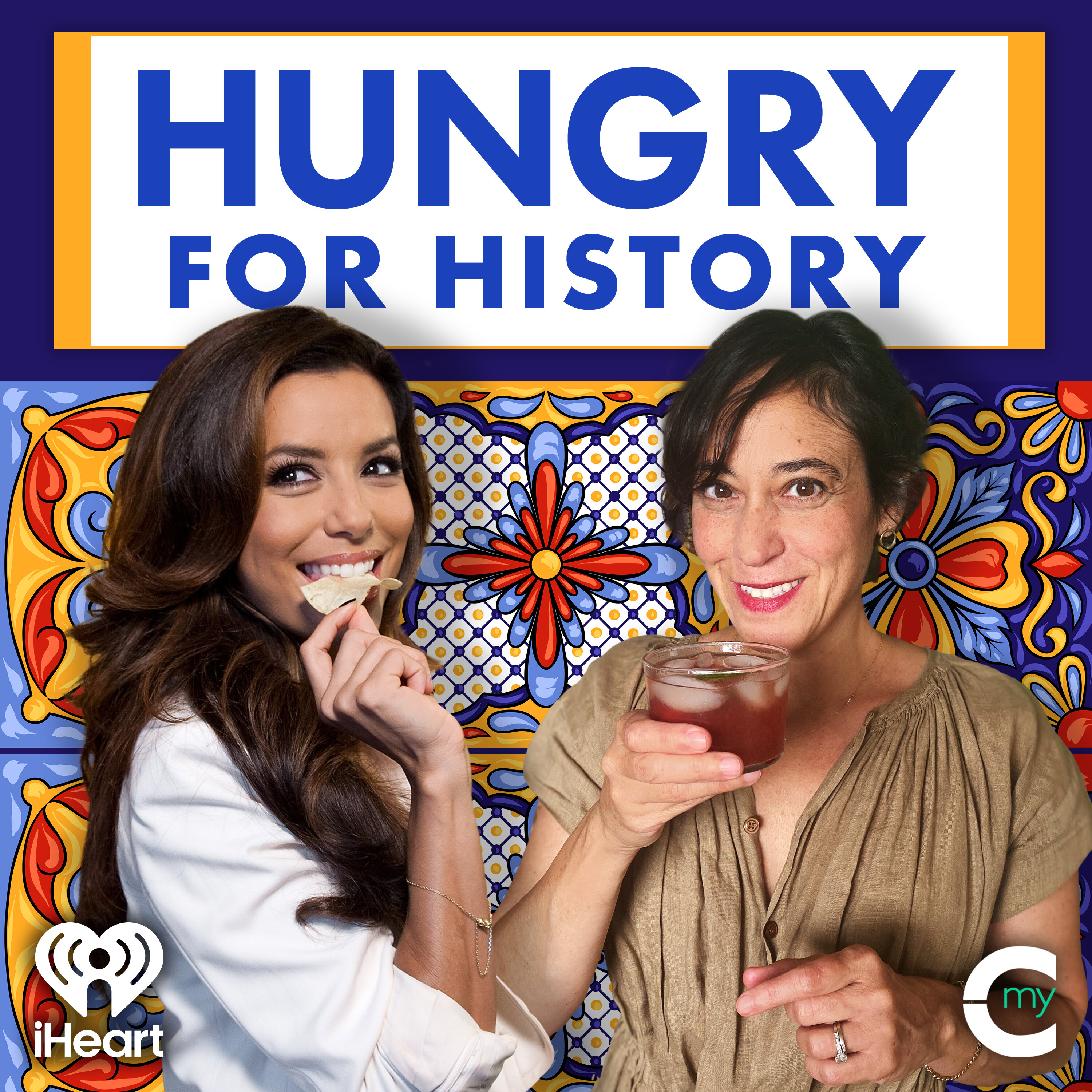
Hungry for History with Eva Longoria and Maite Gomez-Rejón
<p>Taste buds, Eva Longoria and Maite Gomez-Rejon, take a bite out of the most delicious food and its history. Every episode includes - family stories from Eva and Maite, fascinating facts on the yummiest ingredients from their culture, interviews with food enthusiasts, chefs, and historians plus on-location episodes that bring you closer to the hidden history of your favorite foods. Oh, and these's lots of taste testing, drink making, and recipes for you to try at home.</p> <p>Listen to Hungry for History every Thursday and learn more about the dishes and drinks you grew up enjoying while discovering the origins of new favs too.</p>
The note was deleted
The note was saved
For the season finale, Eva and Maite take a bite out of the history of botanas, appetizers, and snack culture from around the world. From bar bites to late-night cravings, they explore why humans have always loved a little snack. Along the way, they reflect on an eclectic season filled with stories, history, and unexpected connections across cultures. See omnystudio.com/listener for privacy information.
This week, Eva and Maite trace the layered history of Los Angeles through four places that reveal the city’s shifting identity: the Los Angeles River, Placita Olvera, Chinatown, and Boyle Heights. Long before freeways and concrete channels, the LA River sustained Indigenous communities and shaped the city’s earliest settlements. From there, they move into the heart of Los Angeles at Olvera Street, where questions of heritage and tourism collide. They explore the displacement and reinvention of Chinatown and end in Boyle Heights, one of the most culturally rich neighborhoods in the country, where Jewish, Japanese, Mexican, and Eastern European communities once lived side by side. Together, these places tell a larger story about migration, erasure, resilience, and the many communities that built Los Angeles.See omnystudio.com/listener for privacy information.
Maite is joined by artist Monica Martinez, the founder of Don Bugito, a pioneering edible insect business that blends design, sustainability, and food innovation. The conversation moves between industrial design and the realities of industrialized food systems, highlighting Monica’s work raising edible insects on an organic farm in Oakland, CA. They trace the deep culinary roots of insects in Mexico, explore flavor combinations grounded in memory, and how these traditions are being translated for U.S. audiences amid shifting cultural perceptions of food. The episode closes with a reflection on where insect-eating may be headed in the next 10 to 20 years. Link to Don Bugito: https://www.donbugito.com/ See omnystudio.com/listener for privacy information.
In this episode, Eva and Maite explore the long global history of eating insects—an ancient practice shared across cultures in Asia, Africa, and the Americas. They unpack how insects have moved to the forefront of modern food conversations, reshaping what we consider food in a changing world. Along the way, they consider the nutritional power of insects as a rich source of protein and their growing role in sustainable food systems, offering a glimpse into the future of food rooted in deep tradition. Link to Don Bugito: https://www.donbugito.com/ See omnystudio.com/listener for privacy information.
Eva and Maite trace the evolution of the fair from holy day marketplaces to the grand World’s Fairs of the 19th and 20th centuries, where visitors encountered sensational visions of the future. Think electricity and dishwashers, but also popcorn machines, ice cream sundaes, and even tequila! Yet these spectacles were far from democratic: intellectual, artistic, and technological contributions from non-Western societies were often minimized or erased. Their influence eventually waned with the rise of the internet. Today, state fairs continue to gather communities around agriculture and tradition, while modern global expos increasingly focus on sustainability and the future of the planet. The Current War: Director’s Cut (the final scene takes place at the Chicago's World's Fair) https://www.amazon.com/Current-War-Directors-Cut/dp/B0833VRPDP See omnystudio.com/listener for privacy information.
Eva and Maite continue their burger series with the invention of the Happy Meal and the powerful marketing of fast food to families. Along the way, they spotlight the often overlooked contributions of women and trace the evolution of the burger from fast food staple to gourmet icon, including the rise of the smashburger. As the burger crosses borders, it transforms, absorbing local flavors and traditions. This episode reveals how one of the world’s most recognizable foods continues to evolve, reflecting the tastes, histories, and creativity of the people who make it their own. Eva’s cookbook in Part 2 of Burgers:https://www.penguinrandomhouse.com/books/739587/my-mexican-kitchen-by-eva-longoria/ See omnystudio.com/listener for privacy information.
Eva and Maite kick off a two-part series on burgers by tracing their roots long before the bun. They begin with the global history of minced meat, follow its path to the United States, where the hamburger starts to take shape, find its perfect match in the bun, and win the heart of America. From early 20th century fears around contaminated beef to the rise of drive-ins and drive-thrus, they explore how car culture transformed the burger into a symbol of freedom, youth, and modern American life, ushering in the age of fast food.See omnystudio.com/listener for privacy information.
Dinnerware tells a story far beyond the table—it’s a history of technology, aesthetics, trade, empire, and everyday life. In this episode, Eva and Maite begin with a simple question: what came first, the dish or the bowl? From humble clay vessels to fine porcelain and paper plates, they trace how what we eat from is a reflection of how we live, how we dine, and how we connect with one another. Sevres Porcelain Manufactory: https://www.sevresciteceramique.fr/en.html Heath Ceramics: https://www.heathceramics.com/ HACHA ceramica: https://hacha.com.mx/ See omnystudio.com/listener for privacy information.
This week, Eva and Maite sip the history of Mexico’s aguas frescas, from pre-Columbian fruit waters to the sweet, creamy evolution of horchata. Explore how these refreshing drinks traveled across continents, transformed with local ingredients, and became beloved in markets from Mexico to Central America and beyond. Maite’s Horchata Recipe: https://www.artbites.net/recipes/mexicanhorchata See omnystudio.com/listener for privacy information.
Eva and Maite head to the kitchen to prepare a deconstructed bacon wrapped hot dog recipe from Eva’s new cookbook. And they share lots of history of course! From the earliest references to sausages in antiquity, to how said sausage found two warm pieces of bread to snuggle into, how immigrants transformed it into our favorite baseball food and how the humble sausage found bacon and chiles in Mexico. This episode is all about creativity!See omnystudio.com/listener for privacy information.
Eva and Maite explore how cooking shifted from open flames to enclosed heat, tracing ovens from communal hearths and clay domes to cast-iron and white enamel ranges, Easy-Bake Ovens, microwaves, and the sleek stainless-steel kitchen aesthetic. Once sites of ritual and gathering, ovens migrated into private homes, reshaping daily life and defining who controlled heat, food, and time. These changes cast fire as clean, modern, orderly (and feminine), while new technologies redefined expectations around care, labor, and domestic responsibility, revealing dynamics of gender, power, and the meaning of progress. Sapiens: A Brief History of Humankind: https://www.harpercollins.com/products/sapiens-yuval-noah-harari?variant=44475655421986 See omnystudio.com/listener for privacy information.
The Industrial Revolution didn’t just remake factories and cities, it transformed how the world eats. In this episode, Eva and Maite trace its origins in England and its uneven spread across the United States and Latin America, shaping labor, extraction, and global trade in very different ways. They explore how these industrial systems laid the groundwork for today’s climate crisis, then zoom in on tuna and tinned fish. From mass production to fancy cans, it’s a story of how industrial systems turned ocean life into shelf-stable commodities, and how we’re now rebranding them as luxury. Food Chains Documentary: https://www.youtube.com/watch?v=6vw-qTCW8fo See omnystudio.com/listener for privacy information.
Breakfast hasn’t always been sweet, crunchy, or aimed at children. In this episode, Eva and Maite trace the surprisingly strange history of cereal: from its origins as a moral prescription and digestive aid in the 19th century, to the rise of sugary cartoon mascots, toys in boxes, the nostalgia of Saturday-morning cartoons, and the modern return to ancient grains. Join them for a crunchy look at how breakfast reflects our shifting ideas about health, pleasure, and what it means to eat “right." Perfect Granola Recipe: https://www.seriouseats.com/eleven-madison-park-granola-salty-recipe See omnystudio.com/listener for privacy information.
What do arepas, gorditas, and pupusas have in common? Each is a golden pocket of corn masa — crisp on the outside, tender within — stuffed with everything from beans and cheese to meats and vegetables. In this episode, Eva and Maite explore the histories behind the Venezuelan and Colombian arepa, the Mexican gordita, and the Salvadoran pupusa, and ask a bigger question: why do stuffed foods taste so good? Along the way, they talk migration, identity, and how corn-based foods carry memory across borders. They also tap into a timely conversation: California recently passed a law requiring folic acid to be added to corn masa products like tortillas — a move intended to improve public health, but one that has sparked debate about tradition, nutrition, and how food policy intersects with culture.See omnystudio.com/listener for privacy information.
Butter is so ordinary we barely notice it — until you stop and ask how it’s made, who made it first, and why it once symbolized power, wealth, and even ritual life. In this episode, Eva and Maite trace butter’s story from its accidental invention to its central place in religious and ceremonial traditions. They explore how butter became one of the earliest globally traded foods, prized for its portability, shelf life, and value long before refrigeration, and how it signaled status across cultures. Along the way, they break down the simple alchemy of turning cream into butter and pause at butter’s most controversial rival: margarine! They travel to France, where butter reshaped baking and regional identities and speak with baker Clémence de Lutz of Santa Monica’s Petitgrain Boulangerie and learn how laminated dough turns butter into edible architecture. Link to Petitgrain Boulangerie: https://www.petitgrainboulangerie.com See omnystudio.com/listener for privacy information.
Eva and Maite opened the season with a series on revolutions, asking a simple but urgent question: what does it take for people to finally say, enough? This week, Maite talks with Clémence de Lutz of Santa Monica’s Petitgrain Boulangerie about bread, strikes, and social responsibility. A baker and activist, Clémence reflects on food as a political act and how our everyday choices carry real weight. It’s a reminder that bread has always carried meaning beyond the oven, especially in moments of social tension. If you are able, consider donating to: Coalition for Human Immigrant Rights National Immigrant Law Center Immigrant Law Center of Minnesota See omnystudio.com/listener for privacy information.
In this episode, Eva and Maite toss up the surprisingly juicy history of salads—from the invention of the Caesar salad on the U.S.–Mexico border to the rise of the Asian chicken salad. They dig into where the word salad comes from, the origins of France’s vinaigrette ratio, and how ranch dressing became America’s most beloved condiment.See omnystudio.com/listener for privacy information.
Spoiler: mushrooms aren’t plants, they’re fungi! Eva and Maite dig into the history of mushrooms and why they exist on every continent on Earth. From the sacred mushroom ceremonies of María Sabina in Oaxaca to the ritual significance of huitlacoche, the Mexican corn fungus, and the global obsession (and hunt for) truffles, they uncover how fungi have shaped food, medicine, myths, and culture.See omnystudio.com/listener for privacy information.
From its origins in Indigenous South America to its rise as a global symbol of wealth and migration, Eva and Maite explore the surprising history of the pineapple. They trace its journey across the Atlantic, where it became a prized status symbol among European aristocrats—so rare it was sometimes rented for dinner parties instead of eaten! The story then moves to Hawaii, where plantation agriculture turned the pineapple into a mass-market product and reshaped the islands’ economy and landscape. Along the way, they dig into one of the most debated foods ever: Hawaiian pizza, invented in Canada by a Greek immigrant. To bring the fruit home, Maite visits Leo’s Tacos in the heart of Hollywood with food writer and Taqueando host Bill Esparza for a tasting of tacos al pastor, where pineapple plays a crucial role in balancing spice, fat, acid, and heat. Listen to more of Bill Esparza's food adventures on his podcast, Taqueando! See omnystudio.com/listener for privacy information.
In Aztec mythology the fertility goddess, Mayahuel, is the personification of the agave plant - the source of some of the most delicious spirits in Mexican culture. Eva and Maite talk about the ritual significance of pulque, a fermented drink, to the introduction of distillation techniques post-conquest and the first mezcal, all while drinking margaritas! Ivan Vasquez, owner of Madre Restaurant in Los Angeles, shares his thoughts on mezcal. Learn more about Ivan Vasquez and Madre Restaurant here. Click here to try Chica Salte! Maite’s Margarita Recipe Ingredients: 2 ounces of Tequila Blanco 1 ounce of lime juice ½ an ounce of triple sec ¼ ounce of agave Instructions: Fill a cocktail shaker up halfway with ice. Add lime juice, tequila, triple sec and agave. Cover and shake until your fingers feel like they have frostbite. Serve in a glass with a salted rim. Enjoy! Try Casa Del Sol. Check out Rejon Tequila. See omnystudio.com/listener for privacy information.
Ring in the New Year with Eva and Maite as they explore the story behind the classic “hair of the dog.” They trace where the phrase comes from, how it became a go-to hangover remedy, and why the Bloody Mary earned its place as the ultimate morning-after cocktail. From the rituals and traditions people lean on to recover from last night’s celebrations to the science of why hangovers happen (and whether “hair of the dog” actually works), join Eva and Maite in greeting 2026.See omnystudio.com/listener for privacy information.
This Christmas, Eva and Maite celebrate how bread—and the people who bake it—keep family, tradition, and community alive, even as this season looks different for many immigrant communities. They explore the bakery as a window into history, tracing the journeys of the baguette, pretzels, bagels, and pan dulce, and how immigrant communities shaped neighborhood bakeries in the U.S. Along the way, they reflect on the history of posadas, highlight bake sales as an expression of community, and uncover the roots of beloved bread idioms—from “putting bread on the table” to “breaking bread.”See omnystudio.com/listener for privacy information.
Who first decided that food deserved a critic? This week on Hungry for History, Eva and Maite dig into the origins of food criticism. From the earliest French tastemakers and the rise of the Michelin Guide to the influence of trailblazers like Duncan Hines, Barbara Hansen, and Jonathan Gold, this episode explores how food writing transformed from simple taste-testing into a rich, cultural conversation. Discover how critiques of what’s on the plate became reflections of identity, community, and the world around us. See omnystudio.com/listener for privacy information.
Restaurant history tells the story of who we are, what we value, and how culture moves. In this week’s episode of Hungry for History, Eva and Maite explore the impact the French Revolution played in the birth of restaurants and why French Cuisine became the culinary standard. They dive into the contributions of key figures like Auguste Escoffier, who organized the kitchen and standardized culinary techniques, the cultural significance of brasseries, and the role chefs play in shaping restaurant culture. We also sit down with Chef Rico Torres of Mixtli, the groundbreaking Michelin-starred restaurant in San Antonio, known for turning Mexican culinary history into an elevated, narrative-driven experience. Together, we explore how menus become archives, how tradition becomes innovation, and how the restaurant world is shifting as more diverse culinary voices take center stage. Learn more about Mixtli: https://restaurantmixtli.comSee omnystudio.com/listener for privacy information.
Tierra y Libertad: Food and the Mexican Revolution In Mexico, revolution was as much about reclaiming the land as it was about reclaiming the kitchen. Over a century after the French Revolution, the Mexican Revolution of the early 20th century drew inspiration from ideas of liberty and equality, showing how food could be political. Indigenous ingredients — dismissed as lower class during the entire Colonial period — became emblems of resistance and unity. Corn, beans, and chile spoke for the people in ways politics could not. Artists and intellectuals celebrated these humble ingredients as the foundation of Mexican identity. In this episode, Eva and Maite trace how the Mexican Revolution elevated native foods into a symbols of pride, power, and belonging, connecting the fight for justice on the battlefield with cultural identity at the table. This is part 3 of a 3 part series called, How Eating Shapes History! Haven't heard the first two episodes? Go back and listen from the beginning starting with The French Revolution. See omnystudio.com/listener for privacy information.
Revolution on the Table: The American Fight for Independence and the Birth of National Identity Before independence was won on the battlefield, it was declared in the kitchen. From boycotts of British tea to the brewing of “Liberty Tea” made from native herbs, Americans turned everyday meals into acts of protest. Taverns became centers of political debate and rebellion, while dishes prepared with local ingredients came to symbolize freedom and self-reliance, and act traced in early cookbooks. In this episode, Eva and Maite explore how the American Revolution transformed eating into an expression of resistance and how food helped shape a distinctly American identity. They discuss France’s influence on American Independence, and how Benjamin Franklin and Thomas Jefferson brought French recipes and dining customs home, forever changing the nation’s culinary culture. This is part 2 of a 3 part series called, How Eating Shapes History! See omnystudio.com/listener for privacy information.
Liberté, Égalité… Gastronomie: The French Revolution and the Birth of Modern Cuisine The French Revolution wasn’t just fought in the streets, it was fought at the table. As bread riots shook Paris and hunger fueled rebellion, the collapse of the aristocracy also dismantled an entire culinary world. Former royal chefs opened the first public restaurants, feeding citizens instead of kings and redefining what it meant to dine in a new democracy. In this episode, Eva and Maite explore how food became a language of equality and national pride and how revolutionary ideals gave rise not only to modern dining, but also to the first democratic cookbooks. These cookbooks, written for the public rather than the palace, captured the spirit of liberty and gastronomy that would shape not only France, but the way the world eats today. This is part 1 of a 3 part series called, How Eating Shapes History! Join us next week as we explore the American Revolution. See omnystudio.com/listener for privacy information.
This week, Eva and Maite serve up the surprisingly spicy history of mustard—from ancient apothecaries to royal tables, the rise of Dijon as the mustard capital of the world, and its journey to the Americas. Along the way, they uncover the mysterious moutardier, or mustard-maker. And Maite quizzes Eva to see just how well she knows her mustards!See omnystudio.com/listener for privacy information.
What do sacred crops and chips have in common? Turns out, more than you’d think! In this episode, Eva and Maite uncover how Latin America’s native ingredients - corn and potatoes - went from offerings to the gods to the cornerstone of billion-dollar snack industries. They talk about how the Mexican American company Siete Foods is redefining what it means to “know your worth” in the snack aisle, and why honoring your roots might just be the most revolutionary business model of all. History, culture, flavor, and empowerment… all that and a bag of chips!See omnystudio.com/listener for privacy information.
In part two, Eva and Maite dig into peanut-related idioms as they follow the legume into the modern age where it became a symbol of innovation, resilience, and identity. They talk peanut farming in the American South, George Washington Carver, and the rise of peanut butter as an American obsession. From Southern gardens to Reese’s Peanut Butter Cups, the globetrotting peanut transformed economies, culture, and the way we snack.See omnystudio.com/listener for privacy information.
In part one, Eva and Maite explore the peanut’s journey through Latin America, from its origins in Indigenous food traditions in South America to its spread into Mexico, the Caribbean, and eventually Asia and Africa. The tiny but mighty peanut became a key ingredient in local dishes wherever it landed, finally making its way to the American South and sparking a national obsession: peanut butter. Along the way, they talk Mexican snacks like crunchy Japanese peanuts and mazapán, and Maite is on a mission to convince Eva to become a full-on peanut lover.See omnystudio.com/listener for privacy information.
Eva and Maite kick off season three by cracking open the tiny but mighty oyster: a once democratic delicacy, ancient symbol, natural water filter, and cornerstone of coastal economies. They dive into food idioms and the oyster’s reputation as an aphrodisiac. Plus, they welcome actor Demián Bichir to the show. For more on oyster farming check out: https://www.billionoysterproject.org/See omnystudio.com/listener for privacy information.
Y'all, we're back! - Eva and MaiteSee omnystudio.com/listener for privacy information.
Eva and Maite wrap up the season by reflecting on some of the highlights of season two and on the importance of celebrating our stories and achievements through the lens of food. See omnystudio.com/listener for privacy information.
Ahead of Eva's show, Searching for Spain, we rewind to season one when Maite visited Eva in Spain to discuss the history of wine in Mexico! See omnystudio.com/listener for privacy information.
Whether forced or by choice, our dishes and culinary traditions are constantly being adapted due to migration. This week, Eva and Maite discuss the Sephardic Jewish roots in some of their favorite Mexican dishes, including cabrito (roasted kid goat) and albondigas (meatballs). They welcome medieval scholar, chef and author of Matzah and Flour: Recipes from the History of the Sephardic Jews, Hélène Jawhara Piñer, to the show to talk about one of their favorite topics, tortillas!See omnystudio.com/listener for privacy information.
Who popped corn first? What early recipes used popcorn as an ingredient? Who invented the popcorn machine? Who brought popcorn to the movies? From garlands worn by young Aztec girls to honor of the rain god, Tlaloc, to a beloved movie treat around the world, Eva and Maite get into the rich history of our favorite snack… popcorn!See omnystudio.com/listener for privacy information.
With spring coming, honeybees are busy foraging nectar and pollen from blooming flowers. From ancient foraging to the modern day farmer’s market - E+M celebrate the rich symbolism of bees and the magical honey-making process in this special episode.See omnystudio.com/listener for privacy information.
In this episode, Eva and Maite continue their exploration of the South Texas lands they grew up in. They share stories of hunting and digging for arrowheads and welcome chef and Texas food historian Adán Medrano to the show. Together they reflect on how the land can tell stories about the daily lives of the people who have lived on it, the animals that have inhabited it, and the changes it has undergone over time. https://adanmedrano.com/cookbook-author-adan-medrano/ https://texasindigenousfood.org https://wwnorton.com/books/The-Social-Conquest-of-Earth/See omnystudio.com/listener for privacy information.
Eva and Maite start the episode talking about the complexity of moles and how this ubiquitous Mexican dish melds together flavors, textures, cooking techniques, and spices (!) from around the world. They then delve into the rich and spicy history of spices, which were once so desired by wealthy Europeans they kicked off the Age of Exploration.See omnystudio.com/listener for privacy information.
Food preservation has been around for centuries and canned foods are an essential part of our modern-day pantries. From Nicholas Appert in France to John Mason in the U.S. and Don Clemente Jacques in Mexico, in this episode Eva and Maite talk about some of the key characters in the history of canning and pickling.See omnystudio.com/listener for privacy information.
With the rising cost of eggs, Eva and Maite decided to dive into the history of one of the most versatile kitchen staples. Who ate eggs first? When did the chicken become domesticated? Why are eggs sold by the dozen? Why are some eggs blue? Learn that and more!See omnystudio.com/listener for privacy information.
In this episode Eva and Maite talk Guatemalan comfort foods with Guatemala born and raised actor and host of the new podcast, Greatest Escapes, Arturo Castro. They talk about the rich history of the region and uncover how some staple ingredients - like bananas and coffee - have been tied to political instability and conflict. Maite visits the Guatemalan Night Market in Los Angeles with food writer Bill Esparza.See omnystudio.com/listener for privacy information.
In the wake of the LA Wildfires, Eva and Maite welcome Antonio Diaz, an Emmy-award winning and James Beard Award-nominated filmmaker and founder of Life & Thyme to the show. They discuss the restaurant as the soul of a community, how the LA restaurant industry has come together to help those in need, the precarious nature of the restaurant business, and what we can do to help. Life & Thyme: https://lifeandthyme.com + IG: https://www.instagram.com/lifeandthyme Antonio’s IG: https://www.instagram.com/liberateantonio/ Independent Hospitality Coalition: https://www.ihcla.org Feed the Streets: https://www.feedthestreets.info Hollywood Food Coalition: https://hofoco.org National Day Laborer Organizing Network (NDLON): https://ndlon.org Pasadena Community Job Center: http://pasadenajobcenter.com See omnystudio.com/listener for privacy information.
Black Seminoles were led to freedom in Northern Mexico where they settled in El Nacimiento in the 1800s. Their Mexican descendants, the Mascogos, have a transnational history that spans borders. Eva and Maite explore this rich history, the cookbook Recetario Mascogo de Coahuila, and Juneteenth, a federal holiday in the U.S. since 2021 that has been celebrated in El Nacimiento since 1865.They welcome Dr. Maria Hammack, a scholar and historian whose work bridges histories of liberation and abolition, and Windy Goodloe and Corina Torralba of the Seminole Indian Scout Cemetery Association to the show. Seminole Indian Scouts Cemetery Association: https://www.seminolecemeteryassociation.com Dr. María Esther Hammack: https://mariaestherhammack.me Recetario Mascogo de Coahuila: https://contigoenladistancia.cultura.gob.mx/detalle/recetario-mascogo-de-coahuila See omnystudio.com/listener for privacy information.
In the years before the Civil War, many enslaved people found freedom in Mexico, where slavery was abolished 36 years before the Emancipation Proclamation. In the first of a two-part series on Freedom Fighters, Eva and Maite explore the Southern route of the Underground Railroad and meet Silvia Webber, often referred to as the Harriet Tubman of Texas. They welcome Dr. Maria Hammack, a scholar and historian whose work bridges histories of liberation and abolition, Sofia Bravo and OJ and Leslie Treviño of the Webber Family Preservation Project to the show. Webber Family Preservation Project: http://wfpptx.org/projects.html#/ Dr. María Esther Hammack: https://mariaestherhammack.me Texas Runaway Slave Project: https://digital.sfasu.edu/digital/collection/RSP See omnystudio.com/listener for privacy information.
When people plant their flag in a new country, they do it first though food. In this episode, Eva and Maite talk about the often painful history of Chinese migration to the United States and Mexico and celebrate the rich Chinese contribution to both country’s food-ways. See omnystudio.com/listener for privacy information.
Eva and Maite take a dive into the history of raw fish consumption from ancient Peru and Japan and its possible introductions to Mexico. They explore how ceviche developed into the dish we love today thanks to Japanese immigration to Peru which led to the development of the country’s Nikkei cuisine.See omnystudio.com/listener for privacy information.
From Birria Ramen to Esquites, Eva and Maite kick off 2025 exploring the fusion of cultures that can be found when enjoying street food that you can eat in a cup! Plus - Los Angeles based food writer, Bill Esparza, joins the show to discuss how food can build community especially for immigrants planting their flag in a new country. See omnystudio.com/listener for privacy information.
Listen to Hungry for History from the beginning! Enjoy this rewind episode from Season One. Eva and Maite take a trip down memory lane as they explore the unique past of Tex-Mex food. From the unknown history of the San Antonio Chili Queens to the difference between Tejano and Chicano, the ladies dive into the rich cuisine that is Tex-Mex. Maite's Chili Queen-Style Chile con CarneSee omnystudio.com/listener for privacy information.
Listen to Hungry for History from the beginning! Enjoy this rewind episode from Season One. Eva and Maite travel to Papantla, Mexico - home of vanilla. Founded by the Totonacs, vanilla's first cultivators, the city of Papantla is the perfect place to explore the history of this edible orchid native to Mexico. Plus, Maite attends a Voladores de Papantla rain ceremony and Eva pollinates a vanilla bean at a farm called, Gaya Vanilla. Vanilla Chicken Recipe Ingredients: 4 skinless, boneless chicken cutlets 2 vanilla beans, spilt lengthwise and seeds scraped salt and pepper 1/4 cup unsalted butter 1 large yellow onion, thinly sliced 1/2 a cup of heavy cream 1/2 a cup of ricotta Instructions: Place chicken between 2 sheets of plastic wrap or parchment paper and, using a mallet, pound to 1/3-inch thickness. Season with salt and pepper. Heat the butter in a large skillet set over medium-high. Add the chicken and cook about 3 minutes per side or until cooked through. Remove chicken from skillet and set aside. In the same skillet, sauté the onion until soft and transparent. Add the vanilla seeds to the onions and cook until fragrant, about 2 minutes. Place the vanilla infused onions and butter in a blender along with the heavy cream and ricotta. Blend until smooth. Pour the sauce back into the skillet set over low heat and cook for about 3 mins. Return the chicken to the sauce and simmer over low heat for about 5 mins. Enjoy with corn tortillas and fried plantains. See omnystudio.com/listener for privacy information.
Eva and Maite ring in the new year by popping open a bottle of sparkling and diving into the history of Champagne, Prosecco, and Cava! Happy New Year, ya’ll. See ya in 2025. - Eva and MaiteSee omnystudio.com/listener for privacy information.
Listen to Hungry for History from the beginning! Enjoy this rewind episode from Season One. Eva and Maite kick off the series with the tortilla, a staple in Mexican cuisine and the source of a centuries-long conundrum... corn or wheat? The women taste test Eva’s homemade flour tortillas and try some from Sonoratown, a casual destination for Northern Mexican-style tacos in Los Angeles. Maite visits Acapulco Mexicatessen in East LA to experience the nixtamalization process. Plus, Jorge Gaviria, founder of Masienda, shares his thoughts on the corn vs flour debate. Check out Jorge Gaviria’s new book! MASA – Techniques, Recipes and Reflections on a Timeless Staple Learn more about Sonoratown here. Find out all about Acapulco Mexicatessen here. Eva’s Flour Tortillas aka HEB - Mother's Flour Tortillas Ingredients: Recipe makes 12 Servings 2 cup(s) All Purpose Flour 1 Tsp Baking Powder 1 Tsp Iodized Salt 1/2 cup(s) Crisco All Vegetable Shortening 2/3 cup(s) water, warm Instructions: Mix flour, baking powder, salt and shortening in bowl. Add warm water, knead with one hand until dough is well mixed. Form into medium size balls. Roll out each ball into a thin circle. Place on hot griddle, cook one side for about 1 minute, then turn and cook the other side completely until well done. See omnystudio.com/listener for privacy information.
In the spirit of the holiday season, Eva and Maite dive into the origins of buñuelos! You’ll also discover where the Christmas tree tradition came from and delve into the history of funnel cakes, churros and the Hanukkah jelly donut.See omnystudio.com/listener for privacy information.
To some people, desserts are more than a sweet ending to a meal, they are the main reason for the meal! With sweets in our holiday midst, Eva and Maite delve into the history of some of our favorite north and south of the border desserts including flan, arroz con leche, cheesecake and pecan pie.See omnystudio.com/listener for privacy information.
Eva and Maite, buds in all things tasty, enjoy a special treat from Tamales Olmeca, while also diving into the tradition of making tamales this time of year. Here's a short bonus clip about tamales! See omnystudio.com/listener for privacy information.
It's caldo season! Warm soups and stews are the perfect cure for a cold, a broken heart, or a cruda. Eva and Maite kick back in the kitchen to make white pozole and tortilla soup, two of their favorite comforting dishes. Tortilla Soup from the cookbook: Eva's Kitchen White Pozole from the cookbook: My Mexican KitchenSee omnystudio.com/listener for privacy information.
Eva and Maite enjoy salt rimmed margaritas while exploring the history and origins of salt, a mineral-turned commodity harnessed by some of the most powerful ancient civilizations, including Mexico! Plus, did you know that the turkey ("America's bird") is actually Mexican? That, and so much more on this special episode of Hungry for History.See omnystudio.com/listener for privacy information.
With the holidays upon us, this time of year is one of the busiest for markets. On this episode, Eva and Maite go back in time to explore how early communities centered around one thing - mercados! The soul of every community, mercados provided people with gossip, entertainment and, of course, food! Plus, Chef Bryan Ford joins the show to talk about his new book, Pan y Dulce: The Latin American Baking Book. The cookbook is filled with the yummiest recipes from Latin America and explores breads and ingredients that would have been sold in pre-Hispanic markets.See omnystudio.com/listener for privacy information.
Beyond a source of nourishment, for centuries food has been used as a form of protest and activism around the world. From cookbook writing during the American Civil War to Mexican revolutionaries who helped empower women through the kitchen, Jose Andres’s World Central Kitchen and Meymuna Hussein-Cattan’s kitchen with a mission, Flavors from Afar, in this special episode Eva and Maite discuss the different forms of food for good. Links from today's episode: https://wck.org/ https://www.gutenberg.org/files/25631/25631-h/25631-h.htm https://www.flavorsfromafar.co/ https://www.tiyya.org/ See omnystudio.com/listener for privacy information.
In this episode, Eva and Maite explore the histories of the Milanesa and Chicken Fried Steaks of their childhoods. They uncover legends and early recipes including where the term “golden brown” may have come from. Plus - Maite welcomes a very special guest, her mom (!), to the podcast and together they travel through time and make the Milanesa she grew up with.See omnystudio.com/listener for privacy information.
Eva and Maite, buds in all things food, dive into Día de Los Muertos (Day of the Dead), one of the most celebrated holidays in Mexico. Enjoy this BONUS content on Pan de Muerto (Bread of the Dead), a pastry made for this special day. See omnystudio.com/listener for privacy information.
To celebrate Halloween Maite and Eva sip Vampiros, a blood red Mexican cocktail, while exploring vampire-like characters in Mesoamerican mythology. The ladies dive into history and uncover the connection between chocolate and witchcraft in colonial Latin America. Plus, host of Susto and South Texas native, Ayden Castellanos joins the show to share scary stories from the Texas/Mexico border!See omnystudio.com/listener for privacy information.
Garlic lovers, Eva and Maite take us back in time to unravel the mysteries of Garlic, a vegetable with medicinal properties used mostly to flavor food. Eva attempts to convert non egg eater, Maite, into a fan by making a garlicky egg dish from her cookbook, Huevos con Jocoque! See omnystudio.com/listener for privacy information.
To celebrate the launch of Eva’s new cookbook, Eva and Maite talk about how cookbooks can serve as windows into cultures and histories. They discuss the first published cookbooks (one of which involves a plagiarizing scandal!), cookbook history in Mexico, and how recipes can serve as a form of activism. Books discussed in this episode include: Libro de cocina de Fray Geronimo de San Pelayo, 18th century Libro de cocina Sor Juana Ines de la Cruz, 17th century UTSA’s Mexican Cookbook Recetario para la memoriaSee omnystudio.com/listener for privacy information.
As South Texans, Eva and Maite have carne asada flowing through their veins! Join them as they talk about the history of grilling meat, cowboy culture, and how Mexican barbacoa paved the way for American barbecue.See omnystudio.com/listener for privacy information.
When and where was pasta invented? How did sopita de fideo and mac and cheese become classic comfort foods in Mexico and the United States? Eva and Maite explore these questions and more as they trace the history of our favorite comfort foods and head to the kitchen to cook Tacos de Fideo from Eva’s new cookbook. Try Maite's Mac and Cheese Recipe HERE! See omnystudio.com/listener for privacy information.
Eva and Maite head to the kitchen to prepare a deconstructed bacon wrapped hot dog recipe from Eva’s new cookbook. And they share lots of history of course! From the earliest references to sausages in antiquity, to how said sausage found two warm pieces of bread to snuggle into, how immigrants transformed it into our favorite baseball food and how the humble sausage found bacon and chiles in Mexico. This episode is all about creativity!See omnystudio.com/listener for privacy information.
Eva and Maite, buddies in all things tasty, kick off the new season by making their favorite cocktail, the Paloma! For one cocktail: 1.5 oz tequila 1.5 oz grapefruit juice 1/2 oz fresh lime juice 1/4 oz agave Put in a cocktail shaker with ice and shake. Strain into ice filled glass and top off with a splash of grapefruit soda. Enjoy this BONUS content! See omnystudio.com/listener for privacy information.
Eva and Maite kick off season 2 exploring the history of some of their favorite Latin American cocktails, classic bartender’s manuals, Prohibition and more! Maite chats with Marlene Olarra, the beverage director at Nativo in Highland Park, who prepares classic American cocktails with a Latino twist. Salúd!See omnystudio.com/listener for privacy information.
Hungry for History is back! Welcome to season two, ya'll. - Eva and MaiteSee omnystudio.com/listener for privacy information.
Eva and Maite reflect on the highlights from the season and discuss the changing perceptions of Mexican food in the United States. Plus, award-winning Chef Ray Garcia, formerly of Broken Spanish and BS Taqueria, now of asterid in Downtown Los Angeles - shares his experiences as a Mexican-American breaking ground in the culinary world.See omnystudio.com/listener for privacy information.
Eva and Maite dive into the history of street vending and explore the backstory of the taco. Rudy Espinoza, executive director of Inclusive Action for the City, joins the show to share how his organization helps street vendors in Los Angeles. Plus, Hungry For History visits the Piñata District in Downtown LA to talk to Merced Sanchez, an activist and entrepreneur. Want to learn more about Inclusive Action for the City? Click here. Books discussed in this episode: Planet Taco: A Global History of Mexican Food, Jeffery Pilcher Los Angeles Street Food: A History from Tamaleros to Taco Trucks, Farley Elliott Food, Health, and Culture in Latino Los Angeles, Sarah Portnoy See omnystudio.com/listener for privacy information.
On this episode, Eva and Maite explore the history of the mighty potato which was first cultivated in Peru by the Inca people thousands of years ago. See omnystudio.com/listener for privacy information.
Did you know most chiles found around the world originated in Mexico? On this episode, Eva and Maite explore the vast history of chiles and even do a taste test along the way! Plus, friend of the show Ivan Vasquez, owner of Madre Restaurants in Los Angeles, returns to share his thoughts on how important chiles are in Oaxacan cuisine and as part of his culture as a whole. See omnystudio.com/listener for privacy information.
In this episode of Hungry For History, we explore how the past has contributed to today's exploitation of farm workers. From the Spanish Conquest in Mesoamerica to the Bracero Program, the establishment of the United Farm Workers of America, and the aftermath of NAFTA - Eva and Maite analyze the dynamics that affect the people who feed us. Want to watch Eva's documentary Food Chains? Learn how here!Follow Narsiso Martinez's work here.See omnystudio.com/listener for privacy information.
What started off as a treat only enjoyed by the elite soon took over as a yummy bite that all could enjoy. Eva and Maite dive into the origins of nieve (ice cream) and also explore how this dessert was elevated when sugar was added. Plus - chef/owner Fany Gerson, of La Newyorkina (a frozen treats and baked goods shop in New York) joins the show to talk about why she decided to open up a company dedicated to the sweetness of Mexico. Maite's Recipes: Tequila Ice Cream (Yummy with Mezcal, too!)Acocado Coconut SorbetHibiscus Lime GranitaSee omnystudio.com/listener for privacy information.
Eva and Maite explore the backstory of this delicious vegetable that was first cultivated in Mesoamerica. From seeds to salsa, marinara to ketchup, to its bad reputation when it arrived to Europe - the history of the tomato is a unique one. Also on this episode, chef/owner of Holbox Restaurant in Los Angeles, Gilberto Cetina, joins us to talk about how the tomato is a jack of all trades. Maite's Gazpacho RecipeSee omnystudio.com/listener for privacy information.
Here’s a little-known fact you might not have known... The beer industry might be dominated by men today but women were the original brewers and played a vital role in beer’s popularity! In this episode, Eva and Maite explore beer’s fascinating history. Plus - Carmen Velasco Favela, owner and founder of Mujeres Brew House, an all-female run / Latina-owned craft beer company in San Diego, CA joins the show.See omnystudio.com/listener for privacy information.
The Mexican torta is a sandwich stuffed with some of the most delicious ingredients Mexico has to offer including beans, avocado, queso, jalapeños, and of course meat. Although the history of its origin is debated, the result of its influence is clear. In this episode, Eva and Maite dive into the history of this Mexican staple. Also, Chef Bryan Ford whose new podcast, The Flaky Biscuit, launches on April 11th sends us his thoughts on the luscious torta!See omnystudio.com/listener for privacy information.
Eva and Maite celebrate Women's History Month by diving into the past to explore two Latinas from California who revolutionized cookbooks - Encarnación Pinedo and Elena Zelayeta. Plus, Chef Claudette Zepeda of Top Chef fame sends us a message!See omnystudio.com/listener for privacy information.
On this special episode of Hungry For History we celebrate two Afro-Mexican food establishments in Los Angeles, CA. One is a food truck in the city of Watts that has been around for almost 30 years called, Tamales Elena y Antojitos - the other is Pan Estilo Copala, a bakery tucked away in a garage and located in Compton. Plus, Ebony Bailey, a self-proclaimed Blaxican, joins Eva and Maite to talk about her work exploring cultural intersections, diaspora, and social movements. See omnystudio.com/listener for privacy information.
Eva and Maite take a trip down memory lane as they explore the unique past of Tex-Mex food. From the unknown history of the San Antonio Chili Queens to the difference between Tejano and Chicano, the ladies dive into the rich cuisine that is Tex-Mex. Maite's Chili Queen-Style Chile con CarneSee omnystudio.com/listener for privacy information.
Eva and Maite dive into the history of the avocado, a popular ingredient served on Super Bowl Sunday when Americans consume over a hundred million pounds of it. The silky fruit also has aphrodisiac properties making it the perfect topic to explore right before Valentine's Day. Plus, Manuel Treviño of Rosa Mexicano Restaurant in New York City shares his tips on how to make the perfect guacamole. Maite's Recipes: Chocolate Avocado Pudding Chocolate Avocado Cake Avocado Coconut SorbetSee omnystudio.com/listener for privacy information.
Eva and Maite invite Claudia Serrato to join the show! Claudia is an Indigenous culinary anthropologist, a public scholar, a doctoral candidate, a professor of ethnic and food studies, and an Indigenous/Mesoamerican traditional plant based chef. Together they discuss the concept of decolonizing the diet and how one returns to cultural heritage foods. See omnystudio.com/listener for privacy information.
From how it arrived in Mexico to how it would become one of the most indulgent ingredients in Mexican dishes, Eva and Maite dive into the history of cheese. Also, chef/owner Teresa Montaño of Otoño restaurant in Highland Park, CA - sends us tips on how to make the perfect charcuterie board.See omnystudio.com/listener for privacy information.
While in Peralada, Spain - Eva and Maite trace how wine first arrived in Mexico. Like olive trees, wine was introduced after the conquest and was banned from being produced when it became a direct competition to wine production in Spain. Plus, Eva shares how she became a wine enthusiast and the women do a taste test.See omnystudio.com/listener for privacy information.
Eva and Maite explore the history of the humble bean while still in the small medieval village of Peralada, Spain. Plus, the women cook a 2-day bean dish, and special guests drop by to taste test their soup - Pepe, Eva's husband, and actor Amaury Nolasco.See omnystudio.com/listener for privacy information.
While still in Spain, which produces the most olive oil in the world, Eva and Maite explore the history of the olive tree. Known in mythology as the immortal tree because it can live for thousands of years, it was first introduced to Mexico early on during the conquest. Production of olive oil would eventually be forbidden in 1777 by Spain's King Charles III, who felt threatened when Mexico's product grew in popularity. Also, the women do a taste test, and Eva fries eggs drenched in olive oil for her husband. **In this episode we address how some olive oil labeled "extra virgin" can sometimes be misleading. Here is an article if you would like to learn more. See omnystudio.com/listener for privacy information.
Eva and Maite ring in 2023 in the small medieval village of Peralada, Spain. While drinking bubbly, the women discuss the history of some of the most iconic Latin American holiday traditions. From posadas to eating bacalao to enjoying ponche navideño, Eva and Maite celebrate the new year by exploring some of the traditions they grew up with and those they still enjoy today.See omnystudio.com/listener for privacy information.
Tamales are enjoyed all year round but become the center of the Mexican household around the holidays, a testament to the 10,000 year old dish with roots in Mesoamerica. In this episode, Eva and Maite unwrap the history of tamales while taste testing some from Tamales Olmeca in Los Angeles. Plus, a listener sends in a message sharing her family's tradition of making and eating tamales during Christmas. See omnystudio.com/listener for privacy information.
Still in Veracruz, where coffee first entered Mexico, Eva and Maite explore how this exhilarating beverage changed the world. From its place of origin in Africa to the first coffeehouses and intellectual movements, Eva and Maite dive deep into this topic. Plus, Eva shares her espresso tequila martini recipe and two guests join the show - Fernando Diaz of Proyecto Diaz Coffee and Rosalba Cifuentes Tovia of Mayan Harvest.See omnystudio.com/listener for privacy information.
While still in Veracruz, Eva and Maite unpack the history of rice. Not native to Mexico, the Spanish conquistadores first introduced rice through the port of Veracruz, a city with lush tropical climate that also happened to be perfect for growing it. Like sugar, when its popularity exploded so did the slave trade. Also, Eva shares how she cooks perfectly fluffy Mexican rice and the owners of Horchateria Rio Luna in Paramount, CA tell us the best techniques for making horchata, an agua fresca made of rice. Arroz con Leche (a recipe adapted from Maite's mom) Ingredients: one 2-inch cinnamon stick two 2-inch strips of orange or lemon zest 1 ¾ cups water ½ teaspoon salt 1 cup rice 3 cups milk ¾ cup sugar ground cinnamon for dusting, optional Instructions: Put the water, cinnamon stick, orange zest and salt in a medium saucepan. Bring to a boil, cover and simmer over low heat for about 5 minutes. Stir in the rice, cover and cook until tender, about 20 minutes. Remove the cinnamon stick and zest then add the milk and sugar to the pan. Set over medium-low heat and simmer until the mixture just begins to thicken – It should be about as thick as heavy cream, but not thicker, 15 to 20 minutes. Dust with ground cinnamon and serve warm, cold, or at room temperature. Makes about 4 cups See omnystudio.com/listener for privacy information.
Eva and Maite travel to Papantla, Mexico - home of vanilla. Founded by the Totonacs, vanilla's first cultivators, the city of Papantla is the perfect place to explore the history of this edible orchid native to Mexico. Plus, Maite attends a Voladores de Papantla rain ceremony and Eva pollinates a vanilla bean at a farm called, Gaya Vanilla. Vanilla Chicken Recipe Ingredients: 4 skinless, boneless chicken cutlets 2 vanilla beans, spilt lengthwise and seeds scraped salt and pepper 1/4 cup unsalted butter 1 large yellow onion, thinly sliced 1/2 a cup of heavy cream 1/2 a cup of ricotta Instructions: Place chicken between 2 sheets of plastic wrap or parchment paper and, using a mallet, pound to 1/3-inch thickness. Season with salt and pepper. Heat the butter in a large skillet set over medium-high. Add the chicken and cook about 3 minutes per side or until cooked through. Remove chicken from skillet and set aside. In the same skillet, sauté the onion until soft and transparent. Add the vanilla seeds to the onions and cook until fragrant, about 2 minutes. Place the vanilla infused onions and butter in a blender along with the heavy cream and ricotta. Blend until smooth. Pour the sauce back into the skillet set over low heat and cook for about 3 mins. Return the chicken to the sauce and simmer over low heat for about 5 mins. Enjoy with corn tortillas and fried plantains. See omnystudio.com/listener for privacy information.
In honor of all the Thanksgiving holiday cooking, Eva and Maite celebrate home cooks by highlighting two culinary figures in Mexican history who revolutionized the idea of recipes and cookbooks – Vicenta Torres de Rubio and Josefina Velázquez de León. Also, Maite visits a San Judas Tadeo celebration of thanks in Montebello, CA organized by Chef Elsa Chan, one of the founders of Ek’Balam Yucatan Cuisine. Learn more about Chef Elsa Chan here.See omnystudio.com/listener for privacy information.
By far, the greatest gift Mexico has given the world is chocolate. While Eva and Maite eat fresh cacao beans, they explore the rich history of the 4,000-year-old cacao tree which the Mayans believed was the bearer of all life and the reason their civilization came into existence. Plus, Amelia Gonzalez Garcia - Founder and CEO of Casa de Chocolates, shares why supporting fair-trade products is so important. Learn more about Casa de Chocolates here. In Los Angeles? LA Plaza de Cultura y Artes has a new exhibition - The Legacy of Cacao. Curated by Maite, you can visit it now through April 30, 2023. See omnystudio.com/listener for privacy information.
Eva and Maite discuss the history of sugar and dive into the brutal aspects that are rarely discussed when talking about Mexican history. Maite walks through the streets of La Huaca, a neighborhood in Veracruz, Mexico. Plus, Melanie Lino, baker and owner of Made By Lino, talks about pan de batata. Find out more about Melanie Lino and her bakery here. See omnystudio.com/listener for privacy information.
Dia de Los Muertos wouldn’t be the same without pan dulce. Our hosts explore the history of wheat and pan dulce, with a focus on the ubiquitous concha. Mexico City baker and instructor, Eliceo Lara, shares his childhood recipe for rebanadas. Eliceo Lara’s Rebanadas Recipe Instructions: Cut a loaf of bread into thick slices. Sourdough or brioche work great. Make a simple buttercream by incorporating 1/3 cup of room temperature butter and 1/3 cup of powdered sugar. Spread buttercream on your sliced bread. Separately, add a layer of regular granulated sugar to a flat plate. With the buttercream slide facing down, press your sliced bread to the sugar on the flat plate. When you lift it - the top of your bread (the side with buttercream) should be left with a thin crunchy layer of sweetness. That’s it! Enjoy with your coffee or tea in the morning. Want to take an online cooking class with Eliceo? Learn more here. See omnystudio.com/listener for privacy information.
Eva and Maite celebrate Halloween by talking about the evolution of Mexican candies. From ceremonial pre-Hispanic treats to Baroque confections developed in colonial convent kitchens, to modern spicy chamoys, these treats trace Mexico’s complex history. Plus, Maite visits a candy museum in Michoacán, Mexico and Art Historian, Dr. Elizabeth Morán, tells us about the ancient treat, Alegrías. Maite’s Recipes: Alegrías Cajeta Learn more about el Museo del Dulce (Candy Museum) in Michoacán, Mexico. Check out Dr. Elizabeth Morán’s book: Sacred Consumption: Food and Ritual in Aztec Art and Culture See omnystudio.com/listener for privacy information.
In Aztec mythology the fertility goddess, Mayahuel, is the personification of the agave plant - the source of some of the most delicious spirits in Mexican culture. Eva and Maite talk about the ritual significance of pulque, a fermented drink, to the introduction of distillation techniques post-conquest and the first mezcal, all while drinking margaritas! Ivan Vasquez, owner of Madre Restaurant in Los Angeles, shares his thoughts on mezcal. Learn more about Ivan Vasquez and Madre Restaurant here. Click here to try Chica Salte! Maite’s Margarita Recipe Ingredients: 2 ounces of Tequila Blanco 1 ounce of lime juice ½ an ounce of triple sec ¼ ounce of agave Instructions: Fill a cocktail shaker up halfway with ice. Add lime juice, tequila, triple sec and agave. Cover and shake until your fingers feel like they have frostbite. Serve in a glass with a salted rim. Enjoy! Try Casa Del Sol. Check out Rejon Tequila. See omnystudio.com/listener for privacy information.
Eva and Maite kick off the series with the tortilla, a staple in Mexican cuisine and the source of a centuries-long conundrum... corn or wheat? The women taste test Eva’s homemade flour tortillas and try some from Sonoratown, a casual destination for Northern Mexican-style tacos in Los Angeles. Maite visits Acapulco Mexicatessen in East LA to experience the nixtamalization process. Plus, Jorge Gaviria, founder of Masienda, shares his thoughts on the corn vs flour debate. Check out Jorge Gaviria’s new book! MASA – Techniques, Recipes and Reflections on a Timeless Staple Learn more about Sonoratown here. Find out all about Acapulco Mexicatessen here. Eva’s Flour Tortillas aka HEB - Mother's Flour Tortillas Ingredients: Recipe makes 12 Servings 2 cup(s) All Purpose Flour 1 Tsp Baking Powder 1 Tsp Iodized Salt 1/2 cup(s) Crisco All Vegetable Shortening 2/3 cup(s) water, warm Instructions: Mix flour, baking powder, salt and shortening in bowl. Add warm water, knead with one hand until dough is well mixed. Form into medium size balls. Roll out each ball into a thin circle. Place on hot griddle, cook one side for about 1 minute, then turn and cook the other side completely until well done. See omnystudio.com/listener for privacy information.
See omnystudio.com/listener for privacy information.
Your message was sent