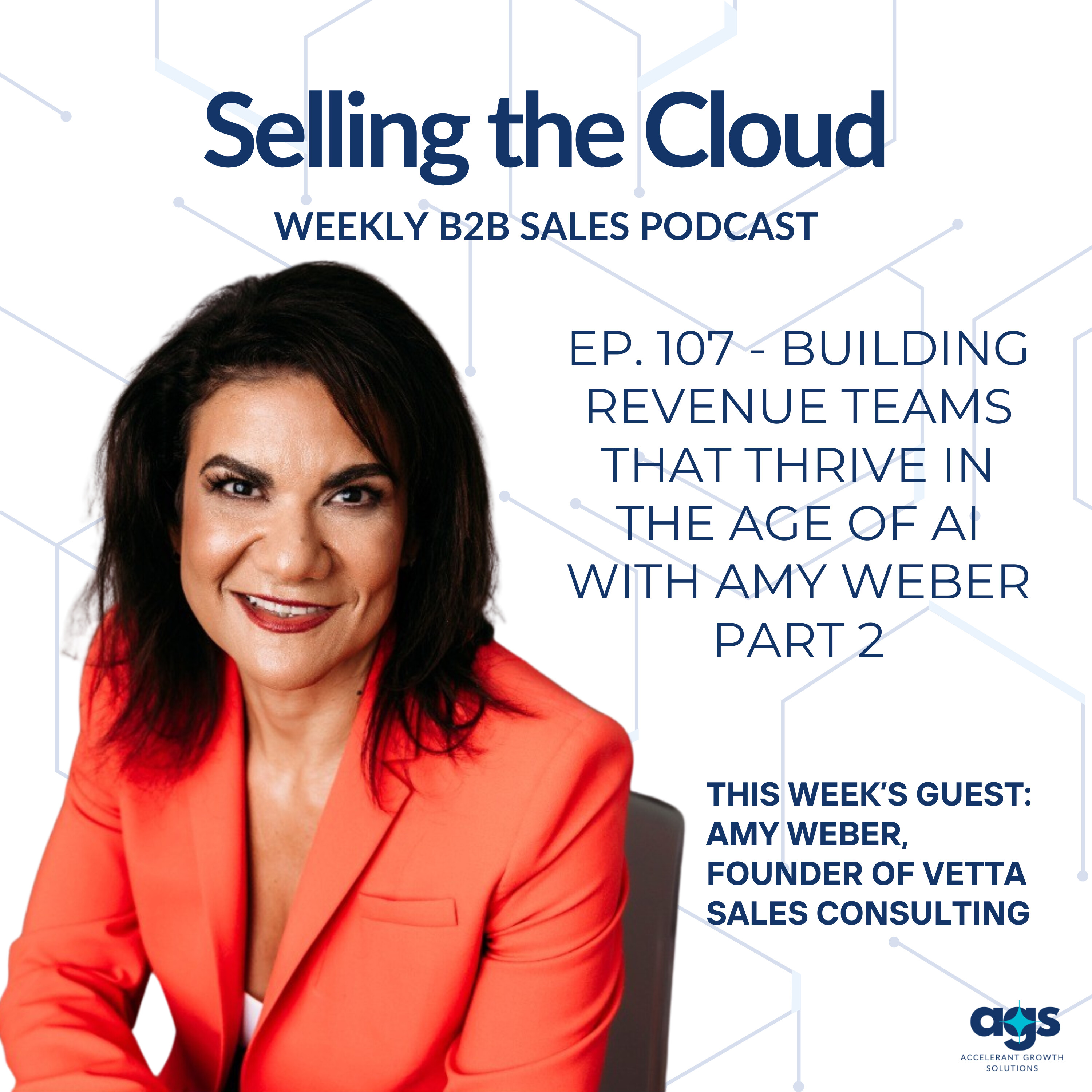
Ep. 107 - Building Revenue Teams That Thrive in the Age of AI with Amy Weber - Part 2
Podcast: Selling Intelligence (formerly Selling the Cloud)Published On: Sun Dec 28 2025
Description: In Part 2 of this Selling the Cloud conversation, Amy Weber joins KK Anderson and Mark Petruzzi to go deeper into how modern revenue leaders should think about AI, outreach, hiring, and coaching. Amy challenges traditional sales motions like cold outreach and rigid playbooks, and explains how AI should be used to personalize engagement, free up seller time, and enable more meaningful one on one conversations.The discussion also dives into assessment driven hiring and coaching, unpacking why resumes are a poor predictor of success, how to identify true talent signals, and how leaders can reduce friction by understanding identity, motivation, and communication styles across their teams. This episode is a practical guide for CROs who want to build revenue teams that perform, scale, and adapt in a more human centered, AI enabled world.What You’ll Learn:Why cold outreach is losing effectiveness and what CROs should prioritize insteadHow AI can personalize messaging without removing the seller’s individual voiceThe right way to define ICPs based on engagement and impact, not volumeWhy playbooks should act as flexible frameworks, not rigid rulesHow assessment driven hiring reveals true talent signals beyond resumesKey differences between hunter, farmer, and CSM profiles and why misalignment hurts performanceHow leaders can reduce friction between managers and sellers through better coaching and communicationWhy understanding identity, emotional resonance, and motivation matters more than process aloneKey Topics:AI powered personalization in sales outreachICP refinement and engaged account strategiesFreeing up seller time for high value conversationsAssessment driven hiring and role fitCoaching frameworks for sales managers and leadersManaging conflict between sales leaders and individual contributorsIdentity based leadership and communication stylesPositive intelligence and managing saboteurs in high performing teamsGuest Spotlight: Amy WeberAmy Weber is a strategic advisor to growth stage and enterprise revenue teams and the founder of VEDA Sales Consulting. She specializes in aligning people, process, and purpose to drive measurable revenue outcomes. Amy works closely with CROs and executive teams to improve hiring, coaching, and leadership effectiveness using assessment driven insights and practical operating frameworks.🎧 Listen now and follow Selling the Cloud for more conversations on building modern, revenue focused GTM teams in the age of AI.KK Anderson (00:31)if I could kind of double click on that a little bit, what's one of your favorite starting points? Like if you're gonna recommend to a CRO, I know it's obviously where they wanna focus, but what are just some examples of where you would have them start first?Amy Weber (00:46)Yeah. So I think that of the first pieces of it is that, look, I don't think cold emails work anymore. I don't think cold outreach works anymore. think it's figure out your ICP who is already engaged and then how do you automate some outreach to them in a way that makes is impactful to them. So using AI tools to be able to take that outreach and instead of a ⁓ rep,doing what you're saying, making a thousand emails a week or a hundred calls, kind of automating that outreach, whether it's through, and maybe it's a multifaceted approach, right? Getting more information out on LinkedIn. One of the things that I hated when I worked for big companies was that they wanted, like they wanted to silence your individual voice and they wanted it all to be very static and documented. Well, then you're getting the same message over and over again.Mark Petruzzi (01:28)Hmm.Amy Weber (01:34)Using AI to take that static message, but to personalize it based upon who you're going after is a real tool and trick today. And so you're getting out in front of more people and you're getting your message out in more ways. The second part is, like I said, figuring out what your ICP is and what's impactful for them. And then leveraging those AI tools to kind of create a outreach that is not generic.and is not just cold, it's taking the people that you know today that you want to talk to and making it more important to them, you know, in that capacity. ⁓an understanding really kind of that the goal is to free up more time for them to meet with these individuals one-on-one. So automating the things that are getting your message out in a content personalized manner so that the AEs and leadership is getting freed up time so that they can actually engage one-on-one because look,The other thing I think is ridiculous, again, I may get in trouble for saying it, a playbook should just be a framework. If you think there's one answer to how to be successful in sales, you're going to fail. Because you have to understand the client and their business need, and not every need is the same. It doesn't matter if you're selling the same product.or the same service, it's how that product or service is going to impact that end user in a new way. And you can only do that if you actually get in front of them and understand what their business or challenge or issue is, how that solution is going to play.Mark Petruzzi (03:12)Great, well let's move to topic three, which is assessment-driven hiring and coaching. And again, something that's near and dear to AGS's heart and what we do, and we're learning a lot as we've gotten to know Amy ⁓ over the past couple months. So how should a CRO use assessment insights wisely and the most productively? Who do they need to assess?Amy Weber (03:35)Yes.Mark Petruzzi (03:36)what two to three signals matter for this role and how do those signals translate into the right interview questions and then most importantly, the coaching plan for that new hire.Amy Weber (03:48)Yeah, like I said, I'm a huge proponent of this because I do think we hire people or we have historically hired people based upon their resumes. That might be the worst possible thing you could ever do. Now, the resume might get you into the door to talk to the recruiter, to the team or get into the interview process, but it shouldn't be indicative of how successful you're going to be in this role. 85 % of millennials will tell you that they are in the wrong role, but they're afraid to change.And so they're just going to keep taking jobs because that's what they did in the past. It doesn't mean that they're in the right role. And scientifically, 1 % of your past success will dictate your future success. So when we do this, we assess people in three different ways. We assess them during the interview process. So you get through the initial screening to say, ⁓ I think they might be a good fit.What are their really, their talent signals? And you're not gonna figure that out just by interviewing them. Because so many people will interview someone and say, I think there'll be a good culture fit. I like them. I'd like to have a drink with them. Great. That means they're a good person. But are they, do they have the right skills to do the role? Right? I'm glad you like them, but are they going to fit the role? like, you know, talking about the hunter, a hunter needs to have a really high driveand desire to go out and be with people and meet people and drive impact and outcomes. Whereas a CSM needs to have a really high precision to say that I can execute on a vision and I can track and make sure that all of the steps are going, that need to be in place for this person to, their rollout to happen in the right timeframe or their,you know, we're engaging the right individuals from their team on a weekly or bi-weekly basis to ensure that everything is going as planned. Those are different people. so understanding those key characteristics, even your emotional resonance, how you deal ⁓ with emotions. And if somebody has, and we can test for that, if somebody has a really high ER and you put them in a hunting role,it might take them a long time if they lose a deal to deal with the fact that they lost that deal. If they have a lower ER, they're going to be like, okay, I lost it. I can move forward to the next piece. And then we customize through the tools that we work with the interview questions to really pull out those key characteristics and those key identity markers because they're different based upon what you're looking for. From there,Once you've hired the people and you've got your team, then you need to determine who your leader is and kind of what their core identity is and how they individually need to understand managing people. That's going to reduce the conflict. And we build out custom management plans for each of those individuals. So we say either here's your team, here's all your benefits. Here's how you should look at your team overarchingly. And then if they have specificissues with a certain individual, whether they're like, I don't feel like I'm getting the most out of them, or we've got some sort ofconflict for the use of a better word. How do I address this? Because I really want this person to stay and be successful. We build out specific plans for them in that regard.KK Anderson (06:58)Yeah. Well, and kind of where my head is going is around that conflict, like what you just said. Like there is, and even kind of pivoting more toward that coaching aspect of making sure that the new hire is successful. There's very often just natural friction, especially in the sales world, right? When you have sellers who are entrepreneurial,you get a lot of friction between sales managers and individual contributors. And like some things that come to mind are, a sales manager may, be insisting that you're multi-threading and talking to different stakeholders in a prospect where the individual contributor is like, no, I have a champion. I've got this under control. I don't want to go around them. So deal strategy, right. Or, or there might be, like communication style issues, right. Where.Amy Weber (07:38)Correct.KK Anderson (07:43)A manager is wanting to review the pipeline and have those laborious, sounds like a broken record meetings every single week. And the individual contributors like would rather just, you know, eat nails. And so like when you have, when you have this kind of friction, like what are, are some ways that you can, you know, that you help alleviate it? Like what's it, walk me through like what you would do.you know, trying to.Amy Weber (08:05)Yeah. So,like I said, number one, when I work with clients, I figure out, I do these assessments and I figure out kind of who the people are that we're working with and what their, what their identities are and then how those are impactful to each other. Right. Because you're right. Look, when you are a driver and you're going out and you've got maybe a manager that was really successful and they want you to do it the way they did it, you're going to have conflict because they have to understand that.that ⁓ they can give an outline or framework, but that if they are trying to say, mandating that you have to do it in a certain way, you're gonna probably lose some of your top performers because those top performers are going to, they thrive in chaos. They're going to figure out the best way to work. And they do maybe have that champion and understand the relationship better. It again is going back and looking at opportunities as individuals, not as⁓ just repeating the same process over and over again. So I figure that out and then I go in and figure out where the tension lies. Is the tension a communications issue? Is the tension a conflict of you've got two really strong opinions and so they're just butting heads? And then it's not so much about changing either one of them, but it's changing how they communicate with each other.It's changing the language. Honestly, what we talk about in business works in parenting, right? You can have two different children that are very different people and maybe how you communicate to one is going to be different than how you communicate to the other. The same is true in the workplace. And you have to think about it from that perspective. If you've got someone who does have a really high empathy level,and so that means they're going to take everything in more personally, then you have to address that problem or that conflict with them in a different way than somebody who has a really low one and you can say, hey, I don't like how you did that change, right? Because they're not gonna take it personal. So we go in and we try to figure out really each of those core components.and then create frameworks for those leaders and those executive leaders accordingly so that they know based upon their core how they should address the different people on their team. And like, I don't think that you should have a team of people who are just clones of yourself. I think that diversity is important, but it's understanding how to manage that diverse environment and where based upon that diversity.you may sometimes falter. We learn as much from our failures or maybe more than we do from our successes. And so if we fall down with somebody, we need to figure out how to pick it back up. And that's just educating ourselves on who we are and who those people are as well. I'm a huge proponent of positive intelligence. I don't know if you know anything about that. Positive intelligence, it's a book, it's been a course.And it says that all of us have ⁓ our saboteurs and, you know, high achiever. Everybody's got the judge and it's trying to figure out how you get to your sage. And that's what we try to coach people on is that it is okay to be hard charging, but understand that you need to take that pause before you just treat everybody the same way.understand who you're talking to before you make that comment. That works, by the way, with your clients as well.So it's just a framework and figuring out where to go and what it's signaling. And then like I said, you also may determine that you just have the wrong people in the wrong roles, be that the individual contributor or the leader.Mark Petruzzi (11:27)Yeah, very good stuff. Cool, all right, well let's move into our final segment here and that is our rapid fire. So real quickly, first product or service you ever sold.Amy Weber (11:38)long distance and you can put an asterisk there for anyone under a certain age to tell them what that means.Mark Petruzzi (11:42)Exactly.KK Anderson (11:43)Likelong distance phones, like services.Amy Weber (11:44)Yep,door to door to evaluate people's ⁓ long distance bill and sell them on a lower cost solution. It was hilarious and it was really good at it and it was probably I had no.Yes, long distance for businesses. It did.KK Anderson (12:03)It started you on your career in sales, that's for sure.Yeah. Okay. So who is a, like a chief revenue officer or a CEO that you love to follow?Amy Weber (12:11)I follow several, lots of them, and some people I've worked for in the past and other people. When I sit down and think about it, there's a few that come to mind. Like, think Mark Cuban is phenomenally interesting to listen to, just the way that he drives companies forward and as a CEO and his mindset and the fact that he is very open to giving his opinion. I'm going to mess up his name, but Satya Nadella at Microsoft, I think is really fascinating today because heHe has taken a very different approach. worked for Microsoft and trust me, he is a very different leader than the leaders I had when I was there, because I think he looks at it from a people perspective. Alicia Tillman at Delta, she's more of a CMO, but she's taken a real people approach as well. So I think her conversation is interesting. And then there's a guy now that's the CEO of a water company that is very active on social media. name is Jay Williams.And he kills me because a lot of what he puts out there is not related to business at all, but he is increasing his following and his brand in such a creative way. I mean, it's water and people are engaging with him at huge rates. you know, I was in Nashville recently and it's kind of like what the guys at Liquid Death did.KK Anderson (13:26)Yeah.Mark Petruzzi (13:26)Excellent. All right, one leadership habit more sales leaders should practice.KK Anderson (13:30)What a great conversation.Mark Petruzzi (13:32)Excellent, thank you again, Amy.KK Anderson (13:34)All right, and thanks to our amazing audience.Mark Petruzzi (13:36)Of course.See Privacy Policy at https://art19.com/privacy and California Privacy Notice at https://art19.com/privacy#do-not-sell-my-info.
The note was deleted
The note was saved
Your message was sent