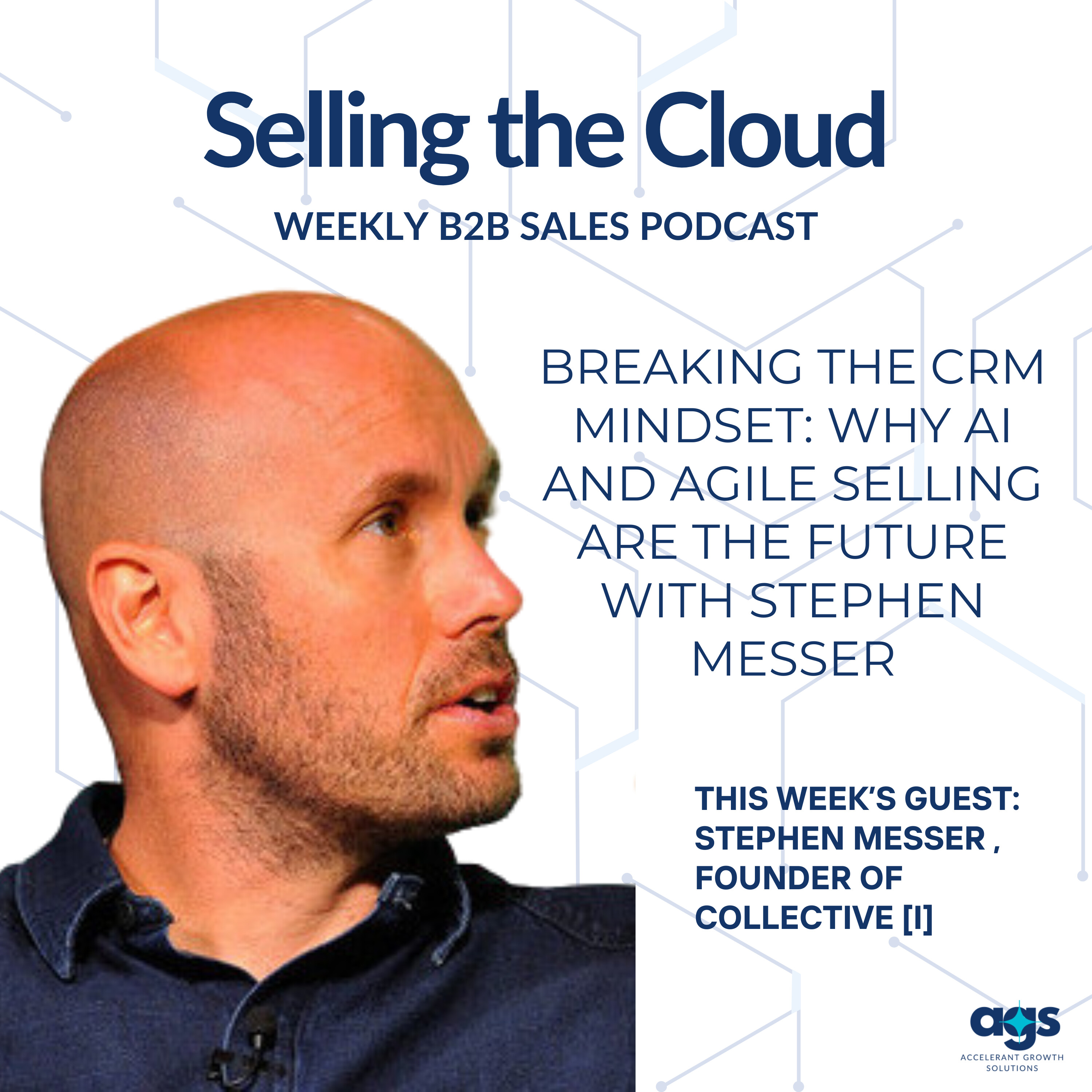
Ep. 90 – Breaking the CRM Mindset – Why AI and Agile Selling are the Future with Stephen Messer
Podcast: Selling the CloudPublished On: Wed Aug 27 2025
Description: In this episode of Selling the Cloud, Stephen Messer, co-founder of Collective[i] and LinkShare, shares a bold and timely vision for the future of sales—one that trades CRM inefficiencies, seller churn, and impersonal cadences for AI-powered intelligence, real buyer relationships, and a return to value-based growth.Stephen unpacks how Collective[i] is building the world’s first economic foundation model for B2B sales—a neural network that learns from billions in live market signals and transforms the way companies forecast, prioritize, and engage. If you’re leading a revenue team, this episode will challenge how you think about data, your CRM, and the very structure of your go-to-market engine.What You’ll Learn:The Real Cost of Today’s Sales Stack: Why CRM-driven workflows have created inefficiency, seller burnout, and buyer distrust.How Collective[i] Works: The power of neural networks that learn from shared, anonymized go-to-market activity—while keeping client data private and secure.Cruelty in Sales (and How to Fix It): A raw and honest take on how modern sales workflows punish reps and buyers—and how AI can fix it.The End of Data Entry: How Collective[i] automates pipeline visibility and eliminates the need for reps to “feed the system.”The Rise of Relationship-Centric Growth: Why trust, storytelling, and insight—not spam—will win in the next generation of GTM.Key Topics:What’s wrong with current sales tech (and why it’s unsustainable)How Collective[i] trains its neural net to understand real buying behaviorThe shift from CRM-driven sales to AI-first revenue intelligence“Lifeguards” and the shadow sellers that make or break dealsWhy buyer relationships have eroded—and how to rebuild themThe moral case for better GTM designReal examples of AI uncovering hidden pipeline riskWhy average sellers will become exceptional (or obsolete) with AIGuest Spotlight: Stephen MesserStephen is the Co-Founder of Collective[i], a next-gen AI platform reinventing how companies forecast, collaborate, and close. He’s also known for co-founding LinkShare, the affiliate marketing pioneer acquired by Rakuten for $425M. A seasoned entrepreneur and thought leader, Stephen now leads Collective[i] in building the world’s first neural network for B2B sales.Resources & Mentions:Collective[i] – WebsiteCI Forecast: Collective[i]’s weekly go-to-market leadership eventBook mentioned: Predictable Revenue (and its long-term impact on sales culture)Topics discussed: AI-powered forecasting, seller efficiency, CRM alternatives, cadence fatigue, relationship rebuilding, data trust modelsListen now and follow Selling the Cloud for more unfiltered GTM insights from the leaders shaping the future of sales.Mark Petruzzi (00:00)Welcome everyone to Selling the Cloud, the podcast where we decode the art and science of B2B selling in the ever-bombing world of SaaS. I'm your co-host, Mark Petruzzi. And I'm KK Anderson, excited to join you on this journey where each week we explore the strategies, insights, and experiences of some of the most innovative thought leaders in the world of sales today.Welcome to today's episode of Selling the Cloud podcast. We are beyond excited to have Stephen Messer, co-founder of Collective Eye with us today. For those unfamiliar with Stephen, he co-founded LinkShare, which revolutionized affiliate marketing and 10 years ago, co-founded Collective Eye with his amazing sister, Heidi Messer and brother-in-law, Tad Martin.Together they've created the world's first economic foundation model that studies how the world buys and sells. It's a groundbreaking development that is completely disrupting the sales landscape. Their neural network has roughly 5 % of the world's GDP under advisement today and growing rapidly. So what makes Collectivize so revolutionary? It is its deep learning and natural language processingthat allows predictive insights to come forward to sales teams with amazing precision. It boosts productivity and it delivers clean, powerful data back into CRM systems. This is a true game changer for sales organizations. It enables teams to make smarter data-driven decisions and scale effectively. This episode is packed with valuable insights for sales leaders, so be sure to grab a pen and take notes.You'll probably want to listen more than once as well. Here are three objectives for today's episode. Steven, to learn how you and your amazing team has built the most powerful neural network in sales tech, creating competitive advantages for your clients, what it means to become an AI-charged selling organization, and why that's crucial for sales teams today, and why traditional CRM datais often inaccurate and how it impacts sales effectiveness and how CollectiVie is cleaning up CRM data across your client base. Steven, let's dive in. You've had an incredible career from founding Lynx Air to now leading the charge at CollectiVie. Can you walk us through how you got to where you are today and what has led you up to being a guest here on Selling in the Cloud?Well, thank you for first of all, thanks for having me here and thank you for letting me reach your audience. I know how important your audience is and I'm excited to have the opportunity to talk with them. So going back in time, you know, I've been fortunate enough to work with my sister and now my brother-in-law. I think all of us have one thing in common, which is we grew up in a world where revenue is really important. My father passed away when I was very young. My mother took over the family business.that they had created together, which was a corporate maintenance business. We literally cleaned offices and from a very young age, we would sit around the table talking about what it takes to make sure that we could make it through another week. And for anyone here who's listening, almost all people I know who are involved in sales found their way there in some way, or form, because they were willing to take the risk to grow something and make something more meaningful for their family. So.Whether it LinkShare, which is really just a commission-based selling on the web, which we started in 1996 and sold to Rockington in 2006, or Collective Eye today, which is really to support for collective intelligence to help sales professionals and revenue organizations really upgrade. I think the one commonality was freeing up people from the fear of what it takes to make the number that they need to, to support their family.and also providing a better service for their customers, which all entrepreneurs think about endlessly. Wow. Stephen, can you walk us through, you know, what were some of the, what did it take and what were some of the challenges of building this incredible neural net that you've built here at CollectorEye? You know, it always seems obvious after 10 years of struggle. I think when we started the business 10 years ago, we beganon this concept of first principles, which is, okay, you have a new technology neural nets. Now this is before chat, GBT became popular. ⁓ but we, we would look back and said, okay, this is a powerful technology. It's going to change the landscape, but it operates a lot differently. One of the things that needs the massive data set to learn. And for those who don't know, chat, GBT is great. Anthropics great, but they're for the most part studying language.So they're really good mimics of how the world operates. It's auto fill to the max. Let's put it that way. But they're not able to learn everything. And in many ways, it's a general type of, ⁓ or a very narrow type of intelligence as opposed to general intelligence that humanity has. So we look back and said, okay, could you apply this to Adam Smith's problem of the invisible hand, which is the economy operates in a way that you can't... ⁓follow. But if you could follow, you could optimize it. And we had some early examples. ⁓ If you go back 10 years and you look at Uber, you might have said, okay, let's get this straight. You've got a web app that's going to connect supply and demand around livery, car service. ⁓ How are they going to be able to maximize and operate the entire world of taxis, ⁓ rental cars, ⁓ you name it. ⁓ And here we are 10 years later andNot only have they done that, but they've optimized to make sure cars are in the right place, that they're getting the right fee, that the good drivers are getting the best passengers. They have done this very quickly and they really leverage a lot of neural nets to help figure out everything from pricing to matching. And we looked and said, okay, early on, this is a proof point that if you can aggregate enough of a particular economy in one place, you could really optimize it. Now everyone said, no one's going to share data. Nobody would do that. In fact, II would bet there are people on this call who are watching this video who are saying, yeah, my company would never do that. But we look back at first principles said, do people do this already? And sure enough, if you look at almost every company today, not only do they do it, but they do it in the majority of the way they operate their business. I'll give an example. Would you ever lend or extend credit to a customer based on their payment history to you alone?I mean, if you want to get fired, you would, but almost always you go to a credit bureau. And what do you do a credit bureau? You give this neutral third party a history of how everyone's paid you. They combine it with all their customers and they give you back a credit score back. Now it doesn't give anyone's history away. It keeps everything confidential. Yeah, that works. We do it in Google every day. You do a Google search. Trust me. They see all of your competitors searches, the companies they're looking for, the people they're trying to find. Same thing with LinkedIn.That happens. You do that with advertising. Your advertiser on one hand is being bought through Google and trying to leverage their network to find the right buyers and other places like that. And we do that happily with lead gen. We do that happily in all the places we are at. But then it comes into our company and we say, no, we can't do that. The only revenue groups have done that. And in exchange, they end up being the most expensive portion of the business with the least results.And so we said, that's got to change. And so for 10 years we've gone out and we now work with some of largest companies in the world, regulated around the world. ⁓ And sure enough, when they do their details, they realize not only is this more secure, not only is this better, but it enables us to have better returns. And that's sort of the flywheel effect that has made our business grow so quickly. Yeah. You know what? It's, it's been amazing to, to watch you build this over the years and to see how these large companieswith all their attorneys and everything else have dove in. And it all comes down to the way you keep all this data blinded and private. But what it brings is this amazing data when you can put it together in this kind of way is so much better than just one company's data. And it's also so much more impactful.because as you build this into this amazing neural network, it's really, I guess it's all about the data and not about the data all wrapped up into one. Meaning it's about what this data together in this combined collective way can help you do for your clients and help you really predict what's going to happen next with your clients. So can we go little deeper into that and how does it reallyto give a competitive advantage when you have this kind of data and you have this type of intelligence behind you, AI intelligence behind your go-to-market, what does that do and how do you create these sustainable competitive advantages that you're helping your clients drive every day?Well, let's start with something that I think is important. There's a lot of leaders. You reach probably the best leaders of almost any group of I've ever come encountered. And what I think is hard for them to fathom in this change is the recognition of the amount of cruelty that the current model pushes on employees and customers. Let's cover that. And then I'm going to talk about what it does to change things.Because I would argue there's a lot of your leaders that are listening to this thinking, what do you mean? I'm not cruel at all. You know, this is just how it's done. But there is a huge amount of cruelty. Let's start with the sellers and the revenue organization. Think about the cruelty of asking somebody to go in, log everything they do every day, non-revenue producing their commission based sellers, go in there, log what they do, find the people that they're supposed to talk to, try to hope to turn leads into something meaningful.and basically prospect all day long when we know for a fact that 85 % of revenue comes from references and referrals.Think about the cruelty of asking them to learn how each different group buys as if they're Columbus or Magellan. Now we know about Columbus and Magellan because they survived the risky journey. But there are a lot of explorers that did not, and we do not know their names. And if you think about sales today, the average churn rate in a sales organization is 35%. There is a cruelty to everybody involved.in setting people up for that kind of failure rate. If you think about your customer, it's even worse. And you know this, we have bombarded them. We have machine gunned them to death with communications. To try to get to the 15 % of prospects we don't know, we are willing to destroy our brands and our reputations by bombarding them with these cadence tools and bombardment tools to the point where they now hide from us.And I will tell you, we call it cadence when we send it, but it's spam when we receive it.And you cannot change those terms. Why do I say that's cruel? Think about a customer today. Well, let's go back 20 years when sales was a relationship driven event. I promise you for every leader that's listening to this call today, they remember a time when, when there were events, they were invited by their customers to join dinners. Frankly, in revenue, we were the most fun people. We had connections to everyone.We knew about every job opening and we knew everything that was going on in the companies. And like McKinsey or BCG consultants, we knew what was being successful and our customers appreciated our ability to share insights that we had gleaned from an overall market. They valued the time we spent with them. We built relationships. We took them with us over time. We kept them honored. It was our job to make sure that the rest of the company delivered the results and those buyersWe it because we helped them become more successful and grow their careers. And the more we helped them, the more they helped us back. Here we are today. They hide from us on Slack. They hide from us on groups. They have groups together where they tell us we're not allowed to join. When there are events, they try to hide from us in every way possible. We are no longer invited to them. When we try to invite them to speak, they don't want to speak to us. When we give them advice, they think it's biased.They do not see us as the partner they used to see us as. If that is not cruelty to everybody involved, I do not know how to help you. So AI offers us a chance to change all of this. And I think when we think about the network that Collective Eye has built and the community that we are building, it is to look and say it is our job not to go to the lowest value.And in fact, I think all these cadence tools have driven us to how do we get cheaper? I see the newest thing is AI SDRs. And don't get me wrong, I'm in AI, but trying to drive down the price to bombard people means our results are so bad that the only way to keep that up is bombard in even more ways than possible. And if we haven't driven our customers into hiding, I don't know what else we can do to do it. Rather than go low value.We must embrace providing higher value to our partners. And that's really what AI is all about. And can I give one last example? I going too long? We need for you. No, please do. Keep going. I think the current sales stack of all these technologies are the way we tried to mass produce, you know, a revenue funnel in the last 15, 20 years. I think what that has done.is move us into this role of how many activities can we do? How cheaply to get whatever conversion rate we'll take. And I can tell you coming from e-commerce that never worked there. In fact, it's gone the exact opposite. Whether you look at influencer marketing, et cetera, it is really about how to connect to our customers and offer value. So we think we're about to go through a massive switch with AI where instead of trying to get the mediocre to be average, which is the old sales staff.How do I use MedPic or medic or whatever, all these things to try to force everyone to be exactly the same. I think we're going to go and start moving because AI takes average people and makes them exceptional. And that's the mission we're on. If we fail, mark my words in 10 years, sales will no longer exist. People will do product led growth because if customers don't want to talk to people anymore, that's the only option they have left.And I think that'd a shame. Wow. You know, I think of AI as personally, you know, as someone who's been in this landscape for 20 years, as the great equalizer. Right. It takes some of the mundane processes of doing sales every day and just does it for you. Right. And it's incredible. It's almost like having like alittle Jarvis on your shoulder, right? Like Tony Stark, know he's, you know, we talked about him yesterday on your Collective Eye forecast, but it's just incredible that you're right. takes a good salesperson and makes him extraordinary. Right? Well, think about yourself. Like you guys were early adopters of this. So you may realize something that your market may not, which is today,Part of the reason why the skills of the current group of sellers over the last 15 years has really destroyed relationship building. It's destroyed the ability to actually understand a customer's needs. Like we talk about all these things we use to work hard to train people, but you know, there's a funny thing when, when they did studies this year to look at the, do what they call functional MRIs of the brain, what they realized was our spatial skills shrink. So now we have this GPS.that tells us where we go, all that skill sets disappearing in our brains. We used to need it, right? If you were going from the East to the West on a horseback, you kind of needed to know you were going West, or if you ended up North, it would get cold fast, right? So we had these skills that all humans had, but it was lost. And what it shows you is when you don't use these skills, it goes away. A lot of the sales stack in the way over 15 years, and I frankly blame this book called ⁓ Repetitive Revenue or Predictable Revenue.I forget the name of the book. I read it years ago that everyone got all hooked on, which is like, we're going to mass manufacturing sales. And what it did was it sort of said, just do these things. And if you do these things, you'll win. And all these things work when you're the first one doing them until everybody does the same thing and they all have low value. Then it goes to zero. And that's sort of what's happening. And if you look at your STRs, if you look at your newer sellers, when you say build a relationship with them, they look at you and say, does that mean like click on LinkedIn?No, it does not. For anyone who's been around a long time, you know, relationship building is about trust. How do you add value? And KK, you said it yourself. We do an event at Collective Eye for our community called CI Forecast. You can go to ciforecast.com and see it. And every single week we bring the world's greatest leaders. Yesterday, you came to Michael Useland, the guy who brought us Batman in the movie theaters. Well, all right. He talked about storytelling, a skill that sales professionals have had for years.Now we give them scripts to read. It's a big different from being a storyteller to an actor. And for anyone on the other side, it's easy to spot the difference between someone who can make a complex story simple and someone who's reading a script, but doesn't understand what they're saying. This is an example of some of that skills that I think we've lost that we have to regain because customers want to reach out to people that add value that can make a complex story simple.They definitely don't want to talk to someone who's reading a script anymore.Well, I'm going to go and I'm going to use this time now to lodge a complaint against Steven you and collective I. My complaint is, you know, having, as you mentioned, being become an early adopter and a huge fan of everything you do at Collective I, I have kind of ⁓ I've lost in some ways my ability to speak.with my prospects, not my clients because they're there with me, but new prospects. And here's a little bit of a backdrop on it. Early in my life, I actually was able to take some great courses in college, high school, in Spanish, and then later on Italian as well. And I was looking to learn both the languages for different reasons, travel I wanted to do in the future.And what I learned, traveling to Italy and Spain and other parts of the world that speak those languages, that I no longer spoke Spanish or Italian. I spoke this version of Spatialian, would be the best way I could describe it. Which what it would do, it would allow me to communicate in these countries, but for the most part, there would be individuals, especially if it was like a teenager hearing me, that would giggle.when I would say that, you know, I would say my sentence, which would be this version. So my point back to collective I is I feel like I'm speaking Spatialian a little bit in that I have learned now through you and your team and the great work we've done with our clients together that there's a new way to think about sales. And it's not about the old CRM way. It's about thinking about the future and it's about thinking ofeven data, data that you're gonna be generating today and tomorrow, not data you generated three years ago. And I find myself, like I said, sometimes I move too quickly with my prospects and they're not there yet. So over time, I've learned how to do this. I've learned to communicate a little better along the way.But I've got to blame that all on you because I see the world from a selling perspective very differently than I did two or three years ago. So I guess maybe we can, you know, flush that out a little bit more. Tell us more of your points of view on that. And then you could probably even describe this better than I do. How do you use the new capabilities and products like Collective Eye to really build more effective selling organizations?Look mark, you're 100 % right. There is a CRM paradigm mentality which thinks about things as failstacks And so the first part of this this blog this podcast was really about what's changed Let's get into the details here of the meat of what's going on for the second half of the podcast Which is really the value which is okay What has changed or you it's easy to say there's a CRM paradigm and then there's an AI paradigm And sometimes that sounds like marketing speak. Let's get right into it, right?In the CRM paradigm, what you're doing is you're typically trying to compartmentalize what people are doing into one tool, training them on that tool and having that tool do what it's doing. What that in theory means from a data perspective is you have silos of data where you have partial information. AI's changed that whole paradigm. says the whole stack goes away. What we're looking for is every interaction of everybody who's involved in this revenue endeavor.Whether that be new business, whether it be a renewal business, whether that be upsell or cross sell, or generally relationships across a large organization in different regions. There is a relationship that you and your organization have with the customer. It says to you, how do I figure out what's going on? Well, the first thing is it watches and helps by observing what's going on. You hit the nail on the head. This concept of entering data by people with paid.licenses and I only bring up the paid licenses because it means there's a whole bunch of shadow people that you didn't buy licenses for that you're just not capturing data on and saying, it's okay. That goes away in AI. And in fact, just so your users know, because our, even our revenue model will seem weird to them. There are no paid licenses for individual users. It is completely complimentary. If you come from the SaaS world, you've got to think I've lost my mind.But if you come from the AI world, you don't want to lower the data quality by creating economic incentives to stop good data. So can I give an example? We call the group of sellers that never get to be seen, the shadow group, we call them lifeguards. Now you might ask, what do I mean by lifeguard? Well, I look and say, here's the deal.If all you do is study the most active people in the pool, you get a picture of the pool that is fine, right? Those are in your world, the sellers, but there are a few people that don't get in the pool often, but when they do, they really matter. That's the lifeguard, right? When the lifeguard jumps in the pool, it paints a very different picture of what's happening in that pool than you would have thought before. But if you're not tracking them because you say, ⁓ they're not in the pool often. Why should I buy license that mattered? Well, then I don't really care.But you get a different view of the world in our world, lawyers, finance people, sometimes client success people, sometimes ⁓ a friend who knows this buyer or a board member. These are people that aren't in the pool often, but when they are, ⁓ boy, it matters. And you want to know what's going on and it can change the outcome today. People essentially try to cost manage those licenses down.And so they don't get access to that. In particular, one group that you know well matters. You do deal with a partner. Each one's got their own CRM. No one knows what's going on in the other guy. But what if I can just invite my partner in at no cost and they can join even one opportunity at no cost where the AI then observes their activities and captures it for you to work together on. This kind of way of thinking not onlyimproves data quality, but it also provides a better view into how everybody's working together, where the risks are, how you can work together and help each other out in a way that's never been done before. That's an example very simply of this AI mindset shift. Yeah, I love it. I know you can. let me I guess let's let me just unleash a little more here there from the standpoint of you.you know, our audience knows that we work really hard to not just talk about products or companies that we're presently working at. And I know you always, you bring so much more general information to the podcast that you go on because you are such a forward thinker in all this. But I'm gonna...just take us a little deeper into CollectivEye because I just feel it's so relevant and this is something I would feel remiss if I didn't do. So when you look at what can be done now with a product like ⁓ CollectivEye, there is all of that stuff that you described that sales reps dread doing, that information that they would put into a CRM andthe time that they spend, you all these latest two research studies that I've seen, and both of these have happened in the last 12 to 18 months, both Gardner and also Salesforce did amazing studies where they tried to just document where sales reps were spending their time. And they found, and they both came up with a very similar number, somewhere around 30 %...was all they were selling in any given week or given month. And the rest of the time was inputting data and giving updates to sales leaders and different, you know, five different levels of an organization if they're in a big enough company. So take us a little deeper into, you know, how easy that is to take that and turn that equation around with leveraging a product like Collective Eye.And how excited do these sales reps get when all of this information is done in an automated fashion for them and they then get to jump onto a system like Electabye and use that in a strategic way and forget about what the sales managers and CRO gets to do at their levels. So take us a little deeper. want to kind of take a little bit of our hand cuts off here.So let's go back to that cruelty. mean, the good thing about cruelty is when you remove it, changes the, the, the way you think about the problem. So, so there are two pieces. So for any of the leaders who are listening to this call today, they're going to think, okay, how big of a deal is it? Half my sales team doesn't do it. I we even called it rigor. Like we had terms for these things, but the nice thing about part about AI is that we are able to, remove that work. Instantaneously without retraining a sales team.We do this by connecting to the APIs of all the digital technologies they use today, but we can do it behind the scenes. We can do it in a GDPR compliant way. We can do with high security and what we can do it in a way where it changes the nature of the paradigm. There's two challenges you need to overcome to solve your data quality issues. The first is you need a powerful neural net to understand how to follow the rules around the world of privacy correctly.That's the first one. And you have to find a way where you don't need to train sellers to do things. The second thing is you've got to reward people who use the application to make sure that they're not hiding information deals that they don't want listed out there. So we solve that by making sure that one, the work is done automatically behind the scenes. It's quick. It's easy. It's reliable. It's safe.The second thing is every time a seller opens an opportunity, they immediately get unique insights that we have learned from our network that they can apply to winning a new deal. There's got to be a reward for sharing information for the seller. And that it's not simply about getting data automated. There has to be a reward. I always talk about all to all these privacy people out there who always worried about data.my God, we have to make sure that people don't use cookies. And if you spent time in Europe, you know, if you try to go on a website, you have to go through 16 clicks just to get past the cookie approval. I don't think it's about lack of knowledge. I think it's a lack of value. In America, we will give all of our information to our supermarket in exchange for coupons. We have no problem because we're getting a value in exchange for giving up data for sellers. It's the same thing. We've got to provide value to those sellers.so that when they will have information, they want to update you sooner about it, as opposed to punishing sellers by trying to do things that hurt them. And Collectivy does that by immediately giving insights that they can leverage, that they want to get earlier to win more business.See Privacy Policy at https://art19.com/privacy and California Privacy Notice at https://art19.com/privacy#do-not-sell-my-info.
The note was deleted
The note was saved
Your message was sent