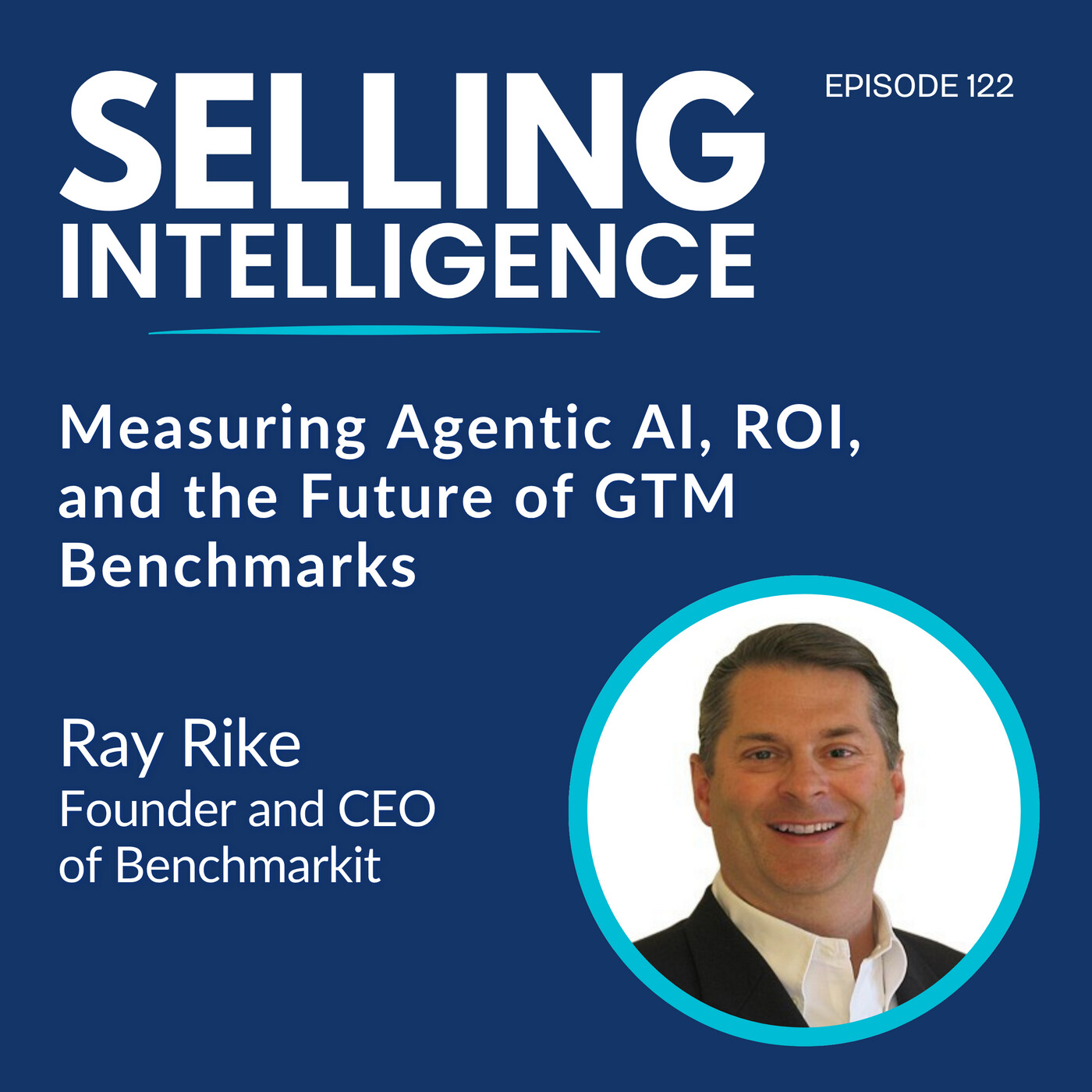
Ep.122 - Measuring Agentic AI, ROI, and the Future of GTM Benchmarks with Ray Rike - Part 1
Podcast: Selling Intelligence (formerly Selling the Cloud)Published On: Wed Apr 15 2026
Description: General Episode Description:In this episode of Selling Intelligence, Mark Petruzzi and KK Anderson sit down with Ray Rike, founder and CEO of Benchmarkit, to tackle one of the most critical questions in enterprise AI today: how do you actually measure success in agentic AI programs?Ray shares why most AI initiatives are stuck in “pilot purgatory,” the common mistakes companies make when trying to automate broken processes, and why an AI-first mindset requires a complete rethink of data, workflows, and metrics. The conversation also explores how go-to-market teams should define ROI, what benchmarks matter in an AI-driven world, and why traditional SaaS metrics are no longer enough. What You’ll Learn:Why AI Projects Stall: The real reasons most agentic AI initiatives never scale beyond pilots.AI-First vs Human-First Thinking: How redesigning processes for AI fundamentally changes outcomes.Data Readiness Matters: Why poor CRM data and lack of governance derail AI success.Measuring AI ROI: The new metrics leaders must track to justify AI investment.The Shift in GTM Economics: Why cost structures and efficiency benchmarks are changing fast.Key Topics:“Pilot purgatory” and lack of enterprise-wide AI focusThe importance of data hygiene and enrichment for AI successRedesigning processes with AI at the center, not as an add-onThe rise of vertical AI and pre-built agent workflowsDefining success with leading, mid-term, and lagging metricsCAC ratio vs AI-driven efficiency benchmarks“COGS is the new CAC” and shifting cost structures in AI-native companiesRevenue per employee as a proxy for AI productivityToken consumption and cost predictability challengesBuilding smaller, modular agents instead of large monolithic systemsThe four-layer measurement framework: productivity, effectiveness, efficiency, and ROIGuest Spotlight: Ray RikeRay Rike is the founder and CEO of Benchmarkit, a leading source of B2B SaaS performance benchmarks with data from over 1,800 companies. He is also the host of the AI to ROI podcast and a founding member of the SaaS Metric Standards Board. With decades of experience as a go-to-market operator and executive, Ray focuses on helping companies move from intuition to data-driven decision-making in both SaaS and AI-driven environments. Resources & Mentions:BenchMarkitAI to ROI podcastConcept: Agentic AI in go-to-marketConcept: “Pilot purgatory” in AI adoptionConcept: AI-first process designConcept: COGS as the new CACOpenAI Frontier AllianceVertical AI platforms (example: Harvey for legal)Metrics framework: productivity, effectiveness, efficiency, ROI🎧 Listen now and follow Selling Intelligence for more insights on AI measurement, GTM strategy, and building data-driven revenue engines.Mark (00:31)Welcome to Selling Intelligence. We're joined today by someone who might have had the honor and privilege of calling both a collaborator and a friend. Ray Reich is the founder and CEO of BenchMarket, the industry's most comprehensive source of B2B SaaS performance benchmarks with data from over 1,800 companies.Ray is also the host of the AI to ROI podcast. He's a founding member of the SAS Metric Standards Board. And full disclosure, my co-author on data and diagnosis driven selling, Ray has spent decades as a go-to-market operator, having served as president of Simply Learn, CEO at Higher Mojo, SVP at Moment Feed,and multiple times SVP market and sales and SaaS companies before founding Benchmark it roughly five years ago. And they have a singular mission, give every B2B reoccurring revenue software operator access to data driven benchmarks so they stop flying blind. Today, we're going, well, first off, let me welcome you, Ray. Thanks so much for joining us.Ray Rike (01:43)Thank you, Mark. Sorry that I'm so old that you had it took that long to read everything I've done.Mark (01:47)Exactly. Well, you know what? That's also a good thing because you've done some amazing things throughout your career and you're not that old. So, yes, let me tell you, let's talk a little bit about today and where we're going to go on this podcast. ⁓ What we'd like to do is tackle what might be the most important and for sure most underserved question in enterprise AI right now.How do you actually measure the success of agentic AI programs? And even more specifically, what does that look like for go-to-market functions? We'll dig into what benchmark its data, what is it revealing, where the industry is setting the bar, and what separates teams that are generating real ROI from those stuck in pilot purgatory. Ray, welcome to Selling Intelligence.Ray Rike (02:36)Okay, excited to be here. Let's dive into it.Mark (02:39)All right, so Ray, you've been collecting SAS performance data for years, and now you're turning that lens on AI. From what you're seeing at Benchmark and in hearing on your podcast, what's the core reason most agentic AI programs never graduate from pilot stage? Is it a data problem, a change management problem, or something else?Ray Rike (02:59)I think it's an evolutionary problem. So I did some research with scale venture partners last year about what the state of AI and GTM adoption was. And what we found, Mark, was it was primarily individuals adopting generative AI tools like Clot or Chat GPT to help them with individual tasks. Things like maybe it was an image creation for an ad campaign. Maybe it wasemail messages for outbound campaigns, et cetera. And the primary benefit was personal productivity. Hey, I can do this much more research quicker for each account, or I can generate this many more campaigns in a month. Now, when we get to process automation, which is really where agentic AI is going to be used, ⁓ we're just at the very beginning there, and we don't have enough experienceof actually deploying agentic AI to have a lot of success stories on a production basis, especially the enterprise, because most of the enterprises, and I'm talking about companies a billion dollars and over, I see an average of 20 or more simultaneous AI proof of concepts going on, and they're not really getting the focus of the centralized IT executive team, they're departmental.Maybe it's just customer service or maybe it's just development with a code assisting tool. So my answer is I'm not seeing enough organizational wide enterprise focus on true agentic AI initiatives yet.KK Anderson (04:32)And Ray, welcome to Selling Intelligence. glad you're here. And I just want to jump on top of what you just said there. It seems like the concern would also be that they're trying to put some agentic AI solutions onto maybe processes that should not be automated or were not the right process to begin with.Ray Rike (04:52)of the most common mistakes, and I've kind of built this framework of the variables that help ⁓ indicate success and agentic AI deployments. But one is the data is a mess, right? Think about today for what, 20 years we've been talking about how bad CRM data is and have we cleaned it up? No, we still have shitty CRM data, but the SDR or the AE will say, well, that's not the right information.Joe doesn't work at company A, Joe's a company B or that's the wrong title, right? So a lot of data hygiene, data prep needs to be done. So that's number one. And then to your point, we're thinking like old fashioned business process re-engineering. Well, yeah, maybe we map current state process and we want to map future state process, but we're doing it with a human first orientation and an AI first orientation isfundamentally going to change each step along the way of that process. Quite frankly, you have to identify what data I'm going to ingest, use at the field level for each step, each granular task within that process. And we just haven't re-engineered the process to be optimized for AI centricity yet. And KK, I don't think we're going to until we have a lot of people who have one or two rounds of experience.redesigning a process with an agentic AI first mentality, then then they can do it to third, fourth and fifth time.KK Anderson (06:16)and has that been defined how to have this kind of AI first mindset? Because we've had several people on the podcast talk about this, right? so, and I know I'm going a little bit off of kind of the agenda here, but I'm dying to hear your take on this. When you say AI first mindset versus just a traditional business process mapping,You know, like we're all used to, we all learned in business school, but the data scientists have been doing for decades. Like, what does that mean? What is AI first mindset? talk me through that.Ray Rike (06:54)I wish I could sit here and say, I've done 22 of these. here's here's the playbook. So I don't have the playbook either. I have a lot of ⁓ signals of why it's so difficult. And one of the big signals was OpenAI, what about two plus months ago, formed the Frontier Alliance. And the Frontier Alliance, right, because they said, we're going to get intoKK Anderson (06:57)Right. I know it's all new. No one knows. That's what I'm curious.Mark (06:58)Thank you.Ray Rike (07:17)agentic AI, not just generative AI, right? They first of all introduced, I think in January, the five layer cake of the OpenAI Frontier application map. And then they announced that McKinsey, Accenture, Boston Consulting Group, and maybe it was Ernst & Young, are now forming this Frontier Alliance to partner with OpenAI to help their enterprise customers deploy agentic AI. Why?Mark (07:35)Mm.Ray Rike (07:43)because it had been failing. A lot of the open AI projects to really do process automation using AI agents were not successful. So that's a signal, right? And as far as what's the secret, I don't have one other than try to find a consultant or a third party who's done two or three of these in the domain or the area. Let's say it's SDR.Mark (07:58)Thanks.Ray Rike (08:07)I want to automate the sales development representative function, right? Either you're probably should work with a software company that they specialize in that because they've actually ⁓ embraced and bundled domain expertise in their predefined agents, which then can be customized and or a third party consulting firm that have done it, that have made some of the mistakes and learn from their previous projects.So that's my recommendation. Go with a bundled application that has AI agent specific to that process and a third party. And if you think about vertical AI, KK and Mark, right? That's why I'm so bullish and so are most VCs on vertical AI. Look at a Harvey in legal. They actually are pre-packaging workflows, i.e. agentic AI.specific to the nuances and subtleties of that industry, including regulatory and compliance requirements. And they're making a lot faster headway into driving real return on investment than a horizontal, agentic platform that has to be custom designed for each customer. Did I answer your question okay, KK?KK Anderson (09:17)Makes a ton of sense, 100%.Mark (09:19)Soyou bring me back to the concept you mentioned earlier around BPR, business process, free engineering, and how this isn't that. But it makes me get to a point of like, where is the value going to come from? And to me, I've always seen the value of companies be a part ofor partially driven, if not significantly driven by their competitive advantages, how they differentiate themselves in the market. What I love about agentic AI, when done right, it allows you to build a set of processes in a way that can't be replicated by any of your competitors. You can't just say, great, I went to HubSpot or I went to Salesforce,and that's going to help me win against my top five competitors. Well, it's not because they all have Salesforce and in SaaS models, these systems weren't as flexible as now, know, agentic AI can be infinitely just, you know, infinitely just different than any other model that is out there today. So,I like that connection back to the business process side and ensuring that you have people who know that business process as a consultant, ensuring that you really leverage all the expertise and the tribal knowledge out of the client side because they know how to make this work. And they probably are working within a model today that is not what they would have recommended if they weren't forced to do it.because of the Salesforce process and what the system looks like or SAP or Oracle or whatever. take us a little deeper into that. Like, do you agree, I guess is the first question, like that these processes can now be more competitive advantages for customers and companies than maybe ever before.Ray Rike (11:12)Let me let me double click to the next level and KK I think you asked this question also. So in this framework, right. So one of the things because process redesign is such a critical part of this. Don't boil the ocean. Don't try to look at the entire customer acquisition, retention and expansion process. Let's get really focused and say, let's look at the outbound lead generation process.Constraint right so you redesign that constraint process first with a I centricity you define all the data that you're going to need to use in your existing systems of record like your account data the contact data the Including title you're going to define all I need to bring in this third party data to enrich it So define what data you need at the field level?Make sure you know where that data is coming from and how you cleanse and enrich. Think about the governance. I call this AI explainability, right? And you're going to need this, especially in regulated industries, but even if you're doing outbound sales for a software company, right? What's my government governance and policy? Who actually makes the determination that I should reach out to these people? Right? Is that in my ICP?What do I do different with a non-ICP member? That doesn't sound like governance, but it is in a way governance. You also need to pre-define human interaction and engagement points. Am I really going to just have that SCR agent do everything or I'm going to have some points pre-defined where human interaction, including maybe reinforcement, maybe ongoing coaching and mentoring, learning of the AI agent.You want to define those right up front. So you're prepared for that not only from a process perspective, but a resource availability perspective. Right. And then this is the major thing, KK and Mark, that I see so many people not doing is defining the criteria of success using metrics. What are my leading indicators? Maybe a leading indicator, since we're talking SDRs right now, maybe it is myengagement per transaction or outreach, right? How many times does somebody respond to the email, et cetera? Maybe it's the conversion rate from a agent interaction to a true discovery call or a sales call. And ultimately, you're going to want to carry that all the way through. What are my measurements as measured by pipeline generated per dollar of agent invested ordollar of new ARR generated by dollar of agent investment that I make, or agent investment plus human ⁓ reinforcement and learning. So you've got to really understand the leading indicators, the midterm, and then the long-term measurements that are going to impact the income statement. And I can go on and on about this, but I'll stop it here. If your CFO can't go to you and say you spent $100 million on AI agents last year,What did we get for it? And if you say, we got 20 % better sales calls, we got 30 % better sales call. Nah, not good enough. maybe I got 20 % more ACV. I just did a podcast with Amanda Kalo, who's the founder of OneMine, which is a great sales AI agent. And they've compressed on average their customer cell cycle time by about 35 % and increased ACV by 25%. SoThose are real tangible things that you as the executive owning your AI initiative, you got to be ready to share with your CFO.KK Anderson (14:43)And you know, and I have this on my list of questions here to ask you because we read that Gartner is predicting 40 % of agentic AI projects are going to be canceled by 2027 because of exactly what you've described, lack of clear value guardrails, know, change management. Maybe they're focusing on the wrong or an invalid process. So there's going to be a lot ofups and downs over the next couple of years as teams begin to roll out agentic AI. And so from your research there at Benchmarkit, and I know you mentioned Amanda as well and some of the KPIs that she's achieving, but what do you think the single leading KPI should be for a CRO? What should they be focusing on? To see if their program is on track to be successful or to fail? Where would you guide?a CRO to look first.Ray Rike (15:36)Well, in the traditional world, I think one of the most important metrics is called the CAC ratio, cost-requisition cost ratio. And this is how much money do I invest in sales and marketing to get $1 of new revenue, ARR in the recurring world, right? And it's around $1.50, up to $2, depending if it's a higher ACV product you spend more for traditional.recurring revenue software companies, SaaS companies. So $1.50 to $2.00. These new AI native software companies, it's 50 cents to a dollar. So it's one third to one half cheaper. if you're a legacy SaaS company or you're a CRO who is going into a AI native software company, you got to think about your CAC ratio with different benchmarks. The other thing that I would sayMark (16:09)ThankYeah.Ray Rike (16:26)It's outcome per dollar of AI investment. So an outcome might be new deals worth $50,000 per $25,000 of AI agent. So always be thinking about what's the input. It's my investment in the, used to be people and all the tools and stuff. Now it's more in AI tools and agents. And what do I get for that?That is ROI when you compare the output and outcome received to the input invested.Did I answer your question okay?KK Anderson (16:59)You sure did. Absolutely.Ray Rike (17:01)Now I will tell you there's another metric and the CROs don't need to be aware of this, but your CFO is going to start asking this because I don't know if you've heard it here first, but cost of goods sold is the new CAC. What do I mean by that? A lot of AI native software companies are seeing 30, 40, 50 % gross margin. What that means is for every dollar revenue, they're spending 70 centsKK Anderson (17:15)Mmm.Mark (17:16)So, so.Ray Rike (17:28)on delivering the product, paying for AI inference, playing for your cloud infrastructure, paying for your AI agents, right? Well, that used to be 20 cents. Well, I'm not, I can't be less profitable as a company. So what do need to do? I need to decrease my investment in sales and marketing, or it can be fancy and call it go to market, right? Well, in most SaaS companies, even larger SaaS companies, like, you know, Salesforce is 35%.an early stage, it can be 50, 75, 100 percent, right? So you're going to have to take your sales and marketing or GTM investments down by an amount kind of equal to what your cost of goods sold has went up as a percent of revenue. So that's why I'm saying COGS is the new CAC.Mark (17:53)Mm-hmm.youI love it.KK Anderson (18:09)Heardit here first. ⁓Mark (18:12)Yep,I love it. Great, why don't we move over to topic two. KK, do want to kick us off there?KK Anderson (18:17)Sure. okay, you, have built in your illustrious career the SaaS industry's most trusted benchmark database. We've talked about CAC, Payback, NRR, Magic Number, and you're moving into AI measurement. You've talked about COGS as the new CAC, right? And so that's clearly one of the emerging KPIs that you're convinced are going to become standard benchmarks.in the next 24 months, what else? What else is there to be focused on?Ray Rike (18:45)Right now, it's hard to get benchmarks for AI native software company productivity because they're too new, right? So even large enterprises who are implementing agentic AI, let's use a GE, for example, because I worked for GE for almost 10 years. They're not typically saying on their earnings calls, I invested five million in this AI agent and it saved me 20 million dollars. So.The number one proxy that I've started benchmarking and I went back now 12 quarters is revenue per employee. Because as I become more efficient and require less human resources, hopefully that means my revenue per employee is going to be increasing. And hell, let's just look at it today. The median revenue per employee for a public SaaS company today is $395,000. The outlier is Palantir at about $800,000.But if you look at Anthropic, they're around $3 million per employee. If I look at Cursor, I think they're at $1.7 million per employee. Even if I look at one of the least ⁓ efficient, Harvey, the legal AI, they're at $804,000 of revenue per employee. So revenue per employee is going to be something everybody needs to look at. I'd mentioned I want to start looking at the evolution of my COGS.KK Anderson (19:39)Wow.Ray Rike (20:00)I'm compared to OPEX. My token consumption, everyone's talking about when everyone. CFOs, I just did a state of AI pricing from the buyer's perspective. The number one issue for CFOs and CIOs is predictability of my AI cost. I have no idea how much it's going to cost because it's all over the board. I don't have enough history. So token consumption per outcome, because you're going to know your token cost.That's going to become a new metric that whether you're a customer and you're paying the L.M. Ford or you're the head of R &D and you're using an L.M. in your product, you only need to know token consumption per outcome. And outcome achieve per agent interaction. Let's just say it's an inbound customer service call. Hey, for 100, my AIA agent is solving 84 % first interaction.We used to call that resolution rate in the old human days, right? And then the last thing is cost per outcome in an agentic AI world. I resolved that customer service call. It cost me 50 cents last quarter per resolve call. And I spent $1.80 for human resolve calls. So cost per outcome is going to be important. When I say cost, start with your AI cost.and then you can look at your fully loaded custom.And I'm working on an entire AI metrics framework for this that I'm going to be publishing hopefully in the next month.Mark (21:19)I love it.Excellent. All right, well, Ray, let me bring you back into the days of you and I starting all our research and all the pre-work for data and diagnosis driven selling. So I hope that doesn't cause you to develop a Twitch or anything like that, because as you and I both know, that was hard work. ⁓ So, but let's, you know.What we really saw right up front is, and we really pushed hard on this, is the idea is you can't manage what you don't measure. And you need external benchmarks, not just internal comparisons to know if your metrics are actually good. You know, it's great. It's great to be able to say, improved this process by 20%. But if you were 45 % behind most of your competitors before that,That 20 % still has you on the back of the pack. So how do you bring that same philosophy to measuring an agentic BDR or an AI-powered deal coaching agent? And we've touched on this, but what's the equivalent of a CAC payback for agents and the entire investment?Ray Rike (22:33)Well, I would start with let's make sure you have your go to market measurements in place, because honestly, we've been talking about these for years. Less than 50 percent of companies have great GTM analytics. ⁓ So things like cost per dollar a pipeline, less than 40 percent of people are measuring cost per dollar a pipeline. So make sure you do that and look at your current state before AI and then measure it post AI introduction. Right.So cost and I'm talking right now, I'm looking very specifically at the customer acquisition process. So cost per dollar pipeline before and after cost per dollar of new AR before and after when rate before and after your average and your contract for you before and after. Cause those are all going to be hopefully much better with AI to your point, Mark. I mean, let's use outreach. Everybody had to have a sales engagement platform, right?How many companies actually said, well, after I invested $1,500 per SCR, I had a better conversion rate or a lower cost per dollar of acquisition? Nobody. You're going to need to do that with AI. So that's my first thing. The second thing, which haven't been defined yet, but I'm working with some VCs on this right now, is AI specific customer acquisition efficacy. So I'm looking at agent costs per opportunity.Agent cost per dollar pipeline, agent cost per dollar of new ARR, agent dollar per cost of retained ARR. So you can think about your gross revenue retention and agent cost per dollar of expansion ARR. Now I'm projecting that we're going to be using agentic AI a lot in those processes or sub processes. And by the way, that's the other best practices.When you design a process, it's better to design a lot of subprocesses underneath so you don't have one large unwieldy AI agent. You have a lot of subprocesses that you have different people auditing and evaluating.KK Anderson (24:27)All right. Let's dig into that design a little bit. So walk us through, and I know this is new, as we've said multiple times for so many of us, what a well-instrumented, agentic, you know, GTM for the purposes of our audience, pilot could look like. You just gave us one great clue, which is, you know, don't make monster agents and, and, and to break them up so that you can, you know, be more agile andand predictable with those. You've walked us through some baseline metrics that you want to set before you launch, things that haven't necessarily been done in the past with programs like our outreach launches over the years. But what does the pilot to scale gate look like? And how do you separate the agent did something from the agent created revenue attributed value?Ray Rike (25:15)Well, let me go to the baseline metrics first, KK. So I think I have four levels of metrics I like to see in any initiative, including the Gentic AI. So one is a productivity metric, and that is outputs per time, you know, whether it's outputs per human hour, outputs per day or time spent per activity.That's what we've been measuring for the last year and a half and AI in marketing and sales. But that's what then you have effectiveness. How effective is my AI enabled process going to be? ⁓ How many desired outputs am I getting versus the inputs? Hey, for every hundred emails my agent sending, how many meetings do I get set up? Right. Then there's efficiency. That's the cost per outcome. And then there'sactual ROI, which is outcome value divided by the AI investment. So productivity, effectiveness, efficiency, and ROI. I'm not going to go into detail what that's like for just an SDR program, but at least it gives you a framework and a layer approach to designing those four layers of metrics you need to measure.See Privacy Policy at https://art19.com/privacy and California Privacy Notice at https://art19.com/privacy#do-not-sell-my-info.
The note was deleted
The note was saved
Your message was sent