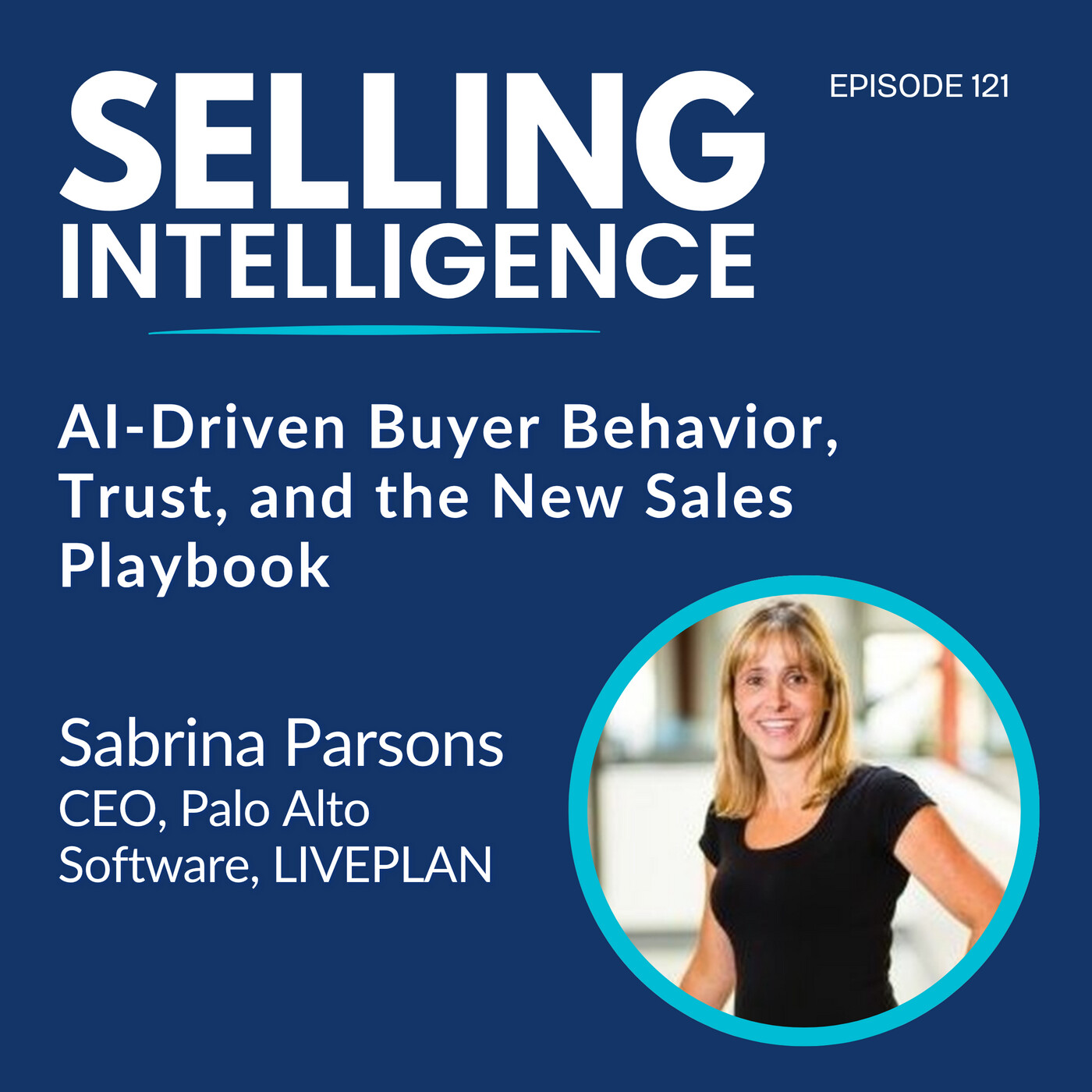
Ep. 121 - AI-Driven Buyer Behavior, Trust, and the New Sales Playbook with Sabrina Parsons - Part 2
Podcast: Selling Intelligence (formerly Selling the Cloud)Published On: Thu Apr 09 2026
Description: General Episode Description:In this continuation of Selling Intelligence, Mark Petruzzi and KK Anderson sit down with Sabrina Parsons, CEO of Palo Alto Software, to explore the human side of leadership, trust, and AI adoption in today’s rapidly evolving business landscape.Sabrina shares her perspective on diversity in leadership, the realities of building a career as a working parent, and why creating an “integrated life” leads to stronger teams and better business outcomes. The conversation also dives into how trust has become the ultimate differentiator in an AI-driven world, and how companies must rethink how they show up as human, credible, and authentic.The episode closes with practical insights on how leaders should approach AI, where it delivers real value, and how to use it as a tool for thinking, not replacing human judgment. What You’ll Learn:Diversity as a Competitive Advantage: Why different perspectives lead to better decisions and stronger organizations.The Integrated Life Approach: How flexibility and trust improve retention, loyalty, and performance.Human Trust in an AI World: Why authenticity and real human interaction are becoming the new moat.Practical AI Usage: How to use AI for preparation, critique, and efficiency without losing credibility.Leading Through AI Disruption: How leaders can guide teams to experiment with AI while setting the right guardrails.Key Topics:The impact of diversity and inclusion on business performanceSupporting working parents and creating flexible, human-centered workplacesThe myth of “doing it all” and redefining success in leadershipWhy trust is harder to earn in a world of AI-generated contentReal vs artificial experiences in customer interactionsThe role of influencer trust and community platforms like RedditUsing real people and authentic content to build credibilityWhere AI overpromises and where it delivers real efficiencyAI as a tool for critique, feedback, and preparationUnderstanding how LLMs perceive your product and brand through consensus signalsThe shift from SEO authority to AI-driven consensus and reputationGuest Spotlight: Sabrina ParsonsSabrina Parsons is the CEO of Palo Alto Software, makers of LivePlan, and a leader with deep experience across sales, marketing, and executive leadership. She is a strong advocate for women in leadership and brings a unique perspective on building resilient organizations, fostering trust, and navigating multiple waves of technological change. Resources & Mentions:Palo Alto SoftwareLivePlanConcept: AI trust gap and authenticity in digital interactionsConcept: Integrated life vs traditional work-life balanceConcept: Consensus-driven reputation in AI search and LLMsBook: Into Thin Air by Jon KrakauerBook: Superintelligence by Nick Bostrom🎧 Listen now and follow Selling Intelligence for more insights on leadership, AI adoption, and building trust in modern go-to-market teams.Mark Petruzzi (00:31)So Sabrina, you're a strong advocate for women in sales and leadership. In your experience, what do women bring to the sales equation that often gets undervalued? And what does the data actually show?Sabrina Parsons (00:43)Yeah, that's a great question. I think that we've, well, hopefully people have, there's been a lot of data over the years that just shows a few things, I know these days, you know, talking about diversity is, you know, a hot topic and not something everybody wants to hear. But if you actually go and look at the data,Any time you're bringing different viewpoints in, it actually turns out the data shows that that's really good for an organization. That when you have six people who all come from the same background, who went, you know, got similar educations, have the same experiences, you're missing out. You're not getting some of these other alternate viewpoints that...could actually give you different insights and make your company better. So from that perspective, be it women or people of color, people from different cultural backgrounds, every time you have different people in a room, you're gonna win because they're gonna bring different information to the table. And then I think that, you know.Even though it's 2026 and I wish we were in a different place with women in leadership, the reality is that we still live in a world where, you know, there aren't as many women in technology. ⁓ And the numbers just show that and there aren't as many women in technology and leadership. And so women who are there and have made it all the way through, particularly in a leadership role, have probably worked really hard to get there.and probably have some really good insights. From my perspective, one of the things that I think is most powerful and I think can bring a lot of value to a company is recognizing particularly working moms and working parents, but as a working mom, I'm not a working dad, so I won't talk for working dads, thatYou know, there's a lot of very motivated, super smart women who want to work for a place. They don't want to have to jump from job to job to job. And if you can give them an opportunity to stay in one place, to continue to move up, if you can be the kind of boss that recognizes that there's going to be some peaks and valleys that a woman with young kids might have someissues with my kid is sick, my kid is going to the doctor, but at the end of the day, if you help them with flexibility, not making their job easier, not giving them less job, but giving them the ability to be flexible and do their job when they can, you're actually going to retain women longer. They're going to be more loyal. if, you know, loyalty and retention, we all know is, you know,There's nothing better for your bottom line, particularly in software and tech sales where people are your biggest asset.KK Anderson (03:36)You preach into the choir. Could not agree, could not agree more. I would love to hear about some of your, know, pursuits with women in sales and leadership and would love to, AGS would love to support you in those as well. Really cool.Sabrina Parsons (03:38)Thank you.Mark Petruzzi (03:47)forSabrina Parsons (03:48)you. I appreciate that. it's been a really, it's interesting. I think when Mark and I first caught up prior to the podcast, we talked about it a little bit, but being a Gen Xer and having grown up in the 80s and early 90s, I am of the generation that watchedthe women's lib movement, And watched all these really strong women come out of the 70s and early 80s, the Gloria Steinmans, This very powerful.movement and we were kind of fed this idea that like you can do it all women can be super women and you can do it all and I bought it I was like I am gonna be superwoman I am gonna do it all and didn't really think anything of it until I had my first child and that's when like the brakes come on and you're like wait what what does this actually mean?And you know, just this reality that like, wait a minute, this is a myth. Like you can't do it all, right? And there's a reason why very successful men were never expected to do it all. And yet we still have this place in 2026 where there's still a lot of judgment with women as mothers, like, you know,Why aren't you there at drop off? Why aren't you there at pick up? Somehow you're a bad mother and all these kind of, know, guilt woven into, you know, being this working parent and how do you deal with it? And what does that mean? And as I had one child and then two and then my third as I was running the business for me really understanding that myKK Anderson (05:14)Guilts.Sabrina Parsons (05:32)take on this, my approach is very much about leaning into who I am, not leaning into the structure that exists today, which I think a lot of us were still being told even 10 years ago when Sheryl Sandberg came out with her lean in ⁓ kind of autobiography, it was all about leaning into the current structure, right? It wasn't, wait a minute, does that actually work? And for,KK Anderson (05:54)Mm-hmm.Sabrina Parsons (05:59)from for me what's worked and what I like to mentor and what I like to, you know, really.do here at Palo Alto Software is to say that doesn't work and I have what I call an integrated life and my kids are older now and I've got two in college but when they were little that meant bringing kids on business trips with me and my mom would come with me. That meant kids in the office after school or on a snow day. It meant having appropriate places in the office.so that they could have coloring books and homework areas. you know, I mean, we often laugh because we have a very old, ⁓ I think it's a Nintendo PlayStation, but it's a very old one. I don't even know if it's called a PlayStation, but it's a very old one where it isn't actually wireless. The console that the game console, like the player that the kids, the controller that the kids play with is actually plugged into the gaming.console. Well, kids love the old thing ever when they come in. but they always break it because they keep unplugging the controllers because they're like they're charged. And it's like, no, these are old school. And they don't even get that, which is always funny. I mean, from my perspective, that's what I've done for myself and for people here in the company is to say,KK Anderson (06:57)NowSuper Mario Brothers.Mark Petruzzi (07:11)HahahaSabrina Parsons (07:20)I'm not going to pretend you don't have kids. I'm not going to make you apologize for having kids. I'm also not going to pretend that if you've got a kid who's sick, that you're actually going to be at the office doing any sort of productive work because I made you come in. Like, okay, you can come in and you're not going to like me and you're not going to be productive and you're going to be worried about your kid. And so why don't we treat people like humans and say, you know what, your kid is sick, go home.Because if I do that, that person is going to work harder for me and be more loyal and be happy. And if you're happy, you're more creative and you're more innovative.KK Anderson (07:58)You know, in a weird way, like it's like a, whole world is coming full circle and our, our humanness, even in this AI world, mean, specifically there are humaneness is now our uniqueness. No, which is wild. And, and so, you know, kind of going back to that, how sales and marketing teams are using AI, you know, it can.You know, we've all seen it simulate preparation and personalization. mean, we were on vacation last week and we took a family picture of the four of us, my husband and my two kids and myself. And we're sitting at a table and there were, you know, dirty dishes in front of us. And my husband just, and his AI, and next thing you know, there's no dirty dishes in front of us. Right? And then, you know, I sent the picture to my mom.Mark Petruzzi (08:40)Ha ha.KK Anderson (08:44)And she was like, that's so great, whatever. And then my husband goes and sends it right back and we're all in like, you know, he's wearing a tuxedo and I'm wearing a ball gown and whatever. He's like, you didn't get invited to the wedding? And you're like, just making it like in five seconds, what? Right? And so, you know, we see that AI can simulate all of these things, right? And there's just, you know, the sky is the limit, the videos, the empathy, the personalization, that it's hard to know. So like,And building off the conversation that we were just having around women in particular, like is, is humaneness like the new moat? that what, you know, what's your perspective on that?Sabrina Parsons (09:18)I mean, that's a great question. I think it is. I mean, it's been interesting too, because not only is it trying to figure out how do you integrate AI into how your employees are using it so that they're using it appropriately and it doesn't come out like all of our communications are robots, right? So like the humanness of interactions. One of the things we do is right now we don't have chat bots. It's all real people.And it's all real people that we employ here in our headquarters. They're not outsourced because of that ability to say we are humans and real people. We're not just bots. ⁓ I think that's really important. I think that the trust that people need, I think they always needed trust, but it was easier to get their trust. And now it's like, because we've all seen,pictures that are different. We've all seen videos that are AI. We've all seen essays that are written with purely AI. I think there's that constant question, is this real? Are you a human? Is this true? And so anything that you can do to help alleviate that fear of what's a fact and what's not a fact.Right? Even now, like we talk about it a lot, like when you think about Instagram and you're scrolling through, most of us have probably made the mistake of that product that you're like, this is awesome. It's just for me. And then you order it and you know, it was supposed to be like a dress that fits me and it's a dress that fits a doll. You've heard all these stories. So I think all of us now know, like you don't trust that on Instagram.Right. This is why influencer marketing is so big because you do trust the person, right? You don't trust the company and the random product. You do trust the person. And so I think that's where we're back. Like, and how do you do that beyond influencer marketing? Right. Why is Reddit such a huge resource for people?KK Anderson (11:01)trust that person.Sabrina Parsons (11:13)because people perceive that Reddit is moderated, that people get kicked out of Reddit if they're bad and they do bad things. And so somehow, at least at this point, people trust that it's real people on Reddit. That's why people go to Reddit.KK Anderson (11:27)And so how are you using that specifically within your team?Sabrina Parsons (11:29)youwe, I mean, first of all, it's changing all the time, but, you know, we really try to emphasize in a lot of our educational videos, we use, you know, I'm in a lot of them, real people at the company, people that, you know, we have personalities. we've just recently even started to put out some blooper videos so people can see us as real people that we aren't just AI bots.KK Anderson (11:54)and not the radio.Mark Petruzzi (11:56)Yeah.Sabrina Parsons (11:57)And really leaning into, you know, the way that we have all figured out how we trust things. And I think that's really important when you think about and work with sales teams is to really get people to reflect like you're out there, you're a consumer, you know the things that you won't trust. You know the things that are kind of that gray material you're not sure. And you know the things that you do trust. And so,the more that you can get your own employees to embrace their own experiences and bring those, I think that brings a lot of value.Mark Petruzzi (12:30)Well, Sabrina, we should really put out some selling intelligence bloopers because there's been some big ones over the years, but probably more me than anyone else. So maybe I'll hold back on that one. Never blooper. All right, let's move into our final topic, leading through this world that we live in today that is just rife with...KK Anderson (12:42)No.Never, never been a blooper.Mark Petruzzi (12:57)AI disruption everywhere. So as CEO, you're managing AI disruption on two fronts, inside your business and in the general market as a whole. Where have you found real efficiency gains and where has AI disappointed you or just over-promised along the way?Sabrina Parsons (13:15)that's a great question. I mean, I feel like AI is constantly ⁓ over-promising. I think that's a constant of like, you know, always thinking and I think everybody else thinking how much AI can actually do. It's been an interesting thread because I have two kids in college right now and working with them for them. So my oldest is a senior, AI did not exist when he was in high school.Mark Petruzzi (13:20)HaSabrina Parsons (13:39)and didn't even exist the first two years that he was in college. It's really just been the last two years. ⁓ And kind of working with him on how do you use it? What's the appropriate use? How is it beneficial to how you study? How is it not beneficial?KK Anderson (13:42)tomorrow.Sabrina Parsons (14:01)He's in a situation where he knows people where entire classes have been caught for AI and how do professors have to rethink things. So I bring it up because I think it's important for us to see as people are coming out of college what their experiences are going to be. So you're back to Blue Book essays in colleges right now.But it's all kinds of issues, right? Kids can't even write because they've been on computers for so long. no one did. Like, if you want to puzzle, you know, a Gen Z person, write something in cursive. Like, it's like code. Yes, they didn't learn cursive. They don't.KK Anderson (14:28)Well, my kids never learned cursive.Sabrina Parsons (14:40)They don't actually, they can't write very quickly or write very well. And so that's been an interesting experience.KK Anderson (14:47)line that's gonna show up under the blue book and say, you stop.Sabrina Parsons (14:49)exactly. So I think that's an interesting thing to think about as you think about where, you know, how people are going to be coming into the workforce and some expectations. The fact that people find that like, if you've written it down, it's somehow authentic and right, which is an interesting idea. But yeah, I mean, I think for me, as we look at these AI challenges, thebiggest thing and what I tell employees and what I tell my kids is you actually just have to be using it all the time and constantly challenging yourself on was that the right use? Did I get what I needed out of that or did it lead me astray? And if it did, why? And maybe that's not the right use for it. You know, so like learning where those guardrails are today and then being open to the fact thatthose guardrails will probably change in two months. And so very much encouraging everybody to not be afraid of it, experience it, but with your eyes wide open.KK Anderson (15:48)one of the things that, one of the ways I love to use AI is just asking it to poke holes in my proposals and in my approach. if you're a CFO or a board member looking at this proposal, tell me all of the ways that it sucks, quite frankly, right? And then just making it bulletproof from there.Sabrina Parsons (16:06)that's, mean, it's one of the ⁓ ways that I've really worked with both my college kids using AI appropriately and not writing their essays for them, but to actually say, hey, this is like a one-on-one tutor who can give you critical feedback.on your essay, in the past this would be like if I paid for a writing tutor to like read your papers and give you feedback, this is how you should use AI. You don't want to use AI to write your paper because you're going to get caught and then when you have to do the blue book you're not going to know it, but it can be used to give you that critical feedback and I think within your company as well, right?Mark Petruzzi (16:34)Mm-hmm.Sabrina Parsons (16:49)Don't have it write your proposals, have it critique it. Don't have it write all your emails, have it help you theme them or schedule them or those things that take a lot of time but don't necessarily need the human element.KK Anderson (17:04)And so what would you do to kind of build off of that? Like what would you say to a founder or a CRO who's listening right now? What would be the first thing you would do to change how they're selling or approaching sales right now using AI?Sabrina Parsons (17:19)Whoa, there's so many things. You know, I think that really living in all the LLMs to see how the LLMs are perceiving your product. I think it's really important because people are going to LLMs to research. And so how is your product being portrayed? How's it coming up?KK Anderson (17:35)Uh-huh.Sabrina Parsons (17:43)If you don't know that, then that's a problem. And a lot of times people don't realize and that is really important. You need to be, and there's tools that can help you ⁓ kind of gauge that and see how many times am I showing up? Is it in positive ways? Is it in negative ways? ⁓ LLMs are referencing different kind of data. It used to be that, you know,the way you showed up and the way customers found you had to do with your search engine optimization. And while there was always all this kind of behind the scenes, Google's not going to tell you if you were really an SEO expert. You knew. And there was the next Google release. And people kind of knew what they had to do to appear in the right places.and Google would assign page ranks and they would say, that HubSpot is great at this, they are the expert. Well, that's gone now. The way that now, know, truth is assigned is through consensus. It's not because we've chosen one thing and said that's the expert piece, it's through consensus. So the LLMs are going out there and seeing.How are people talking about you on Reddit? Where are your reviews? What are they saying? What are the common threads? And they're finding that consensus. And then that's how they're figuring out which solution to recommend. And so I would say that's the number one thing is really understand how are you being portrayed when people are looking and asking questions. And then keep doing that because it's going to continue to change.KK Anderson (19:21)and then use AI to get you into more places. Right, yeah. So Mark, what do you think? Do you wanna take us to rapid fire?Sabrina Parsons (19:24)Exactly.Mark Petruzzi (19:28)Sure, let's kick it off. Perfect. So Sabrina, thanks for all these great observations. So RapidFire goes right into first thing you have ever sold.Sabrina Parsons (19:37)I was thinking about that, I was like, oh wow, was it like a literal lemonade stand, which I think it was. But I thought what I really talk about was when I was in high school, my junior and senior year, I worked at a yogurt shop in Palo Alto right across the street from Stanford campus. And...I actually became at the ripe old age of 17 the manager of the yogurt shop because it was run by two Stanford MBAs, one of whom her dad had bought her the yogurt shop.that she could have experience while she was an MBA and she really didn't want to do it. And so I ended up being like the manager of the yogurt shop doing all of the decisions of like, what are the flavors? Which ones do we put next to each other? Understanding like, if I put these two flavors together next to each other, we sell more. And then at the end of the day, I don't have to clean the machines in the same way and it's better for me.KK Anderson (20:24)the house.Sabrina Parsons (20:36)Europe.KK Anderson (20:36)You're leaningon that experience every day,Mark Petruzzi (20:39)Well, Sabrina, have, I mean, think about that. You were destined to be a CEO because you had two Stanford MBAs tell you you were management material at 17 years old. It's awesome.KK Anderson (20:50)HahahaSabrina Parsons (20:52)Well,I think it was by default more than else, but I definitely took it and ran with it.Mark Petruzzi (20:56)HahaKK Anderson (20:58)If youwere like, I'm going to Princeton. A leader, you know, a leader or communicator that you admire.Sabrina Parsons (21:00)I'm sorry.right, I thought about it a lot and I feel like right now I have to say I love Eileen Gough. If you watch the Winter Olympics at all, ⁓ you know, this phenomenal athlete woman and her leadership and her ability to talk to the press about her experiences.She was embroiled in some controversies because she was raised in the Bay Area, a Chinese immigrant mom, and at these Olympics she decided to compete for China. Very smart, very well-spoken, crazy accomplished athlete who had to deal with a lot of questions that I think women often have to deal with. They're in this place where you're like, she's like the most decorated freestyle.Olympian and you're going to ask her these questions and I just I love how quickly she responds, how she doesn't apologize, how hard she works. Yeah, so for right now I'm going to say Eileen Gough because I think she's earned it.Mark Petruzzi (22:08)Very cool. So one practice every sales leader should adopt this quarter or even better that today.Sabrina Parsons (22:14)One practice, I would say just embrace AI, all of it. Do not be afraid of it, embrace it, figure out all the places you can be using it because it is the future and the more you know, you're gonna have an advantage.KK Anderson (22:29)It's like the, you you can just see the lower third, the more you know, dot, dot, dot, right? my favorite question, advice that you would give to your 21 year old self.Sabrina Parsons (22:34)Exactly.You know, I think I would go back to that, my 21 year old self to say, you don't have to do it all and that's okay. That you actually can think about what you love and focus in on it and you don't have to be everything for everyone. ⁓ That's what I would tell myself back then.Mark Petruzzi (23:01)and your favorite.Sabrina Parsons (23:02)It would have reducedstress in my late 20s and early 30s, I think.Mark Petruzzi (23:06)for sure, your favorite non-business book.Sabrina Parsons (23:09)I do a lot of reading. was really trying to think about, because it depends on when you ask me, but I think I will go back to, I love Into Thin Air. I love that book. I'm an avid outdoors person, do a lot of backpacking and skiing and mountain biking and.water sports and ⁓ I'm fascinated by the story by people who climb Everest, but I'm also fascinated by the decision making and how this whole disaster on Everest actually happened. ⁓ It's just, and it's such a well-written story.KK Anderson (23:49)definitely we need it.Mark Petruzzi (23:50)Yes, andSabrina and I bonded right from our first discussions on rowing as well. we both had children who were rowers and ⁓ we both had done some rowing over the years as well. I love it. And hopefully you get out on the water more often than I do, because I just seem to always be ⁓ on a rowing machine, not an actualSabrina Parsons (24:15)Yo!KK Anderson (24:15)say onMark Petruzzi (24:15)well, that's for sure. I'm going to start rowing on our podcast. That's what I'm going to do to get a little bit of multitasking in. So Sabrina, thanks so much for taking the time with us today. Thank you just for all your great observations and your insights. Thank you, KK, and thank you to our wonderful audience for being with us here every week.You are all amazing.Sabrina Parsons (24:38)Thank you guys, this has been lots of fun.KK Anderson (24:40)It's a lot of fun. Thank you, Sabrina.See Privacy Policy at https://art19.com/privacy and California Privacy Notice at https://art19.com/privacy#do-not-sell-my-info.
The note was deleted
The note was saved
Your message was sent