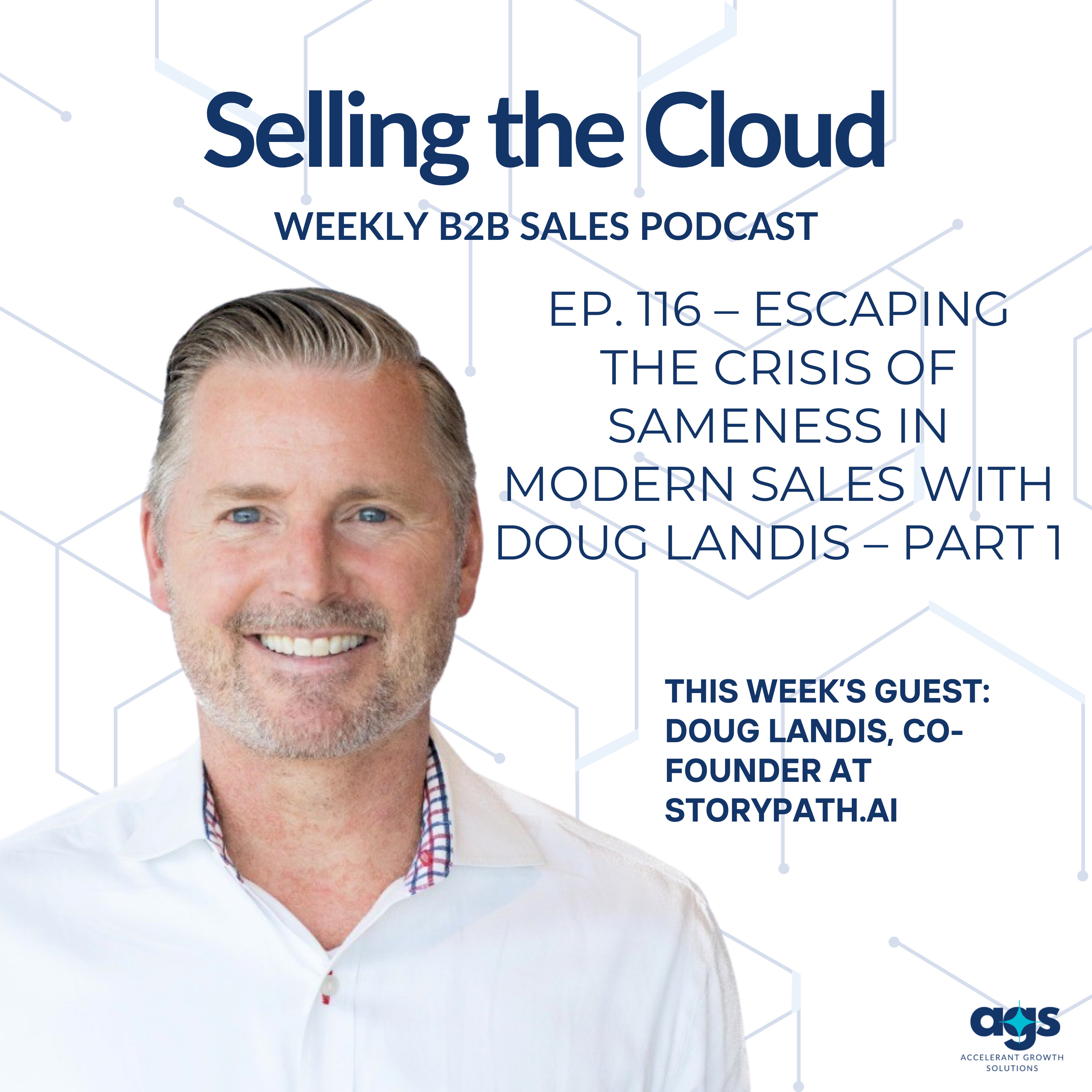
Ep. 116 – Escaping the Crisis of Sameness in Modern Sales with Doug Landis – Part 1
Podcast: Selling Intelligence (formerly Selling the Cloud)Published On: Tue Mar 03 2026
Description: In this episode of Selling the Cloud, Mark Petruzzi and KK Anderson sit down with Doug Landis, Co-Founder of StoryPath.ai and host of Sales Stories, to unpack how AI is reshaping the buyer seller relationship and why most sales teams are still playing by outdated rules.Doug shares why AI has enhanced the buyer’s world more than the seller’s, what he calls the invisible evaluation, and how today’s buyers are 80 to 90 percent through their decision process before ever speaking to a rep.The conversation dives deep into the crisis of sameness in modern sales, why traditional discovery no longer works, and how trust and story have become the last true differentiators in a crowded market.If you are leading a sales team, building a pipeline, or navigating complex enterprise deals, this episode will challenge how you think about first meetings, process, and positioning in an AI driven world.What You’ll Learn:AI and the Buyer Shift: Why 89 percent of B2B buyers are using generative AI and how 83 percent of the journey now happens without a seller.The Invisible Evaluation: How buyers are researching, comparing, and shortlisting vendors without leaving digital breadcrumbs.The Crisis of Sameness: Why AI tools are causing sellers to sound identical and how that kills differentiation.First Meeting Reimagined: How to show up with a hypothesis, point of view, and buyer language instead of running outdated discovery scripts.Trust and Story as Strategy: Why storytelling is not case studies and how narrative builds alignment across large buying committees.CEO of the Territory: Why modern reps must think like business leaders, not process followers.Key Topics:AI’s impact on B2B buying behaviorRethinking the traditional sales processDiscovery versus hypothesis led sellingBuilding trust through empathy and buyer ontologyStory as a tool for alignment and influenceCoaching sales teams in a new paradigmDifferentiation in enterprise SaaS and AI marketsGuest Spotlight: Doug LandisDoug Landis is Co-Founder of StoryPath.ai, an AI native guided selling and storytelling platform designed to help sellers show up with differentiated perspectives, not just better automation. He previously led global sales productivity at Salesforce, served as Chief Storyteller at Box, and was a growth partner at Emergence Capital.Doug is also the host of Sales Stories and a long time advocate for trust based, story driven enterprise selling.🎧 Listen now and follow Selling the Cloud for more insights on modern go to market strategy, enterprise sales, and how to win in a one shot world.Mark Petruzzi (00:34)Welcome to Selling the Cloud. Our guest today is Doug Landis. We're very fortunate to have Doug, who is the co-founder of StoryPath.ai, host of the Sales Stories podcast. He's a storyteller and he's just successfully built early stage companies time and time again. Doug has led global sales productivity at Salesforce.He served as the chief storyteller at Box and spent seven years as a growth partner at Emergence Capital, helping SaaS companies scale smarter. He has sold everything from newspapers and ice cream to enterprise databases and cloud software. Today, he's really focused on and really enjoying building up StoryPath.ai.StoryPath is an AI native guided selling and storytelling platform that helps sellers show up with differentiated perspective, not just better automation. Three topics we'll cover today. How AI has changed buying behavior more than selling behavior. Why trust and story are the only real differentiators left. And how sellers can compare differently and win in a one shot world.Doug, we're so fortunate, as I said, to have you here, and welcome to Selling the Cloud.Doug Landis (01:50)Thank you. So great to be back. That was all I think I was on a long time ago. I don't even remember what we were talking about back then. And you know, it's interesting as you were doing the, you're going through the intro, I was thinking, I was like, well, given the fact that it feels like everything's shifting to be AI native AI first, everything's all AI. Just does the podcast shift to like selling AI instead of selling the cloud?Mark Petruzzi (01:53)Be back.Doug Landis (02:14)By the way, not yet. Just for a little side note, was on a webinar with about 250 operational leaders, sales and rev ops leaders. And I asked the question, Mike, what percentage on average of your entire go-to-market tech stack is still pure SaaS versus AI? And the answer was at least 85 % of their stack was still pure SaaS. So while we say everything is moving AI and it's moving fast, really fast.There's still so much that's already like fully baked in. so now everyone's been trying to figure out like, how do we actually, make it additive instead of completely rip and replace. But anyway, so the pod selling the cloud is still relevant for awhile.Mark Petruzzi (02:52)Yes and no, we're actually working on exactly that now, Doug. So you're hitting us right at the...KK Anderson (02:56)Your ears must have been burning, Dad, because we've been talking about aDoug Landis (02:57)really?sit in a space all the time like, hmm.Mark Petruzzi (03:01)No, no,you do, you actually put out these ideas without even saying it. Because I actually came up with this idea last night and shared it with KK. So I was waiting. you know, we'll talk more about that, Doug. And so maybe you influenced me without even knowing it. But there are things that are changing. There are things that we want to make sure our audience is changing with it.Doug Landis (03:10)No way, that's amazing.Mark Petruzzi (03:25)And it's just really, it's incredible to have you here and you keep getting smarter than even the last time we had you here. So we love it. a couple times you've said something that really stuck with us through your writing, through your podcast. It's all blurred to me because I've listened to all of it over time now.but that AI has enhanced the buyer's world more than the seller's. What do most sales teams misunderstand about what's happening right now? And how can they change their approaches and their processes to be able to really make sure that we are clicking and fitting with the new buyer's world that is out there?Doug Landis (04:06)Hmm.Such a great conversation to have. I love this. You know, when AI first hit the scene, I think everybody asked like, okay, what does this mean to me? What is this? How can I use this? And I think what the reality is for buyers and sellers, AI has dramatically changed how they engage with each other. The relationship between buyers and sellers is changing pretty dramatically. If you think about it for buyers, know, AI has actually become a real superpower for them.You know, they can aggregate data, they can run analysis, they can do things so much faster than ever before. They're just leveling up overnight. And so I'll share some statistics with you. think that are really, really important to understand how what's changing and shifting in this relationship. If you think about this, LLM traffic is projected to overtake traditional search by the end of 2026. So what that means is more than 50 % of your buyers are going straight to a chat bot to begin their buying journey.So think about that and why is that? And the reality is this as agents have gotten better, you know, it's really interesting is what they can do in minutes or hours is what it used to take buyers weeks and months. So the buying process used to be months long and now they can actually go through it in hours because what an agent is doing is an agent will actually look at their, they will form preferences.And they're going to do it in a way that like humans do. But what's crazy is the amount of information they can, they can analyze is stuff that buyers would normally think about over time. Things like, I don't know, think about the data points of like user reviews, right? Or community sentiment or tech, technical documentation or support quality or integration pricing, all of that. And agent can analyze all that in seconds. And a buyer would normally take, you know, weeks or months to go through that. So if you think about it,Statistically speaking, what is it? 89 % of B2B buyers are using gen AI in their purchasing process. The crazy thing is 83 % of the buyer's journey happens without a seller. So that means if a seller is only involved in 17 % of the buyer's activities, then sellers need to show up a little differently. They need to understand and almost anticipate the fact that the buyers are going through a buying process without them.We call this the invisible evaluation. They're evaluating solutions and they're evaluating ways to think about solving problems without any of us knowing. So if you think about like, we've all bought software, right? And so we normally would think about buying software, like maybe we'll go to a webinar, we'll go to a website, we'll talk to some people, we'll reach out to an SDR, we'll download a white paper. That is leaving signal. That's leaving breadcrumbs all over the internet. And solutions out there could pick up on that and be like, ⁓ hey,Doug is out exploring something to solve for forecasting. Awesome. I can reach out to him. can do some, you I can do some outbound now all that's happening in a chat bot and there are no more breadcrumbs. And so like how do sellers know how to marketers know how to brands know that their buyers are actually out there in market. It's really, really difficult. The problem is sellers show up.And I fundamentally think this is going to change the entire sales process. When you think about sales process, what do we think about the traditional sales process? We're going to take a buyer through like, you know, all these stages, discovery demo, you know, negotiation, more discovery, multi-threading, all of that buyer. like, no, I have two questions. I've whittled this down to three vendors. And when sellers try and go backwards, it's like, as a buyer, I'm, losing my mind.Mark Petruzzi (07:20)Doug, you, wow, would. And I'll tell you, I'd love to share a couple thoughts on that, that maybe can even, you know, maybe escalate us even a little more in some of this analysis. So I have been personally on a journey for about seven years where I have been telling all my clients, anyone who reads anything I put out that, you know,It's a different process. was a different process seven years ago even. At least that's when I figured out. Probably was five years before that. But with all the tools that were out there, buyers wanted to buy differently. And I was amazed that some of the best sales reps that I've ever worked with were not responding to that. Some of them were, and I've been able to turn teams of sales reps intointo really understanding the buyer journey and understanding that the seller journey means nothing in all And I'm so proud of what I've done with some clients, but I've seen some clients just not wanna go there. They just won't. That was seven years ago. Now you compound all this with AI and what you just described so articulately, there is like, it's all.whole new game. Like we almost have to get these sales leaders like bats that they can run around sort of hitting sales reps a little bit on the head and saying like, you have to believe now. It's so different. It's not even there's no resemblance. So it's incredible. But I love how you set that up. And I'd love to go deeper into what do we do with with that? And how do we getDoug Landis (08:44)Hahaha.KK Anderson (08:50)So.Mark Petruzzi (08:58)the most stubborn sales reps to understand that we're in a new paradigm.KK Anderson (09:03)Well, and Doug, before you answer that, let me just add on. let me add onto that. So the buyer motion has changed, but we still have to go, we still have to take them through the process of what I call running the bases, like in baseball, right? And you still have to go through this whole idea of what we call the two-cell.Doug Landis (09:05)Great question.Mark Petruzzi (09:05)It'sokay.KK Anderson (09:23)process, is like our sale is getting that buyer to articulate why they need to change. What is the problem they need to fix? And the second sale is why you and why now? And so if they're, when they're coming to you, and this I know is where something like Story Path is so incredibly powerful. We've seen it firsthand with our clients, but if you're getting to that first conversation and that buyer is like, dude, I already know this. I don't want to hear this, right?Like what are, what's your advice to the sales leaders out there who are working on this with their sales team? They still have to close that first sale. They still have to like make that psychological invisible sale happen. Talk me through like, what does all this mean?Doug Landis (10:00)Well, look, I mean, why change? Why now? Why us or why change? Why us? Why now? The whatever flow you use is still relevant, 100 % relevant. The difference is sellers need to show up anticipating the fact that buyers have already been thinking about this. And so instead of going through the traditional discovery questions, which is, you know, kind of a Spanish inquisition of stupid questions, it's like, I need to like, let's just call a timeout. My hunch is you've already analyzedYou've already deeply understand the problem you're trying to solve. You've already analyzed all the different options out there. You've done all the analysis if you're a modern buyer like most of the buyers that I'm speaking to. So the first question is, since you've already done that, you probably have a pretty good idea why changing right now, why changing from what you're currently doing might make sense. I have a hypothesis about it. I'd love to share that with you, but I'm curious as to as if you've actually gotten to that point already.KK Anderson (10:51)So the upfront contract, the way you set it up.Doug Landis (10:52)Interesting, right? It's likeRight. It's all, it's all how you set it up. It's like, if I anticipate the fact that they've already done this and they've got a pretty good understanding as to why change might make sense. Awesome. Let's have that discussion. I've got a perspective about it because I talked to other people just like you all the time. And I'd be happy to share that. ⁓ but I also want to know if you're, if you've already done the analysis and you're already there because most of the buyers I talked to you already have. Right. SoIt's almost like, it's almost like kind of making an assumption. I'm not going to tell them that they've already done this, but I'm going to kind of, it's a little bit of assumption that's like, you know, if this is a big enough problem here and a hair on hair on problem that we continue to see, then my hunch is you've already done some around it.KK Anderson (11:32)Talk us through,I've heard you say this multiple times now, what you call the crisis of sameness.Doug Landis (11:37)Well, so unfortunately, the crisis is so on the seller side, we all thought like, AI is going to make us so much more productive, we're going to become superhuman sellers, right. And the reality is, sellers are all using the same, you know, custom GPT that they built, they're all using chat, GPT or gems, they're all using kind of their own internal data. And they're showing up with the same messaging, the same pitch, the same everything because they don't underbecause they haven't stopped and said, wait a minute, if my buyer's 80 % of the way through the buying process, if they already have a pretty good idea of why change, why changing might make sense and why it might make sense now versus waiting and what are kind of my best options. And if I take them through a standard pitch or use the same email kind of framing that everybody else is using, then I sound like just like everybody else. There's no differentiation. And I think that's one of the challenges. I literally was talking to an investor right before this call.And I was sharing this with him because this is kind of a part of our core thesis is as an organization is we've to get people away sellers away from sounding just like everybody else. And he was like, I literally have gotten 11 of the same emails in the last 24 hours. It's they look in, they look and feel the same. And so it's like, okay, if we're, if we're all kind of following the same playbook and we're using the same tooling,then how do we really start to differentiate? And I think the first thing is you got to first understand where your buyers are now. That's the very first step. The second for a seller to get out of this crisis of sameness is you got to start thinking about being different, you know, and we have a whole thesis on that. That's through trust and story.Mark Petruzzi (13:04)and you know what Doug and KK, I'm gonna ⁓ kind of bust this out, I think, to a whole level here with some of these thoughts. So, and this is why KK and I are so good together and why we're so impactful for our clients because we have these debates all the time. So I'm gonna bring one of our debates to this podcast. KK just described the four bases, like you've gotta go around the four bases and she's incredible.from a process standpoint, sales competency perspective, and I totally get the perspective. I kind of think it's gone to a different point here. And when I show up to a sales process, I kind of think of like I'm showing up to play baseball with the Savannah Bananas, that group that does all that goofy, crazy stuff, right?Doug Landis (13:51)Love that.Mark Petruzzi (13:51)So what I have to do is I first have to understand what are the rules today, like real quickly, not deep, but what are the rules that we're gonna go to to play this game? Let me do my research, let me learn how they played every other game they've ever had. Let me come in with that. And then I wanna see, are we even using bases? Or are we just hitting home runs and catching balls behind their back, whatever they do.Doug Landis (14:15)HaMark Petruzzi (14:16)So I think that's where we are here as well. And that's why I also feel like the concept of the sales rep being a CEO of their territory is real again. And we all watched over 10 years, 12 years, the last 10 years, 12 years, all the technology that sales leaders were putting in place.Doug Landis (14:30)Yeah.Mark Petruzzi (14:39)They then started to say, well, we don't really need people that could be the CEO of their territory. We're going to give them great process and great technology. And hey, it works. Worked. They were growing, especially in SaaS companies, super fast during this time. So I don't argue with the success. But before that, and I think now again, you need at least a subset of your sales team to have that level of intellect and curiosity.and really figure those things out. So I'll weave that together if you don't mind with a question, a more specific question. So if we think buyers are now 80, 90 % through their decision process before they even talk to a seller, how should it change how the rep shows up in a first meeting? And my hypothesis here is that a good one, right? Like you almost have to go in and figure out what gamenot to call this a game, but what are the rules of this process before you even jump in? And you gotta be smart enough to be able to figure that out, which also comes down to the talent management, making sure you have the right people and the right roles.Doug Landis (15:35)Yeah.Yep. it's interesting, you know, it's, would, I would argue what a seller needs to do in the first meeting and first conversation today is arguably the same that I've been touting for years, which is show up with a point of view, show up with a hypothesis, anticipate, try and anticipate where you think they might be might by the way, is a very important word because I'm a linguist at heart because you can't tell somebody where they are. If you come in and tell the buyer where they are, to be like,GFY, you don't know me. ⁓ think, wait, here's, I wanna actually address that, by the way, I love the of the metaphor of the Savannah banana baseball team versus traditional baseball in terms of the shift that's happening. I believe there's two parts actually going on. There's the operational piece of selling which still exists. We still need to understand where does procurement fit in this process.KK Anderson (16:19)Yeah.Doug Landis (16:31)What about security? What about legal review? We'd like, those are operational things that we need to do to get the deal done. Correct, right? We still need to do that. Also, people likely still need to see some sort of demo. They need to understand how this might look and feel and fit in their environment, right? They may conceptually understand the problem they're trying to solve and the options, but you know, they can do all that through these chatbots, but they also then need to look and feel and think more deeply about the integration and how the data flow and then...What kind of risks is this gonna create? So like there's, me, that's kind of the operational stuff of the process. And that's where I agree with KK and that like, there are still bases that we still have to, you know, touch, right, to get a deal done. However, I'm gonna put on my Savannah banana outfit and go like, the way I get to those bases might be a little different,I might, by the way, run to second and then go to third and then to first and then to home. I might go like high five the pitcher, right? Right? So, but here's the key. The key is in order for me to leave home, the home base in order to go to any base that makes the most sense. I have to show up with a perspective and a point of view and an understanding of where my buyer is. And I have to speak their language. I have to understand their ontology. I have to understandMark Petruzzi (17:20)There you go. Yep.Doug Landis (17:42)you know, who they sell to and what they're trying to accomplish with their customers. And that's the language that I need to speak. And if I just show up and I'm speaking my language and I'm asking my discovery questions and I'm putting all the pressure on the buyer to go answer my questions as a buyer, I don't want that interaction anymore. And guess what? I shouldn't have to have it. I shouldn't have to have it. Right. So, and so like,KK Anderson (18:03)Totally appreciate thatDoug Landis (18:06)I'm going to go into the conversation and say, like, let's just say, Mark, I'm trying to sell to you. I'd say, like, Mark, I have a hunch. My hunch is you're so sophisticated that you've already done an insane amount of analysis about the problems that you're currently trying to solve. Just a hunch. And that you've already kind of whittled this down, your selection down to maybe one, two, three different potential partners to work with. My hunch is you also have very specific questions that you haven't really wrapped your arms around yet.And the reality is those questions, that's kind of where I want to spend our time.Mark Petruzzi (18:35)And right after I gave you a big giant hug and said, wow, you get me, Doug, would then be like, yes, and Doug, here's what I need. I need to get X, Y, and Z done. And if we get those things done in a positive way, you got my business. And we're gonna do it really fast because you get me already, Doug. that.Doug Landis (18:35)How does that sound?Yeah. That's, mean, and, and, and, so this is, this is the new reality, right? And I think the challenge is both at a leadership level is we got to quit forcing reps to follow this process. And we also at the leadership level, we need to coach our reps to be able to show up with a really, really strong point of view and an understanding of how to speak our, our buyer's language and understand their ontology. The challenge is if I'm a rep and I have a territory and like, I'm the CEO of my territory, but my territory has like,50 different verticals, different kind of companies and different industries, I got a context switch and that's really hard. Instantly, I've got a series of meetings, I've got calls back to back because my BDR is crushing it and setting up meetings, which we know is really hard. But now I'm going from talking to somebody on oil and gas to manufacturing to retail. I'm like, ⁓ how do I do that? And so what's easier for me is to let me just go through my playbook, follow, ask my questions.KK Anderson (19:28)Mm-hmm.Doug Landis (19:47)do some validation, talk a little bit about us. ⁓ Unfortunately, it happens way too early. And then the buyer's like, all right, well, you sound just like everybody else. Cool.KK Anderson (19:58)Yep. So true. You, I you are articulating this so well. Really. It's incredible. the value hypothesis is critical and you know, well, I don't want, we, don't want to go too far into Story Path, but the very first time I logged into Story Path, the first question it asked me was, what is your value hypothesis? Who are you? What percent are you selling to? What challenge are they trying to solve? And why are they trying to solve it?Doug Landis (20:00)It's hardThank you.KK Anderson (20:20)right, so that you can know exactly kind of what your POV is. So let's move on to the second topic here about trust and story and how they help us win the deal. And so in this kind of world of sameness where we're flipping between industries and on back-to-back calls and we all sound the same, right, a lot of times we're reciting the same case studies, the same stories, and sometimesLike sometimes a salesperson will literally feel like a broken record because they say the same thing 100 times, right? And so, you you and I both know that that story is not just case studies. ⁓ Most case studies aren't even real stories. Like, let's be, let's be real, right? They've taken on a life of their own over time. And so, you know, talk to me about, about what it is.Tell me about why story is so important and how that helps build trust.in the firstDoug Landis (21:10)Well, I mean, look, here's the thing. think, well, there's two parts to this, right? So again, our core thesis is to really truly differentiate as a seller today. It's all about trust and story. Trust is understanding your buyer in a really, really deep way. I was about to use intimate, but that's weird. But like truly understanding your buyer,Mark Petruzzi (21:27)YouDoug Landis (21:29)having, putting yourself in their shoes, having the assumption that like, you know, Mark's already 80 % through the process. He's done the analysis. I understand your language and ontology. That's all going to build trust, right? And I can take that from the company level all the way down to the individual level. And we'll talk a little bit more about that. When I'm sharing back, when I'm communicating back with Mark as my buyer, I want to communicate back in a way that is easy for him to understand, a way that demonstrates some level of empathy, connection, right? Andeasy for him to internalize and turn around and go share with others. Because Mark is one of 17 people. If the deal is over $250,000, thanks to my friend Jen Allen, she just posted a whole bunch of stats. If a deal is over $250,000, there's like 17 buyers now involved in the process, or on the buying team. That's crazy. So guess what? Mark has to go talk to 16 other people and try and build alignment. Like is this a problem that is worth solving? Can we get everybody on the same page?If I just go, here's all the facts and stats about our product, here's what we do, here's how we do it, here's our case studies, Mark has to internalize all that and be like, all right, I'm gonna do the best I can to try and share this. However, what if you were to flip this? What if you were to reframe the way in which you orient the conversation and share a level of, here's what I think I understand and then.and weave that into a narrative, into a story that is a very short, very crisp, easy to digest for Mark, then guess what? I'm earning the next conversation. I'm earning a deeper relationship. I'm building that connection with empathy because story is how we naturally communicate. We can use facts and stats and data to back up the story.But when we just lead with all these statements, it's really difficult for us as listeners, as human beings to remember that. I mean, just think about school, multiple choice questions. At the end of a test, if you were to ask me like, do you remember that question? I'd be like, nope, blacked out. All right, the essays I remember.KK Anderson (23:23)So,love what you're saying, Doug, and I couldn't agree more. And where my head is going is are things like you're telling a day in the life story or a future state story or here's where you are now. Tell me a little bit more about when you'reDoug Landis (23:35)Totally.Bunch of different types. There's a bunch of different story types that you can actually tell. Yeah. Current state to future state. Look, at the end of the day, a story is really about from two. You're taking, you're trying to help somebody imagine going on a journey from somewhere to somewhere else. Right. It's either I'm taking from first base to second base or from first to third. I don't know. Right. So like, and so you can tell that from, from the experience of another customer that was similar and the journey that they went on.KK Anderson (23:50)first face to say and juggling balls behind your back.Doug Landis (24:03)You can tell that from the standpoint of like, hey, by the way, it could just also be like a, hey, Mark, we're just starting to get to know each other and starting to unpack like the connective tissue of this problem that we think might actually be bigger. So let's, let's, let's talk about the next conversation and talk about the story, about the flow of our, of our ongoing conversations. Cause I know there are 16 other people involved in this and how that might look and feel. There are a number of different stories that we can tell. Oftentimes telling a customer story is a really great way to demonstrate some level of credibility.The problem is, sorry marketers, I love you. Stop following the old school frameworks. Problem, solution, ROI. No characters, companies aren't characters. I don't know how to go tell that story, so what do I do? I say, well, yeah, know, Mark, this reminds me of conversation I was having with Cisco. They're like, okay, how is that even relevant? They're not even like, it's like apples and tree bark.Mark Petruzzi (24:36)Mm-hmm.Doug Landis (24:56)doesn't even connect. You know, it's like, oh, okay. And then I'm trying to draw some connected tissue, because that's the only story I remember. And again, take that territory where I've got 100 different industries. How do I remember stories, customer stories for every single industry? And so it's like, so there's a bunch of different stories you can tell, right? So how about tell your own personal story? Right? Your own personal aha story, because you understand if I understand Mark's world really well, I'd like, you know what, here was my experience.KK Anderson (25:00)Right.for the opportunity to ask questions.Doug Landis (25:21)You know, I've, I understand your problem that you're experiencing because I've actually had something similar. So maybe it's a personal story. Maybe it's a, you know, maybe there's a, you know, a why so, many stories live in the why not the what or the how. Right. So like, why did we decide to go? So, so for example, why did we, why as an organization, did we decide to tackle this particular problem? Why have we made it our mission to help people solve for this particular problem?KK Anderson (25:35)What do you mean by?Doug Landis (25:46)Why, why did I decide to come work for this company? I decided to come work for this company. started, decided to start Story Path because I fundamentally want to change the world of enterprise sales, period. Right? So like, guess what? I know Mark loves enterprise sales. He and I are aligned because this is what we both want to do. So like, I just told my own personal why story or I could tell my personal why story. And it's like, all of a sudden now we're building connection.Right? So there's, it's just a lot of different stories that we can tell in every conversation. I think there's a couple of things. One, we're not thoughtful enough to just take a minute and be like, what stories do I actually want to tell in this upcoming conversation? Just take a minute. Just think about that. How do I want to incorporate those stories in the conversation? Which one should I be ready, ready for? The problem is, is a lot of people just don't understand actually how to tell stories. and we haven't really helped them. Well, we are now as a company.I mean, at the end of the day, Story Path is the story company.See Privacy Policy at https://art19.com/privacy and California Privacy Notice at https://art19.com/privacy#do-not-sell-my-info.
The note was deleted
The note was saved
Your message was sent