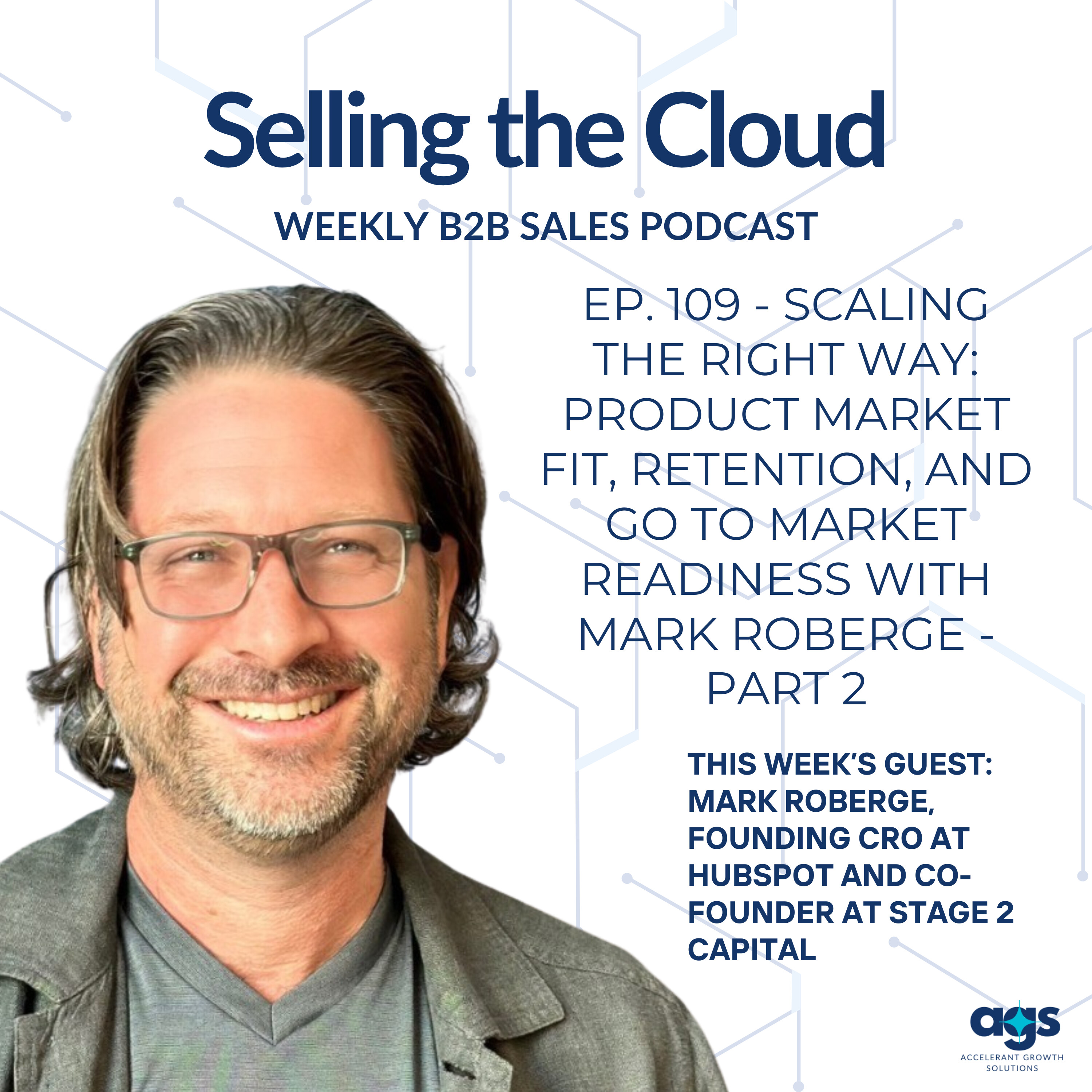
Ep. 109 - Scaling the Right Way: Product Market Fit, Retention, and Go to Market Readiness with Mark Roberge - Part 2
Podcast: Selling Intelligence (formerly Selling the Cloud)Published On: Tue Jan 13 2026
Description: In Part 2 of this Selling the Cloud conversation, Mark Roberge joins KK Anderson and Mark Petruzzi to go deeper into what happens after product market fit is achieved and why going too fast too early can quietly break a business.Mark breaks down the transition from product market fit to go to market fit, explaining why these stages must be earned in sequence, not pursued in parallel. He outlines what real go to market readiness looks like, how to design a buyer centric sales system, and why retention and unit economics are the true signals of readiness to scale.The discussion also tackles sales process design, hiring profiles by stage, and the common mistakes founders make when front loading headcount after a fundraise. Mark closes by sharing a disciplined pacing model for growth and why predictable scaling beats vanity growth every time.What You’ll Learn:• Why product market fit must be proven before optimizing go to market execution• How retention serves as the strongest signal of long term product market fit• What defines go to market fit beyond revenue growth alone• The core components of a buyer centric go to market system• How to build a sales process that mirrors the buyer journey• The difference between discovery driven selling and pitch driven selling• How sales hiring profiles should change across product market fit, go to market fit, and growth stages• Why aggressive headcount expansion often leads to future layoffs• How pacing hiring and spend creates predictable and durable growthKey Topics:• Product market fit versus go to market fit• Retention as a leading indicator of success• Founder selling and unscalable early motions• Go to market system design• Ideal customer profile and buyer journey alignment• Discovery, qualification, and modern selling principles• Sales hiring by company stage• Scaling headcount responsibly• Unit economics and growth pacing modelsGuest Spotlight: Mark RobergeMark Roberge is the founding CRO of HubSpot, where he helped scale the company from zero to IPO. He is a Senior Lecturer at Harvard Business School, co-founder and managing partner at Stage 2 Capital, and author of the bestselling book The Sales Acceleration Formula. His latest book, The Science of Scaling, distills decades of research into a practical, stage specific roadmap for sustainable growth.Resources & Mentions:• Book: The Science of Scaling by Mark Roberge• Book: The Sales Acceleration Formula• Organization supported: McLean Hospital• Opportunity to download the first chapter via Mark’s website• Pre order The Science of Scaling with proceeds supporting mental health research🎧 Listen now and follow Selling the Cloud for more insights on building durable go to market engines and scaling the right way.Mark (00:31)I do wanna go deeper into the topic three here, go to market fit. Before I do that, Mark, is there anything you definitely just wanna cover?in addition to what we did already on product market fit. If not, I've got another question for you.Mark Roberge (00:44)Not at all. Like so far we have is like, you need to try product market fit first. We're quantifying that as retention in the long term and defining a lead indicator retention in the short term. And we created a framework for that. And the famous Paul Graham says, the founder of Y Combinator says, do unscalable things early. We're not worried about a scalable demand gen channel, a scalable sales process. We're doing founder selling. I don't even need to optimize price at this point. And I prefer to pay my salespeople with equity and not industry commission. Let's just get to success.KK Anderson (01:06)I mean, stop it.Mark Roberge (01:12)Once we have that, we move to go to market fit. We can't do them at the same time because you risk optimizing the go to market on the run market. If you don't prove product market fit first, but we moved to go to market fit and that just tells us that we can create this value profitably as measured by unit economics. And this is the stage where optimal quota price, demand, gen channel and sales process come into play. That's where we're at right now.Mark (01:32)Yeah, right on. Okay, topic three. So go to MarketFit. We want to go deeper into the process, the hiring, the demand, the pricing side, the compensation side. This is where I think a company gets to run and increase their productivity the fastest of any other stage. So you define go to MarketFit as generating customer success and revenue consistently and profitably.Starting with process, so starting with process, what should a codified repeatable sales process include at this stage? And where is the line between useful structure and a little bit of bureaucracy that slows deals at the end of the day?Mark Roberge (02:12)yeah, sure.Okay. Framing out one step. talk for a decade now around the go-to-market system design. This is what we teach at Harvard Business School. And so trying to move away from sales is just an art form. Let's give our salespeople a bunch of leads and let them do what they do best and go close business. Now, like we have a system for our finances. We have a system for our product development. We need a system for our go-to-market. So we call this go-to-market system design.The go-to-market system sits on top of obviously your first target market, your ICP, ideal customer profile. On top of that is a definition of how those buyers buy, the buyer journey. And on top of that is your sales process, which just helps them buy. There's two inputs to the system, the salespeople you hire and the demand that you create. And then the system runs by how you coach and pay them. And it spits out in sequence, sales activities like meetings and demos that lead toa forecast that lead to revenue. That's the system. And so within that system, Mark is a process. So it depends where you're like, at the very bottom is the ideal customer profile, which we can talk about. It's just really who we've proven to be able to sell successfully and make them successful. And so I mentioned like on top of that is a buyer journey. This is a part that's often skipped in sales process development. I think founders think that their sales process is a pitch deck.think like a good meeting is like, I went to the meeting and I got through all 27 of my slides about the problem I'm solving and how my product works and the awesome case studies we have. It went great. And there's a million studies that we know that shows that that is suboptimal selling. I can't find a study that says it's good. We know that in the first meeting, the less that the seller the better. And so what's happening in there isYou're qualifying and discovering. You're discovering what the buyer perceives as their biggest problems and how they're thinking about it before you tell them about your product. And you're qualifying to see if you can make them successful, if they're in a position to buy your product and be successful with it. That's our objective. And we can't do that unless we understand a buyer journey. So the buyer journey is really just like sequentially how the buyer comes to terms with purchasing your product.They don't wake up one day and be like, where's that contract? need to buy that product. They wake up one day saying, I have a major problem. And that's their first stage is it's just like the awareness stage is like, is this a problem? Is it a big problem? Yeah, it is a big problem. Why is it a big problem? How do I think about this problem? How do I frame this problem? Then they start considering solutions. how do I fix this problem? Do I delegate it to someone on my team? Do I hire a consulting company?Do I buy a software product? And then once they've decided how they're going to solve it, they choose a solution. I'm going to delegate it to Mary. I'm going to hire a seller in the cloud. I'm going to like, you know, I'm going to buy this software product. Right? So like, no matter what you do as a seller, that's what they're going to do. So if we understand that and frame it in that way, and we look at our sales process, not as going out andMark (04:45)ThankMark Roberge (05:01)pitching the world on everything we've built. But instead going out and discovering how people are perceiving this problem and qualifying whether we can help them and help them make a good purchase, that's modern selling. That's buyer-centric selling. with that in mind, the components of your sales process is your ICP definition, it's your buyer journey, and then it's how you take that, how do you run that first meeting, which is often called the discovery guide.And then once you've done your discovery and qualification, whether that's in five minutes or five meetings, you usually move on to some sort of a presentation process on how you explain how we're a fit. ⁓ then once we're, you know, hopefully the outcome of that is a purchase and we get to a onboarding and customer realization process. like, you know, obviously within there is negotiating contracts. It's like, there's a lot of different steps, but those are generally the components of the sales methodology.KK Anderson (05:52)You are preaching from the AGS playbook the framework that we talk about a lot at AGS, we call it the two sale mentality, which is taking, I feel like I say this every single day actually, whether you're selling Girl Scout cookies or you're selling multimillion dollar software.Mark Roberge (05:56)Yes, exactly. KK. I figured.Mark (05:57)⁓KK Anderson (06:12)every sale is really like two distinct sales. And the first one is getting the customer to articulate why they need to change. And it has nothing to do with what you're trying to sell. It is why, this is a problem, why is it expensive? why getting that and getting them to say it right. And the second sale is why you and why now. And, and one of the things that we do a lot of our competency assessments where we'll, we'll take a sales team and we'll give them,the assessment we use objective management group, and we'll be able to see that they're really low on that discovery, those competencies on the discovery end. And then the second sale, they're like aces. They're selling value is like 80%. They're really good at presentation approach. Like they're really good at selling the second sale. And that is like the immediate recognition of, my goodness, you know, our sales process is not matching our buyers journey.Mark Roberge (06:48)Yeah.Yes.KK Anderson (07:02)And that's, that's, love everything you just said there. So go ahead.Mark Roberge (07:05)KK. I mean, to your point, it's like you have to meet the seller where you are and that's what you all preach. It's just like, okay, we're selling Girl Scout cookies. Like, where are they at right now? Like, thing is like, are they even hungry or not? Like, if they're hungry, I'm gonna pitch them in a different way. I'm like, did you already have...KK Anderson (07:18)youMark Roberge (07:24)Lunch? Yes, I did. Would you like a treat then? Yes. Now I just have convince them that my Girl Scout cookie is better than the candy corn or the dark chocolate. It's a very different pitch versus if they're not even hungry, I can still sell them a box, but my pitch is different because it's like, are you going to be hungry later? And would you like to support a co- like, you know, it's just, it's a very different perception I'm leaning into. So, but like, you know, many founders come out of the gate. I've never sold before.and they just think this is about getting through the 27 slides.Mark (07:52)Yeah. And Mark, though, the one problem with that is that being hungry has nothing to do with when I eat a Girl Scout cookie. It just pretty much is when it's accessible and then I just start eating them. So complicating fact for our sellers.Mark Roberge (08:00)Yes.Right. Just looks really good.KK Anderson (08:06)So I have a quick question though before we keep going. This has just been so fascinating. So let's say you're in go-to-market fit, you've got your go-to-market system down. What are you looking for in those first five A's that you're hiring? How do you know you're gonna get someone that can sell to their sales process?Mark Roberge (08:28)And you're raising up another, I think important abstract point that we take away here, KK, which is at this point, we've got a clear definition of how we move through the readiness to scale from product market fit to go to market fit. eventually we get into the growth stage. What we haven't covered yet, and we have also discussed the go-to-market system, that this isn't an art form, just like we have a finance system and a product development system, we have a go-to-market system.And we've talked about the components of those, you know, our ideal customer profile, sales methodology, our sales hiring, our demand gen strategy, and KK is asking about the sales hiring component. Now what we haven't talked about this important point, which is the optimal design of those components is contextual. have discussed that a little bit. Like don't...Don't be bringing like an AI cyber product to market in 2025 and copy what HubSpot did in 2010, bringing a marketing product to small businesses. Like these optimal designs are contextual to the product you're selling, the buyer who's buying, and nuances of your own business in terms of stage and culture and all that kind of stuff. But another contextual driver is what stage we're in. Product, market, fit, go to market, fit, growth and moat. For each thing.including KK's question of the odd deal sales hire. I will tell you, if you are bringing a new product to market and you're in the product market fit phase, the absolute worst hire you can make is the number one salesperson at workday right now. The number one salesperson at workday is a genius. They are like the Michael Jordan of sales. They make millions of dollars a year.and they will destroy your company if you hire them during the product market fit phase. Because like when they joined Workday, they went through a month of training with all the objections, the entire playbook. Their manager was there coaching them through. You don't have any of that. You don't even know if you have the right product. Right, so like.The optimal hire at the product market fit phase is kind of like half account executive, meaning they can talk about commercials and do a little discovery and all that kind of stuff, but half product manager who can like reflect on the 10 conversations they had with the market this week, summarize the patterns and talk to engineers about them. That's what we need. When we move to go to market fit, which is specifically where KK is asking is, okay, we feel like we've got product market fit now.Now we need to build the process. So we need a couple salespeople probably, and one of them has to be really good at sales methodology development, which the number one rep at Workday has no clue how to do. Okay, so we need a process builder. And then finally, when we get on the growth phase, that's when we got the number one rep from Workday come in. If they're the right hire, again, like the optimal hire for Workday is probably different than the optimal hire for us. But at this point, it's more of as if I can quote the sales learning curve, a coin operated salesperson.that's going to take the pitch deck, it's going to take the comp plan and it's going to sign up a bunch of healthy customers for our business.Mark (11:16)Excellent. Okay, so let's move into our final topic here, growth and mode. So when teams set the growth and mode stage, you warn against front loading, hiring and pushing vanity growth. What pacing model do you like for headcount and program spend and which board level guardrails keep an honest quarter to quarter? And I'd like to really take this deep, just kind of...Mark Roberge (11:24)Mmm.Mark (11:39)reminding myself even how brilliant our audience is and how this is an area that they don't often get guidance on because most of these, whether it's podcasts or things that are written for sales leaders, doesn't go into the level of just execution and structure that I'd love for you to go into in the few minutes we have left here.Mark Roberge (12:03)andyeah, just to frame it, I every quarter I run into this story.You know, whether the company is at like a million trying to go to 10 or if they're at 10 trying to go to 100 or whatever.it's like, just had this one happen. Some founder was pitching me and they're like, yeah, we'd love to raise around and we're gonna go from 1 million to 6 million this year. And that's possible without headcount with like a PLG type distribution, but this wasn't a PLG distribution. I was like, how are you gonna do that? And they're like, well, we hired 15 salespeople last month.And I was like, How many salespeople did you have three months ago? And they said one.And I was like.They're like, what's wrong? I'm like, you're going to lay off 12 salespeople in like eight months. And that's just what I know why it happens. I know exactly why. Well, first off, why does this break? Okay, this breaks because you're just not ready to hire, ramp and enable that many salespeople that fast.Mark (12:47)without question.Mark Roberge (13:00)And there's no appreciation of what that takes. Let's just start with the recruiting muscle. Like I, let's, I don't have like raw data on this, but I know that if you are, generating for each hire sales hire, if you generate 40 candidates and screen 20 and interview 10 and hire one, that hire is going to be better than if you generated one candidate screened one person.interviewed one person and hired one person. It just is. And you just don't have the recruiting muscle to even attract that high of a quality talent bar and interview them. Nevermind you don't have the demand gen formula on how they're going to get meetings. And you also don't have a proven process and you don't have a management layer. Cause the average manager ratio right nowFor outside is six to one and for inside it's like eight to one that will probably change with AI, but we're not there yet. So there's just all these like very obvious reasons why this is going to fail. and so I know why they do it. It's just that they promised their VCs this massive valuation and the VCs bought it. So now they promised this massive growth rate and they just opened up Excel or a Google sheet and divided by the expected revenue divided by.the quotas and that's the number of reps they have to hire next month. And that's what they think of scale pattern is. And so let's go get more leads. So we triple the burn now. So anyway, the easy fix in our final two minutes here is don't think about scale at that point as a one-time event at the beginning of the year or after a fundraise and then absorption over the year of those reps. Think about it as a pace.KK Anderson (14:14)And that's why the CROs are saying, get us more leads.Mark Roberge (14:34)So don't think of it as like we're gonna hire 15 reps in January of 2026 and cross our fingers and try to hit our number. Think about it as we're gonna hire three reps a quarter.And so like, let me just, to finish it real quick is there's gonna be signals every month and every quarter that will tell us if we're going too fast or too slow. It's really the leading indicators of retention and the leading indicators of unit economics. And so if we make those three reps and we go through the ramp and like, we look at this two quarters later and it's like, wow, things are good. Then we go to six reps a quarter.And then it's like, if it breaks, we'll fix it. We'll know a way ahead of everyone else and we'll fix it. It might take a week. It may take a month. It may take a quarter, but we'll fix it. And then we'll go to 12 reps a quarter. And then we'll go to 20 reps a quarter. And then we're a unicorn. And we did it in a very predictable way.KK Anderson (15:18)That sounds amazing and like a strong game plan. If only it were that easy, right Mark? Real quick before we wrap up, I love that you're donating 100 % of the proceeds from this book to McLean Hospital. Why is that important to you? Tell us a little bit about.Mark Roberge (15:24)Exactly.Yeah, I just think like I don't know the last proceeds to an awesome for sales acceleration form at bill.org. That's another really big motivator for me writing a book. You know, you never want to do badness with tech. We always want to make the society better. never want to see that's that's the cause right there. That was awesome. So you never want to. Nice. I love it. I'm feeling the joy.Mark (15:49)got to ⁓KK Anderson (15:51)Yeah,that's my senior finishing his final.Mark Roberge (15:58)You neverwant to do badness with tech. I think like mental health has been a little bit of a negative ramification as we've gone through various variations and I've suffered dramatically myself. I've had severe anxiety and there's a stigma out there in the world around mental health. If you find out that a candidate is a cancer survivor, a job candidate, I think that elevates your perception of them. If you felt like they hadsevere depression and we're hospitalized for it, you have concerns and that's not right. They're both diseases. I've had that and I've been fortunate to be blessed with things that people perceive as successful so I can speak openly about this without massive concern. We're getting better with each generation ⁓ but we need to do even more and I think McLean is the global leader around that.In addition to helping with your skill pattern, just know that you're also helping with the great societal cause as well.KK Anderson (16:50)Well, that is incredible. And so the Science of Scaling is available for pre-order now. It releases on February 2nd. And Mark, if it's okay with you, we will leave a link in our show notes to where they can go to your website and they can download the first chapter. will get you there.Mark Roberge (17:01)Great.I'd loveMark (17:04)Yeah, and we should also includea link to just the donations at McLean. So we will add that as well.Mark Roberge (17:11)Yeah, and you can pre-order the book now if you want to do it that way. That'd be helpful. But thank you, Mark. Thank you, KK. It's an amazing platform to be a part of.KK Anderson (17:19)Thank you so much.Mark (17:19)Pleasure, thankyou as well, Mark.Mark Roberge (17:21)All right.See Privacy Policy at https://art19.com/privacy and California Privacy Notice at https://art19.com/privacy#do-not-sell-my-info.
The note was deleted
The note was saved
Your message was sent