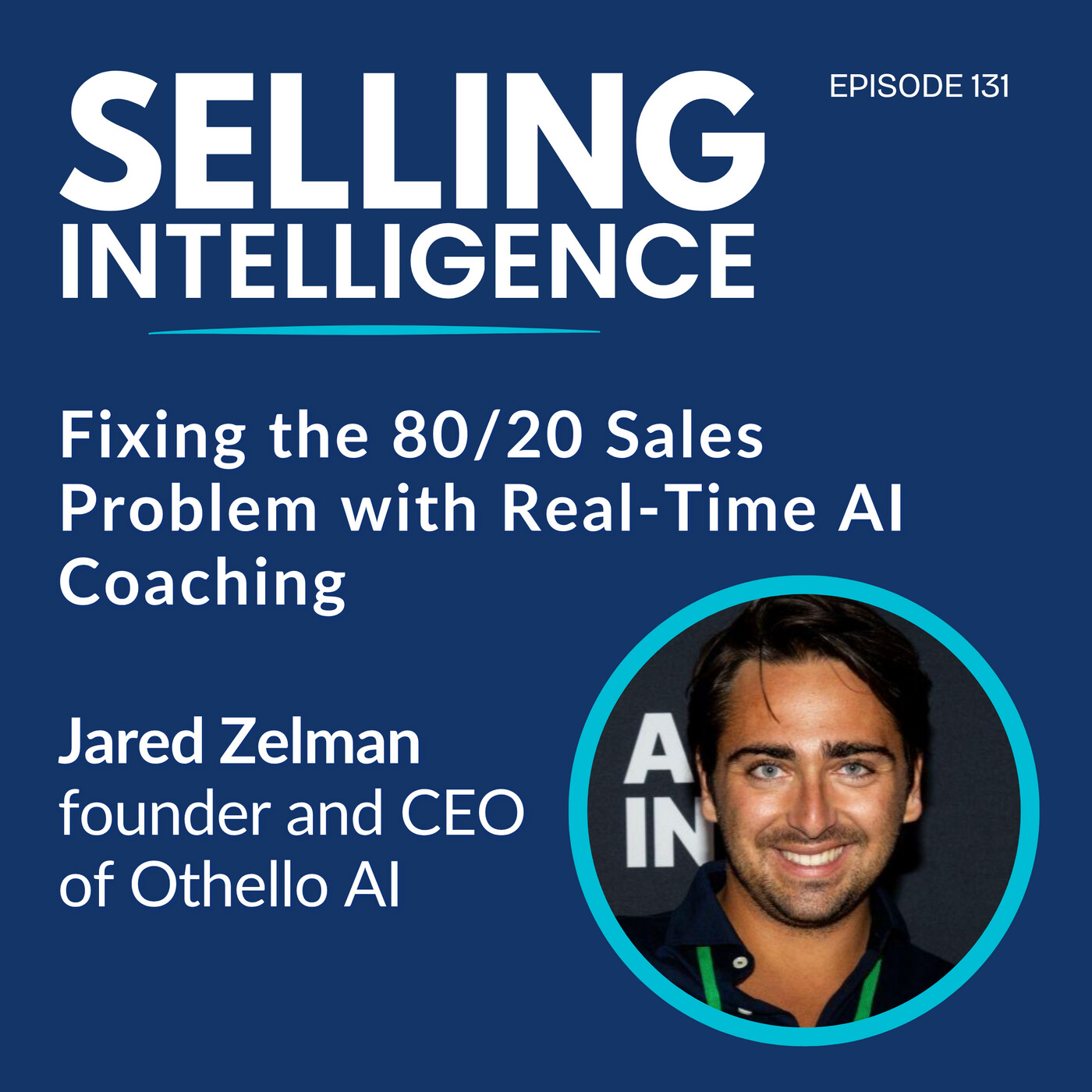
Ep. 131 – Fixing the 80/20 Sales Problem with Real-Time AI Coaching with Jared Zelman - Part 1
Podcast: Selling Intelligence (formerly Selling the Cloud)Published On: Wed Jun 17 2026
Description: General Episode Description:In this episode of Selling Intelligence, Jared Zelman, Founder and CEO of Othello AI, joins Mark Petruzzi and KK Anderson to challenge one of the most accepted assumptions in sales leadership: that 20% of sellers will always generate 80% of the results.Jared argues that the 80/20 problem is not a talent issue. It is a systems issue. Drawing from millions of minutes of sales conversations and real-world customer deployments, he explains how modern AI can capture the behaviors of top performers and deliver coaching in the moment when it matters most: during live customer conversations.The discussion explores why traditional coaching models fail to scale, the limitations of post-call analysis, and how real-time AI guidance can improve discovery quality, qualification, and win rates across entire sales organizations. Jared also shares insights into how AI is uncovering new patterns in selling behavior, including why Sandler-style methodologies continue to outperform across modern B2B sales environments. What You’ll Learn:The 80/20 Sales Problem: Why performance gaps are often driven by systems, not talent.Real-Time Coaching vs. Post-Call Coaching: Why feedback during the conversation matters more than feedback after the fact.Discovery Done Right: How top performers uncover deeper pain points and create stronger buying urgency.AI-Powered Sales Execution: Using AI to replicate the behaviors of elite sellers at scale.The Future of Sales Methodologies: How AI is identifying winning patterns across millions of sales interactions.Key Topics:The Pareto Principle in sales organizationsWhy most CROs attack the wrong coaching problemReal-time AI coaching inside customer callsImproving discovery conversationsThe “question behind the question” frameworkWin rate improvement versus productivity improvementWhy CRM automation alone does not improve revenue performanceAI-assisted coaching and behavioral reinforcementThe difference between efficiency and effectivenessRote versus rogue selling behaviorsPersonalized coaching versus scripted sellingSandler methodology and AI pattern recognitionCustom sales methodologies powered by organizational dataUsing AI to scale top-performer behaviorsThe future of AI-enabled sales leadershipGuest Spotlight: Jared ZelmanJared Zelman is the Founder and CEO of Othello AI, a real-time AI sales coaching platform designed to improve sales execution before, during, and after customer conversations. Built by the team behind Cicero, Othello helps organizations scale elite selling behaviors across entire teams through contextual, in-the-moment coaching. Since launching in 2025, Othello has rapidly grown to support thousands of users across Fortune 500 companies and high-growth technology organizations. Resources & Mentions:Othello AISalesforceHubSpotGongSalesloftClariMicrosoft TeamsZoomSandler Sales MethodologyCiceroDan LawrenceLenovoCostcoHome DepotGeneral ElectricComing Next Week:Part 2 explores how sales leaders should manage AI-augmented teams, how coaching changes when AI handles execution consistency, and Jared’s founder-led go-to-market playbook for building a venture-backed company through strategic cold outreach and relationship-driven selling.🎧 Listen now and subscribe to Selling Intelligence for more conversations on AI, revenue leadership, enterprise sales, and the future of go-to-market execution.Mark Petruzzi (00:28)Welcome to Selling Intelligence. I am Mark Petruzzi, and I am joined as always by my co host, KK Anderson. Our guest today built the company on a number every CRO already knows and hates. Those numbers are the 20% of reps drive 80% of the results. The question is, what do you do about it? Most leaders throw more coaching hours at the problem.Build out their enablement team, and then just hope it scales and gets more productive. Jared Zellman did something a little different. He went out and he built an AI that sits inside the call and fixes it in real time and on every call. Jared is the founder and CEO of Othello AI, a real-time AI sales coaching platform that guides reps before, during, and after every call.Built by the team behind Cicero, Othello launched in July of 2025 and reached over 5,000 users and 1 million in revenue within its first six months, with clients spanning Fortune 500 companies and high-growth startups. Othello integrates with the go-to-market stack you already have, whether it's Salesforce, HubSpa, Gong, SalesLoft, Clary's, Zoom, or Teams.And sits as the execution layer that makes sure what happens on the call matches what the playbook says.KK Anderson (01:55)What I love about Jared's story is that he is not just a founder talking about sales AI. He is a practitioner of the exact skills he built Othello to teach. He built his entire investor base, his early customers, and his mentor network through deliberate, personalized cold outreach to some of the most senior people in the business. Howard Schultz, CEO of Lenovo, CEO of Costco.All started as cold emails, which is incredible. And that kind of disciplined, researched, human first selling approach is what Othello reinforces at scale. So this interview will be a part of a two-series, a two-part series overcome excuse me, reviewing four topics. today we're gonna get into the first two topics. Topic one, that 80-20 problem that Mark mentioned.And why the performance gap between your best and average reps is not a talent issue. It is a systems issue. And why most CROs are solving the wrong problem. Excited to get into that. And the second topic for today's episode is real-time AI coaching and what it actually means to have AI inside the call, how the live cue cards and pre-call briefs work, and the results that the teams are seeing.And this modern, AI run, coaching platform, which is really interesting. Now, next week, when you tune back in, we'll talk about topic number three, managing an AI augmented team. what a CRO's job looks like when AI handles execution consistency. and topic number four, the founder go to market playbook. And this is one I can't wait to get into. So tell us exactly how, Jared, you went frombeing a new college grad with no network to ⁓ VC back CEO with Fortune 500 clients in under a year. So we got a lot to dig into today. Jared, welcome to Selling Intelligence.Jared Zelman (03:46)Thank you for having me. I'll try not to bore you guys.Mark Petruzzi (03:48)No, you would never. So Jared, ⁓ you built Othello on the premise around twenty eighty. Twenty percent of reps driving eighty percent of the results. And that this is a solvable problem. Most CROs have lived with that ratio for their entire career and has accepted it as a fact of selling life. Please make the case for us that it is not a talent problem.Jared Zelman (03:55)Mm-hmm. Yep.Mark Petruzzi (04:12)What is actually happening structurally in the calls of average reps that top performers are doing differently? And how do you make sure those those top performer practices actually get leveraged into the rest of the team, those eighty percent of reps that we we all know?Jared Zelman (04:30)It's the Pareto principle, right? So the Paretto principle isn't it's it's not a law, like things don't need to adhere to it, but it's a commonality. So most sales organizations will suffer from the 80-20 problem. Doesn't mean they have to. I was just chatting with a mentor and advisor to our company, a guy named Dan Lawrence, one the most lovely and impressive sales leaders I know. He's the GM of America's at Nebbius. Nebbius does not suffer from the 80-20 problem.Right? Like a rising tide lists all ships. He's been able to upscale all of his reps to be so effective that they're all ⁓ top performers, especially if you compare them to any competitors. I believe it's a systems problem, not a talent problem. I actually think you can turn the middle sixty percent into the top twenty percent. The bottom twenty percent is a different story, but at the very least you can get to performing better.KK Anderson (05:12)And it's all by being there in the moment.Jared Zelman (05:15)Well, like it's it's interesting.It's like a like let's let's use like basketball as an analogy. Practice is obviously crucial. No one's gonna tell you that practice isn't important, right? And that's preparation, right? In sales, it's the same thing as going, Tuesday afternoon after school practicing ⁓ shooting hoops, right? But what's also crucial and you can't live without is having your coach screaming at you when you're shooting hoops in a game.Live, right? we try to bring that into sales. ⁓ similar to how if you guys are in sales or have been in sales, your sales manager perhaps would have been slacking you on the side telling you what you should be saying, or even like hooking up to your call with headphones, kind of like whispering in your ear what you should say instead. We try to replicate that experience with AI.KK Anderson (05:54)So but you're not the ma you're not the coach screaming at you from the sideline.Jared Zelman (05:58)We⁓ no, we can't. It's when you're dealing with salespeople, it's a b it's an art and a science, right? Like on paper, what does work doesn't always actually work ⁓ in practice. ⁓ sales reps are dealing with very high pressure sensitive environments. So ⁓ I mean that's like one of the reasons why a lot of engineers fail at building sales tools is you need empathy for the user experience, which is very different from the UX and other products.KK Anderson (06:03)It is. It's⁓So when you went went deep on this problem before building your platform, what like what did you find in your research that surprised you the most? I think I read in one of your articles that you were starting with a different like something about celebrity avatars or something, and then you quickly pivoted when you saw the market. Like tell us what you s tell us what you saw and what really resonated.Jared Zelman (06:38)Yep, that was my first company.of course.I can tell you about the avatar business prior to Othello. ⁓We can touch on that in a second. ⁓ how did I fall upon this major problem though that we're solving at Othella, which is like the 80 or 20 problem of sales? look, it doesn't take like an investigative journalist to like understand that, yeah, there's something going freaking wrong when it comes to the power law of sales rep performance. ⁓ I think the more controversial thing though is ⁓ just how massive this impact is. Let me put this in perspective. Most commerce in America, like most of our GDP, is derivative of B2B commerce. It's usually it's mainly business-to-business, okay? ConsumersSpendingis huge, but B2B is actually the crux of most of it. Everything else is generally downstream. About 80%, call it 75 to 80% of B2B commerce is driven by account executives or account executives with a different name, right? Like account director, for example.That's just one job role, and that's only about 5 million people in America driving 80% of the B and B commerce, which is the majority of GDP. Like if you were to actually draw that corollary, you would see just how important those five million human beings truly are to economy. Consider that 80% of them are nearly or entirely non-productive. That's massive.If you can squeeze even 20% more juice out of that fruit, you can get instead of 20% of them being top performers, 35% of them hitting quota repeatedly, the impact that that has downstream on the US economy is extremely consequential. When I did the math, when I spoke to these people like the CEO of Lenovo, Costco, Home Depot, General Electric, and they all concurred, I realized this is ⁓ this is a fact of life that that very frankly is a whole bunch of bullshit.That there is no way we can justify and just sit idly by as the economy is in some ways carried by 20% of five million people. Right? AEs are the backbone of the US economy. I've never heard that in any business, any economics class I ever had growing up or in college. ⁓ so I said, look, I'm gonna solve that problem. How I solved that problem, I do not know at that point, but I was zeroed in on ⁓ at least getting a piece of the action.KK Anderson (08:36)I have been in sales for over two decades and I have never heard that AEs are the backbone of the US economy and I think I love it.Jared Zelman (08:42)It'sit's tacky, like no one wants to he you hear it.KK Anderson (08:46)Yes, I love it.Jared Zelman (08:47)It's the truth. Like run the freaking numbers. It's true. People don't like understand that. Like there's look, there's like some ways you can like different ways to cut the pie up, obviously. But ⁓ don't sleep on them AE's. They're they're massive. So but you can also make the argument, right? Like if they're getting their leads from SDRs, then SDRs are the backbone of the economy, right? There's like different like layers to the cake, but AEs are the bulk of the action there.KK Anderson (08:58)Don't sleep on me.Yeah.Mark Petruzzi (09:08)Very interesting, Jared. The conventional solution is has been post-call coaching. Gong, chorus, just having manager one on ones. ⁓ that's been the that's been our history in sales. Now you have said by the time the analysis is done and these systems pull this together and you're no longer with the prospect, the opportunity is gone.Jared Zelman (09:17)Gog, stuff like that. Yeah.Mark Petruzzi (09:33)You r you really can't go back and really correct things that may not have gone well in the original call. So walk us through the specific moment in a call where you think a deal is really one in won or lost and why postcall feedback does not touch that moment in time to be able to change the outcome.Jared Zelman (09:54)Yeah. I I think ⁓ I think it's uncontroversial to say that deals are won and lost in meetings. ⁓ at least for the companies we sell to, many of those, not all of those, but many of those meetings are happening, via Zoom or via some kind of phone call on your computer. The deal can be won and lost in a several like several different moments. Most deals are one and lost in discovery. ⁓ good sellers know that.Right? If I'm not digging deep enough in a discovery call, if I'm not having true empathy for the customer, then yeah, I'm gonna lose them. No matter how good your product is, you're probably gonna lose them. So I'll give you one example of what Othello will do. Othello can remind me in the middle of a disco call, hey, double-click on that pain point. Or say, KK, you were to say something like pretty gaping about a problem you're trying to solve. Thello may have me ask, okay, but KK, what have you tried to solve? How have you tried to solve that problem? Why did that fail?And then we try to give you the question behind the question, like a layer deeper beneath the surface. ⁓ we believe if we can improve the quality of your discovery, if we can get you to convert 10% more of your discovery calls, ⁓ the trickle-down economics of that are meaningful for any company.KK Anderson (10:50)So it's interesting. We do at AGS, our firm, we do lots and lots of behavioral competency analyses on on thousands and thousands of sellers. And there's a core set of competencies that we call the sales DNA, which are, the competencies that really are between your ears deep in the brain. And it's things like your ability to stay in the moment and listen to a prospect. Like you're you're just and you're describing discovery. And when you have a youngerJared Zelman (10:57)Yeah.KK Anderson (11:16)Sales person, especially AE or BDR or whoever it is, a lot of times when that customer or that prospect is talking, they think they're listening, but really in their mind, they're they're thinking about what they're gonna say next, or how are they gonna overcome that objection, or how should I phrase this value pitch, or they're they're they're thinking in their mind and they're not necessarily truly listening to what's happening with every breath that your prospect is speaking.But a lot of that comes with maturity, right? And experience and being able to do it for a long time. But very often what we see is that sellers will miss the opportunity to pull on the thread of the sweater, right? To dig into, the TED questions. Tell me more about that. Can you explain that to me? Can you describe that? I mean, some of these simple tricks that sellers have had for for decades, they'll just miss it entirely. Or a, the other thing we see all the time is that.A salesperson has had the same call so many times that they have an assumption that the prospect must have this problem, they must be doing it this way because that's how all my other clients did it. And they may say something that is is compelling and is different, and they may not may they may just totally miss it. Right?Jared Zelman (12:25)What I've what what so here's the thing. I I agree with you by the way. Like and I do think there is an element of that that will never change. Like that's human nature. And as long as human beings will be in sales, you're going to have human elements affecting sales conversations, especially if they're repetitive, right? Because we're creatures of habit. I I don't say, I don't I don't think it's technology's job to like necessarily replace that human element, but I do think we can supplement and augment it.So I'll give you an example. ⁓ and and maybe I'll ask you guys this question first. KK Market, do you guys think sales will continue to be human led, at least B2B sales, for the next ten, twenty years? You think it'll be human led or AI led?KK Anderson (12:57)I think there will always have to be a human in the loop because at the crux of sales is trust and relationships. And I don't think that's going to change. As a matter fact, I think AI is is swinging the pendulum back to how it was in the 50s when sales started. Now, can we automate a lot of what happens in sales and make us more exceptional and more differentiated and and utilize the superpower, superintelligence? But heck yeah. But I do think a human will always be in the loop.Jared Zelman (13:10)Yeah.So I agree with you on that. I will say though, when it comes to like sales, you're judged not on your efficiency, right? You're not judging how quickly you can get the job done generally. It's a good thing, obviously speed and sales cycle like reduction is good. You're judged on how much money you're bringing in. So it's ⁓ efficacy, right? Like effectiveness, not efficiency. ⁓Hence most AI automation around the margin, like CRM node automation, for example, while it is nice to have, is not going to be redefining performance for a sales organization. At least not a good one. Right? Like you saving like eight hours a week for your sellers, as great as that shit is on paper, is not going to move the needle from like a corporate revenue perspective. Un unless you guys are truly like the most like effective, like and every minute is worth millions of dollars to your team.KK Anderson (13:47)Yeah, I agree.Jared Zelman (14:04)where you will juice the hell out of your margins and performance is if you can improve win rates. Like that's 90% of it. Everything else is downstream of that. And automation does not help improve win rates.Right? You need to focus on quality of meeting as that's where the money is made and lost. ⁓ post-call note taking obviously is a step in the right direction. Practically completely unused. Like, who are we kidding? Like, no one is spending four hours a week looking at call notes, no one's spending four hours, five hours a week in AI role play talking to some AI character. They want to be selling. So you need to find a way to enable them, get them to perform better. frankly, without perhaps having to put in a whole lot of effort to do it.That's that's the crux of my philosophy and frankly like the foundation of Othello's product.Mark Petruzzi (14:39)Yeah.Yeah, and I I think that's a big differentiator for you. Jared for you and Othello. let's move to topic two. ⁓ real time AI coaching. And ⁓ the ⁓ our audience here knows that I typically don't like to talk too much about any company's individual product. really as you've been describing, I love to learn. I I think my audience l likes to learn.the ⁓ the framework, like what what you what you have built and why does that tie back to a product? Here I think I'm a little more comfortable pushing on this a little bit. So take us to specifically what Othello does. walk us through a little bit how does the the real call, the pre-call brief, the in-call cue cards,Postcall automation. How does that come together? And what does the rep see, feel, feel, and hear at each of those stage that really does influence them in in their overall selling efficacy, as you put it?Jared Zelman (15:50)Yeah, so we're trying to do one thing, and that is to get reps to say the right things in calls. You have to do that a few different ways, but 80% of the value comes from the core product, which is the real-time in-call suggestions. And let me like specify here. ⁓ these are not suggestions that are pre-gridden or pre-populated and designed by enablement. You're getting a new suggestion on your screen almost every single time. I'll I'll draw you a picture here.I'm selling widgets to you, Mark, and KK. Othello will put a pop-up on my screen guiding me to say the exact right thing in that moment. Taking context about what you care about, about who you are, about what you just said, about what you asked me in the last call. So the suggestions will always be different and hyperintelligent. Pre-call and post-call, we give intelligence, coaching, suggestions, a lot of proprietary tech there as well. But truly the sea change comes from what happens during calls. So we focus on that.KK Anderson (16:40)So Jared, you've described a tension that you call rote versus rogue. the rep who follows the AI Q cards too rigidly on one end and then the repu ignores them entirely on the other. So so where where does the AI add the most value in that spectrum? And like how do you how do you design a thello to keep reps in the zone where AI helps rather than hurts?Jared Zelman (17:04)I would say that this differs depending on the user. So we have people that we we for example, like we have like sellers that are like sixty five years old and above. ⁓They like to design the earth element, and you can toggle this, right? To be very lightweight, very suggestive, not scripted. It'll be more of a n a nudge like, hey, double click on that. Like or dig deeper is what you'll see on your screen, as opposed to like a literal question to ask, for example. ⁓ and that's very, very ⁓That's very like, I don't know the word, like very like light. And then maybe people that love a script and they have super high frequency pop-ups. ⁓ they both work, it depends on who you are. never do we suggest you go fully rogue. And obviously if you're gonna go rogue, then just don't buy our product, just do whatever you're doing. If you're an A-list seller, then maybe you don't need any help. But if you do, then yeah, you should definitely not go rogue.Like I don't have any like really advice on that. We've had to build a product such that anybody can use it the way that they want. You have to meet sellers where they are. You can't expect them to take the product as is. They need to be able to customize it.Mark Petruzzi (18:00)Yep, good stuff, Jared. So you have said that the Sandler methodology has emerged as the as AI's preferred approach based on what it observed across thousands of calls. That to me is a fascinating observation. ⁓ the AI, in the way I've I've read and and heard from you, has reallyreverse engineered a winning framework from the behavioral data. Walk us through what the AI saw in the data that pointed much more towards Sandler and what that tells us about what actually works in complex B2B sales in 2026.Jared Zelman (18:39)It's hard for me to answer the second part of that question. I'd give you my POV, but it's a really it's a big it's a big question with a lot of ramifications. firstly I'll answer the former. Yeah, we we trained on like 20 million ⁓ sales minutes. That's the largest trainable data set of that type in the world.And once you have like that many minutes, you spend enough time and enough cash on compute, like you can start to draw some corollaries and identify patterns. It seems like Sandler is the way to go, at least over our dataset, which is pretty robust. Sandler isVery well tuned for the modern seller. It seems like modern buyers respond well to Sandler, as folks are a little bit less they're more hesitant and more reticent to purchase tools these days. So Sandler kind of flips the script and gets it back faster. That's our common belief. Like that's why we think Sandler has been most kind of like successful. I think going forward,I think Sandler will continue to be the highest performing sales mess sales methodology, at least according to AI. but I do think that ⁓ methodology performance is like very much it it depends on the times, it depends on the zeitgeist. you could not have used Sandler in the fifties, you would not have hadfrankly like God and anybody to want to work with you, you can do that now as people are a bit more caustic. ⁓ but it's it changes with the Zeitgeist. Not a great answer perhaps to your question. It's like the answer is no answer. It depends is always the best answer. And that's kind of what I'm referring to.KK Anderson (19:55)I wonder if with the advent of AI, if people will not have to follow some of these, old school methodologies like Sandler, because they can take their tribal knowledge that is within the brains of their 20% top performers and and leverage it in a way that they've never been able to do before because of like even being able to use a tool like yours, I imagine, helpshelps ⁓ I mean there may be some process there. Of course you the best objection to overcome is one you never have, right?Jared Zelman (20:22)SoThe g one of the great things about AI is its ability to customize things to you, right? It's context.Right? Like you can take a crap ton of say call recordings for your company, and AI is able to create what it defines as the best practice for your sales conversations. You can pretty much now create a custom methodology based on what works and what doesn't work if you have enough data. you're right, KK. Methodologies are fantastic, but they are heuristic. But now AI is able to take a ton of unstructured data and glean analysis from that.KK Anderson (20:52)Uh-huh.Jared Zelman (20:53)I do think that one size fits all methodologies in general are ⁓ they're going to slowly go away because you you don't need a heuristic anymore. You can actually get the facts if you're able to run a model on top of your data. Which is what we do. I mean that like that's like that's like kind of what we do over time with each of our customers. Like the model changes, the more calls you have.See Privacy Policy at https://art19.com/privacy and California Privacy Notice at https://art19.com/privacy#do-not-sell-my-info.
The note was deleted
The note was saved
Your message was sent