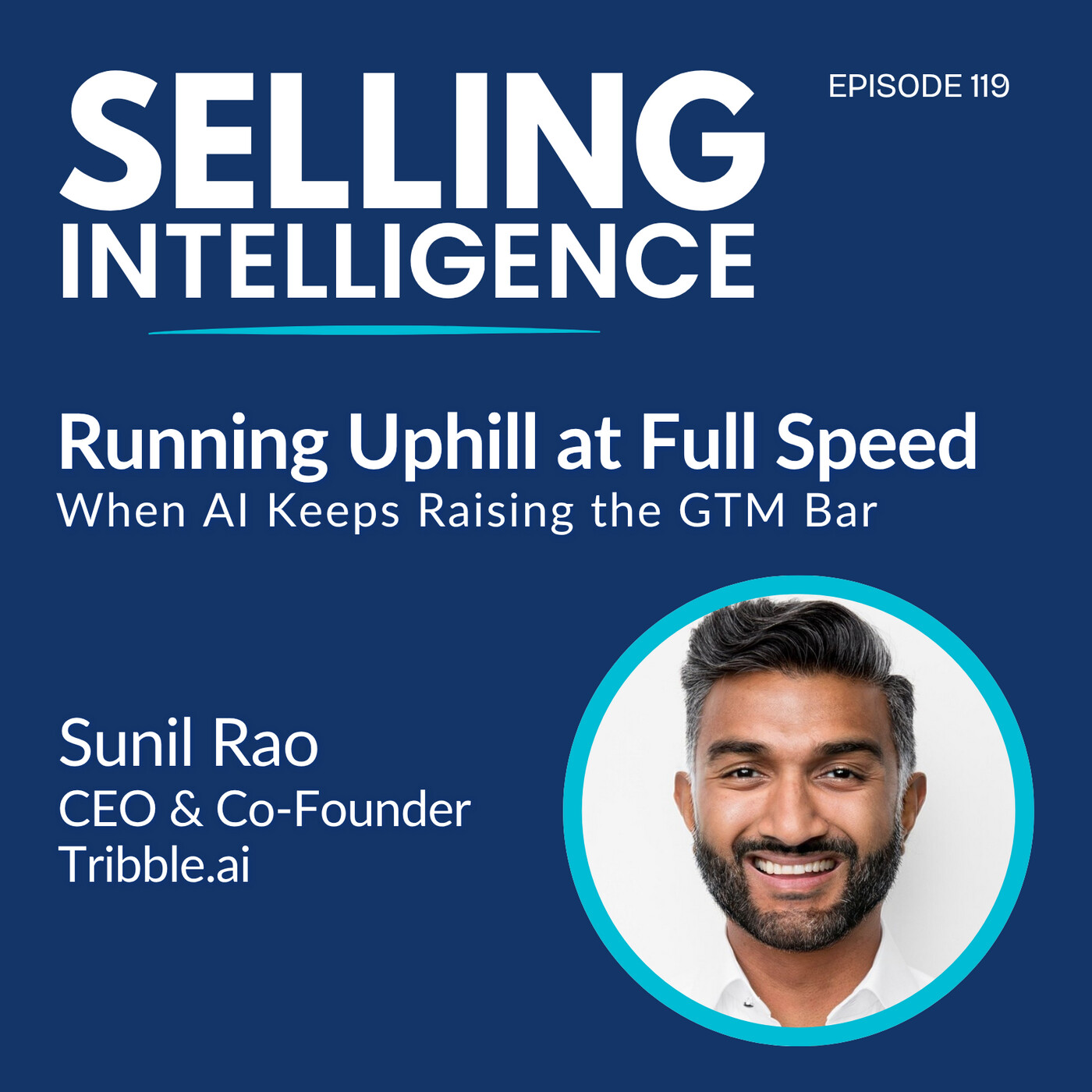
Ep. 119 – Running Uphill at Full Speed When AI Keeps Raising the GTM Bar with Sunil Rao – Part 2
Podcast: Selling Intelligence (formerly Selling the Cloud)Published On: Wed Mar 25 2026
Description: In this episode of Selling the Cloud, Mark Petruzzi and KK Anderson continue their conversation with Sunil Rao, founder and CEO of Tribble, diving deeper into SaaS fatigue, agentic execution, and the challenge of scaling institutional knowledge in enterprise sales.Sunil breaks down how AI agents are reshaping the way work gets done by becoming the interface across systems, eliminating the need for constant tool-switching, and enabling teams to operate from a single layer of intelligence. He also shares how modern GTM teams can capture and scale expertise across conversations, documents, and internal knowledge to improve performance over time.The discussion closes with a look at the human side of selling, where trust, collaboration, and real customer engagement remain irreplaceable even as AI automates more of the workflow. What You’ll Learn:SaaS Fatigue and the Shift to Agents: Why the future interface is not more tools, but a single AI layer that connects everything.Agentic Execution in Practice: How AI can capture context across calls, RFIs, and RFPs to generate smarter, more personalized responses.Scaling Institutional Knowledge: How to turn tribal knowledge, conversations, and documents into a usable system of intelligence.The Failure of Static Content Systems: Why traditional enablement platforms fall behind the speed of modern business.Human + AI Collaboration: Where automation should take over and where human judgment, trust, and relationships still win.Key Topics:“Kiss your apps goodbye” and the rise of agents as the new interfaceEliminating tool-switching and browser tab overload for GTM teamsCapturing context across the full sales lifecycle, not just at the RFP stageUsing AI to coach reps in real time during customer interactionsBuilding knowledge graphs from calls, documents, and internal conversationsDenoising and validating data from sources like Slack, Gong, and CRM systemsWhy knowledge bottlenecks exist due to limited subject matter expertsThe limits of traditional enablement programs and static content librariesDesigning AI systems with humans in the loop for approval and quality controlReallocating 30% of seller time from admin work to customer engagementGuest Spotlight: Sunil RaoSunil Rao is the founder and CEO of Tribble, an AI-native platform that helps enterprise sales teams automate and optimize go-to-market workflows. With a background as an engineer at SAP and a leader at Salesforce, Sunil brings a unique perspective on both the technical and human sides of enterprise selling. At Tribble, he focuses on building systems that scale knowledge, improve response quality, and enable teams to operate more efficiently with AI. Resources & Mentions:TribbleConcept: Agentic workflows in go-to-marketKnowledge graphs for sales and GTM intelligenceSaaS consolidation and interface shift to AIThe Hard Thing About Hard Things by Ben HorowitzSuperintelligence by Nick BostromConcepts: “SaaS fatigue” and “tribal knowledge” in enterprise organizations🎧 Listen now and follow Selling the Cloud for more insights on AI-driven GTM strategy, enterprise sales transformation, and the future of work.Mark Petruzzi (00:31)So Sunil, let's talk about the SaaS fatigue problem. Companies are drowning in tools, licenses, and unused platforms. If you built a company in the enterprise software space going right at all of that overflow, how did you design Tribble to be part of the solution rather than be another product out there that's part of the problem and the challenges?Sunil Rao (00:54)I think from the very early days, one of the things we thought about deeply was, hey, where is this all going? If I think for two, three, five years, what do we think happens? And it was very clear to us that there's a consolidation that's going to take place across where people want to go to get their information.when we see what was happening with ChatGPT and you think about how this kind of AI can be pervasive across systems, this is one of the things I was telling someone recently. If you go back on the internet, you go to the Wayback Machine, which is a website that allows you to go back in time, you can go see the 2023 December page for Tripple. It says, kiss your apps goodbye at the very top. Say hello to agents. And that, I think, was very indicative of, this is what's going to happen. We probably did that message too early because no one knew what an agent was in 2023.But I think that's where we are right now, right? It's like, hey, there's this new interface, right? I can talk to an agent or I can talk to software and I can give it access to all the other systems I work with. So I kind of don't need to go to all those systems again, right? I can do the work through this proxy.And the way that we always describe it is like in the future, you know, when you onboard a new employee, what do you do? You say, here's your license to system one, system two, system three, system four. And they're sitting on their chair and their browser tabs and they're swiveling from one to another, to another, to another.That kind of all goes away. So I think when I think about SaaS fatigue, think agents actually are going to change and become the interface. And Trivel, for us, when we think about go-to-market technology, we want that to be the interface when we think about the respond process and the engage process. That's our bet. And underneath the hood, we have many systems we integrate with. But I had a prospect ask me this the other day. They're like, hey, if we're using your tool, do I need to go to these other systems? And the short answer is no, you don't.Get everything you need right over here.KK Anderson (02:35)So walk us through like what an agentic execution actually looks like in practice. So like when a sales team sends triple an RFP, what's happening behind the scenes? Like how much is automated versus augmented, if you will.Sunil Rao (02:49)Yeah, so I'll give you two examples, KK. I think one, let's think about a company that responds heavily to RFPs and that's a big portion of their business. The RFP coming to you isn't the first point of contact with the customer, right? And depending on the size of the organization and how big this engagement is, it might be something more like, hey, we've had an initial call with the team and they shared with us that they're going to issue an RFP. So there's some discovery being done. We learned some requirements. We learned some players at the table, the different business units that are relevant here.Fast forward a week, another call takes place. Different team members at both organizations are on a call. Information is shared. Then you get to another call and then they issue an RFI, which is the precursor to the RFP.So it's one document that gets sent over and then you got to answer a bunch of questions. Then you finally get to the RFP, which then ends up becoming a bigger proposal. But we think about the journey across all these touch points as opportunities to collect context. So one of the things we do is we show up on the call for each of these touch points. We collect context. We coach the folks live on the call on what data to collect.and how to think about this so that when it comes time to build the response, it's contextual on all the data we've collected for this specific prospect, but every other conversation we've had and where we've won bids and where we've lost them. And that way we can see, historically, when you've answered no to this question for this type of company, you've lost the deal. So one of two things, either explain you can do it because it's on your roadmap or actually put it on your roadmap. Right. And these are the kinds of insights we can glean because we're integrated to thethe systems behind the scene, as we come across these insights, we can go write the data back directly. The agent will go and update a ticket in JIRA, or it'll go make an update in Salesforce directly. And it's done throughout the journey, throughout the process. So that's kind how we think about it across the lifecycle.Mark Petruzzi (04:30)that's excellent. Excellent. So let's go to topic three here, scaling institutional knowledge. We use this, the term kind of tribal knowledge and a lot of the work we do in engendric space ourselves. So yeah, let's dive into that. One of the most interesting things about Tribble, that it's not just about speed, it's about scaling the...the expertise, scaling the process, making those processes better over time as well. You've described the problem of a limited number of experts having the necessary knowledge. In your experience at Salesforce and now at Tribble, why is knowledge scaling such a massive bottleneck in most enterprise organizations, particularly within their sales function?Sunil Rao (05:15)Depending on how big the organization is and what products you sell, historically for me, one of the things that I've experienced firsthand, when you're selling a complex product or you're selling into a vertical where the business processes are very specific and non-standard and it's not something everyone knows, you usually will have a gap in terms of the understanding of the field team and what it is that the customer wants. So how do you speak the language of the customer is always a term that we used a lot in my career.And whether you're in financial services, health, whether you're in CPG, retail, manufacturing.There are processes that are very specific to that industry. So how do you enable the field teams to know what it is the customer's pains are and what they need? And how do you build the right software to meet those needs? So I think that ends up in, thinking back five, 10 years ago, how do you scale that within a company? Well, you create these enablement organizations. You create enablement programs. You take everyone to Vegas for kickoff, and you show them 800 bajillion PowerPoint presentations and hope they remember it for the year. And of course they do, because that works every single time.Right? And when you show up, you've now enabled everyone and they're talking about the product. I think that that kernel, it.The one consistent theme that we've seen and I've experienced it firsthand is you still need to leverage these SMEs during the sales process and you tap them on the shoulder and bring them in. And whether they're sales engineers, they're industry experts, technical architects, program architects, whatever you call them, they all have some level of knowledge and there's too few of them in the organization. So that's what I think about when I think about the scarcity of that type of resource and how do you scale it? So for us, we've always thought of, you've got data in docs.Those documents will inform a certain amount of the business process. You've got knowledge now in these large language models that we can tap into.And there's tribal knowledge, right? We know that Mark actually is really, really good at this one feature in that product that no one else in the company knows, but it's not written down anywhere. It's in Mark's brain, right? So like, has Mark mentioned that on a call? Is that something that's come out in calls with customers? How do you tap into that kernel, right? So we take that data from the calls. We take the data from the documents and everything we're observing across all the calls in the company. And we create a graph of the experts in the company and who has what tribal knowledge and what documents.have what knowledge. So we're trying to solve it in that way Mark of how do you scale the expert? Will you create a backup of them and you try to understand in the organization where you can go to for what.KK Anderson (07:36)And so that's, does that one explain why you're, you're ingesting all kinds of secondary information like Slack conversations or conversations between engineering or product or sales teams? That is that part of how you do that?Sunil Rao (07:49)that you before something becomes a document people are usually talking about it on slack or on callsKK Anderson (07:54)So how do you, like a couple of things come to mind. Number one, like how do you ingest that much information without just having a lot of junk? know, like 80 % of gong conversations are junk and there's a maybe a golden nugget in there. you, mean, it seems like a lot of memory, a lot of space.Sunil Rao (08:11)You haveto compress it. You have to de-noise it, and then you have to compress it. So we actually have, it's funny, when I was geeking out with the engineers on this, we were thinking, look, and I've done sales as well. Sometimes people say things on calls that are not necessarily factual, right? So we have to attribute for the fact that it happens, and especially with gone calls, you have a lot of salespeople saying a lot of stuff on calls.But then you have this idea of ground truth, which pertains to your product information that we're connected to systems of record that we pull data. So we'll look at the data that's coming in and the really noisy stuff, which is gone calls call transcripts, and we'll cross check it. We'll almost fact check it with what we know is in the main store. And if there's anything new gleaned, we will pull that out and denoise and get rid of all the back and forth that's not necessary to store. But we try to pull out the key facts. We try to understand, hey, who was on this call? What were they discussing?which people were saying which things, what regions, locations, product lines, segments were discussed. So anything that pertains to go to market is what we try to pull out of this and then we store it in what we call our knowledge graph. And that allows us to like pull out the signal from the noise if you will, KK. And then we will fact check some of that.And we'll also use the folks using the product to actually validate if information is correct or not. So that way we move from this vast ocean of noise to a usable data set that's otherwise really hard to get to.KK Anderson (09:28)it's really, reallyMark Petruzzi (09:29)most companies, as we all know here, have invested heavily in content libraries, knowledge bases, sales enablement platforms. Yet somehow the right answer is not there when the rep needs it. Why do traditional knowledge management systems fail in high-velocity sales environments? And again, how does Tribble andthe things that you do overcome some of those challenges.Sunil Rao (09:55)It's almost like a short circuit cheat code, right? Because I remember the Russian December.to get high spot loaded with all of our content. When I was at Salesforce working with marketing and it was like the stretch going into Christmas and we're all building the 40 different variations of first call decks and second call decks and these subvertical plays and you'd create and it's this one moment in time where all the content gets created gets uploaded to these systems and it's not any one system. It's just the way it was done, right? You have to have a central place where people can download this content.But the problem with that is you do it at some frequency that's not fast enough for the speed of the business. Information is changing at the rate at which product is being released at the company. And there are just new pieces of information that are coming out. So tapping into the higher velocity data sources, like conversational data, whether it's coming from Slack, whether it's come from Teams, or it's coming from call transcripts, and corroborating that with data that's being created by organizations like product marketing, I think you can move a lot faster.then you can also provide information that's based on new information as opposed to information from six months ago. And you can also use the human in the loop to validate the new stuff.And AI obviously gives you a lot of leverage to do that. So I think that's why it's just a different way of thinking. Think about the lifetime of the asset and how long it's relevant and how quickly we can distribute the load of people validating that it's still correct instead of it being one poor person that's responsible for updating this repository every six months, which tends to be the bottleneck in a lot of orgs.KK Anderson (11:25)Wow. So moving on to our last topic here around the human element, right? And where AI should take over and we're at must step back. So you started your career as an engineer who would look at the sales leader and be like, no, heck no, absolutely not. Can't do it. Not going to do it. Right. And now you're a CEO who's deeply embedded in the go-to-market strategy. So,What did you learn about the human side of selling that you could not have understood when you were on the engineering side of the business?Sunil Rao (11:56)I appreciate the sales side of it so much more now. even think back.⁓ to like my initial days as an engineer, I just never understood this side of the house because it was just, it was, it was illogical to me. It would be like, why are you positioning something that, know, how, how are you positioning what's real versus not? And not to say salespeople don't do that, but I think you tend to think more now as a consultant that's helping your customer solve a problem and you see the paths and the opportunities. And it's a very different way of thinking than the very rigid way of like.the logical way of like, this is true now or not true now and therefore we can't do it. So I think the change for me really was more, hey, how do you build trust with people? How do you kind of show up and actually bring value and meet them where they are, but then also work with them to build the future together? And I think that opens up.a much more collaborative kind of trust-based relationship. And ultimately, that's what this whole thing is. It's, hey, do you trust me to help you solve the problem? I might not be there 100 % at this moment, but I will get there with you. And I think that that mentality allows you to both portray a vision that you can go on together, but also attack problems with the reality of what you have now. So it was just a mindset shift, would say, KK.Mark Petruzzi (13:08)So Sunil, there seems like there's a bit of attention in the ⁓ product philosophy from the perspective of, know, one of the things you guys do and do so well is automating the RP process, something very specific, very process oriented and some of the info sec ⁓ questionnaires, which are all pretty.technical and repetitive. But I love and get very impressed by the way that you talk about the human side of all this and as you just described, like the things you've learned along the way about the human side of selling. So where's the line? right now, it's gonna change like in about 12 hours, but it's right now, like where's the line? You know, what should AI own?And in your mind, like what should really remain human, at least for now?Sunil Rao (14:00)You know, if you asked me this question like 10 years ago, I think a lot of people will say the same thing. I wouldn't have guessed that sales, enterprise sales, heavily relationship based sales would be one of the last things to go. I would not have guessed that. And I think that that intuition comes from the fact that this is very much a very trust-based human-based business where you're going in and helping these companies transform and helping build relationships to do that.So I think from that perspective, it's where it's disrupting and changing things.There are a couple of implications of that, right? Like how do you bring folks along for the ride? And you mentioned product tension. Like we think deeply about, you automate the thing end to end or do you make the surface area where the AI does the work that's really rote and repetitive, but you still have the human in the loop to go in and have the knobs and dials to finalize what needs to go out. So I think our product philosophy has been that, right? Because we've been selling to these teams that are operating where they have to do a lot of the manual repetitive work, but also be theapprovers and now it's can we give you the tooling to remove some of the manual repetitive work? You still maintain the approver status, but now you can handle a lot more throughput as an organization, right? So that impacts UX decisions and product philosophy. Humans aren't going anywhere for a little while. I mean, this stuff will move and you're right, in 12, 24 hours, 48 hours, it's probably gonna jump even further. But I think the rate with which it goes into the company is still gonna be slower than we think.KK Anderson (15:21)And it goes back to this idea of AI is becoming table stakes. So you're giving sales teams the gift of time with your technology. And so it becomes a question of what are sellers going to do with that time? And that's where they get their edge. That's where they can increase the strength of their relationships and their networks and how they can bring value and help individuals, help others, help their customers.Tell me your kind of philosophy around that. What do you want your sales team doing with their time that you're giving them back?Sunil Rao (15:53)go meet more customers, go out in the field, go take them out to dinner, like understand.KK Anderson (15:57)Do theSunil Rao (15:57)Show up, go do a ride along, understand how they sell to their customers and what are they trying to achieve. If you're stuck trying to update fields in a document at your desk and you're not out there, then you're not really doing the job that you can have the highest leverage doing. So I think, I feel KK, I could have said the same thing selling cloud CRM software 10 years ago and probably 20 years before that selling it. Ultimately, there's always a percentage of the job that is stuff that's getting in the way. And I think I look at this notas replacing the role, it's if you look at the role and you see the jobs to be done of the role, there's probably about 30 % of the jobs that they're doing that you can just take out. And when you take that out across an org of like 500 people, you're not replacing those people, but you're kind of changing the role and making it better suited for the best outcome for that individual. And that's the way I look at the re kind of composition of the work.KK Anderson (16:47)And for a salesperson who's working on a commission, being able to take 30 % of redundant admin BS that they don't want to do and giving them that time back to be able to grow and expand accounts, that puts more money in their wallet.Sunil Rao (17:02)It's like reducing your tax rate.KK Anderson (17:04)Reducing your tax rate. love it.Mark Petruzzi (17:06)I like that a lot. Okay, let's move to one of our most fun parts of this and finish up with some rapid fire questions. This is an interesting one for you because you've been, you you've come from the engineering side. You're a CEO now. You've done some really great years of sales and sales leadership along the way. But what was the first thing you ever sold?either professionally or as a kid.Sunil Rao (17:33)This takes me way back. I'm pretty sure the first thing I ever sold was a trading card.And I used to collect a lot of trading cards like baseball, like Marvel Comics cards. And I remember having to sell some of these like in trades in order to buy more, right? It was always just to get more cards. So it's like, how do you find the right optimal thing? So I think the first selling aspect of it was like, hey, get someone to like really like this, right? Like, and then they buy from you.KK Anderson (18:03)Relationship Selling 101, right? With your buddy down the street. come for a sleepover and I'll give you this card or you give me your card or whatever. Okay, favorite business book that influenced how you think about go to market or AI or kind of where you are now.Sunil Rao (18:18)favorite business book. I've been reading, you know, there's been one of all time, I would say, The Hard Thing About Hard Things by Ben Horowitz. That was just like a classic, right? And I think it was like a very good eye-opening thing, walking into a storm. So that would be my rapid-fire answer, but there's a lot more.KK Anderson (18:37)Is there, I'm curious if there's one that's related to AI though, that specifically has helped shape the way you're thinking about things. I know it's probably not written yet.Sunil Rao (18:44)specifically, would say ⁓ there is a book called, so there are a there's a short paper ⁓ that was, I think it's called, gosh, I'm forgetting the name now.I'll talk about the book instead. Superintelligence by Nick Bostrom. That was a really good read. That was probably 10 plus years ago. And I think that was the first time I heard this idea of like this, you know, when you, when you're building these superintelligence systems, you know, there's this thing called the paperclip problem, right? And if you like tell the thing to go build paperclips forever, you might find yourself in a world that has been completely converted into paperclip factories. And it's basically taken out all the humans in the world, but it's not doing it because it's malicious. It's like your instruction was notprecise enough, right? So anyway, that I would say is AI related, a little more of like critical thinking on where this could go.KK Anderson (19:30)wow.Mark Petruzzi (19:31)that was a great book and it was at the perfect time. It was late enough in the history of our world for him to have a really strong point of view and have some data behind it, but still so speculative versus what we're seeing just 10 years ago or 10 years later from there. So what's the best piece of advice you've received?when you were transitioning from a corporate executive to a startup founder.Sunil Rao (20:00)best piece of advice is...Mark Petruzzi (20:02)And that could evenbe from yourself, like something you just came up with and said, you know what, I gotta do this now.Sunil Rao (20:08)I would say it's actually the realization that a lot of people have advice and opinions. I think, especially when you're out and you're doing this for the first time, know, I, my personality is to seek advice and like really learn from the experience of so many others that have done tremendous things. but also keeping in mind that you need to carve in path, like your own path in your own way. so that's been, it's been, it's been good to keep in mind becauseYou realize very quickly that no one has all the answers and no one's really figured it out. There are people that have done amazing things, but you have to kind of take all of that and make your own path out of it. So that was a good realization for me.KK Anderson (20:43)so interesting. And even as an entrepreneur myself, sometimes the people that love you the most or they're closest to you are the ones giving you the worst advice. Like, are you crazy? Why are you doing this? You're quitting your job? You're doing what? ⁓ Okay, on the advice line here, what's some advice that you would give your 21 year old self?Sunil Rao (21:02)there's many things that I won't say here, but I think from ⁓ what was interesting to me is, the...I've always wanted to build something and I've pursued endeavors in the past as well. So this is not the first time that I kind of thought about startups and building something. think taking the jump earlier and believing in yourself a lot sooner is something that, you know, it's just like, you can go make a dent in the world. doesn't like, you don't need permission. Go do it now.Mark Petruzzi (21:29)beautiful. All right, well, Sunil, thank you so much for taking the time with us. And this has been a great discussion. And I always like to thank our audience who we are so appreciative of, and we so enjoy connecting with you all every week.So thanks again and then I always have to do a special thank you to KK, my partner and all this and yeah, it's ⁓ just too much fun for us to even have to say that we're doing work here. ⁓ And people like you make it really fun. So thanks so much, Sunil.Sunil Rao (22:06)Thank you for having me.See Privacy Policy at https://art19.com/privacy and California Privacy Notice at https://art19.com/privacy#do-not-sell-my-info.
The note was deleted
The note was saved
Your message was sent