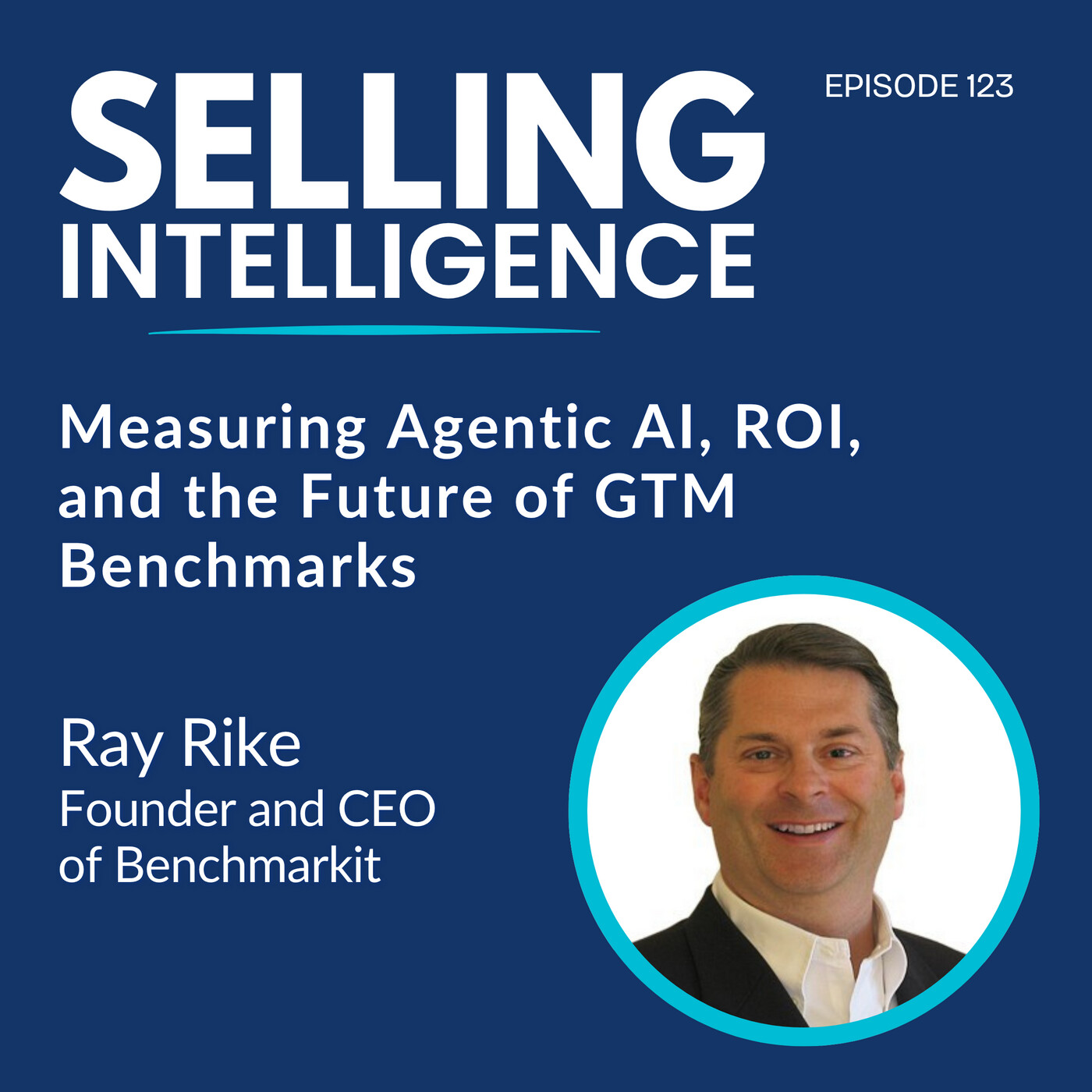
Ep. 123 -Measuring Agentic AI, ROI, and the Future of GTM Benchmarks with Ray Rike - Part 2
Podcast: Selling Intelligence (formerly Selling the Cloud)Published On: Wed Apr 22 2026
Description: General Episode Description:In this continuation of Selling Intelligence, Mark Petruzzi and KK Anderson sit down with Ray Rike, founder and CEO of BenchMarket, to go deeper into how companies should measure, operationalize, and compete with agentic AI in go-to-market functions.Ray breaks down why most companies still lack basic GTM measurement discipline, what new AI-specific benchmarks leaders should track, and how legacy SaaS companies can realistically compete with AI-native organizations that are operating at dramatically higher efficiency.The conversation also tackles the hard truth about workforce reduction, the rise of AI operators, and why companies must rethink their entire operating model, not just layer AI on top of existing processes. What You’ll Learn:Measurement Before AI: Why most companies must fix GTM analytics before introducing AI.AI-Specific Benchmarks: The emerging metrics for measuring agentic GTM performance.Competing with AI-Native Companies: Why legacy SaaS teams must rethink their entire playbook.The Role of AI Operators: Why AI expertise is becoming more critical than traditional RevOps.From Pilot to Scale: What success should look like at 90 days and 180 days.Key Topics:Cost per pipeline and cost per ARR before vs after AIAgent cost per opportunity, pipeline, and revenueDesigning modular AI workflows instead of “monster agents”The four-layer framework: productivity, effectiveness, efficiency, and ROIRevenue per FTE gap between SaaS and AI-native companiesWhy legacy SaaS companies struggle to match AI-native efficiencyRadical restructuring: reducing headcount and rebuilding with AI-first processesAI enabling deeper personalization at scale for outbound teamsThe rise of “AI operators” as a new critical roleThe “SaaSpocalypse” and pressure on net revenue retention (NRR)Using AI to improve retention, expansion, and customer insightsBenchmark expectations for agentic SDR performance at 90 and 180 daysGuest Spotlight: Ray RikeRay Rike is the founder and CEO of BenchMarket, a leading provider of B2B SaaS performance benchmarks. With decades of experience as a go-to-market leader, he helps organizations move from intuition to data-driven execution. Ray is also the creator of the AI to ROI newsletter, where he analyzes hundreds of AI developments weekly to help leaders understand what actually drives business outcomes. Resources & Mentions:BenchMarketAI to ROI NewsletterConcept: Agentic AI in go-to-marketConcept: AI-first operating modelsConcept: Revenue per employee as a key efficiency metricConcept: AI operators vs traditional RevOpsConcept: SaaSpocalypse and NRR pressureFramework: Productivity, effectiveness, efficiency, ROI🎧 Listen now and follow Selling Intelligence for more insights on AI benchmarks, GTM transformation, and building high-performance revenue organizations.Mark (00:26)Excellent. All right, well, Ray, let me bring you back into the days of you and I starting all our research and all the pre-work for data and diagnosis driven selling. So I hope that doesn't cause you to develop a Twitch or anything like that, because as you and I both know, that was hard work. So, but let's, you know.What we really saw right up front is, and we really pushed hard on this, is the idea is you can't manage what you don't measure. And you need external benchmarks, not just internal comparisons to know if your metrics are actually good. You know, it's great. It's great to be able to say, improved this process by 20%. But if you were 45 % behind most of your competitors before that,That 20 % still has you on the back of the pack. So how do you bring that same philosophy to measuring an agentic BDR or an AI-powered deal coaching agent? And we've touched on this, but what's the equivalent of a CAC payback for agents and the entire investment?Ray Rike (01:33)Well, I would start with let's make sure you have your go to market measurements in place, because honestly, we've been talking about these for years. Less than 50 percent of companies have great GTM analytics. ⁓ So things like cost per dollar a pipeline, less than 40 percent of people are measuring cost per dollar a pipeline. So make sure you do that and look at your current state before AI and then measure it post AI introduction. Right.So cost and I'm talking right now, I'm looking very specifically at the customer acquisition process. So cost per dollar pipeline before and after cost per dollar of new AR before and after when rate before and after your average and your contract for you before and after. Cause those are all going to be hopefully much better with AI to your point, Mark. I mean, let's use outreach. Everybody had to have a sales engagement platform, right?How many companies actually said, well, after I invested $1,500 per SCR, I had a better conversion rate or a lower cost per dollar of acquisition? Nobody. You're going to need to do that with AI. So that's my first thing. The second thing, which haven't been defined yet, but I'm working with some VCs on this right now, is AI specific customer acquisition efficacy. So I'm looking at agent costs per opportunity.Agent cost per dollar pipeline, agent cost per dollar of new ARR, agent dollar per cost of retained ARR. So you can think about your gross revenue retention and agent cost per dollar of expansion ARR. Now I'm projecting that we're going to be using agentic AI a lot in those processes or sub processes. And by the way, that's the other best practices.When you design a process, it's better to design a lot of subprocesses underneath so you don't have one large unwieldy AI agent. You have a lot of subprocesses that you have different people auditing and evaluating.KK Anderson (03:28)All right. Let's dig into that design a little bit. So walk us through, and I know this is new, as we've said multiple times for so many of us, what a well-instrumented, agentic, you know, GTM for the purposes of our audience, pilot could look like. You just gave us one great clue, which is, you know, don't make monster agents and, and to break them up so that you can, you know, be more agile andand predictable with those. You've walked us through some baseline metrics that you want to set before you launch, things that haven't necessarily been done in the past with programs like our outreach launches over the years. But what does the pilot to scale gate look like? And how do you separate the agent did something from the agent created revenue attributed value?Ray Rike (04:14)Well, let me go to the baseline metrics first, KK. So I think I have four levels of metrics I like to see in any initiative, including the Gentic AI. So one is a productivity metric, and that is outputs per time, you know, whether it's outputs per human hour, outputs per day or time spent per activity.That's what we've been measuring for the last year and a half and AI in marketing and sales. But that's what then you have effectiveness. How effective is my AI enabled process going to be? ⁓ How many desired outputs am I getting versus the inputs? Hey, for every hundred emails my agent sending, how many meetings do I get set up? Right. Then there's efficiency. That's the cost per outcome. And then there'sactual ROI, which is outcome value divided by the AI investment. So productivity, effectiveness, efficiency, and ROI. I'm not going to go into detail what that's like for just an SDR program, but at least it gives you a framework and a layer approach to designing those four layers of metrics you need to measure.Mark (05:19)Excellent. All right, let's move into topic three, the benchmarked view, and tell us a little bit about what the data has been telling you and your team at Benchmarkit. And let's go with, guess, a baseline of that. Some of your initial benchmarks that you have been working on are showing AI native companies hitting two to three times higher ARR per FTE.than a legacy SaaS, as one example. From our listeners who are operators inside non-AI native companies that are trying to deploy these agentic go-to-market programs we're describing, how do they close that gap? What are the structural differences they need to address? Not just the tooling, but the operating model as well.Ray Rike (06:02)In the let's be real. It's going to be real hard. And the reason being is a lot of the AI native companies are getting new budget. They're getting experimentation budgets. They're getting budget from labor versus budget from I.T. investments. Right. So I hate to say it, but it's going to be hard. But hey, there's a lot of people out there in legacy says companies that they need to get there. Right.So number one is you've got to be laser focused on number one, the effectiveness. Can AI help you get more conversions? Can they get higher ACV? Can they increase your win rate? And you got to go right to cost per. If AI is not getting you a reduced cost per dollar of new ARR, it's going to be really hard. And honestly, Mark,The hardest part is for me, if it was me and he brought me into a $50 million SaaS company, I would say we got to throw out the old playbook and start from scratch. But I don't have the new playbook based upon years and years of experience. So it's going to be really hard to throw out the old playbook and build the new one. So that's why I bring in someone who's got maybe six, 12, 18 months of experience and an AI first culture.and have them do it with you or hire a third party consultant.KK Anderson (07:22)Wow. And it's quite the conundrum that we're all faced with right now. All of these native SaaS leaders trying to compete with these AI native companies who are just crushing it.Ray Rike (07:33)I mean, when you're talking about your best in class, SaaS companies are doing 600 ⁓ to 800,000 revenue per FTE and Anthropics doing three to four. How do you compete with that? It's a little bit like saying, how did JCPenney compete with Amazon? ⁓ I'll bring in a guy from Apple who created the Apple retail experience and that's going to fix it. We saw how that worked, right?KK Anderson (07:42)blue.really is.Ray Rike (07:57)Sometimes it's just nice being part of the next generation versus trying to reinvent the current generation. I'm being honest here.KK Anderson (08:04)you know, and I know it's hard to answer that, but if you were a CRO in one of these old school SaaS companies, what, aside from calling a consultant, like what, where do think you would go first? Like what would you, what would you do? How would you that gap?Ray Rike (08:17)I would completely get rid of my SDR team and make it 100 % agent based. I would reduce my number of salespeople by probably 50 % and say, okay, now that we got 50 % less staff, how do I manage more of their task with AI agents, research discovery, etc. So I would just basically look at what the AI native companies are doing, and then burn the ships and say, we got to do this with 50 % less people.Having a bandaid, I don't think helps. You got to rip it off. So even customer success, right? I do a lot of work with Gainsight. It's like AI is the best retention vehicle in the world because you can look at things that humans can't, kind of like usage patterns, et cetera. And they can predict churn faster than any CSM can. But when you've got 10 CSMs, they're like, that's my job.Well, if I only have three CSMs, I'm not going to be able to do this much, right? So I'm forced to try AI and automation.KK Anderson (09:11)Yep. And just since we're talking about the sensitive topic of AI replacing humans, is something, you know, questions we get a lot of, right? And we are firmly of the belief that yes, of course AI is going to replace some humans, but it can also make humans, that super intelligence can have an exponential impact on their effectiveness, sellers in particular, on their effectiveness if they're using AI correctly.So if you've got the three BDRs instead of the 10, what are some ways that, I don't know, talk to me about how AI can help them be more effective in these roles where there's less people.Ray Rike (09:48)I'll give you BDRs for example is research and doing a lot more targeted research and personalized outreach to those contacts in your ICP at scale. Where maybe I could do 20 or 30 emails that were personalized, best case now maybe I can do 50 a day or 75 a day. So research, highly targeted. That'd be one thing I'd be doing as a BDR every day.I would be using AI to say, how do I follow up with this person who I talked to three months ago? What's the best approach? Let's look at their LinkedIn profile. Let's look at the latest corporate articles out there in the ethos, you know, and on the internet, and let's tailor my next follow up based upon my AI agent helping me get more personal and personalized.KK Anderson (10:32)And what's interesting is more and more we are hearing about this kind of crisis of sameness, right? Where AI has enabled, know, everyone's got the same content, everyone's saying the same things, everyone's sending the same emails. Like you can tell if it's AI, you know, from a mile away. And then we also are also hearing this theme around how now, you know, your humanness is your uniqueness.And people are loving when they see a typo in an email or a message or a, hey, by the way, this is really me. This is not a bot.Ray Rike (11:04)So, you know, I don't know if this is good for this podcast, but I have to call, say it the way I see it. So I don't know if we saw the New York Times research from about a month ago, where 54 % of people prefer AI written communication versus human written communications. 54%, right? AndKK Anderson (11:11)Yep.Mark (11:23)Yep.Ray Rike (11:25)that's going to increase as AI becomes more, more able to personalize the communication to KK versus Mark, right? Which humans are going to have a harder time doing that. So ask me the question again, KK, I went on a tangent.KK Anderson (11:28)normal.What,when I was just thinking, you know, we're hearing now that your humaneness is your uniqueness. And so,Ray Rike (11:42)yeah.So an enterprise class sells, I think it's going to continue to be the case. But, know, I think even having, you know, children who are early career people, right. So and I hate these type of generic comments, but be the person who knows how to use AI in your function better than anyone. Everyone should be spending at least an hour a day on their own, learning how to use AI in their role.They should be learning a new tool at least once per quarter, if not once per month. So that's one thing, because for the next few years, those who know how to use AI in your function, whether it just is your assistant to do your function better, or you become what I call the AI operations guru, you can go into any company and say, I'm going to improve your sales development process by 5X.by doing this, that, this, this, and this that I've done four times before. So doing it as a practitioner and then be able to do it as a consultant, you're going to have job security for quite a while.So that would be my advice. Learn it and be better than anyone else. And by the way, make sure that your boss knows that you're the person who knows it better than anyone else. Because when it comes time to get rid of people, like, I can't get rid of Joe. Joe knows more about this AI agent than anyone in the company. So that's why, Kay, I think you asked me this earlier. I believe that AI operations is going to be much more strategic and important.Mark (12:52)Yeah.Ray Rike (13:07)than rev ops ever became. And I actually saw three different job posts just on Monday from big companies asking for to hire AI operators. They didn't call them AI operation specialists, they called them AI operators.KK Anderson (13:21)Really cool.Mark (13:22)We can't let you go without going into some of the narrative that we're all hearing out there. And it starts with the term the SaaSpocalypse. So we all know that traditional SaaS and NRR is under significant pressure. Some companies in the bottom quartile now below 100 % of NRR.For listeners who are sales leaders, not just the executives of those companies, what does that signal mean for how they need to sell differently? And how does agentic AI factor into the defense strategy, the attack strategy, or whatever you pull together from here?Ray Rike (13:58)Well, net revenue retention is a combination of how much ARR you retain from existing customers plus how much expansion ARR you add. Right? So if you have a leaky bucket problem, i.e. your gross revenue retention went from 88 % last year to 80 % this year, which by the way was Zoom Info's big issue. They lost so many of their customers in the tech sector. You better quickly try to understand what I can do.and how you can harness the power of AI to increase customer retention, right? And then second, you've got to get a hell of a lot better on your customer expansion motion. And in fact, if you only have one or two products in your portfolio, I would start talking to your CEO and had a product about why these other three near adjacent products could really help you from an NRR and how it impact you. But start withHow do you retain customers better? How do you increase the efficiency of your expansion motion? And how do you open the aperture of the opportunities to expand your existing customers? New ARR is still going to be really hard as a legacy SaaS company if you're competing against agentic AI or AI native software vendors.KK Anderson (15:06)Okay, last question before we move on to the rapid fire. And this is gonna be one where again, you know, it may be too early to tell, but just work with us here, on this one and let's kind of think about what the hypothetical is and just try to make this a little bit more concrete for our audience. So let's think of a real world benchmark anchor, okay? So a company with 25 million to 50 million ARRThey're deploying their first agentic SCR or pipeline management program. What do we think good should look like at 90 days or even at six months? Which of these benchmarks that we've talked about today would tell you that this program is worth scaling versus killing? And how quickly do we know?Ray Rike (15:54)Within 90 days, your agent should be performing as good as if not better than a human SDR. Because you take some time to make sure you train it, you refine it, etc. Days 91 to 180, you should see a minimum of 25 to 50 percent lift on your conversion rate from outbound activity to sales call.You should see at least 25 percent lift from sales call to opportunity and your win rate should go up by at least 10 percent. So these are just some benchmarks out there, but you can't be just as good. It's got to be better.So I don't know if that gave you enough granularity, 90 days to prove the case, 180 days to make it tangible with real ROI.KK Anderson (16:32)It does. It does.Mark (16:37)those are reasonable timeframes and that's why this is working. Okay.KK Anderson (16:39)Mm-hmm.Ray Rike (16:42)by the way,Mark and KK one day, I mean, the days of experimentation were in the last three innings of that using a baseball metaphor. You're going to start competing for budget for AI. So you're going to need to say, here's my AI project and here's my projected ROI. And if it's lower than this one over here, you may not get it. So you better be ready to fight for your budget.Mark (17:04)You know, Ray, you hit on such a great point with that because I, you know, it's funny, as we've jumped into more of the pure play at Gentic work that we have done over the last year, maybe a year and a half, the real discussion with me reaching out to CEOs and board members that I know was, you know, okay, like, what are you guys doing with AI?ask your CEO, okay, you have seven direct reports reporting to you. What are they thinking about doing with AI? Because you had all these board members, especially kind of two years ago, a year and a half ago, going to everybody, come on, man, you got to do this, you got to get us a piece of this, we got to become more efficient. And it was really about like they were getting dragged in most of the executives I spoke with.we're getting dragged in to do this. So they had to go do something. But as we've gone over the past maybe nine months or so, I've seen and I've changed my approach accordingly, that it's now, you hey, it's not, you've got to be doing something in AI, but you got to be doing the right things in AI. And with the work I've done being on the board with Humigentic and the work KK and I have done with Humigentic as one example of a company,There is, you have to have that precision as well. So before we go into rapid fire, any thought that's popping in your mind based on what I just shared?Ray Rike (18:30)So I've done state of AI research and finance and marketing and sales and customer success and two thirds to three quarters of the time, the person who pushed AI into the department was the CEO, not the departmental executive, which is telling. And to your point, man, evenIf you're not that comfortable with it as the head of marketing or head of sales, you better hire someone. Maybe you hire your AI ops person instead of a rev ops person who's got that deep experience. And you're like, I need you to take this process completely redesign it and share with me how we can make this AI first. You got to take that lead because you're going to become obsolete so quickly.If you don't do it because you're fearful or you don't know, what you're not going to know is where you're going to get your next paycheck from. You need to know it and you need to learn it and embrace it.Mark (19:23)Yeah,Excellent advice. Okay, rapid fire. Let's finish up here. ⁓ First thing you've ever sold professionally or even as a kid.Ray Rike (19:34)My dad had his hobby, which was a small engine and lawnmower repair shop. We also sold new lawnmowers. So I got good at selling upsells to doing like total engine rebuilds or selling a new lawnmower when the old one was going to cost too much to get fixed.KK Anderson (19:49)Very good. Okay, one metric most go-to-market leaders are still measuring wrong.Ray Rike (19:54)customer acquisition cost ratio because they're not measuring it and they don't separate the measurement for what it costs to get a new customer's dollar of ARR or an existing customer dollar of expansion ARR.Mark (20:05)So if a CRO could only instrument one thing about their agentic go-to-market pilot, what should it be?Ray Rike (20:12)You are outbound.And specifically, that's not one thing. I would want the research and the outreach to be the first thing they automate.KK Anderson (20:20)advice you would give your 21 year old self.Ray Rike (20:23)be an entrepreneur. And by the way, I helped many entrepreneurs and VCs make a hell of a lot of money, right? Five exits out of seven companies. But being an entrepreneur at the last stage of my career is the most fun I've ever had. And in today's world, the chance to build a business, because you know AI better than anyone, there's never been a better opportunity to be an entrepreneur, never.Mark (20:46)Okay, your favorite chapter in data and diagnosis driven selling. And what would you write differently with me ⁓ if we had to do it again?Ray Rike (20:47)Thankprobably the different metrics by stage of the customer acquisition process. And I would layer a lot more AI measurements. And quite frankly, even though we had a chapter dedicated to this, you know, and this was only what less than three years ago, a lot more focus on the AI first acquisition retention and expansion process versus how we wanted to automate and make it more efficient.Mark (21:15)Yes.We thought we were, yes. And it's funny, we thought we were so far ahead of what was about to happen. And we were pretty proud of even how we integrated stuff in and that one chapter that we were able to go a little deeper. But man, oh man, that tidal wave just came over our head, didn't it?KK Anderson (21:21)I sense an update coming.Okay, one sales ritual or habit that no AI agent will ever replace.Ray Rike (21:47)Maybe they can fake it or emulate it, but it's true concern about your customers win. Like one of the things I always try to do is understand what my buyers personal win was. My economic buyer and my influencer champion. Why are they going to win? Because they do business with me and my company. And then of course, how does the business really win? Right? AndBe really curious about that and don't just even take what you hear for the truth. Kind of say, well, but I've also seen this or heard this. So how do you marry these two? I think it's just a human authenticity, curiosity and true concern to make sure you win, KK.Mark (22:28)Good stuff. So, and where will SAS benchmark data be most disrupted by AI in the next two or three years?Ray Rike (22:36)I think it's all going to be pretty disrupted, but it's going to be revenue per employee. And it's going to be how much I spend and operating expenses versus cost of goods sold.Mark (22:45)Beautiful. Well, Ray, thank you so much for spending the time today with us. It's always a pleasure. And also thank you to KK and our incredible audience. Thanks for joining us each week. All the best.KK Anderson (22:58)reallyRay Rike (22:59)Hey Mark!KK Anderson (22:59)great.Ray Rike (22:59)Hey Mark, can I make a plug?Mark (23:00)Of course!KK Anderson (23:01)Yeah.Ray Rike (23:01)so me and my partner, we publish the AI to ROI newsletter every day. We cover a different topic, but we'll look at 200 to 1000 news articles a week and we pick out the top five to 10 and we share that with our audience and we do deep analysis on what it means. Man, if people could go to AI ROI dot sub step dot com, I really believe in. By the way, we don't. This is not aGet the free one so we can charge you subscription. Everything I do is for free to help the industry evolve. I think it'll take hours of research away from every individual who reads it and hopefully give them highly relevant contextual research and analysis.KK Anderson (23:43)And it's AI, the number two, ROI.substack.com. And you do not need to have a Substack subscription to be able to participate. And it's a fabulous newsletter, highly recommend.Ray Rike (23:58)That's it. And by the way, just go out there and get uncomfortable, do the unfamiliar and create the future that is AI.Mark (24:06)Beautiful. Thank you again and we'll see you soon.KK Anderson (24:06)Amazing.Thank you, Ray. Really enjoyed it.Ray Rike (24:11)Thank you.Mark Petruzzi (24:12)We hope you enjoyed this conversation and found it valuable. If you did, like and share it with your network. That's the best way to support us and the work we're doing here at AGS. And if you're curious where your sales team stacks up in the AI era, head to get-ags.com. That's get and the dash symbol, AGS.com for a complimentary sales team benchmark. Until next time.See Privacy Policy at https://art19.com/privacy and California Privacy Notice at https://art19.com/privacy#do-not-sell-my-info.
The note was deleted
The note was saved
Your message was sent