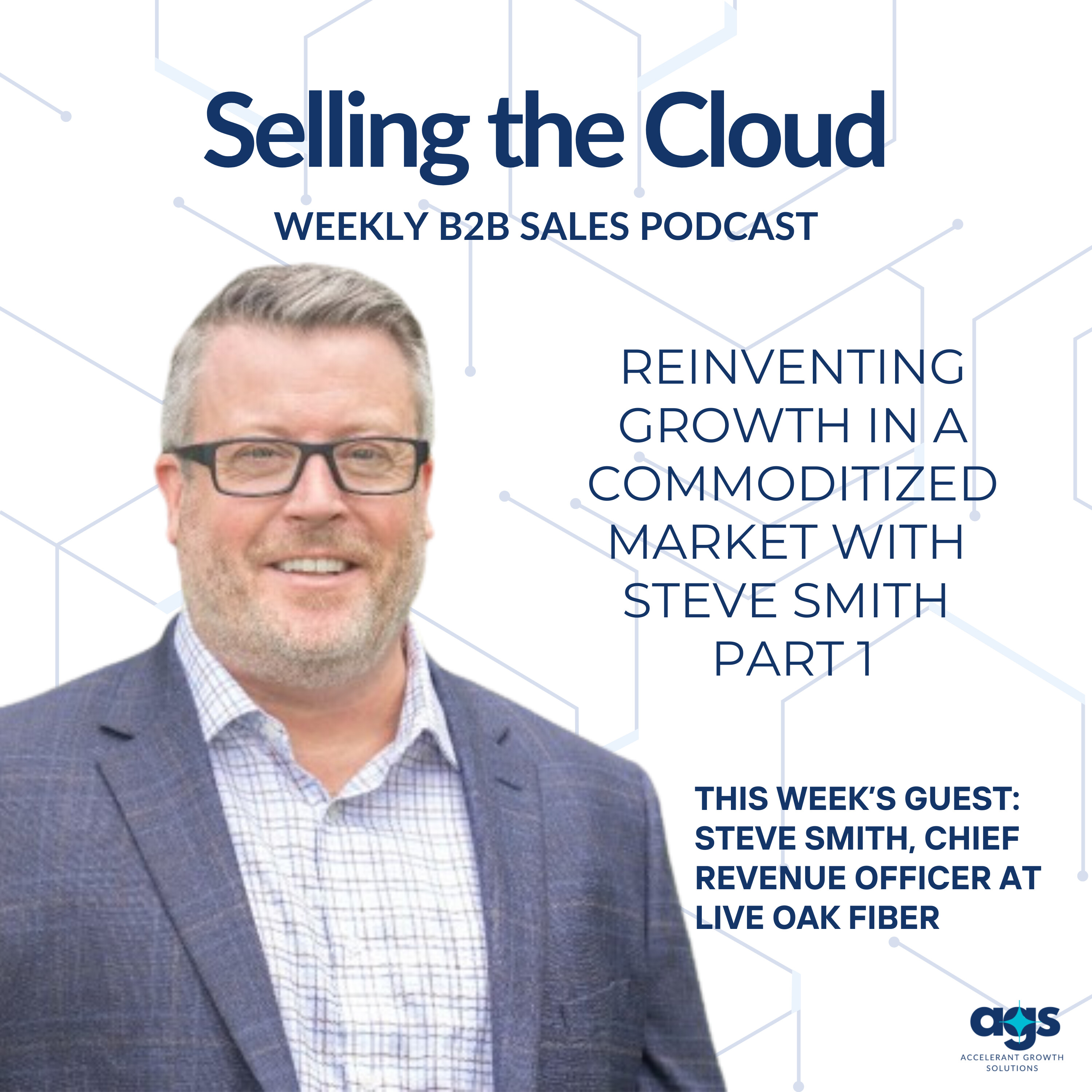
Ep. 93 – Reinventing Growth in a Commoditized Market with Steve Smith - Part 1
Podcast: Selling Intelligence (formerly Selling the Cloud)Published On: Tue Sep 16 2025
Description: In this episode of Selling the Cloud, Steve Smith, Chief Revenue Officer at Live Oak Fiber, joins co-hosts Mark Petruzzi and KK Anderson to share what it really takes to stand out in a commoditized market. Drawing from 25+ years of telecom and GTM leadership, Steve reveals how Live Oak is building a “fiercely local” go-to-market model powered by customer obsession, simplicity, and a people-first sales culture.From recruiting talent outside the industry to treating broadband like a luxury retail experience, Steve breaks down how to differentiate when your product looks the same as everyone else’s on paper, and why NPS scores in the 70s are possible when you design everything around the end user.What You’ll LearnHow to Compete in a Commodity Market: Why Live Oak avoids tech jargon and positions packages around home square footage—because customers don’t care about speeds, they care about experiences.Hiring Outside the Box: Why Steve hires from Louis Vuitton and paddleboard shops, not just telecom resumes—and how that decision drives creativity and customer care.Fiercely Local GTM: Learn how a hyperlocal mindset builds trust, unlocks referrals, and builds brand advocacy—especially in overlooked communities.Customer Experience that Rivals Apple: How Live Oak’s white-glove service and full-time technicians boost NPS to 76 (compared to cable companies’ scores below zero).Product Simplicity That Wins: How pricing transparency and a “price-for-life” model inspired by the Savannah Bananas builds loyalty and eliminates churn frustration.Key TopicsBuilding a customer-first sales cultureDifferentiating when your product is a utilitySegmenting sales teams by audience (residential, MDU, SMB)Why most broadband companies have a bad reputation—and how to flip itLocal community engagement as a growth strategyMetrics that matter: NPS, feedback loops, and service consistencyGuest Spotlight: Steve SmithSteve Smith is the Chief Revenue Officer at Live Oak Fiber, where he leads go-to-market strategy across residential, business, and MDU channels. A veteran telecom executive with a passion for customer-first innovation, Steve is helping redefine broadband with a culture that starts and ends with people—both inside and outside the business.Resources & MentionsBook: Good to Great by Jim CollinsBook: Start with Why by Simon SinekInspiration: Savannah Bananas (yes, really!)🎧 Listen now and subscribe to Selling the Cloud wherever you get your podcasts. Stay tuned for Part 2 with Steve next week!Mark Petruzzi (00:31)Welcome to today's episode of Selling the Cloud podcast. We're excited to welcome Steve Smith, Chief Revenue Officer of Live Oak Fiber. Steve is a seasoned telecom executive and growth strategist with more than 25 years in leadership roles across sales, marketing, and product. At Live Oak Fiber, Steve is helping to redefine how broadband providers can stand out in the world.where internet service is both a necessity and a commodity. Under his leadership, Vivo has adopted a customer first model from hiring outside the industry to building fresh perspectives that simplified billing and driving net promoter scores in the range of Apple, not in the range of many of their competitors. Today, Steve will share what it takes to build growth cultureand differentiation in a commoditized market, lessons that apply well beyond technology to any CRO or CMO navigating crowded competitive categories. Four themes for today. Building a people first go to market organization, so powerful. Differentiating in a commoditized market, I guess I would say so, so painful sometimes. Balancing residential business and MDUgo to market motions, and how to leverage AI community engagement for growth as well. This episode is packed with practical insights for revenue leaders looking to drive loyalty, accelerate adoption, and differentiate in highly competitive markets or less highly competitive markets if there are any of those still out there. Let's dive in. Welcome, Steve. We're so happy to have you here on Selling the Cloud.Steve Smith (02:07)Thanks, Mark. Thanks, KK. It's great to be here. I'm excited to have this conversation. I'm always excited to talk about Live Oak.Mark Petruzzi (02:09)Excellent.Yeah, for sure. And we've had some nice little discussions as well before this. So we think we've got a good one for you. Topic one, building a people first go to market organization. So Steve, you have said your biggest early advantage was hiring people outside of telecom. And tell us a little bit, that was also at some of your other telecom companies that you've worked for or if that's been a new approach at Live Oak.Steve Smith (02:19)Yeah.Mark Petruzzi (02:38)And why was that decision so important?Steve Smith (02:42)I've always looked for people that bring fresh perspectives. think industries that are older, it's easy to get into a rut. I think over past 20 years, I've hired people that ran, for instance, there's a gentleman in Chattanooga, I worked for a company down there, and one of our first hires was the gentleman that ran the rec soccer league program. He was in charge of scheduling all the fields, recruiting referees, and needed someoneHighly organized and local, and his name's Billy Tendal, if he's listening, and we got Billy, we were excited to have him, and now he's probably 20 years in a career in telecom, but Billy was highly organized. He understood people, and he understood what made people tick, and how to navigate all that. People can get a little testy on their soccer field scheduling, so that's how we got Billy. But that was just one example, and at Live Oak,definitely intentionally got people outside of telecom because they bring a fresh perspective. They bring creativity. I look for people that have a customer first mindset and when you have kind of an older industry you need these fresh ideas. You need energy and you need people that are really kind of bought into your mission and what you're doing and if they have the will you know you can teach them the skill but you can't teach that customer first centric thing.We have a lot of people that have sold paddleboards. I've had some top salespeople that have rented beach chairs. The first sales manager we hired who's now a director, she ran sales for Louis Vuitton here in Denver and Aspen. Louis Vuitton and Lululemon are two brands that she worked for. if you're listening, if you're familiar with those brands, like my daughters and wife would knock me down to get into a Lululemon store and...If one customer's upset, they're all upset. And if you have that mindset and you bring that to telecom, it's disruptive in a great way. So yeah, it's always worked out. Always worked out, though.Mark Petruzzi (04:22)Yeah, andSteve, you've already proven that you're bolder than me because I've done that and I have accomplished some of that throughout my career and I've done it in a different way. Forget about just legacy industries, but even new industries or kind of middle of the road industries, that fresh idea is so, powerful.Steve Smith (04:35)Okay.Mark Petruzzi (04:44)But as you were describing what you've gone through, it reminded me of some times that I've lost that battle. And for example, like where I've had to go to a board and get approval for that type of hire or that individual or working, I've worked a lot with private equity companies and private equity company and operating partners coming back and being like, you're crazy. This other person we're talking about is just.Steve Smith (04:49)Yeah.Mark Petruzzi (05:09)12 years and exactly what we're doing here and you're telling me you want to bring somebody from the telecom industry into this SaaS software company. maybe I should have been a little bit more bold and little more, just persevered a little more. And I'd have some more stories that mirror your stories as well, but very impressive.Steve Smith (05:27)Well,don't all work out, but for the most part they do. If you're betting on people, they do. And I like to bet on people. And you get athletes. When you look at teams when they're drafting players, they always have, okay, I need to fill this position. But if they get to the point in the draft where there's an athlete on the board, maybe doesn't fit what they're looking for, but can play, they get that person. They get that person becauseThey're adaptable. They can wear many hats. They can deal with adversity. And then you can figure out where they fit. I think that book, Good to Great, talks about get the right people on the bus first. And then you can figure out where they sit. But get them on the bus. mean, entrepreneurs, a lot of times, and you interview people and they'll say, we want an entrepreneur. And they really don't because it's kind of messy.Mark Petruzzi (06:05)I love it.Steve Smith (06:14)So you have to have, I think in the case of Live Oak, I think we got lucky and blessed that we had some investors that were okay with messy. wanted, entrepreneurs starting something new is messy. For some people that are crazy like me and some of the first 20, 30 people we hired, that's fun. For others, that is absolute chaos and they're gonna get upset quick. So it just takes time, but having those fresh perspectives. The other kind of example I look at is thatThe movie Ford versus Ferrari is a great example of an entrepreneur working with an old company and they took a bet on Carroll Shelby and they crushed it. They beat a brand that had won that Le Mans race hands down for, I don't know, 20 years. And they got so good, they were good at building machines and he was good at managing people that were eccentric but were athletes. But they could build a machine that could go incredibly fast, they could work together to do it. Didn't fit into the Ford mode.Mark Petruzzi (07:03)No way.Steve Smith (07:03)of course, but thatwasn't what they wanted. They wanted to win Le Mans and I think when they won it, the year they won it, they won it first, second, third. They were so far ahead that they had to ask the lead driver to slow down so they could have a photo finish, one, two, and three. So that is a great way to kind of look at it. It doesn't always work out, but sometimes you win, sometimes you learn. I've learned a lot. I've learned a lot, Mark, so you know.Mark Petruzzi (07:16)hahaKK Anderson (07:18)Wow.Well, and.Steve Smith (07:28)It happens.KK Anderson (07:29)in thinking about, especially kind of our theme today with selling in a commoditized market. And, when it's a commodity, it's the same as everybody else, right? These are items that are utility, if you will. And when you were starting Live Oak Fiber, in a telecom industry where there's a lot of competition and everyone in their mind has their sort ofmindset and perspective or perception, if you will, of what a telecom company does, what might differentiate them. when you're hiring outside of telecom and you're bringing in kind of those passionate customer-focused sellers, I think by default you're breaking the mold because they're not just going to go sell a commodity because they don't know anything about it.Steve Smith (08:03)Ahem.Well, and them not knowing about it is a huge advantage too. When we brought people on, it's literally like you get a focus group of people that will tell you how to sell the product because we get in a rut. We use acronyms. Telecom is notorious. We have a lot of acronyms and we get so used to saying and we forget. We think we're selling technology, but it's really a solution. And when you bring someone in that's not from the industry, they'll tell you how you should sell it because it speaksSo you have this own group and I tell them this constantly I'm like always go back to when we first talked like that's the perspective I need don't get wrapped up in the doodads and the Connectors and the acronyms think about how we positioned the product in the beginning and how we spoke about it a good example for us was in the beginning talking about packages for residential customers we Decided that most people most people really believe the internet is the Wi-Fi in their houseAnd most people know how big their house is, how many rooms they have and devices. So we've designed the packages around square footage in homes. And if your home is about this big, most people know, then you probably should have this package. And that made sense. It was easy to talk to people about that. It was a lot easier than trying to tell them about speeds, which nobody understands. The quality of a speed, like a fiber versus a wireless connection or whatever, theyKK Anderson (09:25)I still don't understand that.Steve Smith (09:28)Yeah, nobody does. They just want it to work. They will not say the internet doesn't work, they'll say the Wi-Fi is out. Well, what's the Wi-Fi isn't working. So that's how they relate to it, and that's how we started positioning the products in the beginning. But to get out of that commodity mode is difficult, and it is a race to the zero. And what we decided initially was we would be fiercely local.we don't have, a lot of companies have a mission statement. We decided to have a, why. Why do you come into work every day? And we followed this, Sinek is the one that invented this. He wrote a book, you know, Find Your Why. And if you find your why, then people do more. And our why is to improve the quality of lives of the communities that we serve through technology. And that's it. So if you take your why and apply it to problems as you go through the day,KK Anderson (09:58)Mm-hmm.Steve Smith (10:12)It's really easy to get to a customer focused mindset. We're there to serve. So we talk about the communities we serve and our customers live in these communities and we want to be their local internet company. And we have customers online say, that's, I have, you know, I love my Live Oak. And that when they say that I'm like, okay, we're, we're on message. on, we've, we've, it's the best feeling and it's more than internet. You know, it's we want them to be aKK Anderson (10:30)That's gotta be the best feeling.Steve Smith (10:36)partner they value, not a bill that they tolerate. I think if you rate different types of things that people spend money on, the things that they really hate to spend money on or hate to interact with is the dentist. Sorry for all the dentists out there, but you already know that. But then it's the cable company and probably a close second is your mobile company. And you don't really care to hear from them. You get a bill, you pay it, my gosh, is it really this much this month? And you don't get any interaction from them or any great ideas.We look at as we try to change that paradigm and make it a better experience if they do interact with our people. So, hey, let me help you get your streaming hooked up. Some companies will outsource their technicians. We have full-time technicians. Full-time technicians with Career Path, because that's really the face of our company. Yeah, they're gonna see me, unfortunately. I have a face for radio. Maybe they'll hear me, but they're gonna see those technicians, or they're gonna remember them by name. And sometimes they take their cell number, because they're gonna stay and make sure, hey, I'm gonna...I want this to be almost a white glove experience. When I leave the customers home, everything is going to work. The gaming is going to work, the streaming, they're going to know who to call if there's an issue. And I think that's the mindset we have. And that's how you separate it from the commodity. It's hard. You get a lot of noise toKK Anderson (11:42)I love that.Fiercely local. I absolutely love that. That's incredible. And do you have a commercial organization as well where you're selling to businesses?Steve Smith (11:51)We do. have our sales teams are organized around the customer types. So we have a group that works mainly with residential customers. We have a group that works with business customers. And then we have a group that works with multi-dwelling units. So you have town homes or condos or resort campus locations and homeowners associations. And those are specific sales teams, professional sales teams that understand those customers and what they're looking for. Now everybody knows what everybody does.So there's handoffs. if a business customer, if you sell a business in town and you join a chamber, they probably have a home in the town. So you pass that lead off to the residential team. Or if you're a residential user, you probably know someone that has a small business and you can start to get this cross pollination on referrals and things like that. So that's how we delineated at Live Oak.Mark Petruzzi (12:36)I love it. So Steve, you've compared your approach to the Savannah bananas ticket pricing. I have, and I guess that's kind of simple, transparent, no hidden fees. Make a comment of Savannah bananas there, just a sidebar. When that came out, when I first saw that was out there, my initial reaction was no, never.these guys flipping around and doing that and throwing the ball. But it keeps kind of showing up on some of my sports feeds and surely but surely I'm starting to say like, know, wow, maybe we do see this. Now I don't have any, eight year olds, 10 year olds that would, you know, in my family at this point. So it'd be a little harder to go to Savannah Benton Bananas. Maybe I would have been a little more inclined. ButSteve Smith (13:00)Yeah.Mark Petruzzi (13:23)But I have to say that level of connection they have to their customers, to their target market, it's incredible. So for you, how does that translate into loyalty? How does that transfer into the customer experience?Steve Smith (13:33)It is.Well, to be fair, I didn't know about the Savannah Bananas either when we started Live Oak about three years ago. And I heard about them and a friend said, if you ran a baseball team, this is probably what it would end up as, you know, all these shenanigans going on. And so of course I was interested in it and, but we were already kind of down the path. So we were trying to do the opposite of what the large cable companies did. a lot of times you have fees or whatever you buy online.Mark Petruzzi (13:51)Hmm.Steve Smith (14:05)Every other thing that you buy online, you say it's $12.87. It's literally $12.87. It's not $12.87 plus some strange fee, some strange fee. It is what it is, except for, unfortunately, a lot of these subscription telecom services. It starts to get a little wonky. So we just eliminated that and we don't have those fees. And we had to overcome a lot of kind of market confusion around that. We even offered aThe first promotion we did, which we still offer, is Price for Life. Because people literally feel like, okay, I get it, you're gonna give me this rate for a year and then you're gonna come back to me and jack it up at 20 bucks and I'm gonna have to wrangle my way back. So anyway, that's what we did. But as we got going, I ended up finding out about the Savannah Bananas, which is a great story. The guy that owns it is Jesse Cole. And I started listening to how he did it and he was a startup. There was a nearly abandoned baseball stadiumSavannah and he said I've got this idea about baseball. He went through the startup Savannah incubator there and they helped him. I mean of course they were like absolutely we'll help you do something with that abandoned baseball stadium that's a kind of an eyesore and he created a brand out of it and he was like he goes through a lot of the so if you order a ticket from the Savannah bananas and it's $20 it's $20.Mark Petruzzi (14:57)Wow.Steve Smith (15:20)It also includes, if you do it at the home stadium, you get a coke and you get a meal. So it's a two hour show, kind of like the Harlem Globetrotters, but with baseball. And it's hard to create that in baseball, but he's done it. And they have meetings all the time. Now he's got spinoffs because there's the party animals and I think there's now there's new teams like the tailgaters and the firefighters. And now he's like running all these groups that are, banana ball. They have like rules about banana ball, butMark Petruzzi (15:26)Yeah.He did it.Steve Smith (15:45)if you watch him, talks about the customer experience and that's everything. he's super successful and we just happen to be in the same area at the same time and I haven't met him yet. But I love everything that he's doing and if I can incorporate more of what Jesse's doing into us, absolutely, because it works. Customers are really connected with him.Mark Petruzzi (16:02)Maybe you shouldsign them up as your corporate sponsorship.Steve Smith (16:08)We're in discussions. a sponsor yet.Mark Petruzzi (16:10)There you go.KK Anderson (16:11)that'sWhat's so funny is I actually remember where I was sitting at Los Tios restaurant on Westheimer in Houston the first time I saw the Savannah bananas. And I was like, what is this? what? Because we're like, why are the Astros not on? And we ended up watching it and we were laughing so hard and we had so much fun that night. I, my customer experience wasSteve Smith (16:22)Yes.Right.outstanding.KK Anderson (16:33)Like, wow, this is so cool. I was immediately on their website. Like, how do I go see them? Yeah, it was really cool. Okay.Steve Smith (16:36)Right, right. Yeah, they get great,great connections.KK Anderson (16:41)Steve, one thing I know you're super proud of is your Net Promoter Score rivals Apple's, which is awesome. And most broadband providers, their NPS scores are in the toilet, or far lower. So I don't know, tell how you achieve that and tell me the numbers. Like what's yours, what's kind of somebody else's? I think it's super important to differentiate.Steve Smith (16:53)their love.We measured quarterlynow. We're going to go to a transactional measurement. For those listening that don't know, a net promoter score is how likely is someone to purchase a service to recommend it to other people. And they rate that number on a zero to 100. most cable companies are very, and you can be negative. So most cable companies, if they're lucky, zero to 10. Most are negative.Mark Petruzzi (17:23)Wow.Wow.Steve Smith (17:24)Well, right, for all those reasons. And then if you get a good, a decent broadband provider, a new broadband provider, you're probably in the 40s or 50s. Google as a company, separate company, probably runs in the 60s. Apple runs in the 70s. We're 76, which we're super proud of. And we measure it every quarter, so thank you, it's a lot. And the best thing about it though is if...KK Anderson (17:41)Congratulations.Steve Smith (17:46)Rich Shea is our COO and he said, we pulled the numbers and he's like, is this true? If people interact with our customer service team, that number actually goes up by 68 points. So that's true, six to eight. It'll go up to 82 84 because we have people that they're bought into the why and they want to solve the problem. So we're very excited about that. We're moving to a transactional model.KK Anderson (17:58)By how many?Wow!Steve Smith (18:11)So you're probably familiar after you have an install or you eat at a restaurant, they say how good was our service? And you rate them, that translates in that five questionnaire thing will translate into a score. And so we use that and we look at that, we try to figure out who's upset and how we can work with them and to bring it up. We're happy with the ones that are happy obviously, but that's just part of, that's just one of the.I call it the money ball statistics that we focus on. We don't focus on all of them. We try to find the important ones. And that's definitely a key one. That's a differentiator.KK Anderson (18:44)so you do like real time customer feedback. Like when, when your technician's walking out the door, they're getting a text message with five questions.Steve Smith (18:50)We'reyoung, that's our next phase. That's what I would call transactional NPS. And that's what we're gonna do next. And I'm excited to see how that looks. And yes, it's gonna rate people down to the resource level, how good you do, but our folks are competitive and they don't, this will be good for all of us. So today we just do it, we do an email and we have a very high participation rate for that.You've got to get a certain amount. I wish I knew the numbers off the top of my head, but it can't just be like five people. can't call your mom and your grandma and have them skew the survey. You've got to have a certain amount to fill it out to get that number. We do it through a third party, it's legit number. We're excited about that.Mark Petruzzi (19:27)Cool.See Privacy Policy at https://art19.com/privacy and California Privacy Notice at https://art19.com/privacy#do-not-sell-my-info.
The note was deleted
The note was saved
Your message was sent