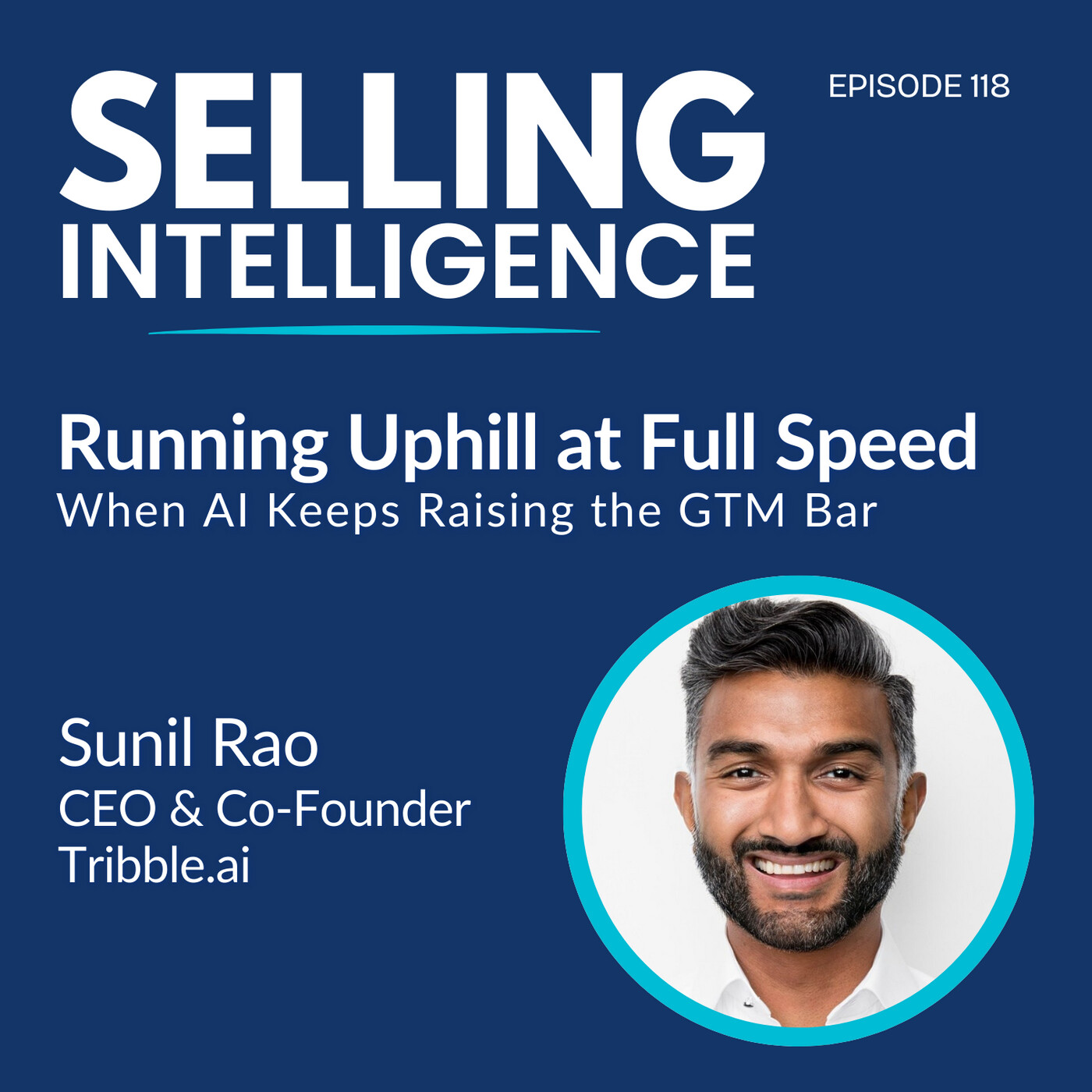
Ep. 118 – Running Uphill at Full Speed When AI Keeps Raising the GTM Bar with Sunil Rao – Part 1
Podcast: Selling Intelligence (formerly Selling the Cloud)Published On: Wed Mar 18 2026
Description: In this episode of Selling Intelligence Podcast, Mark Petruzzi and KK Anderson sit down with Sunil Rao, founder and CEO of Tribble, to explore how AI is reshaping enterprise sales, go-to-market execution, and the future of software itself. Sunil shares why AI-driven productivity alone is no longer enough to create advantage, how the rise of agents is changing what software should do, and why trust, personalization, and institutional knowledge are becoming even more important in a world flooded with AI-generated noise.The conversation dives into the productivity paradox, the coming consolidation of fragmented SaaS tools, and the shift from software that assists humans to systems that can actually take action on their behalf. What You’ll Learn:The Productivity Paradox: Why AI makes everyone faster at the same time, raising the bar instead of creating instant advantage.AI and New Work Creation: How efficiency gains in one part of the workflow can create new review, oversight, and decision-making work elsewhere.Differentiation in an AI World: Why personalization, timing, and relevance matter more now that everyone has access to the same tools.From SaaS to Agents: What separates AI-assisted software from agentic systems that can actually do the work.Trust in Autonomous Systems: Why transparency, confidence, and clear decision logs are critical when AI operates inside core business systems.Key Topics:The treadmill problem in modern sales productivityWhy AI has upgraded everyone at the same timeThe flood of low-quality outbound and the need for precision engagementUsing digital exhaust and customer signals to guide better sales conversationsWhy traditional scaling models relied on people because software could not solve the problem yetHow fast-moving foundation models are changing product designThe coming consolidation of SaaS point solutionsWhy the future interface may be lighter, with more approvals and fewer manual workflowsBuilding AI-native products that can evolve with each new model releaseReducing SaaS fatigue by designing for orchestration, not more app sprawlGuest Spotlight: Sunil RaoSunil Rao is the founder and CEO of Tribble, an AI-native platform built to help enterprise sales teams scale knowledge and automate critical go-to-market workflows. Before founding Tribble, Sunil began his career as a software engineer at SAP and later held leadership roles at Salesforce, including GM of Consumer Goods. Tribble was founded in 2023 and has quickly gained traction for helping companies automate RFP responses and improve GTM efficiency with AI-native workflows. Resources & Mentions:TribbleSalesforce Ventures generative AI fundRFP automation and response workflowsAI agents versus traditional SaaS applicationsSaaS consolidation and platform orchestrationThe role of trust and transparency in AI adoption🎧 Listen now and follow Selling Intelligence Podcast for more conversations on AI, modern go-to-market strategy, and the future of enterprise sales.Mark Petruzzi (00:31)Welcome to today's episode of Selling Intelligence Podcast. I'm thrilled to welcome Sunil Rao, founder and CEO of Tribble, an AI native platform that's fundamentally changing how enterprise sales teams scale knowledge and automate critical go-to-market workflows. Sunil's journey has been fascinating. He started as a software engineer at SAP.moved into leadership roles at Salesforce, including and general manager of consumer goods, and then founded Tribble in 2023. Tribble was quickly added to Salesforce's ventures, $500 million generative AI fund, and has since revolutionized RFP automation, helping companies like Clary, Sword Health, and others slash response times by up to 80%.Today we're exploring a critical challenge facing every sales leader. AI is making us more productive, but the bar keeps rising. It's like running on a treadmill at full speed and just when you your stride, the incline keeps going up. How do you stay ahead when everyone else has access to the same productivity gains? We're gonna focus on four critical themes. The productivity paradox, why AI-driven efficientisn't enough to win anymore. From software to agents, building AI that actually does the work, not just assists, scaling institutional knowledge, the hidden competitive mode in enterprise go-to-market, and the human element, where AI should take over and where it must step back. Sunil.First off, we're really happy to have you here. Thank you for taking the time with us and welcome.Sunil Rao (02:10)Thanks for having me. It's nice to be with you all.Mark Petruzzi (02:12)Excellent. So topic one, the productivity paradox. Let's start with what you have called the treadmill problem. Every sales team now has access to AI tools, chat GPT, co-pilot, all these niche engagement and enablement platforms. And all sales teams are getting more productive, or at least the ones that are investing in this. But here's the thing, if everyone's running faster, you're not actually getting ahead. You're keeping up with the pack.And worse, buyers' expectations are rising because they know that you have these tools. So how do you think about this productivity paradox?Sunil Rao (02:47)Productivity paradox, it's interesting because I think there's a couple of ways that I like to think about it. You obviously have this tremendous technology. It's almost magical. It's been distributed to everyone almost simultaneously. And they're all able to see how much productivity it brings into all aspects of their job. But I back to beginning of when we started Tribble, and this is when Chat GPT has just come out, November of 2022.And everyone had that aha moment of, whoa, this thing can write coherently for such a long time. It can actually write code. It can write snippets of code. And it just started to become a way for you to use in your workflow versus going to Google, searching for information. This thing can synthesize knowledge. So when you look at that and that impact,It already was a tremendous time saver for a lot of smaller jobs. But I think what's been going on and what's been happening over the last few years with these foundation models getting better and better, it gets to the point now where these systems can run for hours on end and complete much more complex tasks. And that's where it's more interesting where, you know, what was not possible to solve with software three years ago.is possible today. And that's where agents come in and everything comes in. it's interesting because like you have that happening in one side and it's really magical technology. But then at the same time, you kind of create new work.when you have access to this technology, because now everyone's a creator. And I see this a lot in the engineering side. Everyone's writing more code, and then it's the question of who's reviewing it. If everyone's writing more content to go in documents, who is doing the human check? So you have this trade-off of, yes, there is efficiency in one part of the process, but you end up creating some work elsewhere. So I think it's the paradox, because it actually changes the distribution of where work is being done.KK Anderson (04:30)Really, really interesting. So when we think about it from, you know, a sales or revenue perspective, right? It's, you know, for, for so many years, it was, do you have this Salesforce CRM? Do you have this outreach, you know, program set up? Do you have this automation set up? And it was, you were always running to keep ahead and to keep up to pace with all of the different technologies that were available. And that was just sort of table stakes.Right? And now with AI, as you just said, like everybody has it. And so now it's how you use AI is, is, and how you become a, differentiator using AI is the new game. Because otherwise it's this, we, you know, ⁓ as Doug Landis, one of our good friends and colleagues says is we're in a culture of sameness right now.Sunil Rao (05:15)Mm-hmm.KK Anderson (05:16)an era of sameness, I think is what he says. So talk to us a little bit about that. So now here we are, we all overnight got Chappie, GBT and these amazing programs. How do we differentiate ourselves in this world of AI?Sunil Rao (05:30)it's an interesting way to think about it, right? It's almost like everyone got upgraded, but exactly to the same level. So then how do you differentiate is the It's how do you stand out from the pack? And, you know, and I take the example of outbound and emails. Like I think what's happened, it's both a gift and curse.KK Anderson (05:37)Yes.Sunil Rao (05:45)I mean, I'd it's more of a curse because now there's so much garbage when it comes to outbound, right? In terms of mass generation of emails that are not personalized, that are not targeted. And I still think that the age old, you know, what makes you really good about that style of top of the funnel engagement is when you are very personalized and targeted. think that just actually gets even more amplified as an important way to stand out, right? Don't, don't try to sell something to the masses. Really think about what signals.indicate that this may be a buyer that's interested and engage with them on the journey at the right time becomes way more important. Because otherwise, you're just feeding into the sea of noise that's being generated because we have these tools that can mass create this content. So I think there's that aspect of it. How can we be much more tailored on the engagement side? And I think about it at different parts of the funnel. For us at Tribble, we think deeply about this problem.when we talk about our customers using our products and how they engage with their customers. So we look at it from two sides of that coin. Mark, you'd shared our respond product, which is all about responding to RFPs, responding to customers. You have to be very particular about what it is you do as a business, how you differentiate.And that's informed by your conversations, your knowledge basis and all this stuff internally allows you to differentiate against your competition. But then on the engaged side, where we have software that helps BDRs, SDRs and others engage with their customers. Like we think really about what is the information that we have captured in all the digital exhaust with all the touch points we've had with this customer that indicate that this is in fact something that they're interested in. And how can we in real time kind of guide that conversation and coach it? So we get to the.And I think customers really want that level of detail and personalization because otherwise you're kind of feeding the sea of noise like you've said.KK Anderson (07:29)All of a sudden to be human is to be cool.Mark Petruzzi (07:30)Yeah.Sunil Rao (07:32)I mean, I think people arepurposefully putting spelling mistakes in LinkedIn posts because it's like now become a sea of, and you see it, right? When you look at the posts and you see the dashes, the end dashes or the dead giveaway of ChatGP, everyone's using them now.KK Anderson (07:43)yeah. The dashes,Mark Petruzzi (07:44)100KK Anderson (07:45)I can't, emojis make my blood curl now. I'm like, ⁓ you know?Sunil Rao (07:50)KK,like, here's a funny question. I actually thought about this the other day. I actually don't know how to type the dash on the keyboard. So it's like, where is it coming from?KK Anderson (07:55)I don't know.Mark Petruzzi (07:56)That is great. You know what, Sunil, when you mentioned the top of funnel and what's happening there, that's an area that KK and I spend a lot of time with our clients to make sure that they don't fall into this AI paradox where five years ago, before we were in the,KK Anderson (07:57)really don't? That's awesome!Mark Petruzzi (08:18)Gen. AI era before it even had a name. You saw that there was so much outbound going to prospects and customers. And what we found is there's been more damage in that than benefit in a lot of companies, meaning they are pushing more potential clients away than in some cases they're ever bringing through the door.So taking you back to your time at Salesforce and when you were running your go-to-market operations initiatives there and seeing all the inefficiencies that were happening with customers of Salesforce but also right in with Salesforce as well, what was the breaking point for you that made you realize traditional approaches to sales productivity were just fundamentally broken?Sunil Rao (09:07)You know, I think it's.Once again, this comes back to the point earlier of what is now solvable by software simply wasn't solvable five years ago, right? So what did you do? The problem was solved by hiring humans and kind of building processes, building checks, building scaling functions, building these expert groups within the company that house knowledge that would scale the rest of the organization. You invest heavily in resources like that and all the supporting functions and resources to keep them going. And I think, you know, thatthat goes far and frankly if you don't have the technology you have today, that's the only way to do it at the time.For me, the inflection point clearly was the rate of change of the technology outside that was indicative that, hey, if I had to build a company from scratch today, I would probably not staff it the same way, given where tech is at this moment in time. That was 2022, right? And then you go forward in time one year, the number of people factors down even further because the technology is now improving at an exponential rate. And you fast forward another two years and it's crazy how fast things are moving. So I think, like I would saythe tools and capabilities and what it is that you are building from a scaling standpoint, as more is becoming available outside, really how quickly can you factor that into the organization and how quickly can you grow? Like this has to be top of mind for every executive at every company right now, right? And I think that that is changing at such a fast pace that folks are just open to having those conversations now and like really thinking, how do we build this differently?KK Anderson (10:32)And it, does it become less fragmented? Right. Or more fragmented. You're adding in, there's a big one million AI products and solutions out there. And there's one, you know, go to market inside this, this, this company. Right. Like, how do you even begin to look at and think about.you know, how you're gonna weave in and out all of these products and how they're gonna talk to each other and I don't know, talk to me a little bit about that.Sunil Rao (10:55)Our thesis on this is there's a mass consolidation coming. And I don't think that that is a very unique point of view. I think most people realize it. The general purpose nature of the underlying technology serves itself very well to addressing many use cases. And what I mean by that is when we started the company, thought about a category and we were, the vision was always to do something much broader and go to market, but then you kind of say, hey, what's the thing I'm going to do tomorrow really, really well?And we picked RFP. And the reason for that was it's a known problem. People knew how to buy software in that domain. And there's a lot of pain there. But that being carved out as a product category, and this is true for any other category of software, these are artificial boundaries created as, this is a category of software. There's a level of functional kind of capability locked in it, technical difficulty to enter it and build it.But there's no reason sometimes these adjacent categories shouldn't be talking to each other. So think, KK, to your question, I think people will expect tools to do a lot more. Hey, I want you to be a tool that does x, y, and z, not I need a tool for each of these. I think the last decade with all this fragmentation of SaaS and so many point solutions, there's just fatigue in buying. And AI is now going to be a consolidation on top of that. Because the beauty of this technology is it can connect to the downstream systems and become the new interface ontop of several so it can orchestrate across them right and I think a lot of the companies that are building like us have that as an advantage.KK Anderson (12:18)Makes a lot of sense. let's take us into the second topic here from software to agents, just as you're talking about, and building AI that actually does the work and not just assists in the work. And you've made a very deliberate choice with Tribble, and you didn't build another SaaS app, right? You built an agent. ⁓ So talk to us about the fundamental difference betweenAI assisted software and truly agentic AI. I think a lot of our audience and sales leaders would like to really understand that. And why does that distinction matter for go-to-market teams?Sunil Rao (12:54)I think there are a couple of implications of thinking about it. just to orient how I think about this and what we think about it at Tribble. Software up until the point where this new stack of technology, specifically LLMs, vector databases, and everything that goes into the new kind of architecture has historically been, you know,You have a database and then you have a UX on top of that database and you have a whole bunch of workflow capability automation and even AI as it was, I it has been around forever, right? It just changes what it actually is. And that's been the way things have been built, but it really is predicated on this transactional data store on which a user interface exists for teams of humans to go operate. AndYou know, lot of companies have done really well. And even my previous employer working at Salesforce, one of the things they did really well is they did the cloud first really fast. And I still remember when we were talking to customers 10 years ago, comforting them that the cloud was a safe place to put their data, right? Now that's, that's not a problem anymore because folks have like taken that modality as a good, it's a good way to scale subscription model makes sense. Software makes sense when you deploy it in the cloud. ⁓and all of that stuff. So now what happens in the last three years is we've got technology that allows you to kind of short circuit some of those layers. So when we think about what is an agent-first product, well, what is the layer between where the data is stored and how it's served up to the user? And in which cases do you even need to serve it up to the user anymore? The entire idea of user interface for us, for us to go in there, see the knobs and dials, and change things.Mark Petruzzi (14:20)Thanks.Sunil Rao (14:25)I think that doesn't go away because obviously humans are in every company and they will continue to be for the foreseeable future. Then the question is, okay, what parts of that process maybe can we automate away where they don't need to see it, right? It doesn't get served up to the UX. So I think it changes the way you think about how you build these products becausewhen you have this broker in between you and where the data is stored, and you can rely on that broker to do some of the work for you, it's kind of like having a really, really capable employee that's going to do stuff and you trust them to do it. So like, if you had that as part of it, do you need to see a screen that's as busy? Maybe not. Do you maybe need to see as many screens? Maybe not. Maybe you just have approval buttons instead of actually seeing the detail every time. So there's these architectural implications in how you build the products. And I think, youBut the thing that also changes when you build it this way is when these foundation models, like these companies like Anthropic and OpenAI, they're moving at blistering speed. If your two model releases behind...you're not harnessing like 60 IQ points of new capability. So how do you build a product that can seat itself on top of that innovation and harness it as it comes out? That's the way you have to build software in the future. Now, if you built it the old way and you sprinkle the new stuff on top, you still have to bring along the old stuff for the ride, right? And, you know, lot of big companies have very, very smart people. I've worked with many of them. And when you have a large customer base using the old stuff, it's really hard to just go to the new stuff.Mark Petruzzi (15:25)Hmm.Sunil Rao (15:48)have to think about how you bring the old stuff along for the ride, right? So I think that's the way I like to think about it. When you're AI native, you've been given the privilege to make some choices that allow you to move a lot faster. And this could also just be true of startups, right? think it's like we're seeing it at an accelerated rate.KK Anderson (16:02)It's a master class.Mark Petruzzi (16:03)and Sunil, of the things KK will tell you about working with me is that, and I know it myself, I'm always focused on productivity. I use that word too many times in a day. And I've learned, having worked with many CEOs, having been a CEO myself, that you learn how these CEOs, some of themget caught up into the process and the control access or the control aspect rather is the right word of being a CEO versus an enablement aspect and just a value add role. And it's going to happen, it is happening the same way with agents just as you described. So I love how you describe this, the agents,have to be autonomous. This is not another form of automation. We're moving through much more productivity and ability to learn, get better, get smarter, do a particular job better. Now what I'm seeing now is a lot of customers and clients are looking at it and saying, okay, well, they're monitoring the agents. They want to see it just like a CEO that wants to be copied onevery email from every VP and up within a company. tell us a little bit about how you, like how do you feel that, how do you make that change? How do you get a client to look at this and say, I'm gonna be bringing these agents into your business with I know you're gonna have to do your due diligence and you're gonna have to really get confident in it.But when you get confident in it, let them roll. Look at them just like human employees, just unfortunately for us humans, they're a lot more productive. They don't take a vacation. They work 24-7, we don't.Sunil Rao (17:54)You know, I think Mark, it's a very timely question and KK, I think you said something along these lines at the very beginning. Trust.Right? Like it's never been more important and it's relevant to the fact that we have the sea of sameness, right? How do you trust that this is a real message meant for me? How do I trust that, you know, how do I trust this relationship from the very beginning? Are you just treating me as one of the many masses? I think that theme comes into even product strategy and how we think about where we show up with our customers.So if you are going to use a product, especially if you're going to use a product that you give a level of autonomy to, and it's going to go in right against your master and your systems of records, you better trust it. So then it's like, okay, how do you build that trust? What kind of transparency do you put into the product? do you make it very clear? The log of decisions that were made, right?Sunil Rao (18:40)Makes sense.Mark Petruzzi (18:41)let's talk about the SaaS fatigue problem. Companies are drowning in tools, licenses, and many unused platforms. Yeah, you built the company in the enterprise software space to go right at that. How did you design Tribble to avoid becoming part of the problem and rather being part of the solution?Sunil Rao (19:01)I think one of the things we deliberately did in the early days was really think about like, where are things going, right? Just in the next three to five years, what do we think happens? If you go back to ⁓ the way back machine, which allows you to see kind of websites from.can take look at Tribble's website in like December, 2023. had the headline, Kiss Your Apps Goodbye, Say Hello to Agents. And that was, founded the company in 2023, but it was very clear to us that, hey, this idea of having all these applications.KK Anderson (19:23)I love it.Mark Petruzzi (19:30)Cool, okay, so we'll jump in so let me go read that one again and we'll go and we'll do that question one more time.See Privacy Policy at https://art19.com/privacy and California Privacy Notice at https://art19.com/privacy#do-not-sell-my-info.
The note was deleted
The note was saved
Your message was sent