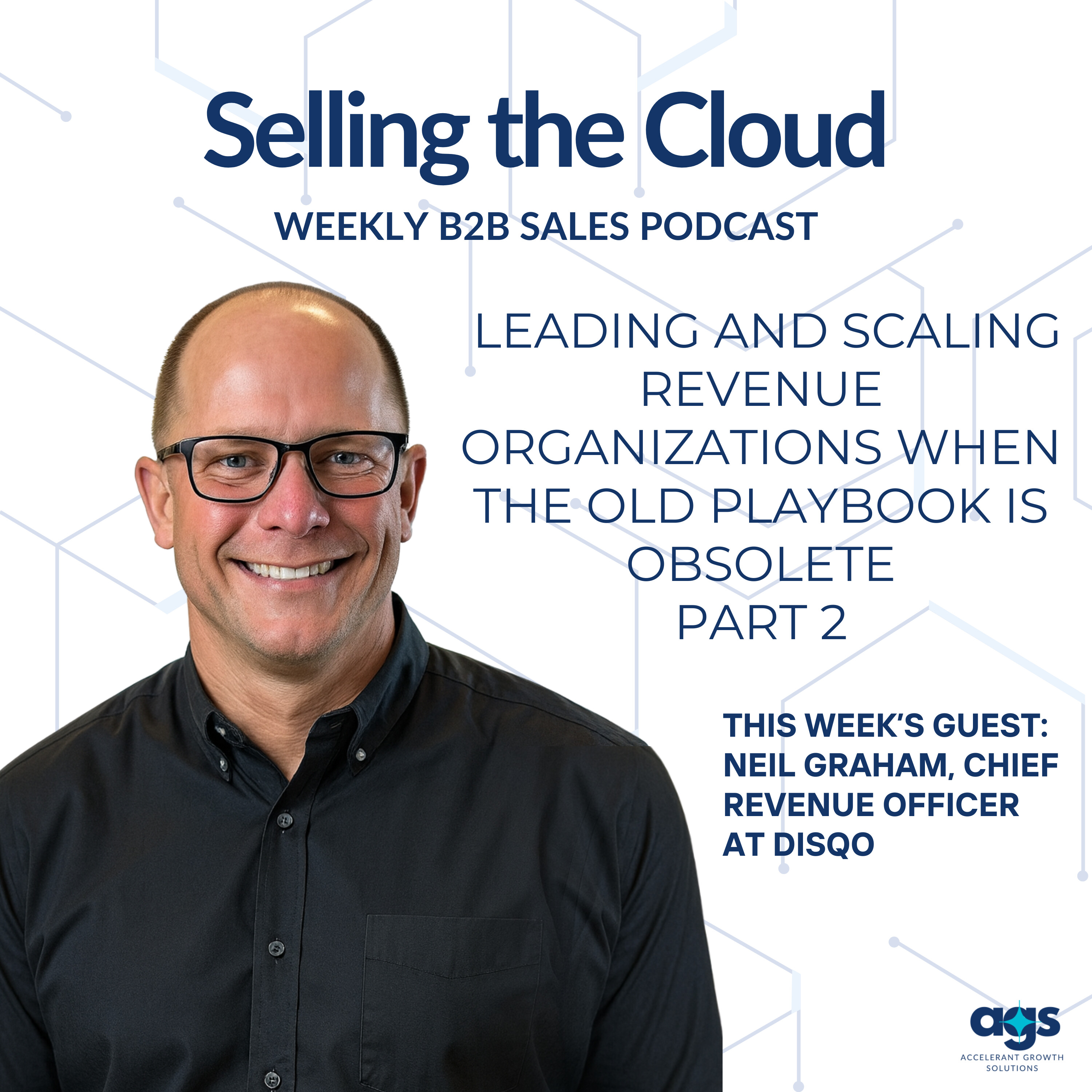
Ep. 100 – Leading and Scaling Revenue Organizations When the Old Playbook Is Obsolete - Part 2
Podcast: Selling Intelligence (formerly Selling the Cloud)Published On: Tue Nov 04 2025
Description: In Part 2 of our conversation with Neil Graham, Chief Revenue Officer at Disqo, we dive deeper into how modern CROs must rethink their org design, marketing execution, and AI integration strategies to stay competitive in 2025 and beyond. Neil shares why curiosity, humility, and bias for action are now non-negotiables; and how his team is operationalizing those values inside a flat, fast-moving GTM system.From building AI-generated deal strategy sessions to deploying 24/7 agents on the website, Neil unpacks the real-world tools and team behaviors that are reshaping sales and marketing execution. This episode is packed with tactical insights for CROs leading through change.What You’ll LearnFlatter Orgs, Bolder Execution: How Disqo’s three-layer model speeds up decisions and drives alignment across marketing, sales, and delivery.Non-Negotiables in Revenue Teams: Why curiosity, humility, and action orientation matter more than ever, and how to screen for them.AI as a Revenue Multiplier: How Disqo uses AI for outbound personalization, content creation, and automated deal intelligence.Coaching in the AI Era: How Neil’s RevOps team leads enablement through data-driven strategy docs and always-on insights.Creating New Roles for the AI Age: Why Disqo now has a dedicated AI strategy lead embedded in RevOps, and how other CROs can follow suit.Key TopicsScaling outbound without bloating headcountRedefining RevOps to include data, process, enablement, and AI ownershipDesigning a leadership team that balances vision and executionThe future of SDR and BDR roles in an AI-enabled GTMUsing AI agents for 24/7 coverage and real-time buyer insightsBuilding culture through feedback, modeling, and EQ-based hiringGuest Spotlight: Neil GrahamNeil Graham is the Chief Revenue Officer at Disqo. A proven growth operator and revenue architect, Neil has helped scale iconic brands like Salesforce, Siebel, and Jive. At Disqo, he’s building a flat, AI-accelerated GTM machine that prizes speed, ownership, and alignment over legacy hierarchy.Resources & MentionsCompany: DisqoFrameworks: MedPick, DSF (Disqo Success Framework)Sales Tools: Gong, Clay, ChatGPT, AI agentsLeadership Inspiration: Carl Schachter, Eli Cohen, John BarrowsBook: Emotional Intelligence by Daniel Goleman🎧 Listen now on Apple Podcasts, Spotify, or wherever you get your podcasts.KK Anderson (00:32)to drill into this topic, topic three, talking a little bit more about the flat org and the expanding CRO role, we've had this conversation quite a bit on our podcast about how CROs are now...taking responsibility of the marketing org, of the customer success org, of the sales org, of the entire go-to-market revenue system. And one of the things we see every day in our customer conversations is how disjointed marketing can be from sales disjointed product and from product management as well. And soas marketing is kind of folded in under you and this kind of this new flatter org and you mentioned that the alignment that you're having with your SLT every week but tell me a little bit about how this is helping to kind of bridge that gap between marketing sales customer success like the whole go-to-marketNeil (01:24)So I am a big fan of the CMO role in today's modern company and organization and, I know the SaaS and sort of technology world really well. So I'll speak from that perspective.I can't really make a comment on other industries, but I am a big fan of, the CMO's role, and, sort of ownership of a modern AI driven marketing strategy. that said, we're trying to innovate quite a bit and do some really cool disruptive stuff and shift the focus of our marketing strategy here. And my CEO is a big vision behind that as well. And,hoping that I'm actually a pretty good impact on that. and we've got some great leadership on our marketing team that's doing an awesome job thinking big and bold and in a differentiated way, but also really good at execution. And I think, this is a little bit of a side point, but I do believe in, making sure that on your management team, you've got a good, portfolio of leadership skills.from vision to execution oriented people. So you can do both. And we've been really careful to kind of put together our leadership team on the marketing team and the sales team. I don't own the success side of the business here, as you mentioned. We've got a whole, Chief Customer Officer owns all of our post-sale delivery and customer success functions, implementation consultants, all that kind of stuff. But doing a great job there.creating a leadership team that spans between visionary and execution oriented and has skills and that can kind of augment each other and kind of take both to market. That said, in marketing, I think what we've done a really good job at especially the last nine to 12 months, is shifting the focus to data-driven ROI creation activities and initiatives and making sure that everything thateverybody's focused on has proven results when it comes to lead creation and continued pipeline development of those leads into high converting opportunities. Right. And so we look at the data constantly in terms of how many leads, how many stage one pipeline deals were created, what conversion rates are going on and how much closed business happened from the marketing activities we're doing and dropping the stuff that doesn't have higher ROI.And for us, some of the traditional things that most people in this industry think drive a ton of output are things that we've actually cut. And just from a perspective keeping our own sort of information and strategies a little bit behind the scenes, like I'll just leave it at that, butin a pretty severe direction from less inbound and more outbound pipeline creation strategies with our marketing team and our marketing skill. that's been a lot more focused on demand gen, content, sales-facing, market-facing content, and overall product marketing.And those are the skills that we've really built out on the team. because, you know, getting into like the final subject a little bit, but we can dive deeper into AI. But I mean, because of AI, it's like, it's allowed us to do this. there's mass personalization that we can do at scale, truly. And people have always said, you know, mass personalization at scale. like today with the tools that are available in the market for us to understand the ICP.that we're focused on, our ideal customer profile and the key personas at those companies that have challenges that we solve for in a unique way. That data is all now massively in our CRM and with other tools, it makes it easy to augment a message to those people at those companies based on specifically what they care about and specifically what the business issues and challenges are at that company at scale.so we can get out the best prospecting that the most senior BDR and or sales professional would do because they know this account and they know these people and they've worked with them the last 20 years, that's starting to happen at scale in an automated AI based way. So we can get a message out there to the market that's hyper contextualized for the person in the company that we're targeting.And create awareness and pipeline that way. So mass personalization. The other thing we're doing in marketing, like creative content factories, like we're getting with AI, we're getting five, 10 times the output and a consistent brand voice.through creative and through content creation than we did before. And it's all kind of wrapped around what I'd call before that curiosity culture, that experimentation culture, getting a lot of velocity there with, auto-generated hypotheses and variants and insights into how to create better content, have better creative, do better outbound at scale. And that's what the whole marketing team's focused on right now.Mark Petruzzi (05:58)Excellent. Neil, very cool.Mark Petruzzi (06:02)So Neil, what are the non-negotiables?Neil J (06:05)The non-negotiables. All right. Quick question back. Are you talking about what non-negotiables exist in terms of how I run my business, my team, the operation itself?Mark Petruzzi (06:14)Yeah, I mean, would say kind of yes, yes, yes, all three. Just what are the things you have to do for success in this business?Neil J (06:17)Okay,KK Anderson (06:18)as well.Neil J (06:21)Ah, that's a great question. I think they all, to me they all ladder back to, and maybe this is for other leaders too, they ladder back to the core values of the company that you're at. And hopefully as a business you've done a good job or as a business or a business leader flushing those core values out and making them applicable to the unique attributes of your culture and your company and the space you're in and all that kind of stuff. Because they shouldn't just be words that are up on a wall, right?here we've got four core values at Disco. I'm not going to go into each one of them. They're actually on our website. They are up on a wall, but at other companies they've been slightly different. And I think about, I go back them quite a bit in the way that I lead, in way that I help my leaders lead the organization. If we keep kind of connecting things back to, as we talked about before, the DSF, the overall objectives of the company, for us it's our Disco success framework. Or if it's...the core value of the employee experience and the culture itself, right? One of ours is together, win together as one team. Another is pursuing outsized impact. So delivering exceptional results, being relentlessly all in as a third. There's more, but I think those are really impactful for, especially for a customer facing organization that are driven by numbers and that have clear objectives in terms of what good performance is and what it isn't. Like having those three things be.kind of non-negotiable to me and the rest of our core values non-negotiable and we try and bring things back to that quite a bit, right? We do a lot as a business to really rally around that. There's some other things too. I just think that, you know, I think about attributes in terms of how we deliver results every day and how we behave and operate. I've mentioned the word quite a bit already in this discussion, curiosity.I want my team to be genuinely curious. I don't want people to like try to manufacture it. We're living in a world where AI is reshaping how we work. And when people lean into that and experiment and ask questions and figure things out, that's a real competitive advantage. And I think curiosity drives innovation and it's just non-negotiable for the skills of the people that are around my organization and how I lead.A couple others that come to mind, one is humility. I think we all make mistakes, but what matters most is owning them. And I tell my team, over communicate, fall on the sword for your teammate or your customer, do it naturally. Again, needs to be natural. It needs to be part of their core instincts and their core kind of makeup. You can't force humility. It's too obvious. I think when leaders model this kind of...behavior and they look for that in employees that they're bringing into the organization and they help reinforce it along the way. It really builds trust and unlocks a culture where people step up and support each other. And then I'd say the third kind of major attribute that is non-negotiable for people in and around the go-to-market operation that I want to be a part of is problem solving and sort of taking action. You can call it action orientation. You can say, youproblem solving kind of mindset, but people that don't wait for permission, they take charge. we're in a flat company as we've talked about where it's small, it's nimble. We can't wait. We got to go make things happen. We may fail, but that's okay. Use data, evaluate the scenario, make a decision to move forward and then don't just bring problems. You know, what frustrates me as a leader is when we get into a meeting or I have a one-on-one and it's like, you know, data dump of all the problems that are going on. Okay.That's fair. There's always challenges, right? But what I try to coach and enable my leaders and the people that roll into my leaders are working with them and I am every day in terms of here's an issue I'm seeing that impacts our number one or number two priority. Here's the data that I'm looking at that calls this issue out. Do you agree with this data? Let's talk about this. Do we all agree it's an issue? Okay, cool. We agree it's an issue. Here's my idea is to solve for it. What else is there?help me out team, help me out Neil, whatever it is, Versus just bringing problems, right? So I think that kind of shift in people's approach to the market and how we're gonna move forward and communicating internally and also with customers and prospects is like something that's just non-negotiable. It's like, you either have that skill, sure, we're always tweaking it and developing it, but you either have that kind of mindset in how you operate. And if you don't, not a problem solver, if you're not action oriented,If you don't have humility, if you don't have a ton of curiosity, then we try and figure that out upfront and not bring those people in.Mark Petruzzi (10:26)Yeah, and those items are just far less coachable. So I totally get it and all great stuff.Neil J (10:31)That's a good one too.Yeah, people talk about EQ quite a bit, right? To me, there's that emotional, I think the Q was quotient, but it was like emotional intelligence, right? And that kind of sums up a lot of this self-awareness and self-management and just having a focus on relationship management and taking action. So I think that's a, it's a buzz term, but you got to like know what you want out of EQ and make sure that you're seeking that out. When we interview, we...Mark Petruzzi (10:40)intelligence, yeah.Neil J (10:57)we ask scenario-based questions to flush this kind of stuff. Like, how would you act in this situation? And if you're not doing that, it's just so powerful. And so I think you gotta sit with your leadership team based on the role in the JD that you're looking to bring someone in on and make sure that you agree on the types of questions that you ask and where you like to see the conversations go to flush out those things like humility and curiosity and action orientation. Because the stories,that people tell you will tell you if they are or not. And so I think that's a real way to be careful in terms of bringing people in that have the right skill set and the right approach to the culture and the DNA that you're looking at.KK Anderson (11:36)Let's dig into the AI conversation a little bit more. You've said that you've experimented with Gong, Clay, Chatubi-T, even building your own AI. Where are you seeing the most value?Neil (11:47)a lot of what you just said from a technology perspective. I think the disruption opportunities in marketing, I called some of them out already, like the, outbound personalization at scale, kind of creating these content factories. call them creative and content factories where you can.KK Anderson (11:50)Mm-hmm.Neil (12:04)really get higher output and get a consistent brand voice and create content and impactful creative at scale. I think there's a lot of automations just within marketing there and those disruptions, we have the always on personalization that we're, that we're able to have based on some of the tools that you mentioned and also through some of the tools that we're using on our websitewith chat bot and through the tools that we're using with our outbound strategy. But think about the AI agents and go to our website and you can now interface through an agent and they handle the questions and the objections better than a human and they're always there. And so we've been able to use agent technology to actually create more leads into the organization than we had before covering it 24 by seven when before we were kind ofwith higher propensity leads on our website, our chatbot interface would fall over to a human being. And we're able to cover that with an agent now. So we're able to kind of save a headcount or two just in one little process within business development. In sales, there's a lot of disruptions around mass prospecting, as I said.We're doing deal intelligence and deal strategy sessions with those tools that you mentioned ⁓ to surface multiple data sets of information into one document.and we're running deal strategy sessions for our top pipeline opportunities without the reps having to put anything together once a week. And we're typically getting through six or eight deals within about an hour and a half time. And the rep doesn't have to put anything into it. Like previously it would be, sales professional, let's do a deal strategy review with the team. Here's the PowerPoint template. You got to go fill all this stuff out. This data already exists.in Salesforce and in Gong and all these places. Today, the AI can just pull it all together into one place and use something like a traditional framework like MedPick or value selling as a methodology or whatever you have, whatever your flavor is as the basis for that strategy doc.let's say we use MedPic here. So walk me through this opportunity from a perspective of what's the pain points investigating the pain that the customer wants to try or the customer wants to solve for? what are the metrics that they have in terms of their business issues and challenges? And if they could solve for this pain, what's it going to drive their business? D, what's their decision criteria? Other D, what's their decision process?So AI can take all that stuff in and around a framework like MedPic and surface it all into a document that we can all come onto a call together and go through really quickly. but the information's all there and nobody has to put all the information together like you used to have to do.So things like that, deal intelligence, deal strategy sessions. If you think about customer success, QBR templates, customer success, health scoring, generation of QBR, support triage, support knowledge base, auto updates, all that can be kind of augmented and enhanced with the use of AI. So everything, marketing, sales, success, it's like we're seeing 510x improvements in efficiency through the use of AI, being able to kind ofbring the base level of information up into one place and allow us to be more strategic and talk about how do we win, not what's happening,Mark Petruzzi (15:05)that makes perfect sense, Neil. So you've questioned whether the whole concept of SDR, BDR functions will survive in this world here of AI. In general, how do you see AI reshaping early stage prospecting?Neil (15:20)I think like any technology change, there's going be massive job creation, not job loss. anything in history. whether it goes back to, the industrial revolution to the creation of the wheel like, we don't, it's hard to envision.exactly what the jobs are going to be. But we all know that the information is there and it's up leveling the value that humans bring to the conversation. but we still need humans. we're gonna like the, roles of humans in the world of, which istechnology, solving problems for businesses, communicating that, executing on understanding their needs so we can solve those problems and show them how we're going to do it and then implementing it and being there to support it. Humans are going to have to be involved in all that stuff. What they bring to the table is just quickly being up leveled and the job creation is going to be massive around the future. I think in the short term,There's efficiency gains. Like for example, we on our BDR team, because of some of the automation we put in place, we didn't have to fulfill on a head count that we had planned in this year. But that's just such a super in the moment tactical small point in time of what's going on. Ultimately, I think that, organizations are going to thrive with more and more job creation through the use of AI.than job elimination, like any technology ever in the history of mankind.KK Anderson (16:48)It's almost as if we don't know even what those drops might be. it's moving so fast that there could be a whole new role in sales that we haven't even identified yet, or that hasn't even become mainstream yet. Right?Neil (17:02)Yeah. It's smart because people smarter than me. And what I mean, one job that we did just create in the last six months is like on my rev ops team, just this, like we've got a really talented person who's super curious, super innovative, very good at collaborating cross departmentally that rolls into my VP of rev ops and has been more on sort of the system side of our revenue operation.Our rev ops team, like a lot, and maybe not everybody's as familiar with this, but our rev ops team is data and process and enablement, right? And so they're constantly looking at the data. They're, constantly using what we find in the data to drive new process. And as we roll out new process and tools and strategies, we have to enable everybody. So there's an enablement strategy and plan. There's resources in all those areas,our team of...people that are managing the tools, really talented individual there that we took and we promoted to be the head of our AI strategy from a tools and data model perspective. And I've practiced some other sales leaders that have this role on their team now. And that person has been in charge of understanding the potential use cases across. the entire go-to-market.pipeline generation, to execution, to ongoing customer success and adoption and renewal. And they're identifying the use cases across these constituents and narrowing down the platforms of which we will use to enable those use cases. And some of those tools that you mentioned are going to be, or are already our major platform for AI enablement going forward. So we've taken like 30 different technology potential ideas that we're kind of bubbling up either in the form ofbeing used, being POCs, they're being evaluated across our go-to-market. And we've narrowed that down to about three platforms, maybe four. And we're excited about that because generally speaking, we can go tell our employees, go get creative with AI. You've got these platforms that will lead with AI in everything you do. Be creative, be curious, and lead with AI. And they're coming up with the use cases. We don't have to go solve for every use case. We just know thatWe've picked platforms that holistically help us enable use cases around a really solid data model.Mark Petruzzi (19:09)So Neil, unfortunately we are coming to the end or towards the end of our time with you. Can we do a quick rapid fire and a few questions here to finish this up? All right. All what was the first product or service you ever sold?Neil (19:19)Sure.man, you're catching me off guard. Product and service I ever sold. T-shirts. Junior high. Made a few thousand bucks and realized, wow, you I can be an entrepreneur and I can actually sell and win and pay for things. So at that time I bought my own motorcycle and then I ended up buying my own car, it was powerful.Mark Petruzzi (19:28)He searchedI love it.KK Anderson (19:39)awesome. Okay, favorite CRO or CEO that you like to follow?Neil (19:43)My favorite CRO is a gentleman that's not a CRO anymore, people aren't going to know him. Just a great coach and career mentor of mine, guy named Carl Schachter. Maybe they'll know him. Some people will know him. Carl, you know him.Mark Petruzzi (19:54)Yeah, I think more will know than you think.Yeah, I know. Sure.Neil (19:58)In fact,funny, because I met with a client yesterday, a gentleman in New York who worked with Carl at their previous endeavor where Carl was CRO. And he and I hit it off. And I'm like, yeah, we both commented on the fact that he's been a great and this gentleman was a engineering leader. But he's like, Carl taught me how to sell anyways. Great leader with us in the early days. was even he headed up some of the alliances teams at Oracle back in theIn the 90s, in the 2000s, I got to work under him at Salesforce as we scaled that company from 12 million in revenue to two and a half, three billion over about 10 years. This gentleman went and ran the Japan operation, went and ran part of Europe, but I got the fortunate experience to work for him and still call on him for coaching and assistance and all that kind of stuff.Couple other people, really, and this goes back a little bit to the Salesforce ecosystem, but people that I'm big fans of, and I think some of the people here will know these people. Eli Cohen, who's the CEO of a company called Saleshood, an amazing leader, an amazing innovator. John Barrows, the CEO of company called JB Sales. I've used John and his methodology as almost like an extension of our selling team.He has a methodology around just lightweight methodology on how to prospect really effectively for BDR organizations and how to go win for sales organizations. And it works. It's easy. It's logical. And the energy and the culture that he and his team bring to organizations when you partner with them are worth it. Outside of the methodology, it's just like an extension of your selling culture. And so really big fans of those people as CEOs of their companies.small business.Mark Petruzzi (21:33)Yeah, youyou put out some great names there and I hope the audience does look and research some of them.Neil (21:40)no affiliation. Hopefully that helps. No,KK Anderson (21:42)HahahaMark Petruzzi (21:43)All right, well, Neil, thank you again. This has been fantastic. I guess real quick, where can people find you? What's the best way to connect if they'd like to?Neil (21:52)LinkedIn.I'm a big fan of being super real on LinkedIn reach out to me on LinkedIn, tell me what you need, and I'll be direct with you and let you know if I can help.Mark Petruzzi (22:01)Excellent. Beautiful. Neil, thank you again and to our incredible audience. Thanks for joining. All the best.Neil (22:07)Awesome. Thank you.See Privacy Policy at https://art19.com/privacy and California Privacy Notice at https://art19.com/privacy#do-not-sell-my-info.
The note was deleted
The note was saved
Your message was sent