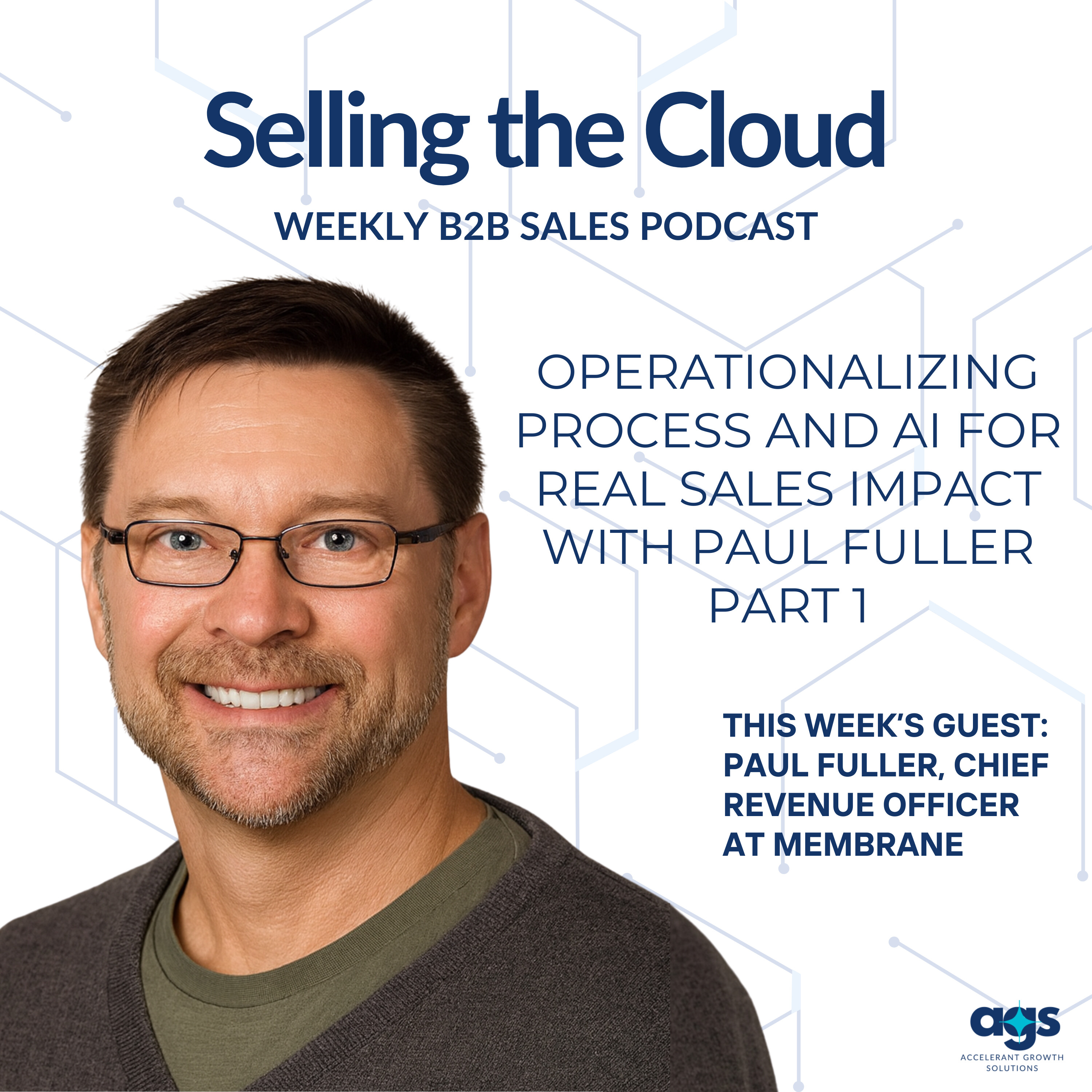
Ep. 102 - Operationalizing Process and AI for Real Sales Impact with Paul Fuller – Part 1
Podcast: Selling Intelligence (formerly Selling the Cloud)Published On: Tue Nov 18 2025
Description: In this episode of Selling the Cloud, Paul Fuller, Chief Revenue Officer at Membrane, joins KK Anderson and Mark Petruzzi to reframe how revenue teams win in complex, multi-stakeholder deals. Paul explains why many orgs over index on apps and one-off skills while under investing in operating rhythms, leadership habits, and relationship-driven execution. He introduces the idea of real intelligence as the who and why that guide the how, and shows how process plus AI inside the workflow can coach managers, focus reps, and change what happens every Monday morning.What You’ll Learn:Defining real intelligence: moving beyond tools to leadership, service, and wayfindingBuilding operating rhythms: weekly coaching, clean pipelines, and a cadence of accountabilityEmbedding insights in the workflow: checklists that coach, not just boxes to tickActivating AI where it matters: individualized multi-stakeholder follow ups and manager signalsProving what boards fund: focusing on measurable behaviors that move win rate and cycle timeKey Topics:Systems over one-off training for durable behavior changeProcess plus AI to guide day-to-day actions in CRMCoaching frameworks that reinforce who, why, then howMulti-threading effectively and right-sizing stakeholder engagementFrom performative pipeline calls to meaningful operating reviewsGuest Spotlight: Paul FullerPaul is the Chief Revenue Officer at Membrane. He helps complex sales organizations operationalize process, coaching, and buyer-centric execution so managers can coach and reps can execute without bouncing across tools.Resources & Mentions:Fathom and Gong for call capture and summarizationMembrane workflow checklists and coaching cadenceWINS framework for servant leadership based sellingBooks: The Greatest Sales Question Ever Asked by Brent Long; A Mind for Sales by Mark Hunter; The Speed of Trust by Stephen M. R. CoveyLeader to follow: Matt Green of Sales Assembly🎧 Listen now and follow Selling the Cloud for more GTM insights from enterprise operators and CROs. Subscribe wherever you get your podcasts.Mark Petruzzi (00:31)Today on Selling the Cloud, we're joined by Paul Fuller, Chief Revenue Officer at Membrane. Paul spent years helping complex sales organization operationalize process and coaching, bringing structure to multi-stakeholder deals while keeping sellers focused on what moves outcomes. At Membrane, he's championed approach that layers insights and prescriptive guidance inside the workflow so managers can coach and reps can execute.KK Anderson (00:40)youMark Petruzzi (01:00)without bouncing across tabs. We'll dig into Paul's thesis on real intelligence, the durable leadership practices that operate, rhythm sales teams need to thrive amid AI tool bloat and rising partner competition. We have three topics we'd like to cover with you today. From skills to real intelligence, why systems, leadership habits and operating rhythms be one-off training.Process plus AI, kind of day-to-day actions, putting insights inside the workflow so reps and managers change what they do on Monday morning and every single day of the week. Focus, trust, and proof. Leading in the AI era, keeping teams competent, and proving to the board, CFO, CEO, that relationships and systems move the numbers. Welcome, Paul. We're so happy to have you with us here today.Paul Fuller (01:50)Thanks so much for having me. really appreciate being here. I'm pumped. I'm excited.Mark Petruzzi (01:55)Beautiful. We love it, All right. Let me open with a question here in topic one. So Paul, you've argued that revenue orgs over index on apps and one-off skills while under investing in the systems and leadership habits that drive outcomes. In your words, what is real intelligence for a sales org? And how is it different from adding another tool or another skill module?Paul Fuller (02:17)Yeah, great question. And I think you've, everybody's been there. in terms of we love in the sales world to focus on the how, And how do we get things done more efficiently and quicker and better and put more numbers on a rep and make sure that they get, things done more appropriately. LikeThe whole revolution of the past 25 years has focused on that. Let's, make sales and manufacturing line. Let's get an SDR. Let's get to an AE to an AE that does, another thing at a sales engineer to the next, to the next, to the next, right? How do we make this more efficient? there's, there's an interesting concept though, that I I'm really finding that more and more as we, today's world and what we're dealing with.is we have skipped some certain things. We have skipped some of the fundamentals that it takes us to operate as sales professionals as a human and really make a continual impact in the market. We have skipped things and pushed them to the side. Things like relationships, things like how we work on those relationships together, things like a long-terma relationship that is going to drive impact for your business for years to come instead of, and instead in much of what we focused on, have you gotten a conversation and is there an opportunity? So when I talk about real intelligence and building that into a company, I'm focusing more on the who we want to choose to be. And then the why that we choose to be this instead of, and then move into the how. And I think that focuses on three things that we choose to be in sales.how we choose to lead, how we choose to serve. And I have a word that it's wayfinding, but how we choose to problem solve and find a way to work with companies and, do that core to who we are and define the, make those choices about who we want to be in those actions. We can always figure out the how another app, another thing. andSo many of us just focus on that. How let's just, my gosh, I got this, I got this for data. got this for this scraping. got this for this. And you focus on that so much that you've seen tech bloat. You've seen confused reps. You've seen reps promoted to AEs that just cause they know how to book a meeting, but they couldn't, they couldn't discover and ask a question for the life of them. Or they don't even know who they are and what a sales motion is. So that's what I.Mean when I'm talking about real intelligence.KK Anderson (04:27)So the real intelligence as my daughter would call it is like the invisible thread, right? That connects everything. It is the common denominator that must be there to be able to make a sale. And that's a true relation. It's a human-based relationship. that what I'm hearing?Paul Fuller (04:45)Yeah. Amen. and let's make it real with like one word that you hear a lot in sales today and you hear people throwing up their hands about accountability, right? I can't get my reps to be accountable to leadership or customers. And so how did most people solve that? Well, I'm going to throw, I'm going to throw test management at this. Right. I'm going to throw check boxes that they have to do in their CRM. I'm going to throw.And they think that's solving the problem. Well, the problem lies much deeper than that. Yeah, the problem is much deeper than that, right? The problem is that you haven't invested in your team and built leaders on your team that know how to lead themselves and lead others. So why don't you start? Why don't we start with core components of self leadership as a team and say, that's how we want to sell and what that means to us before we then create this in the line thing wall andKK Anderson (05:10)another box to click.Paul Fuller (05:33)of accountability, because you have so many see I was on a CRO forum the other day and they're like, I just can't get these Gen Z errs or whatever to be accountable. Well, quite frankly, look at the system they've grown up in look at a lot of things that has happened. I think you need to go back to the real intelligence part of this. Let's talk about what it means we want to hire leaders, have leaders in our culture and what that looks like for us here. Let's start there and how that can impact your life.Therefore, you know, so you start a little earlier in the cycle, get rid of that. You do the how, but start with the who.KK Anderson (05:57)Yeah.Mark Petruzzi (06:03)So Paul, where do teams get stuck in this? What's kind of a common anti-pattern? Something that looks smart, feels good, shiny AI, but doesn't translate into consistent behavioral change.Paul Fuller (06:17)well, I'll use, we, are heavily, we love sales process. I love sales process. I actually really appreciate, our, platform is built around sales process, and how we're able to do that. sales process is a wonderful thing. and, let's say it's created in the mind of, the sales process is created in the mind of the medic expert that knows everything and has been.been in there for 30 years and knows exactly the questions to ask and all of those things, right? And then I put that out there and I put it into an organization. I find out, why isn't this working? It should be. I mean, we had an expert design it. it was perfect. It's in a system, right? There are gaps in the people I think don't see where they say, okay, let's fundamentally go back to this. And I put this concept of real intelligence, butlet's go back to these fundamentals of leadership there that are embedded into it. Let's agree on those and gain agreement for our team that that's what we're to practice. And then let's look at that in the context of a sales process. What are the actions that we're going to do continually and how is that going to, how are we going to craft reminders of that initial who that initial agreement, who do we want to be? Right? How do we're going to craft those in the sales process that actually helps us execute?cause if we have our who and our why figured out our how, we can systemize that really well. Right. So I think people get stuck in the anti thing is, well, I'm just going to put it in a sales process. Okay. If, if you just do that, you're going to get a bump. You're not going to optimize unless you have a complete and total agreement and, and, and focus and help people drive their core and, their understanding of why they're doing this and helping them and coaching them to do that.then you can execute on the how really well.KK Anderson (07:50)Sorry, are you saying then that where people get stuck is that they are skipping stages of the sales process or accelerating faster or skipping critical pieces of it and that's why their deals are stalling or, you know.Paul Fuller (08:05)No, I'msaying they're skipping stages. I think we're skipping stages and expectations a lot of times in our sales team themselves. And so for example, I was just talking to somebody last week and they're like, well, I hire really good salespeople. Right?that's what I do. And so I don't, I hire good salespeople. I have this process here that's helpful forum and I asked them to follow the sales process, but I asked them to, I hire good salespeople and I just count on them. And, and it's like, great, that is a wonderful step. They can do that. But I, the, the core thing is then, how, but how are you empowering them to be the best salespeople out there? Well, I really don't. I hire the, I hire the best ones and I let them run.now I think there's a, there's a step there and that is missed, which is all your hiring. You're hiring really good salespeople, but the step is how are you, how are you working with them, coaching them and helping them develop things that we know are core to continually get better. their leadership and account, their self leadership and accountability, right? Back at the ability, how they serve people, how theyhow they help people find what it is they need, right? Those are not things that are necessarily natural to everybody. And even the best salespeople need that help. So how are you continually helping them do that? And then how are you helping put things into the how, into the process that remind them of that activity, of the things that they need to do to be at the top of their game?And so that's really what I'm talking about. I think a lot of times we skip the step we, and we skip it far too often. We expect too much of things like new hires or especially new college grads that are coming in young sales reps that they understand concepts that are inherent to sales leadership service and wayfinding. we don't even give them, we throw them into a ⁓ niche role and we never pay attention to that. And I think it's time that we shift that, especially with AI, cause AI can do a lot of the how now.I can do a lot of research for us. And so we need to develop the things and the skills and the leadership service, the way finding on that side, much more impactfully to scale a good relational organization.Mark Petruzzi (10:05)Right on Paul. So give us a quick before after story where shifting from train to skill to build the system plus leadership habit materially change win rate cycle time and or forecast accuracyPaul Fuller (10:20)Yeah. I have one, that's a very recent one that we've been working with it. We have a partner, that we work with and he dives in and he very specifically focuses on a servant leadership based, who, right? Who we are is, servant leaders. They define that's how they define sales. And then once you decide that and, and figure out, okay. And then each individual is figure out why they're coaching.or why they're selling, which is more of an individual goal. He was able to put in a process and framework. So he's got a framework that he calls wins. And it's an amazing framework. That's how we're going to have these conversations, how we're going to do this continually, how we're going to lead, serve and way find as a, as a team. And then that framework then led into the specific sales processes themselves. So this is the order of operations that we want to follow.Right. Just by doing that work, but doing the hard work first on defining, who we want to be, how we want to lead, how we want to sell, what sales is. Right. And getting that hard work done first that is often skipped. but by doing that in, then putting in the processes of the framework and the processes afterwards, he's able to see, I think the stats on the recent case study or something like a 20 % increase in pipeline development.Quality conversations has gone up with all the reps. So qualification is massive. So pipeline flow through is incredible because they're qualifying more effectively from a place of confidence in who they are and what they can do. and so I will pull up the specific stats for you, but it's been tremendous. And so we do this through our platform. Like he implements a part of this in our platform. but the core of it, it becomes way before that platform.Right? It's, really deciding on who we want to be and the core elements of the, call it again, the real intelligence assets that we want to dive in, how we want to up or who we want to be and why we want to operate as a team. Is that helpful?KK Anderson (12:10)I think this is going to take us into our second topic, right? Around process and AI and how it impacts day-to-day actions. And so I know you love process. I believe one of the reasons you love it is because you also believe that this real intelligence is insights. they have to live where the reps work. Like it has to be in the workflow.in the CRM in membrane. And so on a Monday morning, what does an AE actually see? how does this real intelligence show up?Paul Fuller (12:40)Yeah, great question. So membrane itself is we love process because again, process helps us do the job that we have, we can do to the best of our ability. That's, that's what it is. It's consistently it's a checkbox, right? now let's tie this in. Before I answer that question, I'm going to use an analogy, if you don't mind. I'm going to tie it to the medical profession,KK Anderson (12:50)consistently. Right.Paul Fuller (13:00)Medical profession has this defined pretty darn well and a lot of things that they do. They have that who we need to be and the critical components of that pretty well defined. They have a Hippocratic oath. They go through a ton of training to understand the type and form of doctor they need to be and really get that down and the person that they want to be operating in that system.skip forward to the checklist, the checklists are there for a medical for a doctor to go through and a process is like, so I don't make mistakes. So I can bring my best self every single time to the surgery that I have. And a lot of times I've seen some of those checklists, like my brother's doctor and, and he'll even make his own. And it's like, before I go into an appointment, I will X, Y, Z, right. I'll take a time, take a second to center myself. I will dodo the appropriate research on the client, on the patient that we have, and I will be able to head in. And then during it, they have additional checklists, right? So again, my thesis is that we're, and what the, is that we are skipping a lot of that stuff in sales that helps us define that who we want to be. Now, in terms of how we activate in that process and checklist, like very simple.a process and checklist that can score a pipeline based on whether or not you have a sales rep has actually had a prep meeting with their manager and gone through coaching on a deal to bring their best self to that sales meeting that they have. That's massive help. If you can score a check, if you can score a pipeline based on whether a sales person has actually gone inand reviewed, all of the core people in that deal has gone into their backgrounds and understands it, let's look at a certain stage of our pipeline understands how the, the vision, so understands the current state they're in, the vision state and the gaps. And you can then have that be a part of your process, but then also score your pipeline on.right and understand based on the actions that the sales rep is taking to be the best person that they can be in this thing, it helps and it also helps the reps. Like so many times CRMs just give data, they're like, just go fill out these six fields that you need to learn and go ask these questions. But they do nothing to help coach or guide and actually help a rep be really good. And that'swhat I believe a good checklist and a good process should do. Cause I mean, a pipeline is nothing but a lot of different sales processes, a lot of different checklists amalgamated into one view. And so what they did when they log in is, I'm just meeting them. Have we gone through, have we done our pre-call prep? we know, do we want to? Yeah, sure I can skip that, but I know if I skip that I'm going to be much less successful.And I can actually measure that have here are some suggestions based on AI and what we've had on questions based on our framework that we have and who we choose to be as a sales team. So serving that up right there in the context of where they're doing their job is so helpful. Instead of forcing them to go to seven different things or go back to a learning management system or call a coach or it's just really helpful to have it in one spot.KK Anderson (16:06)Makes a lot of sense. we talked a lot about kind of checking the box. And so I'm going to ask this question just because I'm wondering if others are thinking it. So we have a box. Did you have a pre-meet with your manager? But don't we run the risk of just having more boxes to check?Paul Fuller (16:22)Yeah, and I think that's the critical nature of, starting with who moving to why and then moving to how, right? And so we do run that risk. If you, and membrane can be abused like any other system, right? You can give a rep for 400 things to do, and say, check all these boxes and make sure you do them and measure them.That's just like any other system. where the difference becomes how do you define? And this is where I think a lot of sales leaders and teams skip is how do you define a process that actually brings in best practices and helps people? So if you, so for example, don't, don't give them a box to check and say, Hey, we defined, the org chart.in the organization and we know who people are and that it's a great box. could literally give a checkbox. I've done that. Right. Instead in the process, give them a way to actually do it. Well, right. give them a way to understand the organization and how they're operating, visually and easily and in something that helps them do it.We just did a big research study on the number of stakeholders in complex B2B sales and like the optimal number for deal success. And we found it hovers around four and a half, right? So between four and five stakeholders actually increase the deal success and above that decreases it. so if we're learning that and we're understanding thatKK Anderson (17:36)Hmm, interesting.Paul Fuller (17:40)And we've decided as an organization that we want to, be the best sales team out there. And that's the who, and we're going to put the work in and be accountable to each other. Then a tool like that within to map those four to five makes is incredibly helpful. just right there. And then we can have great discussions and coaching discussions on, who those people are and how they operate and how they're going to help us work a deal.we could say, Hey, are we talking with too many or too few? it's right there and we can see it and we can work it and it becomes a step, but it also becomes a critical part of it. It's a critical part of winning a deal, that, we know we needs focus. most people, like they'll set up a CRM with, know, here's your 17,000 fields that you need to fill out and do.What we argue for is what are the core things that are going to truly drive both enablement for the sales team and excellence in results. And so take that time and really work on that. So I hope that answers your question, but that that's a philosophy thing that comes out of a lot of years of doing this. It's like, where is the impact and focus on that.Mark Petruzzi (18:43)Yeah, that is very easy to follow. So thank you, Paul. So teams don't need to be prompt engineers when it comes to generative AI. For example, at the same time, how do you enable and engage your team into what they can be doing, should be doing, how they should be leveraging the AI component of this?So can you share two or three prompted actions or snippets that do the things that really matter, like reliably improve their execution, discovery follow ups, multi-threading asks, building up the sponsor relationship and going deeper and wider at the same time. And where do you surface them so that they're used often by the sales teams you work with as well?Paul Fuller (19:29)Awesome question. I have one very specific example that I love and this actually came, it's an innovation. It's actually going into our product pretty soon, but it's an innovation that the team made. And it's actually ties onto that stakeholder discussion that we just had. So let's say we, deal with a lot of complex sales, right? So B2B complex sales.You have the four stakeholders, five stakeholders on a on a zoom meeting. And, one of the great innovations is that let's just say it allows us to be a more effective, salesperson, also ties into our processes. I now have the ability to, to follow up individually so much better. So I don't need to send that, I don't need to send that.to every person, here's my notes. Here's the action items for all of us. I can take a fathom fathom integrates with membrane. I can take that and I can take a snippet and say, Hey, for each of these people, pull out their core questions, their core actions, and some key insights that we have for them. and help me craft an, an email directly for that.Whereas that would have taken two, three hours, if you're really going to do a really well on a meeting follow-up, to do previously, you can now have that systematically built into a sales process. If you have a meeting with multiple stakeholders, four, five, six stakeholders, right? you now have this tool in here that AI and you can have a very specific, we do have what we call snippets in the system thattakes that and says, help me craft these very specific email. And then, then it becomes an editing and execution point because we know that as if we decide on the who that we are, we are going to choose to be accountable and choose to be servants. know that the best way to do that is individually one-on-one with a core team. Let's make sure that they're getting the attention that we've given. The barrier to that has always been, why I can't spendthree hours, four hours on a specific deal, especially for us, like it's if we're get a $3,000 MRR deal, right? that's great, but is that worth spending time, that level of time? And so there was always that trade off. You can start to remove those types of trade-offs systematically and it actually empower reps to be who you want them and who they want to be.And that's the type I think is stuff is awesome. And we're also process like we're processing methodology based. So being able to query a thing like having, we don't, you don't need to be a, context engineer to, if you have developed your sales process, right. And we're, walking through that and we're capturing all the data in that sales process, the system itself.engineers the context, right? Here's where we are in the process and here's maybe some of the differences that we can... And then you can start to query AI ⁓ directly and say, any recommendations based on our methodology, based on our process and based on what we've heard from them, that can help us be better and query that directly. Because you're right, one of the biggest challenges is that context engineering. And we kind of tend to throw...KK Anderson (22:16)Thank you.Paul Fuller (22:25)throw stuff at the wall in terms of that. we try to figure it out. if so, our, that's one of things I love about our system. If we've really defined who we want to be, the methodologies that we want to act, the process we can, then we can leverage that framework really well for AI to bring actual knowledge to us that we can translate to wisdom and how to act.See Privacy Policy at https://art19.com/privacy and California Privacy Notice at https://art19.com/privacy#do-not-sell-my-info.
The note was deleted
The note was saved
Your message was sent