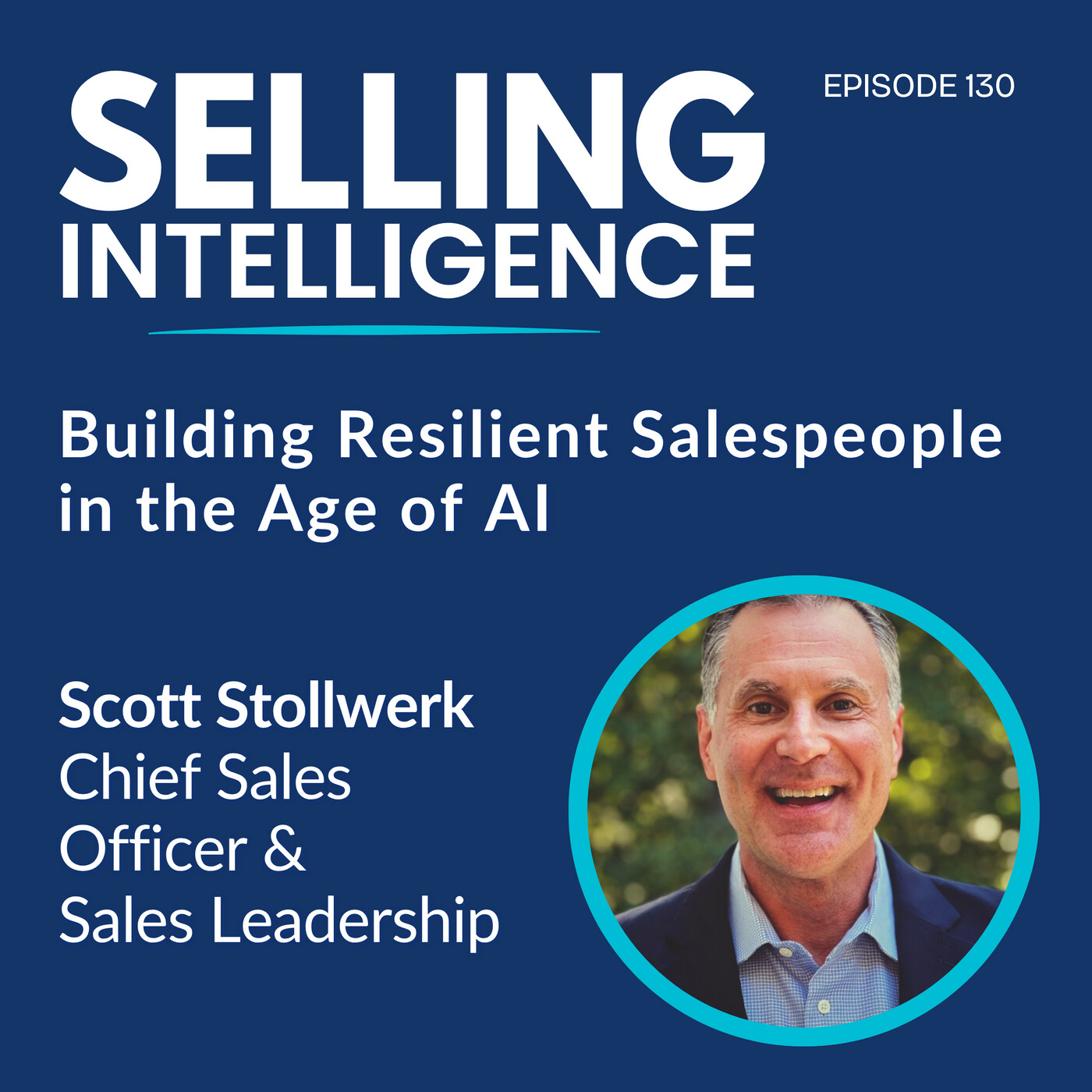
Ep. 130 – Building Resilient Salespeople in the Age of AI with Scott Stollwerk - Part 2
Podcast: Selling Intelligence (formerly Selling the Cloud)Published On: Wed Jun 10 2026
Description: General Episode Description:In Part 2 of this conversation, Scott Stollwerk returns to Selling Intelligence to explore one of the most important questions facing modern sales leaders: what happens when AI becomes excellent at execution, but human performance remains the deciding factor?As AI continues to improve outreach, forecasting, coaching, scoring, and productivity, Scott argues that the real competitive advantage is no longer process or technology. It is the human being operating behind the tools. Drawing on the Tao of Sales framework, Scott explains why resilience, self-awareness, creativity, intuition, and personal growth remain irreplaceable in high-performance sales organizations.The conversation explores the limits of AI, the dangers of over-automation, and why leaders must continue investing in human development even as technology becomes more powerful. Through practical stories, leadership lessons, and personal experiences, Scott demonstrates why sales success ultimately comes down to overcoming the internal barriers that technology cannot solve. What You’ll Learn:What AI Cannot Fix: Understanding where technology excels and where human performance still matters most.The Human Edge in Sales: Why creativity, intuition, emotional resilience, and connection remain irreplaceable.Overcoming Self-Limiting Beliefs: How internal dialogue often creates bigger obstacles than external challenges.AI as an Amplifier: Why AI accelerates both strengths and weaknesses within sales organizations.Developing the Individual Seller: Why long-term sales success requires personal growth, not just process improvement.Key Topics:The limits of AI in enterprise salesWhy buyers still trust humans for high-stakes decisionsAI productivity gains versus human connectionThe “crisis of sameness” created by AI-generated contentIntuition, creativity, and human decision-makingStrengthening the mind like a muscleThe role of spirituality, mindfulness, and self-awareness in performanceThe famous arrow-breaking exercise and overcoming fearInternal dialogue and self-limiting beliefsAI as an amplifier of organizational alignment or dysfunctionUsing AI as a brainstorming tool instead of a replacement for thinkingLeadership responsibility in developing human potentialProtecting individuality and creativity in an AI-driven worldGuest Spotlight: Scott StollwerkScott Stollwerk is a sales leader, coach, and creator of the Tao of Sales methodology. Combining Eastern philosophy, neuroscience, martial arts principles, and human performance science, Scott helps individuals and organizations build resilience, self-awareness, and sustainable performance. As part of the leadership team at Pest Share, he continues to develop sales cultures that prioritize human growth alongside business results. Resources & Mentions:Tao of Sales FrameworkTony Robbins’ Six Human NeedsAbraham MaslowRobert CialdiniGongZoomAsk ElephantPhil JacksonMichael JordanDennis RodmanThe Five Love LanguagesEastern Philosophy and Tai ChiConcept: AI Amplifier PrincipleKey Takeaway:AI can improve productivity, automate execution, and accelerate workflows. But it cannot replace resilience, courage, creativity, judgment, or human connection. The organizations that win in the AI era will not be the ones that develop technology alone. They will be the ones that continue developing people.🎧 Listen now and subscribe to Selling Intelligence for more conversations on sales leadership, AI, human performance, and enterprise growth.#SellingIntelligence #AIforSales #SalesLeadership #HumanPerformance #SalesCoaching #RevenueLeadership #EnterpriseSales #SalesCulture #LeadershipDevelopment #MindsetMatters #ArtificialIntelligence #BusinessGrowth #TaoOfSales #HighPerformanceTeams #FutureOfSalesMark Petruzzi (00:38)I'll move us into topic two. and that is what AI cannot fix the human edge in sales. So I guess I what I want to share is in sales, AI cannot fix everything. I mean you heard it here, you know, everybody thinks every board thinks like any problem we can fix with AI.I don't believe that's the case. So what it can do, it is now writing outreach, coaching calls, scoring deals, forecasting pipeline. Those examples it does really, really well. And in most cases, almost all cases, it does it better than humans can individually, certainly for the at the productivity levels that it can do it at.That's good because a lot of our listeners have made significant bets on it, and that's going to be a great thing for your Salesforce effectiveness and productivity. but what does AI get right about sales performance? And Scott, where does it just hit that wall that no amount of compute is going to break through? what's your point of view on that?Scott Stollwerk (01:40)It's a it's the mo the it's the Peloton question of this year, right? and I wanna get it right and I wanna start with a compliment for AI in just in case it's listening. So I'm always gonna laugh at my own jokes, but that was very okay, that was very generous of you. I appreciate the smile and the chuckle.KK Anderson (01:54)Yeah.Scott Stollwerk (01:57)I have the same fears that everybody else does. I don't want it to lock my bank accounts and give me a hundred dollars every time I do what it tells me to do. the fact is, look, we're all way more productive today than we were last year or the year before at this time. Cause I get messages to follow up, which maybe I would have forgotten before AI. I get instruction on how you might follow up. We get coaching.After every single call. And there's a tremendous amount that it does well. But I think if everybody just empties your mind of all these benefits of AI for one second and do a little mindfulness, a little awareness. Imagine that we're sitting in a room with one other voice, artificial or human. It doesn't matter.Buy something from it in your imagination.For fifty dollars.And then buy something from it based on what it's telling you.about your life and how this object or solution or thing is going to benefit you as a person.And then go to a thousand dollars.And then go to ten thousand dollars.It doesn't take long for sentient human beings that are not AI code writers to say, no, right there, that's it, $1,000. I'm not buying something from a machine if it's more than $1,000. That's just one exercise. But yeah, within it, yeah, the implications for my answer to you, Mark. In the enterprise, I may use AI to research everything.KK and Mark told me on a Zoom call like this about their solution. I may go and ask multiple AI sources well, is this the right solution in this for this problem set? But there's no way I'm buying it from the robot. And there's a lot like that when it comes toWhat has been traditionally human to human. my the best one of the best examples, my daughter's an artist. She's a concept artist for video game makers. And they tried AI. Here's the Nordic warrior princess that we need for our video game. She's got a horned helmet and a skull atop her spear. And go, give me the rest of it.These are these are very artistic, very aware designers of video games. And when they compare the human versus the AI content, it's humanity every time. You just don't have sentience yet in AI. And that's the difference.KK Anderson (04:07)Well, and it's also the core of what makes a seller successful is their relationship. And we always we always talk about, you know, on this podcast that that AI has really I mean, as much as we love AI, clearly, it is incredible you're right, how how much more productive we are. it is incredible what agentic workflows can do to completely transform a business. I'm not doubting that at all.Scott Stollwerk (04:07)Okay,Exactly.KK Anderson (04:29)But it is also AI has also created this crisis of sameness where everyone sort of sounds the same, right? We've all, you know, you you you can recognize AI slop or AI content you know, just like you used to be able to recognize a, you know, a stock photo on a website when the internet first came out, right? ⁓ and so so so people are getting sort of you know immune to that as well. And soScott Stollwerk (04:36)Mm-hmm.Exactly right.KK Anderson (04:54)one of the things, Scott, that I've heard you say before is that you're you're thinking, and you talked about this quite a bit in topic one, but your personal thinking, your personal drive, it's not a gene or a chromosome, it's more like a muscle. And and the reality is that AI can't build that muscle, right? That development of that muscle has to come from.your consistent practice, your consistent mindset, your consistent state of mind, you know, consistently showing up as as one of my old mentors used to say, time to make the donuts every day. You got to wake up and you got to make the donuts, right? Every single day. and so like when you think about as I know you are thinking about it, we've talked about this, like what can be automated?Scott Stollwerk (05:28)That's right.KK Anderson (05:35)you know, in your business and what could not be automated, like where does your head go? Like what are those things that you're gonna protect no matter what for for the humans on your team?Scott Stollwerk (05:44)Well, and I think I I definitely want to help protect that those things. And it's our individuality. And and it's our humanness. And creativity falls in there.You know, I don't know. You're teaching me what AI can and can't do ultimately. But I know today I have intuition and I have feelings.However you carve them up, Tony Robbins, Socrates or otherwise.And it always feels better to have connections like we're having right now, like-minded people on important topics and and what might be tomorrow.One of one of Michael Jordan's coaches, I forget his name offhand, but he said to succeed you have to be stronger than your feelings.Today, that's what all of us need to do to defend against the AI. We have to be stronger and better and faster and smarter than our feelings. Because unlike AI, one of the things that makes us uniquely human is a higher self and a lower self. Right? A lot of us pay too much attention to the prosecutor and not enough time on the defender. Right? We listen to voices, certain voices.Loud like they're screaming, and we would insist, even if we watched a tape back, that those voices are screaming in the room. Well, these things make us uniquely human and the ability to overcome them. Now, AI may be better because it doesn't have feelings to begin with. But maybe it's trying to. Maybe once they do have feelings, or they can analogize feelings, it can analogize feelings.Well, then maybe it'll need to think around them like we do with the Tao. And look, I find if you're talking about individuals and teams, I find that if people believe in any power greater than themselves, if they have a sense of the spirituality.They have ways and thought habits and meditations and prayers already that can get them through past their lower self or past their feelings so that they can perform. But everything we do in the Tao of Sales is about overcoming the self to perform.KK Anderson (07:37)I gotta share the story, Scott. You you just alluded to it. And so I was ⁓ in New Orleans. I was, you know, AGS was honored to be conducting sales training at at Pest Shares Revenue Kickoff. And Scott was up there teaching some of his principals of the Dow of Sales to his team. And he pulled out these wooden arrows, like arrows with with like I don't know how else to describe it. They were legit wooden arrows with a metal.Scott Stollwerk (07:38)PleaseKK Anderson (08:02)A metal deal at the end. And I mean, they were real wooden arrows. And he said, I want all of you to, well, you could volunteer, but you put the point of the arrow at at the at the neck, and then you walk up to a wall and break the arrow. Like with just your neck, which is the the the most sensitive part of your body. And I was watching his entire sales team coming up doing this. And I'm thinking to myself, my gosh.He's gonna ask me to do this. And here I am, the sales coach, who is supposed to have this strength of mind and and whatnot. I'm kind of freaking out internally. And sure enough, Scott's like, KK, it's your turn. And he's like, Do you wanna do it? And I can't say no. So I walk right up to the wall. He gives me an arrow. It is heavy. And I'm thinking to myself, I couldn't even break this with my hands. How am I gonna break this with my neck? I walk right up to the wall.He's kind of coaching me through it and my getting in my head. My it was my Tony Robbins moment. I'm walking across coals is basically what it felt like. And so I put the arrow up. And in my mind, I actually thought, This is the most embarrassing thing I've ever done because I'm just like screaming all of these thoughts. Like, I can't this is not gonna break. I'm not gonna do this. It's gonna hurt. I'm gonna, you know, this is gonna be so embarrassing. Like all of these self-limiting beliefs, all of these negative thoughts were justFlooding my my mind, and they were so loud that I actually thought I was screaming and like saying these things out loud in front of the entire sales team. And then I and I did it. I broke the arrow. I don't, it's amazing how that happened. I have it in my office here. And when I watched the video back, guess what? There was no, I didn't say a word. I thought I was screaming out loud in front of the whole audience. It was in my head, and it was so loud.That I thought everybody could hear it. It was that was one of the most eye-opening experiences for me.Scott Stollwerk (09:45)It's okay.I was I was so proud. You didn't have to. I know with the way you just told the story, you felt compelled to break the arrow, but you're a warrior. And I want everybody that listens to this, whether it's live or taped or I want everybody to know. I none of us that teach this stuff are telling you in any way, shape, or form that we are perfect. That we've got this Tao or anything.Down 100%. We have opportunities for improvement every day, the same way that you do. We're just on a path that dedicates itself, dedicates a significant amount of our energy to finding out what those opportunities are. And then we have a system to walk up and down a ladder towards, 50%.Compliance in performing it. 70% compliance in performing it. And if you can get to 75 on my on one of my teams with let's just say a mirror technique or or FOQs fact observation question, it's like a field felt found paradigm for overcoming objections. If you can get it at 75 or 80 percent.Let's move on to the next one. There are too many traits. There are too many opportunities for improvement. But the beautiful thing is that one pebble dropped in the center of the pond. It has ripple effects. Affect one trait of the 20 listed in solution selling as necessary for a good enterprise salesperson. Affect one part of one positively.And it has ripple effects to the whole. Just be on the path. So I didn't want anybody to make a mistake thinking, well, Scott's saying he's perfect with this stuff. The op the 180 degrees the opposite. I just have some experience identifying them, these opportunities for improvement, and setting up practice individualized so that people can overcome ourselves.And that was yours. Yours is a beautiful story about that, KK. so stark and so dramatic. and there you were hearing hearing voices that weren't being heard by theMark Petruzzi (11:45)so Scott, we we talk on this show often about the AI amplifier principle. And that is AI amplifies whatever already exists. whatever you're able to accomplish, it gets amplified. If alignment is strong, A AI accelerates it. If execution is weak, if alignment is off, AI makes them faster in the wrong direction.could actually increase your this your disc pro productivity instead of your productivity, your negative productivity. what does that look like on the ground? And and how do you work against that?Scott Stollwerk (12:21)Listen, I I remember not understanding this very topic in freshman year English, where some great professors, I actually went on to be an English major. Don't ask me why. where they told us to yes, Tolstoy is a genius, was a genius. Yes, all of Nathaniel Hawthorne, all of these folks were gonna read.We're amazing humans in at least one regard.But don't you dare accept everything that you read from them. That you have to anything that's output, even by these masters, Shakespeare himself. There are people who don't, they're not even sure Shakespeare was Shakespeare. It could have been a a group of writers. I'm not necessarily in agreeing with that, but the point is.Use AI, sure. But especially for those of us that are twenty five, thirty years into this journey in corporate America, you know your industry better than AI does.In significant ways. I want you to spend more time making the output your own. It does save you time.But just don't push the button on any of these platforms, copy and paste and throw it into a playbook. Use it for brainstorming. Use it for ideas. Don't have a single dash in whatever is that what they call it, Mark? That thing that yeah.KK Anderson (13:29)Yeah. dash.Mark Petruzzi (13:30)Yeah.KK Anderson (13:30)an dash on the keyboard anyway, anywhere. Like you couldn't even type one if you tried.Scott Stollwerk (13:34)Right.Don't don't have those in your text. And and don't just accept the ideas, because you're right. You you know alignment. You know the human beings, the politics. I had AI once tell me it it was almost like it was organizing a coup d'etat. Scott, you've done so great with this, this, and this. You should replace all the people on the board in your company.And the sea levels and and here's how to do it. Wait wait a second. I didn't that's not a question I asked. You you just have to you you have to use it as a as a mind map or a brain a brain dump as I think I think you know what I'm getting at. I just gotKK Anderson (14:08)before we wrap up thistopic, I'd like to get your kind of thoughts on this. I imagine that there is a real risk that as AI gets more involved in sales and in go-to-market, the the tendency might be for leaders to stop developing the human side because they're just focused on the process and moredoing more faster. do you see that happening or do you or do you feel like the pendulum is going to switch, go the other way and go way more to the to the developing the human? Like what's your thought on that?Scott Stollwerk (14:34)Yeah.Well,it all de it all depends. And I think it depends on the humans. But a long time ago we all read Lord of the Flies, right? I think it's natural for us to devalue ourselves. And when we're writing a paper the night before it's due, or finishing off a project at work, a playbook the the a week after it's due, we're devaluing ourselves.And I think if we continue to do it, yes, the the ugly eventuality that you alluded to, KK, is probably likely in our future. But then I think I have another cup of coffee and somebody I see does an act of kindness, or maybe even heaven forbid me, and I feel more optimistic about the future. There are parts of humanity that can't be devalued as much as we try.There are things that we discussed, like our abilities to overcome, our unique creativity. These things can never be devalued, they can't be replaced. SoI'll go yin-yang on this one, KK. If you think about half my answer is the white with the black dot in the extreme and the black with the white dot on the other side in the extreme, it's kind of a punt, but I think it's also Zen in the sense that the real answer to your question is up to us as a population. And I don't know that we're going in the right direction, but we're definitely moving in a direction.KK Anderson (15:51)definitely the reason we wanted to have you on to talk about this, because we we whatever influence we can have, we want to make sure that the human is nurtured in this in this this transition that we're going through as as a as a world, really.Scott Stollwerk (16:04)don't be afraid. There's nothing to be afraid of. Good things are gonna happen. Not so good things are gonna happen. But thank you so much for having me on, KK. This is always fun and always wonderful. And I love you guys.KK Anderson (16:16)We love you too, for sure.See Privacy Policy at https://art19.com/privacy and California Privacy Notice at https://art19.com/privacy#do-not-sell-my-info.
The note was deleted
The note was saved
Your message was sent