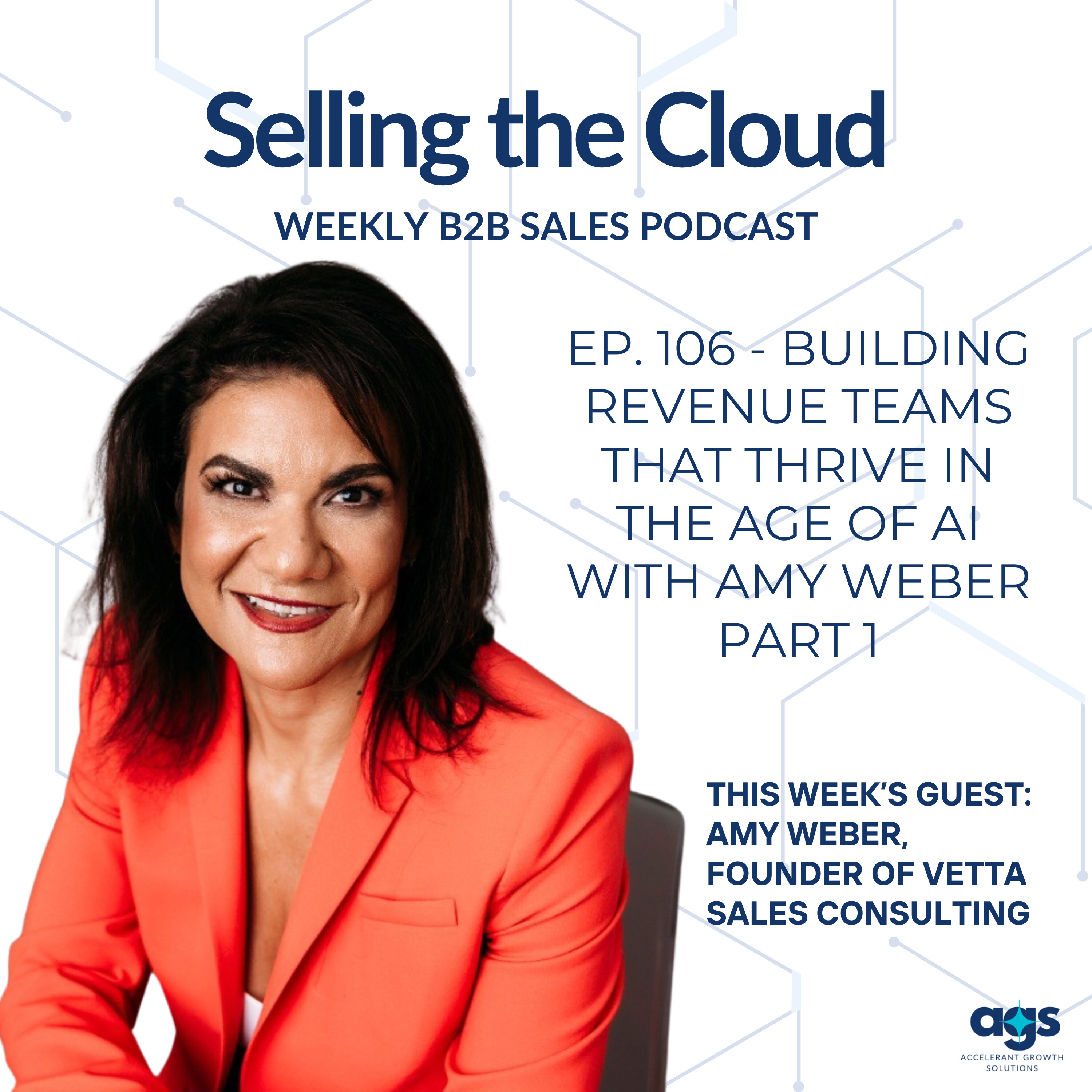
Ep. 106 - Building Revenue Teams That Thrive in the Age of AI with Amy Weber - Part 1
Podcast: Selling Intelligence (formerly Selling the Cloud)Published On: Tue Dec 16 2025
Description: In this episode of Selling the Cloud, Mark and KK sit down with Amy Weber, founder of Vetta Sales Consulting and strategic advisor to GrowthStage and Enterprise revenue teams. Amy specializes in aligning people, process, and purpose so strategy translates into real performance. She shares why many revenue organizations stall not because of tools or plans, but because of role confusion, misaligned talent, and leadership gaps.Amy breaks down how to design roles that reflect reality, how to hire and coach based on true behavioral identity, and why companies must stop promoting top reps into leadership without assessing desire and capability. She also explains how AI can power a stronger customer experience by removing low value tasks and freeing sellers to focus on discovery, executive access, and relationship building.This conversation hits the core of modern revenue growth: the right people in the right roles, operating in a healthy, human selling system.What You’ll Learn:The three fastest tells that your people or role design are brokenHow to distinguish hunters, farmers, and CSMs without relying on personality stereotypesWhy top performers burn out in “Frankenstein” job descriptionsHow to test for core sales behaviors using identity based assessmentWhy leadership is not a reward and should not be given based on quota attainmentHow AI can support human selling by automating research, follow up, and content prepHow to create operating rhythms that ensure AI actually frees time, not adds more dashboardsKey Topics:Role design and talent fit for revenue teamsBehavioral identity vs personality in hiringMisaligned promotions and the manager IC divideWhy customer success is undervalued and misunderstoodModern client experience and relationship driven sellingPractical, tool agnostic ways to use AI for research and personalizationOperating cadence changes that make AI adoption realAvoiding analysis paralysis when implementing new technologiesGuest Spotlight: Amy WeberAmy Weber is the founder of Vetta Sales Consulting and an advisor to high growth revenue organizations. She helps CROs and CEOs fix the people's side of revenue through role clarity, talent fit, and leadership development. Her work replaces outdated activity goals with clear rhythms and systems that actually change behavior, increase productivity, and create healthier teams. Amy also advises organizations building AI for talent decisions.Resources and Mentions:Cisco sales story on customer experienceMedium content repurposing with LLMsTalent identity and psychometric assessmentsOperating rhythms for revenue teamsRelationship led selling frameworks🎧 Listen now and follow Selling the Cloud for more GTM insights from leaders driving the future of revenue. Subscribe wherever you get your podcasts.Mark Petruzzi (00:31)Welcome to Selling the Cloud podcast. Today we're joined by Amy Weber, a strategic advisor to GrowthState, Stage and Enterprise Revenue teams and the founder of VEDA Sales Consulting. Amy's work centers on aligning people, process and purpose. So strategy turns into the most powerful performance. She's known for helping CROs fix the people side of revenue, writing roles that match reality, hiring for fit.not just overall pedigree, and coaching managers to run simple weekly systems that actually change behavior and drive the highest level of productivity. Amy Kevin Lee serves as a strategic advisor to organizations building useful AI for people decisions. And she's led transformations that replaced the old fashioned ad hoc activity goals with clear operating rhythms.This allows there to be a freeing up of more human time for discovery, executive access, and relationship building. Her lens is tool agnostic and outcomes first. What should change on Monday morning and how do we start measuring it? We'll cover three topics today. People and with the focus on them being greater than tools, roles, fit, and real leadership.Why growth stalls when the wrong people sit in the wrong roles, and how leaders create clarity and accountability. AI plus a strong experience culture, freeing time for human selling, using AI to take low value work off the team's plate so sellers could spend more time with customers, and assessment-driven hiring and coaching, really tool agnostic but practical ways to use talentdata to hire coach and fix manager IC friction without turning it into a tech commercial. So most people who know us and are on this ⁓ podcast with us every week know that's all things that are near and dear to KK and my heart and to what we do at AGS as well. So in another way, we're bringing an opportunity to get a...a different perspective or another perspective, but I think we're going to agree on a lot of things here based on the stuff we know about Amy already. So Amy, thank you so much for joining us and welcome to Selling the Cloud.Amy Weber (02:43)Thank you both. really appreciate it and I'm looking forward to the conversation today.Mark Petruzzi (02:46)Excellent. Cool. So first question, lots of teams have the right strategy and plenty of software, but the people role fit isn't right and results off install. As a CRO, what are the three fastest tells that role design or fit is the real problem and that it's not the plan or the overall tech as well?Amy Weber (03:04)Yeah, it's great because everybody steps back and they're like, what tool can I put in place? What new playbook can I roll out? What's our strategy? But they forget about the fact that the number one thing that they need to determine is do we have the right people in place and are we managing them correctly? So number one is, are your top performers miserable? Are they out there driving sales, but they are updating their LinkedIn? They're telling you that they're unhappy. They show up and they are on Monday mornings.you can just see that the energy is drained out of them. Because they're driven individuals, they're going to go out and they're high achievers, they're going to go focus on success, but you can just see that they're deflated. So number one, top performers are just absolutely miserable. You the second thing I see is that you see the same mistakes over and over again. You're providing individual or team coaching. You're giving a...guidance, you're rolling the playbook out, but you're seeing that the mistakes are just compounding. That's just repeating themselves. And then really the third one is we're promoting people incorrectly. So promotions are causing problems. I tell people that leadership is not a reward, it's a responsibility. So we're taking top sales performers. We're like, oh my God, they killed it. They were 300 % of their number again, and they've made club every year. So we're going to make them the manager.a director. And they may be a phenomenal sales individual, but they have both not the desire nor the actual skills to lead a team. And that desire component is really important. You could be the best sales rep in the world, but really not have the desire to want to manage, train, create empathy, you know, in other situations. So for me, those are the three glaring ones that I see that when I go into organizations, I'm like,They say we can't grow or we're stagnant or we've got a lot of they say culture problems. It's it's not culture. It's people you people problemsKK Anderson (04:56)That's so interesting. what we see with our clients and sales organizations is that the quote unquote job description for the sales roles, I mean, they're conflicting. You've got this mandate to go out and hunt and prospect and build new business, must hunt. And yet they need to be also an account manager and running projects and programs and keeping the relationship of the...keeping everybody happy, right? And then, you know, some of them are also part-time analysts. And so it's just like a lot of conflicting roles. And I think that probably leads to what you described with that burnout almost, right?Amy Weber (05:37)Exactly.I call those Frankenstein job descriptions because they're like, I want a self-starter who's a good collaborator. And I'm like, what? You know, I need somebody who's going to really go out and drive revenue and has the executive relationship that's good at doing the research. OK, well.KK Anderson (05:41)Yes.Mark Petruzzi (05:46)Ha!Amy Weber (05:54)They're just, they're putting together these, what they think the requirements are and they really need to hire for the key components of what they're looking for. A hunter role is different than a farmer role. A customer success manager, and sadly we see that get cut from companies all the time. It is cheaper to maintain a good client than it is to find a new one. And I could repeat that over and over again, but people don't understand it. And they're like, well, they,Accounting executives as Hunter can be the CSM as well. You know what? They probably don't have the right skills because a good CSM is going to be somebody who really wants to be a collaborator, can hide behind the scenes, is very detail oriented, likes to follow a process, right? A good salesperson thrives in chaos. There's somebody who goes out and can just drive opportunities because they're listening to the business needs.and they can kind of pivot and determine how to pitch the right solution, but they're not following a step one, step two, step three mentality that a good CSM really needs to do. That's why I don't think, and I get in trouble all the time, and I'm going to say it and just throw it out there. Most SDRs are not salespeople and should not report to sales. SDRs are operations people. They are good at following a script and setting an appointment, but they're not doing the key coreKK Anderson (06:53)Right.Amy Weber (07:10)attributes of sales, is listening to the business problem and creating a solution.KK Anderson (07:14)Right. So I follow up on that real quick though. So once we get those kind of roles rewritten and we figure out like what are the real core behaviors as you said, that that job demands, do you have any tricks on how to like test for those behaviors in interviews and specifically, know, a hunter, right? It's a very hard role to hire for. And they may think, for example, thatMark Petruzzi (07:15)Great.KK Anderson (07:38)because this person is an extrovert that they're gonna be really good at picking up the phone and making connections and calling people, not necessarily true. So talk to our audience, if you will, a little bit about how do you like kind test for behaviors.Amy Weber (07:50)soI actually do test and I leverage psychometric analysis tools in that regard to really determine people's core identities. So the irony is this, look, I've been in these roles 30 plus years now, which I like to tell people that means I was 12 when I started because I sadly do not want to acknowledge how much older I've gotten. But ⁓ we took this personality test from the time I was in college.KK Anderson (08:07)That's right. You were.Amy Weber (08:16)and your personality changes as you grow and as you meet new people and things, but your core identity doesn't. So somebody who is a self-starter should really have a high drive of influence. And there are specific questions that you can ask during an interview and or a promotion stage and or as a sales leader to determine if they have that true drive, right? If somebody is saying, talking about the influence that they have or that theythat they've had in a deal or with a specific executive, you know that they're a high influence type individual ⁓ versus someone who says, work really well and I like when people bring ideas and I like to brainstorm those and I like to work in a group to determine that. That is not somebody who's going to go out and be impactful from an influence perspective. They're going to be good at working behind the scenes. Someone who's a good influence person is going to kind ofbe a strategic thinker and then you need those people with the lower influence to implement that strategic vision. The same is true on like, I don't care if they're an introvert or an extrovert. Some of my favorite people I know are incredible introverts that can turn on that extroversion because they're passionate about the solution or the product or the service that they're providing. But once they've done that, then they...they'd master that Irish goodbye, they can just leave. They don't like that small talk or that networking where, it doesn't matter. You don't have to be that extrovert, but there are, there are solutions, there are tests that you can take that really get to the core of who you are. And then there are interview questions that we coach people on asking to really understand kind of where they are from a influence, sociability, consistency and precision perspective.Mark Petruzzi (09:35)Ha ha.Amy Weber (09:56)to model out who makes sense in these different roles. Like I said, I had a young lady who worked for me. She was fabulous. And her previous leader was like, I would fire her. And I'm like, okay. So I interviewed her and when I was bringing her onto the team and I laughed because they had her a ⁓ hunting role. She was a farmer. She was very precise. She was very good at maintaining clients and getting them to buy new products.She did not like the aspect of going out and building new relationships every day. She wanted to take a relationship and grow it. That is a farmer versus a hunter. And you have to understand as a company, what are you really looking for and where are you putting those people? And then coaching them and managing them per their identities versus everybody's the same.Mark Petruzzi (10:40)Amy, those are all great insights and I'm going to bring us back to a point you made earlier where you were saying how, there's all these companies that are cutting customer success and the value and the cost of driving a new deal, finding a new one, hunting a new one versus the concept of just, you know, keeping clients, keeping them happy, keeping them expanding.I've always, I am always saying that to my clients as well. And there's a couple thoughts I have behind that. And in the first book that I wrote, Selling the Cloud, I have a whole chapter around how in general, I believe women are better sales reps and sales leaders than men on average. That's just the nurturing.Amy Weber (11:07)Mm-hmm.Mark Petruzzi (11:25)perspective, the empathy connection, all those things are so valuable. Even grit, I think women have more grit on average than most men I know, including myself. So with that in mind, this concept of like hunting being more valuable than farming or customer success is something I fight about every day. And I think it's a bit of a machismo type of mindset that we all know.most CROs or sales leaders over the last 20, 30 years are men, not women. And luckily and thankfully, that's changing. But when we look at that concept, it all kind of comes down, guess, this. Nobody celebrates the person who comes back with a, a bucket of fruit or nuts and something they just cultivated and brought back into a village.but the person who has a deer or some other animal on their shoulders and they're carrying it back, they get a big celebration when that happens. So how do you think you change that mindset when it really comes down to it? How do you make companies just understand that it doesn't matter. A dollar of revenue is a dollar of revenue.Amy Weber (12:34)Yeah, you know, I've got a specific story I'll tell you. Back when I was a young sales rep, I walked into an account, literally walked into it. The receptionist wasn't there and I just wanted to figure out what the company was doing. I'd never heard of them. And I met the CEO. Luckily, he didn't just pitch me out of the office, which he could have because I was well.I had inappropriately entered their building. And I ended up having this great conversation with him. He's still a friend of mine to this day, so I think it's hilarious because I just walked in and knocked on his door and I said, hey, what do you do here? And when he got done laughing at me, he's like, how did you get here? And I said, well, no one was at the front desk. But the long and the short of the story is that they were a growing company and they were a small business when I first met them and they are now a massive provider of technology.Mark Petruzzi (12:54)Yeah.KK Anderson (12:54)That'smy thing.Mark Petruzzi (13:05)youAmy Weber (13:16)and he's no longer the CEO there, but across the country, across North America. And they said, I was working for Cisco at the time and they're like, you're too big, you're too expensive, we won't need you. And I said, okay, that's your opinion, but really I just wanna hear what you do. And they appreciated kind of the fact that I just wanted to learn. So they invited me into a technical meeting. Long story short, they had zero Cisco when I took them on.When I left Cisco all those years later, they went from zero to 95 % of their footprint was in our product. they, whereas they were never going to spend any money on us, 95%. And it was because we listened to them and we helped them determine ways in which they could leverage the technology. They became a reference of look out. They were a multimillion dollar customer for us. Right. When I left Cisco and I was no longer the rep at that time, I had moved into leadership and other aspects.But I had stayed engaged with them. People did not keep that relationship going. And they moved off of all of that platform. So they went from zero to 95 to back to almost nothing again, because I had built the relationship, I had listened to them, but I had supported them not just when we needed a PO. I had supported them when they were growing or they had ideas and we went and talked. It wasn't about justcelebrating their success when they were spending money with us, it was helping them figure out what their plan was for the future. And that's why I say the number one skill in sales is listening. And then it's that customer engagement. I'm kind of, you know, I talk to people about, getting back to that point where that client experience is going to be the key. And whether you are a retailer or atechnology company or a restaurant. I was down in Miami for a holiday weekend recently and we went to this fabulous restaurant and it was a Michelin star place and they could only seat 16 people at one time. And you're having this curated prefix menu experience. And I whisper basically to my significant other, I'm a little chilly. And within seconds, cashmere pashmina was draped over my shoulders.That is a client experience. I never said a word. And that is what we need to take to our companies, that idea that when we're talking to them, that we understand their needs, even if it's just that they're cold. Right? And so it's really just taking that step back and figuring out kind of what we need. And what we need is client customer experience to go out and ensurethe client is continually taking care of. We need the account type reps that aren't out for the big kill, that they're not looking for the next elephant, but that they understand that they can take their current client and continuously grow them. And then you still need the hunters that are gonna go out and find new business.KK Anderson (16:00)So I love that story. And it's actually the perfect segue into our next topic, talking about AI and really kind of this customer experience culture that you're talking about. And what you described, is just so human. And that is the human part of selling that will never be replaced by AI.Right? It will never, it will never be replaced. Now that said, that's, that's what's critical. And you're right. and we talk about this a lot on our podcast. The pendulum has swung from everything being process heavy tool, heavy, you know, send 5,000 emails a day, make 100 calls a day, being able to use technology to just,increased productivity, even if it's not productive, right? Or effective, all the way back to, wait a second, people buy from people they trust and relationships are what matter. And Mark, maybe that's why women tend to be so effective in sales roles because that's paramount, you know, in our hearts and in our minds is that relationship like you described.Amy Weber (16:53)Correct.KK Anderson (17:06)Knowing and appreciating and 1000 % agreeing that the relationship and the human activities and the experience are paramount. How can a salesperson use AI for the other things? Like what are some things, specific tasks that they can do that you've seen your customer or clients doing to give them the time to have that human experience?Amy Weber (17:23)Yeah. ⁓Yeah, it's great questions and all of that I agree with as well, right? I think that one of it is ⁓ that research and account prep. I don't want a rep to ever go into a meeting that they don't know the answer to the questions that they're asking, right? They should have done, there's so much information out there, but instead of them spending time, I mean, I remember being a young rep reading when it was a publicly traded company, I was reading the financial reports. And thankfully I have a degree thattaught me how to do that, but a lot of people don't, right? And so using AI to do that research and that account prep to really build out kind of a portfolio and the tools are so good at that and kind of reaching out across all the different platforms, know, is the person you're meeting with, are they active on LinkedIn or socials or are there blog posts? What's interesting? So that you build that connection. So that's one. And then being able to take that information andpersonalize the content that you're sending back to them. Whether it's the communication from you speaking to them, whether it's the emails that you're sending, whether it's you you see an interesting article that you think would be good for them, that content personalization. And then post meeting intelligence work. So being able to automate all of that. So that you're not spending time doing the mundane tasks of the follow-up.and those repetitive outreach type solutions, automating that through AI and having that process put into place. One of my clients is actually, they've ⁓ got an individual that has been writing on Medium for like the last 11 years. And so his voice is really interesting. And he is, instead of him continually having to write and post because he's really busy,they're now using, they built in their, LLM to be able to go out and kind of pull segments from what he said in the past so that they can then automate it to repost it on the social channels in different ways. And that's fascinating because you're taking his intellectual property and AI and you're putting it together. So his voice is still being heard, but in smaller bite-sized pieces. So there's a lot of really different.cool ways to leverage AI that what it's then going to do is free up time for me to be out in front of the customer more. I think we spent a number of years back in front of the video camera like we are now. I think that now we are pivoting back to, we want to be out in front of the customers and clients and talking to them one-on-one and listening and understanding and engaging in group discussions and all of that. And AI will free up our time to be able to do that.because it's going to just take away those repetitive tasks that we don't need to be handling or doing. The tools will do that for us so that we can get back to the real interaction of the human engagement.Mark Petruzzi (20:14)Good stuff, Amy. ⁓ Teams say that we use AI, but at the end of the day, nothing really changes in our calendar. What weekly operating changes, cadences, coaching, or metrics ensure AI actually creates more customer time, more selling time, and not just a lot more dashboards or new processes?Amy Weber (20:35)Yeah, analysis paralysis is kind of the mindset that comes to me, right? That they just keep linking on additional tools and instead of thinking, how is this providing benefit to the teams or to the organization? So I like to think of it as stop trying to boil the ocean, pick one tool that's going to make a difference, implement that, and then move on from there. So have a plan.If there's multiple tools that you want to engage or that you think might be good and you're testing them, pick the one that you think is the most impactful first, deploy it, and then execute based upon that tool, right? Automate one task out of the gate instead of all the tasks. And then measure the time savings that you're getting from that tool, not just how many people in the organization are using it. we tend to, organizations are like,I've got a 50 or 75 % adoption rate into this tool. But is the tool really giving the people back more time or is it just another tool that they're using, right? Then layer in the next piece of automation and analyze that behavior and just follow that routine. Because that's how you're going to determine, am I really getting any results from this versus just investing in multiple tools and multiple components.So it's stop trying to boil the ocean, pick one thing, focus on it, do that well, and then move to the next step.See Privacy Policy at https://art19.com/privacy and California Privacy Notice at https://art19.com/privacy#do-not-sell-my-info.
The note was deleted
The note was saved
Your message was sent