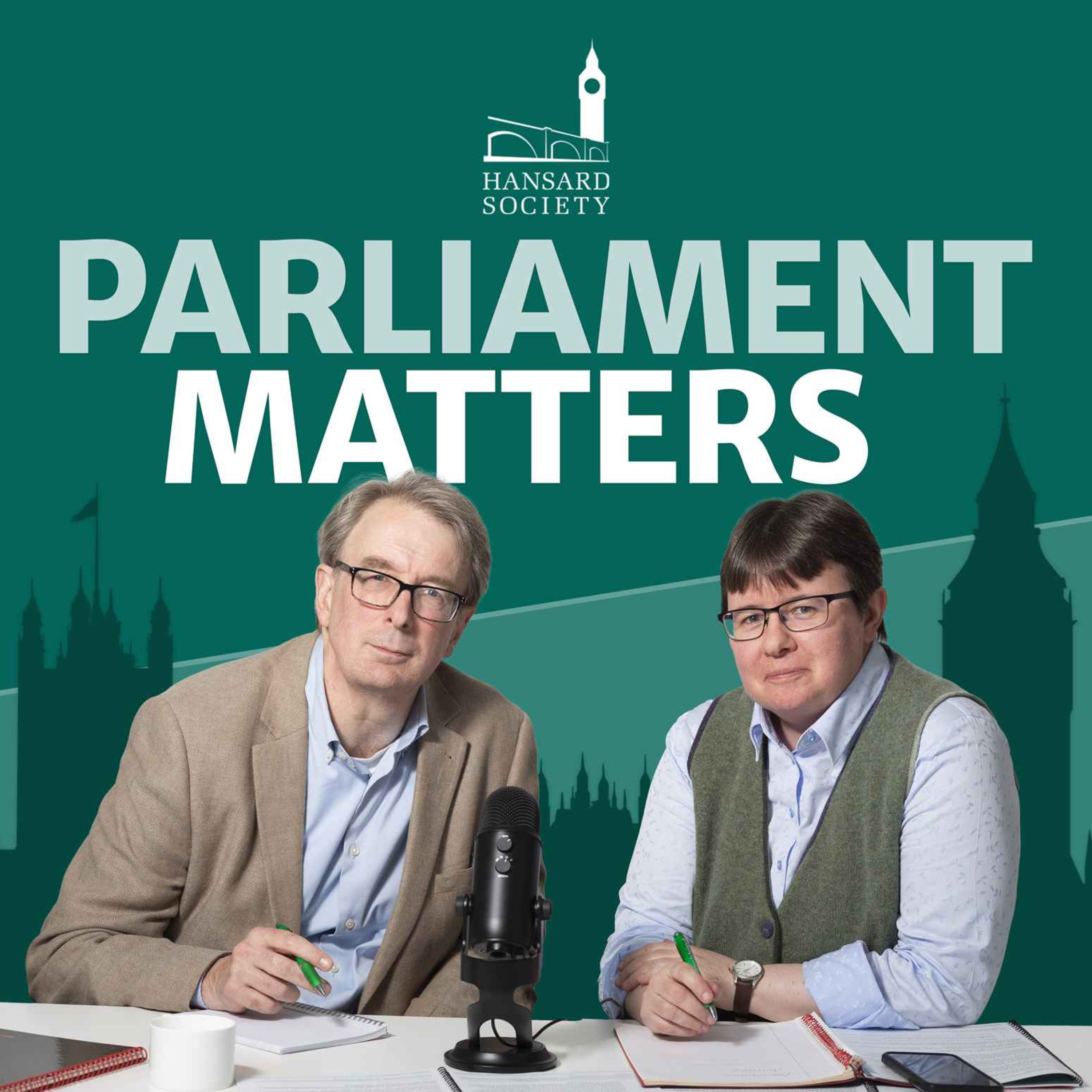
Parliament Matters
Parliament Matters

<p>Join two of the UK's leading parliamentary experts, Mark D'Arcy and Ruth Fox, as they guide you through the often mysterious ways our politicians do business and explore the running controversies about the way Parliament works. Each week they will analyse how laws are made and ministers held accountable by the people we send to Westminster. They will be debating the topical issues of the day, looking back at key historical events and discussing the latest research on democracy and Parliament. Why? Because whether it's the taxes you pay, or the laws you've got to obey... Parliament matters!</p><br><p>Mark D'Arcy was the BBC's parliamentary correspondent for two decades. Ruth Fox is the Director of the parliamentary think-tank the Hansard Society.</p><p><br></p><ul><li>❓ <a href="https://hansardsociety.org.uk/pm#qs" rel="noopener noreferrer" target="_blank">Submit your questions</a> on all things Parliament to Mark and Ruth via our website here: <a href="https://hansardsociety.org.uk/pm#qs" rel="noopener noreferrer" target="_blank">hansardsociety.org.uk/pm#qs</a></li><li>📱 Follow us across social media @HansardSociety and...</li><li>✅ <a href="https://hansardsociety.org.uk/nl" rel="noopener noreferrer" target="_blank">Subscribe to our newsletter</a> for all the latest updates related to the Parliament Matters podcast and the wider work of the Hansard Society: <a href="https://hansardsociety.org.uk/nl" rel="noopener noreferrer" target="_blank">hansardsociety.org.uk/nl</a>.</li></ul><p><br></p><p><em>Parliament Matters is a </em><a href="https://hansardsociety.org.uk/pm" rel="noopener noreferrer" target="_blank"><em>Hansard Society</em></a><em> production supported by the </em><a href="https://www.jrct.org.uk/" rel="noopener noreferrer" target="_blank"><em>Joseph Rowntree Charitable Trust</em></a><em> </em> •<em> Founding producer Luke Boga Mitchell; episode producer Richard Townsend. </em></p><hr><p style='color:grey; font-size:0.75em;'> Hosted on Acast. See <a style='color:grey;' target='_blank' rel='noopener noreferrer' href='https://acast.com/privacy'>acast.com/privacy</a> for more information.</p>

Why is Britain’s first female cabinet minister almost invisible in our political memory?In this episode we are joined by historian and author Nan Sloane, whose new biography of Margaret Bondfield has just been published, to uncover the remarkable and largely forgotten story of this pioneering figure. Bondfield – a working-class trade unionist – became the first woman to serve in the British Cabinet yet is rarely mentioned alongside figures such as Nancy Astor or Ellen Wilkinson. She did not enter politics through the suffrage movement. Instead, she rose through the male-dominated trade union movement, often as the only woman in the room. Born into a large working-class family in Somerset, she left school at thirteen to work in shops where staff were legally treated as domestic servants and endured punishing conditions. Driven by a fierce commitment to social justice, she became a powerful organiser, accomplished public speaker and a leading national figure within the labour movement.Elected to Parliament in 1923, she made history in 1929 when she was appointed Minister of Labour, becoming the first woman to serve in the Cabinet and the first female Privy Counsellor. But it was, as one colleague put it, the worst job in government. In the grip of a deep economic crisis, unemployment was soaring, the national insurance system was stretched to breaking point, and painful decisions had to be taken. By 1931 the crisis had split the Labour Party and brought down the Government. Bondfield lost her seat and never returned to Parliament. Rather than being remembered as a trailblazer, her legacy was overshadowed by economic crisis and party division. Was she a pioneer, a pragmatist caught in impossible circumstances, or a woman judged more harshly than her male colleagues? In conversation with Nan Sloane, we explore Bondfield’s character, her relationships and international networks, and the political choices that shaped both her career and her reputation.Nan Sloane, Margaret Bondfield: The life and times of Britain’s first Cabinet Minister (Bloomsbury Publishing)🎓 Learn more using our resources for the issues mentioned in this episode. ❓ Send us your questions about Parliament: ✅ Subscribe to our newsletter. 📱 Follow us across social media @HansardSociety / @hansardsociety.bsky.social £ - Support the Hansard Society and this podcast by making a donation today. Parliament Matters is a Hansard Society production supported by the Joseph Rowntree Charitable Trust. Presenters: Mark D’Arcy and Ruth Fox Producer: Richard Townsend Hosted on Acast. See acast.com/privacy for more information.
What happens when you lose the party whip? A conversation with Neil Duncan-Jordan MPLabour MP Neil Duncan-Jordan joins us this week to reflect on his experience as one of the new intake’s most prominent rebels. He describes defying the whip over the means-testing of the Winter Fuel Allowance and proposed disability benefit cuts, the fallout from his suspension from the Parliamentary Labour Party, and the personal and political pressures that come with rebellion. He also discusses his relationship with the Whips and explains why he has twice called for Sir Keir Starmer to step down, most recently in the wake of the Mandelson affair. In this week’s episode, we also assess Starmer’s increasingly fragile position following the Mandelson–Epstein controversy, examining the risk of further damaging disclosures about Mandelson’s contact with Ministers and the potential implications for the Government’s legislative programme. We untangle the constitutional confusion surrounding proposals to strip Peter Mandelson and other disgraced peers of their titles, exploring weaknesses in the House of Lords’ Code of Conduct, and the broader dangers of legislating in response to a single scandal. Gordon Brown has called for sweeping “root and branch” standards reform – from a new anti-corruption commission to greater use of citizens’ juries on parliamentary standards and enhanced select committee scrutiny of ministerial and other public appointments. Ruth and Mark question whether such changes would genuinely rebuild public trust, pointing to nearly two decades of Hansard Society polling showing consistently low levels of trust in politicians and in the effectiveness of the political system. They also argue that the current focus on expelling disgraced Peers from the House of Lords misses a fundamental issue: the Prime Minister’s largely unchecked power to appoint them in the first place. We return to the slow progress of the assisted dying bill in the House of Lords, where disagreement continues over whether the pace of debate reflects legitimate scrutiny or amounts to filibustering. Some MPs are calling for accelerated Lords reform in response – but would a wholly elected second chamber be more likely to block legislation rather than less? Finally, we discuss two significant reports from the Procedure Committee: one recommending against the introduction of call lists for debates in the Commons Chamber, and another proposing changes to the way select committee chairs and deputy speakers are elected in the House of Commons. 🎓 Learn more using our resources for the issues mentioned in this episode. ❓ Send us your questions about Parliament: ✅ Subscribe to our newsletter. 📱 Follow us across social media @HansardSociety / @hansardsociety.bsky.social £ - Support the Hansard Society and this podcast by making a donation today. Parliament Matters is a Hansard Society production supported by the Joseph Rowntree Charitable Trust. Presenters: Mark D’Arcy and Ruth Fox Producer: Richard Townsend Hosted on Acast. See acast.com/privacy for more information.
It has been a bruising week for the Prime Minister after the House of Commons backed a Conservative “Humble Address” demanding documents on Sir Keir Starmer’s vetting of Lord Mandelson for the Washington Ambassadorship. We explain how the procedure works, what role the Intelligence and Security Committee may play in decisions on disclosure, and how legislation to strip a peerage could be introduced. Plus, the latest on the Restoration and Renewal of Parliament as yet another report lands with a new set of costings.______🎓 Learn more using our resources for the issues mentioned in this episode. ❓ Send us your questions about Parliament: ✅ Subscribe to our newsletter. 📱 Follow us across social media @HansardSociety / @hansardsociety.bsky.social £ - Support the Hansard Society and this podcast by making a donation today. Parliament Matters is a Hansard Society production supported by the Joseph Rowntree Charitable Trust. Presenters: Mark D’Arcy and Ruth FoxProducer: Richard Townsend Hosted on Acast. See acast.com/privacy for more information.
This week we explore one of Westminster’s strangest constitutional hangovers: why MPs can’t simply resign. With the Gorton and Denton by-election triggered by Andrew Gwynne’s departure, listeners asked the obvious question – why the medieval-sounding detour via the Chiltern Hundreds (or its less glamorous cousin, the Manor of Northstead)? We trace the rule back to 1623, when the Commons barred resignations, and to later fears about MPs being bought off by “offices of profit” from the Crown. The workaround – appointing an MP to a Crown office that disqualifies them – still survives, complete with modern legal “fudges”. Along the way, we revisit colourful resignations and near-resignations, from mass Ulster Unionist walkouts to John Stonehouse’s attempted disappearance and Gerry Adams’s objection to being handed a Crown role he didn’t want.In this episode we also check the Government’s legislative scorecard as the Session edges toward its expected May close, with several dozen bills already on the statute book and many more still in play. We explain “carry-over” motions – how some bills can leap across prorogation – and why the Government has produced surprisingly few bills for pre-legislative scrutiny compared with the first Session in recent previous parliaments.Finally, the focus shifts to the Armed Forces Bill, the five-yearly legislation rooted in the Bill of Rights that renews the legal basis for military discipline and Parliament’s consent for a standing army. Labour MP Jayne Kirkham joins us to discuss how her Ten Minute Rule proposal secured Royal Fleet Auxiliary access to the new Armed Forces Commissioner, and what it’s like learning the ropes on bill committees as a new MP._____ 🎓 Learn more using our resources for the issues mentioned in this episode. ❓ Send us your questions about Parliament: ✅ Subscribe to our newsletter. 📱 Follow us across social media @HansardSociety / @hansardsociety.bsky.social £ - Support the Hansard Society and this podcast by making a donation today. Parliament Matters is a Hansard Society production supported by the Joseph Rowntree Charitable Trust. Presenters: Mark D’Arcy and Ruth FoxProducer: Richard Townsend Hosted on Acast. See acast.com/privacy for more information.
The assisted dying bill – properly known as the Terminally Ill Adults (End of Life) Bill – is facing an extraordinary procedural logjam in the House of Lords. More than 1,170 amendments remain to be debated, organised into 89 groups for debate, yet only 20 of those groups have been reached after seven days in Committee. With just a handful of sitting Fridays left before the end of the Session, Lord Falconer has warned that the Bill is very unlikely to complete its Lords stages in time. In a letter to Peers, he has floated a list of possible compromise amendments but has also, for the first time, strongly indicated that the Parliament Act may need to be invoked to override the opposition of a small group of Peers and secure the Bill’s passage in the next Session.Although rarely used, and never in relation to a Private Members Bill, the Parliament Act has been deployed before on highly contentious measures, most recently the Hunting Bill in 2004. Using it to force through the assisted dying bill would require intricate choreography in both the Commons and the Lords, as well as major political decisions about whether the government formally takes ownership of the Bill or whether it continues as a Private Member’s Bill. It would also raise difficult questions about how amendments are handled, and how far MPs and ministers are prepared to go to assert the primacy of the elected House in the face of sustained resistance from a small but determined group of Peers.In this episode, we explore how the Parliament Act works, how it could be used in this case, and the political and constitutional trade-offs involved in relying on it to deliver this legislation.____ 🎓 Learn more using our resources for the issues mentioned in this episode. ❓ Send us your questions about Parliament: ✅ Subscribe to our newsletter. 📱 Follow us across social media @HansardSociety / @hansardsociety.bsky.social £ - Support the Hansard Society and this podcast by making a donation today. Parliament Matters is a Hansard Society production supported by the Joseph Rowntree Charitable Trust. Presenters: Mark D’Arcy and Ruth FoxProducer: Richard Townsend Hosted on Acast. See acast.com/privacy for more information.
In this episode, we ask whether MPs who switch parties should be forced to face a by-election – and what this month’s spate of defections says about representation, party power and voter consent. We also unpick a dizzying week in British and global politics as “hurricane Trump” batters the post-war order, testing the UK-US alliance and raising awkward questions about NATO, defence spending and procurement. Plus: the Lords’ push for an under-16s social media ban, Chagos ping-pong, and why is the bill to remove hereditary Peers from the House of Lords stalled?____ With Westminster watching Washington’s every swerve, we explore why Keir Starmer’s most outspoken pushback on tariffs and Greenland matters – and why making big foreign-policy statements outside the Commons still rankles. In the Lords, a proposed ban on social media for under-16s forces the government into damage-limitation. Is the government’s promised consultation a serious route to action, or simply a way of kicking a difficult issue into the long grass? We look at how enforceable such a ban would be, how it fits with the existing Online Safety Act, and the political and constitutional tension of tightening access at 16 while simultaneously debating votes at 16. We then turn to a growing list of legislative headaches: the Hillsborough Law stalling again amid disputes over national security carve-outs; renewed procedural drama over the Chagos Islands Bill, how the financial privilege of the House of Commons blocks Lords amendments, and what options Peers have left.  We also ask why the bill to remove he remaining hereditary peers appears to be stuck in a curious parliamentary holding pattern. Finally, we focus on party switching, the e-petition calling for automatic by-elections for defecting MPs, and whether such a rule would enhance democratic accountability or simply hand party machines a powerful new weapon against dissent. As we were recording, news broke of an actual by-election, with Andrew Gwynne MP announcing his resignation on health grounds – a vacancy that could trigger a contest with significant implications for Labour’s internal politics and Sir Keir Starmer’s leadership.____🎓 Learn more using our resources for the issues mentioned in this episode. ❓ Send us your questions about Parliament: ✅ Subscribe to our newsletter. 📱 Follow us across social media @HansardSociety / @hansardsociety.bsky.social £ - Support the Hansard Society and this podcast by making a donation today. Parliament Matters is a Hansard Society production supported by the Joseph Rowntree Charitable Trust. Presenters: Mark D’Arcy and Ruth FoxProducer: Richard Townsend  Hosted on Acast. See acast.com/privacy for more information.
What are MPs actually paid and what does the public fund to help them do their job? In this conversation with Richard Lloyd, chair of the Independent Parliamentary Standards Authority (IPSA) we explore the delicate balance between supporting MPs to do their jobs effectively and enforcing strict standards on the use of public money. We discuss how IPSA has shifted from a rule-heavy “traffic cop” to a principles-based regulator, why compliance is now very high, and the security risks and pressures facing MPs‘ offices as workloads rise and abuse becomes more common._____Sixteen years after the expenses scandal that reshaped British politics, Richard Lloyd offers a rare insider’s account of how Parliament is now regulated from the outside. Drawing on his experience in government, regulation and civil society, he explains why MPs’ pay and expenses were taken out of politicians’ hands, how IPSA evolved from a body widely seen as hostile and bureaucratic into a more service-focused regulator, and why independence remains essential even when it attracts controversy.Richard explains the basic package of salary and pension, and how this compares with those of parliamentarians in other countries, but also the less well-understood support that sits behind an MP’s work: travel between Westminster and constituency, accommodation for those far from London, and – most of all – the funding that pays for staff, offices and equipment.We revisit how the 2008–09 expenses scandal changed everything, and how IPSA’s early reforms tightened the rules on housing costs, ending practices like mortgage interest claims and “flipping” second homes. Richard also addresses more recent controversies, including MPs renting to other MPs, and why IPSA has moved to stop new arrangements where public confidence and perceived conflicts of interest are at stake.Richard argues that today’s system is delivering: spending is now close to 100% compliant, serious wrongdoing is rare, and IPSA’s approach is evolving from dense rulebooks to clearer principles – parliamentary purpose, integrity, value for money and accountability – backed by enforcement when needed. We also explore the strain on MPs’ offices, the separation between parliamentary and party-political activity, the rising security threat, and the growing impact of AI on constituent correspondence.Finally, Richard discusses the politically charged question of MPs’ pay, the Citizens’ Panel work that shifted views once the reality of the job was understood, and the wider role independent regulators can play in rebuilding trust in our democratic institutions._____🎓 Learn more using our resources for the issues mentioned in this episode. ❓ Send us your questions about Parliament: ✅ Subscribe to our newsletter. 📱 Follow us across social media @HansardSociety / @hansardsociety.bsky.social £ - Support the Hansard Society and this podcast by making a donation today. Parliament Matters is a Hansard Society production supported by the Joseph Rowntree Charitable Trust. Presenters: Mark D’Arcy and Ruth FoxProducer: Richard Townsend Hosted on Acast. See acast.com/privacy for more information.
In a dramatic day at Westminster, Kemi Badenoch launched a pre-emptive strike against Robert Jenrick, sacking him from the Shadow Cabinet, suspending the Conservative Party whip, and moving before his headline-grabbing jump to Reform UK. We unpack what the defection tells us about party discipline, Reform’s “fishing operation” for Tory MPs, and whether anyone else might follow.We then turn to government difficulties over the Public Office (Accountability) Bill, better known as the Hillsborough Law. With its proposed “duty of candour” for public officials, campaigners fear national security carve-outs (especially around MI5/MI6 evidence) could fatally water it down, with MPs particularly from Merseyside and Manchester pushing back hard as the Bill heads toward key Commons stages.In our interview, Backbench Business Committee chair Bob Blackman MP sets out his committee’s “manifesto” for Commons reform: spreading backbench time beyond Thursdays, fixing the committee’s stop-start elections, and even replacing the Private Members’ Bill lottery with a more rational selection process.Finally, we assess whether the assisted dying bill is being talked out in the Lords, what rescue routes might exist - including invoking the Parliament Act - and we note the arrival of a new Lord Speaker, Lord Forsyth, as wider Lords reform looms.____ 🎓 Learn more using our resources for the issues mentioned in this episode. ❓ Send us your questions about Parliament: ✅ Subscribe to our newsletter. 📱 Follow us across social media @HansardSociety / @hansardsociety.bsky.social £ - Support the Hansard Society and this podcast by making a donation today. Parliament Matters is a Hansard Society production supported by the Joseph Rowntree Charitable Trust. Presenters: Mark D’Arcy and Ruth FoxProducer: Richard Townsend Hosted on Acast. See acast.com/privacy for more information.
What is it like to be part of a small but growing parliamentary party? We talk with the leader of the Green Party group at Westminster, Ellie Chowns, about the challenges of operating with limited numbers, the practical realities of parliamentary life, and how institutional structures shape the influence of smaller parties. We discuss our political culture, the Greens’ approach to leadership, internal decision-making, and the Green’s longer-term ambitions for electoral and parliamentary reform and a more representative system.With only four MPs, the Green Party covers a wide range of policy areas with a small parliamentary footprint. We explore how this affects visibility, workload, and the ability to intervene in debates and committees, within a system largely structured around the governing party and the official opposition and how smaller parties have to work strategically, pooling resources and coordinating closely to make the most of limited opportunities.Those structural constraints are set alongside the everyday realities of parliamentary work and the gap between Westminster’s formal traditions and the practical demands of representing constituents. Our discussion reflects on how much of an MP’s role is shaped by operational pressures: setting up offices, handling large volumes of casework, and mastering complex procedures while immediately taking on full responsibility for constituency representation.We explore how the Commons operates in practice and what this means for reform. Chowns raises issues around speaking rights, voting processes, and the allocation of time and space, linking them to wider questions of efficiency, accessibility and accountability, and to longer-standing debates about whether existing procedures are suited to a more diverse and multi-party political landscape.We also look at how the Green Party functions internally, both within its small parliamentary group and in its relationship with the wider party leadership. We consider how approaches to policy development, legislative coordination and party discipline shape representation, particularly in the absence of the tightly enforced whipping systems used by larger parties.Finally, we talk about electoral reform and the case for a more proportional system. The experience of operating as a small party within a majoritarian parliament is connected to broader arguments about structural change, the future direction of UK politics, and how rising public support for the Greens could translate into greater influence.____ 🎓 Learn more using our resources for the issues mentioned in this episode. ❓ Send us your questions about Parliament: ✅ Subscribe to our newsletter. 📱 Follow us across social media @HansardSociety / @hansardsociety.bsky.social £ - Support the Hansard Society and this podcast by making a donation today. Parliament Matters is a Hansard Society production supported by the Joseph Rowntree Charitable Trust. Presenters: Mark D’Arcy and Ruth FoxProducer: Richard Townsend Hosted on Acast. See acast.com/privacy for more information.
With the Government investigating allegations of foreign influence in British politics, we are joined by John Pullinger, Chair of the Electoral Commission, to take stock of the health and resilience of the UK’s electoral system. Our discussion ranges widely over the pressures facing elections and campaigning today, and what issues Parliament may need to grapple with in a future elections bill.A major theme is political finance and the extent to which current rules are fit for purpose. We explore concerns about the risk of foreign money entering UK politics, the role of large donations, company funding and unincorporated associations, and the growing difficulty of tracing money in a digital age. We also discuss whether capping donations is realistic, and how reforms can restore public confidence without creating new loopholes or partisan flashpoints.Participation and engagement are another key focus. With millions missing from the electoral register and turnout at historically low levels, we discuss the barriers facing groups such as young people, private renters and disabled voters, and whether better civic education and democratic literacy could help reverse long-term disengagement – while staying firmly politically neutral.We also look at the increasingly hostile climate in which candidates campaign, including harassment, intimidation and online abuse. We consider where responsibility lies between social media platforms, political parties and the police, and whether stronger standards and enforcement are needed. Linked to this are wider concerns about misinformation, deepfakes and digital campaigning, and how online activity is blurring traditional lines in election spending rules.Finally, the conversation turns to election security and foreign interference, the independence of the Electoral Commission, and practical challenges such as postponed local elections and the growing pressures on electoral administrators. Together, these themes underline the scale of the challenges facing UK democracy – and the difficult choices involved in tackling them._____🎓 Learn more using our resources for the issues mentioned in this episode. ❓ Send us your questions about Parliament: ✅ Subscribe to our newsletter. 📱 Follow us across social media @HansardSociety / @hansardsociety.bsky.social £ - Support the Hansard Society and this podcast by making a donation today. Parliament Matters is a Hansard Society production supported by the Joseph Rowntree Charitable Trust. Presenters: Mark D’Arcy and Ruth FoxProducer: Richard Townsend   Hosted on Acast. See acast.com/privacy for more information.
In this episode we are joined by author and former royal correspondent Valentine Low to explore the evolving relationship between Downing Street and the Palace and why it matters for Parliament. Drawing on his book Power and the Palace, we explore how royal influence has shifted from Queen Victoria’s overt political interventions to Elizabeth II’s studied neutrality. Along the way, we connect historical episodes – where monarchs helped shape diplomacy and constitutional outcomes – to today’s flashpoints, from the prorogation and dissolution of Parliament to referendums and royal finances and the looming constitutional headaches of future hung parliaments.We trace the story from Queen Victoria, who sought to shape foreign policy and even push ministers out of office, to the modern expectation that the Sovereign stays “above politics.” Low brings this history to life with vivid portraits of royal–minister tensions: Victoria’s exasperation with Palmerston’s “forgotten” correspondence, Edward VII’s surprise charm offensive in Paris that helped thaw relations ahead of the Entente Cordiale, and George V’s attempt to convene politicians at Buckingham Palace to tackle the intractable question of Irish Home Rule.From there, we turn to the weekly audience between Monarch and Prime Minister – private, unknowable, but still constitutionally significant – before arriving at the Boris Johnson years, when prorogation and election timing strained conventions and exposed how fragile the “golden triangle” of Palace–No.10–Cabinet Office co-ordination can be. Low also unpicks the uncertainty over dissolution rules after the Fixed-term Parliaments Act, the continued secrecy surrounding the expanded Cabinet Manual, and how “Sedwill’s Law” effectively created a new precedent for what happens if a Prime Minister dies in office.Referendums have revealed further strains: the carefully calibrated words attributed to the Queen during the 2014 Scotland vote, the controversy over claims she backed Brexit, and the Palace’s tightrope walk once neutrality is publicly questioned. We also revisit the aftermath of Diana’s death and the Blair years, the role of state visits as diplomatic “show business,” and the perennial politics of royal costs.____🎓 Learn more using our resources for the issues mentioned in this episode. ❓ Send us your questions about Parliament: ✅ Subscribe to our newsletter. 📱 Follow us across social media @HansardSociety / @hansardsociety.bsky.social £ - Support the Hansard Society and this podcast by making a donation today. Parliament Matters is a Hansard Society production supported by the Joseph Rowntree Charitable Trust. Presenters: Mark D’Arcy and Ruth FoxProducer: Richard Townsend    Hosted on Acast. See acast.com/privacy for more information.
Why do UK Prime Ministers seem to burn out so quickly? Joined by historian Robert Saunders, we explore why so many leaders have struggled to survive in office since the Brexit referendum. The role has always been exceptionally demanding, but have the pressures of the post-2016 era made it harder than ever? Brexit and the Covid-19 pandemic are major political shocks that have destabilised parties and strained the capacity of government, while the rise of new media has created a relentless and unforgiving environment of scrutiny.We also examine the leadership pipeline, with politicians reaching the top more quickly and with less experience of policy-making, party management and elections. Against this backdrop, we consider whether conventions such as collective cabinet responsibility are now part of the problem rather than the solution – encouraging inauthenticity, stifling legitimate disagreement and making it harder to manage broad political coalitions. The discussion explores the widening gap between public expectations and the realities of governing in a low-growth, post-financial-crisis economy, and concludes by asking whether rebuilding trust will require more honest communication, better political training and a willingness to rethink long-standing assumptions about how power is exercised at the top of British politics.___🎓 Learn more using our resources for the issues mentioned in this episode. ❓ Send us your questions about Parliament: ✅ Subscribe to our newsletter. 📱 Follow us across social media @HansardSociety / @hansardsociety.bsky.social £ - Support the Hansard Society and this podcast by making a donation today. Parliament Matters is a Hansard Society production supported by the Joseph Rowntree Charitable Trust. Presenters: Mark D’Arcy and Ruth FoxProducer: Richard Townsend Hosted on Acast. See acast.com/privacy for more information.
We’re taking a short break over Christmas and New Year, but to keep you company we’ve wrapped up a selection of standout episodes as a festive gift for you. 🎁Whether you’re travelling, cooking up a feast, putting your feet up, or stealing a quiet moment away from the chaos, dip into these great conversations over the festive period.We’ll be back to normal parliamentary podding in the New Year.In the meantime, you can catch up on this selection — or explore our full back catalogue — via your favourite podcast app or on our website.With best wishes for the season from everyone at the Hansard Society.Ruth & Mark. __________❓ Send us your questions about Parliament for us to tackle in the New Year.  ✅ Subscribe to our newsletter. £ - Support the Hansard Society and this podcast by making a donation today. Presenters: Mark D’Arcy and Ruth Fox Producer: Richard Townsend Hosted on Acast. See acast.com/privacy for more information.
This episode brings you an exclusive recording of the official hustings for the election of the next Lord Speaker. Organised by the Hansard Society and chaired by podcast co-host Ruth Fox, the event took place last week in the Robing Room of the House of Lords.Peers put questions to the two contenders for the role: Conservative peer Lord Forsyth and Crossbench peer Baroness Bull. This episode gives listeners rare access to the full exchange between peers and the candidates.The discussion ranged from the practical business of running the House of Lords chamber to some of the biggest constitutional and governance challenges facing Parliament.The Lord Speaker chairs proceedings in the Lords from the Woolsack and acts as an ambassador for the House. The role also includes chairing the House of Lords Commission and sharing responsibility for the Restoration and Renewal programme for the Palace of Westminster. Created in 2006, the post replaced the Lord Chancellor as presiding officer and is filled by a five-year election among peers. Once elected, the Lord Speaker steps away from party affiliation and does not vote.From the outset, peers quickly tested a central tension in the contest: was Lord Forsyth too political, and was Baroness Bull political enough? Questions followed on how the Lord Speaker should defend the House if a future government had little or no representation in the Lords, prompting discussion of constitutional conventions, respect for the Commons’ electoral mandate and the Lords’ role as a revising, “think again” chamber.Key themes included governance, security and the looming decisions on restoration and renewal, with both candidates stressing the need for clearer accountability, better communication with members and efforts to rebuild public trust in Parliament. Other questions covered public engagement and media coverage, sitting hours and late nights, amendment grouping and Question Time, and the practical support available to members, especially those based outside London._____🎓 Learn more using our resources for the issues mentioned in this episode. ❓ Send us your questions about Parliament: ✅ Subscribe to our newsletter. 📱 Follow us across social media @HansardSociety / @hansardsociety.bsky.social £ - Support the Hansard Society and this podcast by making a donation today. Parliament Matters is a Hansard Society production supported by the Joseph Rowntree Charitable Trust. Presenters: Mark D’Arcy and Ruth FoxProducer: Richard Townsend Hosted on Acast. See acast.com/privacy for more information.
There have been three significant developments at Westminster this week: a Commons vote that the Liberal Democrats are presenting as a major breakthrough, a peerages list that raises questions of political balance, and renewed concerns about the limited powers Parliament holds to scrutinise international treaties.We begin with the Ten Minute Rule Bill proposed by Liberal Democrat MP Dr Al Pinkerton, intended to create a duty on the Government to negotiate entry to the EU Customs Union. The motion succeeded only on a tied vote, resolved by Deputy Speaker Caroline Nokes using her casting vote. This was not a vote on the Bill’s text, nor does it compel Government action: it simply grants leave for the Bill to be introduced and placed in the Private Members’ Bill queue, where its prospects are uncertain.We then turn to the latest appointments to the House of Lords. Labour gains the largest share, and the Liberal Democrats secure five new peers, while Reform UK receives none—an outcome that is increasingly difficult to justify given Reform’s parliamentary and local government presence and their sustained lead in the opinion polls.  We also consider the implications of the anticipated hereditary peer departures on Lords committee work and scrutiny.We also preview the upcoming Lord Speaker contest between Lord Forsyth and Baroness Bull. Ruth chaired the official hustings earlier this week, so she discusses the issues and questions that were raised.   We talk to Lord Goldsmith, Chair of the International Agreements Committee, about treaty scrutiny. Lord Goldsmith argues that the current 21-day scrutiny period under the Constitutional Reform and Governance Act is inadequate and overly dependent on Government control of parliamentary time. When in opposition Labour spokespersons agreed, but now they are in Government Ministers think the system is satisfactory.Finally, the programme closes with an update on the Assisted Dying Bill’s slow progress in the Lords and the potential reputational consequences if proceedings continue to stall.____ 🎓 Learn more using our resources for the issues mentioned in this episode. ❓ Send us your questions about Parliament: ✅ Subscribe to our newsletter. 📱 Follow us across social media @HansardSociety / @hansardsociety.bsky.social £ - Support the Hansard Society and this podcast by making a donation today. Parliament Matters is a Hansard Society production supported by the Joseph Rowntree Charitable Trust. Presenters: Mark D’Arcy and Ruth FoxProducer: Richard Townsend Hosted on Acast. See acast.com/privacy for more information.
This week we focus on the Hansard Society’s new book, Britain Votes 2024, which brings together a powerhouse team of leading political scientists - including Professors Sir John Curtice, Phil Cowley and Tim Bale - and many other distinguished experts to dissect every facet of a record-breaking general election. The 2024 contest delivered the largest post-war swing, a Labour landslide, and the Conservatives’ lowest-ever parliamentary representation. This volume, a special edition of our Parliamentary Affairs journal, explains how and why such a dramatic turnaround came about. We talk to the editors Alistair Clark, Louise Thompson and Stuart Wilks-Hee to unpack how Labour won a landslide on just a third of the vote, why the 2024 contest shattered so many electoral records, and what this says about the resilience – or fragility – of UK democracy. We explore the extraordinary disproportionality of the result, the historically low turnout, and the sense of voters “fishing around” for alternatives in a system under strain.Britain Votes 2024: The 2024 UK General Election is available now from all good bookshops and online retailers. Podcast listeners can get 30% off via the Oxford University Press website using the discount code: AUFLY30This week we also discuss another turbulent week in Westminster, from the Budget fallout and the sudden resignation of OBR chair Richard Hughes to the unusual constitutional power Parliament holds over his post via the Treasury Committee. We explore the politics of abstention versus rebellion inside a government with a huge majority, and what to expect as the Finance Bill and a separate National Insurance Contributions (Employer Pension Contributions) Bill reach Parliament before Christmas.We also examine the afterlives of ex-MPs: Lloyd Russell-Moyle’s move from Labour to the Greens, the flow of former Conservatives into Reform, and what these shifts say about deeper tensions on the right. Plus, we dig into a row over local democracy as the government delays new mayoral elections in parts of Sussex, Essex, Norfolk, Suffolk and Hampshire, prompting cross-party accusations that Labour is “cancelling democracy” and confusion about whether other local contests will still go ahead.____ 🎓 Learn more using our resources for the issues mentioned in this episode. ❓ Send us your questions about Parliament: ✅ Subscribe to our newsletter. 📱 Follow us across social media @HansardSociety / @hansardsociety.bsky.social £ - Support the Hansard Society and this podcast by making a donation today. Parliament Matters is a Hansard Society production supported by the Joseph Rowntree Charitable Trust. Presenters: Mark D’Arcy and Ruth FoxProducer: Richard Townsend  Hosted on Acast. See acast.com/privacy for more information.
It’s Budget week, so we look at what happens after the Chancellor sits down and how the days announcements are converted into the Finance Bill. We speak to Lord Ricketts, Chair of the European Affairs Committee, about whether Parliament is prepared to scrutinise the “dynamic alignment” with EU laws that may emerge from the Government’s reset with Brussels. And we explore the latest twists in the assisted dying bill story, where a marathon battle is looming in the New Year after the Government allocated 10 additional Friday sittings for its scrutiny.___Please help us improve Parliament Matters by completing our Listener Survey. It will only take a few minutes.Go to: https://podcastsurvey.typeform.com/to/QxigqshS___In this episode, we unpick a Budget Day thrown off course by an early OBR leak that overshadowed Rachel Reeves’ statement, gave Kemi Badenoch an unexpected advantage, and left MPs scrolling their phones rather than watching the chamber. But once the drama fades, the hard legislative work begins. MPs must first approve 101 Ways and Means resolutions before the Finance Bill can be presented. We explain the crucial 30-sitting-day deadline for getting the Finance Bill through Second Reading, and we demystify why, in Westminster-speak, scheduling that debate for “tomorrow” almost never means it will take place the next day.We then turn to the new House of Lords report looking at the reset of the UK–EU relationship. Lord Ricketts, Chair of the European Affairs Committee, joins us to explain how “dynamic alignment” on food standards, carbon pricing, youth mobility and even defence loans could pull the UK closer to EU rules. He warns that Parliament – especially the Commons – has neither a plan nor the structures, expertise or capacity to keep track of the steady stream of technical agreements likely to emerge, raising familiar questions about whether “taking back control” has empowered ministers far more than parliamentarians. We also discuss what happens when a Lords committee cannot reach a consensus on a report, and whether such divisions may become more common in an age of polarisation.Finally, the Government Chief Whip has announced a further 10 ten Friday sittings for consideration of the assisted dying bill in the New Year. We look at what this reveals about government neutrality, the prospects for filibustering, and when this parliamentary Session is really likely to end. We also look at the proposed new Lords inquiries on national resilience, domestic abuse, vaccination and numeracy, and examine the justice reforms floated in Sir Brian Leveson’s review, including the contentious suggestion that the right to a jury trial could be abolished in some cases.___🎓 Learn more using our resources for the issues mentioned in this episode. ❓ Send us your questions about Parliament: ✅ Subscribe to our newsletter. 📱 Follow us across social media @HansardSociety / @hansardsociety.bsky.social £ - Support the Hansard Society and this podcast by making a donation today. Parliament Matters is a Hansard Society production supported by the Joseph Rowntree Charitable Trust. Presenters: Mark D’Arcy and Ruth FoxProducer: Richard Townsend  Hosted on Acast. See acast.com/privacy for more information.
In this episode we look at the latest Covid Inquiry report addressing the lack of parliamentary scrutiny during the pandemic and the need for a better system for emergency law-making. With the Budget approaching, we explore how the Commons Speaker, Sir Lindsay Hoyle MP, might discipline ministers who announce policies outside Parliament and why a little-known motion could restrict debate on the Finance Bill. Sir David Beamish assesses whether the flood of amendments to the assisted dying bill risks a filibuster and raises constitutional questions. Finally, we hear from Marsha de Cordova MP and Sandro Gozi MEP on their work to reset UK–EU relations through the Parliamentary Partnership Assembly.___Please help us improve Parliament Matters by completing our Listener Survey. It will only take a few minutes.Go to: https://podcastsurvey.typeform.com/to/QxigqshS___As the Covid Inquiry highlights how little parliamentary scrutiny many pandemic restrictions received, we look at the problems in the UK’s emergency law-making process and urge parliamentarians to develop a better system for the next crisis.With the Budget looming, we explore how the Commons Speaker, Sir Lindsay Hoyle MP, could discipline ministers who announce major policies outside Parliament (for example, changes to income tax…). We explain why an obscure technical motion might limit debate on the Finance Bill – the legislation that will implement Rachel Reeves’ tax plans – and why leading figures in the Government should steer well clear of using it.The assisted dying bill is inching through its House of Lords committee stage. Our Lords procedural guru Sir David Beamish joins us to consider whether the huge volume of amendments proposed by Peers could threaten the bill’s progress. When does rigorous scrutiny become filibustering? And would it be unconstitutional for their Lordships to block the Bill?Finally, we meet Marsha de Cordova MP and Sandro Gozi MEP, the parliamentarians quietly working to de-frost the UK–EU relationship through the Parliamentary Partnership Assembly which monitors and reports on our Trade and Cooperation Agreement with Brussels.🎓 Learn more using our resources for the issues mentioned in this episode. ❓ Send us your questions about Parliament: ✅ Subscribe to our newsletter. 📱 Follow us across social media @HansardSociety / @hansardsociety.bsky.social £ - Support the Hansard Society and this podcast by making a donation today. Parliament Matters is a Hansard Society production supported by the Joseph Rowntree Charitable Trust. Presenters: Mark D’Arcy and Ruth FoxProducer: Richard TownsendThis episode contains Parliamentary information licensed under the Open Parliament Licence v3.0  Hosted on Acast. See acast.com/privacy for more information.
In this episode, we are joined by Lord Falconer, the Labour Peer steering the Terminally Ill Adults (End of Life) Bill through the House of Lords. Although he has attempted to legislate for assisted dying several times before, this is the first occasion he is working with a bill that has already cleared the House of Commons. In a wide-ranging conversation, he explains why this issue has driven him for more than a decade and assesses the Bill’s prospects of becoming law.___Please help us improve Parliament Matters by completing our Listener Survey. It will only take a few minutes.Go to: https://podcastsurvey.typeform.com/to/QxigqshS___Lord Falconer sets out why he believes the current legal framework for assisted dying is “unfit for purpose” and argues that while the Lords should scrutinise the Bill thoroughly, it should not overturn a measure endorsed by elected MPs. He warns against attempts to filibuster the legislation and against adding so many safeguards that the system becomes impossible for terminally ill people to use.The discussion tackles several of the Bill’s most contested provisions: the role of Coroners and Medical Examiners in reviewing assisted deaths; how mental capacity should be assessed; who should approve the drugs used in assisted dying; and whether an appeal process is needed for applicants who are refused. We also explore the number of delegated powers in the Bill, how an assisted dying service might operate in practice, and how it would be funded.Lord Falconer also reflects on the parliamentary timetable. He is confident there is enough time for the Lords to complete their scrutiny and for legislative “ping-pong” between the Commons and the Lords to reconcile any changes to the text – and he predicts that most Peers will resist any attempt to stop the Bill through deliberate time-wasting. Hosted on Acast. See acast.com/privacy for more information.
Ten years after the House of Commons Petitions Committee was created – does it actually work? Does it genuinely shift policy? Or is it an emotional release valve? In this special anniversary episode, we bring together four Chairs of the Petitions Committee – one current, three former – for a candid conversation about what happens after hundreds of thousands (or sometimes millions) of people click “sign”.___Please help us improve Parliament Matters by completing our Listener Survey. It will only take a few minutes.Go to: https://podcastsurvey.typeform.com/to/QxigqshS___The House of Commons Petitions Committee is the place in Parliament where ordinary people set the agenda. Now, a decade after it was created, is it actually the most powerful pressure valve in UK politics?In this 10th-anniversary episode we trace the origins of the Committee – from the early battles with government and the breakthrough on brain tumour research – to the Covid era when petitioning briefly became the country’s primary political participation channel. And we revisit the petitions that blindsided even the MPs in the room.To mark ten years, the current Chair — and three former Chairs — answer directly:• what really happens when a petition passes 100,000 signatures;• which petitions genuinely changed government thinking;• do ministers watch the queue of petitions nervously;• should petitions now get votable time in the main Chamber;• how the pandemic supercharged petition culture;• why petitions debates are the most watched debates after PMQs; and• whether petitions amplify the already-loud or give voice to the unheard. This isn’t a theoretical seminar about “democracy”. This is the Committee inside Parliament where the public decides the agenda. After a decade, what’s the verdict?____ 🎓 Learn more using our resources for the issues mentioned in this episode. ❓ Send us your questions about Parliament: ✅ Subscribe to our newsletter. 📱 Follow us across social media @HansardSociety / @hansardsociety.bsky.social £ - Support the Hansard Society and this podcast by making a donation today. Parliament Matters is a Hansard Society production supported by the Joseph Rowntree Charitable Trust. Presenters: Mark D’Arcy and Ruth FoxProducer: Richard Townsend  Hosted on Acast. See acast.com/privacy for more information.
As Britain’s modern party system frays, we rewind 300+ years to Queen Anne’s reign to trace the messy, very human birth of Britain’s party politics in conversation with historian George Owers, author of Rage of Party. He charts how religion, war, and raw parliamentary management forged early party politics, as the Whigs and Tories hardened into recognisable parties. Parliament turned from an occasional royal event into a permanent institution, and the job that would later be called “Prime Minister” began to take shape through court craft and parliamentary number-crunching.___  Please help us improve Parliament Matters by completing our Listener Survey. It will only take a few minutes.Go to: https://podcastsurvey.typeform.com/to/QxigqshS ___ The Glorious Revolution triggered one change that proved transformational: Parliament now had to sit, and sit often. The Monarch’s continental wars needed constant funding, and constant funding required annual Parliaments. That imperative created a new game: the Crown’s ministers had to manage two chambers increasingly organised along party lines, avoiding the dreaded scenario in which a single faction could “force the chamber” and dictate to the Monarch. Out of that pressure cooker evolved new techniques of parliamentary management: whipping, coalition-stitching, patronage-trading. The dark arts of parliamentary arithmetic were born in this crucible.With Queen Anne’s death in 1714, the Hanoverian succession froze out suspected Jacobite sympathisers and handed the initiative to the Whigs. Over the following decade, Robert Walpole consolidated that advantage into something new: stable, one-party government under a single commanding figure. His mix of administrative grip, parliamentary mastery, and monarchical confidence is why he is widely counted as Britain’s first true Prime Minister.Our conversation lands back in the present with a sobering parallel. If today’s House of Commons continues to splinter, tomorrow’s successful leaders may look less like top-down disciplinarians and more like Walpole: Commons operators who live in the tea room, count every vote, understand every constituency interest, and build governing majorities from shifting factions rather than from iron party control. It’s a story about where our party system came from – and a primer for the coalition politics it may be heading back towards.___ 🎓 Learn more using our resources for the issues mentioned in this episode. ❓ Send us your questions about Parliament: ✅ Subscribe to our newsletter. 📱 Follow us across social media @HansardSociety / @hansardsociety.bsky.social £ - Support the Hansard Society and this podcast by making a donation today. Parliament Matters is a Hansard Society production supported by the Joseph Rowntree Charitable Trust. Presenters: Mark D’Arcy and Ruth Fox Producer: Richard Townsend Hosted on Acast. See acast.com/privacy for more information.
Reform UK leader Nigel Farage made headlines this week with his attempt to introduce a Ten Minute Rule Bill to take Britain out of the European Convention on Human Rights. The proposal was swiftly defeated by a coalition of Labour, Liberal Democrat, Green and Independent MPs, with Lib Dem leader Ed Davey leading the opposition._____Please help us improve Parliament Matters by completing our Listener Survey. It will only take a few minutes.Go to: https://podcastsurvey.typeform.com/to/QxigqshS_____In this week’s episode, we look at why Farage’s bill was always doomed to fail, and why Labour’s reluctance to formally whip against it raised eyebrows. Does that hesitation point to a deeper problem – has Labour really absorbed the lesson of the Caerphilly Senedd by-election, where Plaid Cymru took a Labour seat, Reform surged, and Labour’s vote collapsed? If progressive voters are prepared to rally behind whichever party can stop Reform, should Labour be bolder in confronting them directly?We also consider Lucy Powell’s decisive victory as Labour’s new deputy leader – an unusual role outside government that frees her from collective responsibility and could make her a key power broker in what promises to be a gruelling budget season. How far can a tough fiscal package stretch manifesto promises before trust breaks, and is Keir Starmer in danger of drifting into a “Clegg zone” of broken-promise backlash?The discussion then turns to the Speaker’s Conference reports on the abuse and intimidation faced by MPs and candidates. Guest Sofia Collignon, from Queen Mary University of London, outlines the full spectrum of harassment – from online threats to in-person intimidation – and explains why women and minority candidates are often targeted most. She explores what could genuinely make a difference: stronger accountability for social media platforms, a dedicated national policing unit, clearer party responsibility for campaign conduct, and improved citizenship education. Drawing on international examples, she argues for firm action that protects democratic participation without shielding politicians from legitimate public scrutiny.A listener’s question about Westminster Hall sparks a discussion about the history and purpose of the Commons’ parallel debating chamber. Ruth and Mark trace its origins to the late 1990s, when it was created to give MPs more space to raise issues and hold ministers to account. They explain why no votes are taken there, how it provides a forum for petitions, select committee reports and backbench debates, and why some of the Commons’ most-watched debates now happen there._____🎓 Learn more using our resources for the issues mentioned in this episode. ❓ Send us your questions about Parliament: ✅ Subscribe to our newsletter. 📱 Follow us across social media @HansardSociety / @hansardsociety.bsky.social £ - Support the Hansard Society and this podcast by making a donation today. Parliament Matters is a Hansard Society production supported by the Joseph Rowntree Charitable Trust. Presenters: Mark D’Arcy and Ruth FoxProducer: Gareth Jones Hosted on Acast. See acast.com/privacy for more information.
This week, we explore how far Parliament can go in holding members of the Royal Family to account, as pressure grows for MPs to scrutinise Prince Andrew’s finances and royal titles. We ask whether Nigel Farage should get a right of reply at Prime Minister’s Questions amid his growing prominence, and examine Labour’s reshuffle of select committee posts and calls for greater transparency in how they’re filled. Plus, a look back at the rebuilding of the House of Commons Chamber, 75 years after its postwar reopening. ___ Please help us improve Parliament Matters by completing our Listener Survey. It will only take a few minutes.Go to: https://podcastsurvey.typeform.com/to/QxigqshS ___Normally Parliament steers clear of discussing the Royal Family but with Prince Andrew embroiled in the scandal around the convicted paedophile Jeffrey Epstein, there are increasing calls for MPs to act. Could he be called before a select committee to explain his finances and housing arrangements? Might Parliament legislate to strip him of his titles? Could he be removed from the line of succession to the Throne? To explore these issues we are joined by Dr Craig Prescott of Royal Holloway, University of London, an expert on the modern monarchy.With other party leaders increasingly using Prime Minister’s Question Time to take potshots at Nigel Farage, does the Reform UK party leader deserve some kind of right of reply? The problem is that while he may have a commanding lead in the opinion polls, he leads a tiny contingent of MPs – so giving him a regular slot, ahead of other parties could create more problems than it solves. But there are ways he could hit back at his critics.There’s also movement on the select committee corridor as Labour MPs elect new members to fill vacancies left by those promoted in the recent government reshuffle. But questions remain about the process itself. Should there be greater transparency around how parties decide who sits on these influential committees? Finally, this month marks 75 years since the Commons Chamber re-opened after being destroyed in the Blitz. We speak to Dr Eloise Donnelly, Curator of Parliament’s Historic Furniture and Decorative Art, about how the reconstruction balanced modernisation with tradition. From a 15-year-old apprentice carving the Speaker’s Chair to German prisoners of war quarrying the stone, the story of the rebuild is one of craftsmanship, controversy and continuity. At the heart of a new exhibition marking the anniversary is a remarkable architectural scale model of the postwar Chamber — built in 1944 to help MPs visualise the design, exhibited across the country, lost for decades, but then rediscovered in Parliament. As Ruth reveals, this long-missing model solves a small but fascinating mystery in the Hansard Society’s own history.🎓 Learn more using our resources for the issues mentioned in this episode. ❓ Send us your questions about Parliament: ✅ Subscribe to our newsletter. 📱 Follow us across social media @HansardSociety / @hansardsociety.bsky.social £ - Support the Hansard Society and this podcast by making a donation today. Presenters: Mark D’Arcy and Ruth FoxProducer: Gareth Jones Hosted on Acast. See acast.com/privacy for more information.
It’s been an extraordinary week in Westminster, with three separate ministerial statements to the Commons on the China spying case. To make sense of the confusion, Ruth and Mark are joined by Professor Mark Elliott, public law expert from Cambridge University, to unpack the sudden collapse of the prosecution against two alleged spies._____Please help us improve Parliament Matters by completing our Listener Survey. It will only take a few minutes. Go to: https://podcastsurvey.typeform.com/to/QxigqshS_____Newly released government witness statements revealed details about the claims of espionage inside MPs’ offices, yet the case was abruptly dropped amid tangled legal arguments over whether the Government had ever formally designated China as an “enemy state.”So, what really happened? Was this a legal failure or a political fix to avoid a diplomatic crisis? And with the Joint Committee on the National Security Strategy now launching an inquiry, where does the story go next?Plus, as the parliamentary season re-opens after the party conference break, Ruth and Mark look at the elephant traps ahead for the Government, including the Budget (Mark wonders why anyone in the Government thinks it is a good idea to “live-brainstorm” tax raising ideas), the lingering row over the Afghan data leak and superinjunction, the long-promised vote about the future of multi-billion pound restoration and renewal of Parliament and the steady drip of terrible local election results chipping away at Labour morale.And finally, the latest developments on the assisted dying legislation which is now facing scrutiny by a special Lords select committee. We go through the membership and the balance of opinion on what could be a very important body. If the subsequent debates on the bill over-run, Ministers could face a legislative logjam in the Upper House.________🎓 Learn more using our resources for the issues mentioned in this episode. ❓ Send us your questions about Parliament: ✅ Subscribe to our newsletter. 📱 Follow us across social media @HansardSociety / @hansardsociety.bsky.social £ - Support the Hansard Society and this podcast by making a donation today. Parliament Matters is a Hansard Society production supported by the Joseph Rowntree Charitable Trust. Presenters: Mark D’Arcy and Ruth FoxProducer: Gareth Jones Hosted on Acast. See acast.com/privacy for more information.
In this episode, we speak with Peter Just, author of a new book, Margaret Thatcher: Life After Downing Street. Peter explores how Thatcher reinvented herself after her departure to maintain her status as an international figure, and how she remained a parliamentary thorn in John Major’s side. We also compare her parliamentary afterlife with that of other Prime Ministers, and consider the value that former leaders can bring to the institution of Parliament. ___  Please help us improve Parliament Matters by completing our Listener Survey. It will only take a few minutes.Go to: https://podcastsurvey.typeform.com/to/QxigqshS   Peter Just’s new book, Margaret Thatcher: Life After Downing Street, explores the political afterlife of Margaret Thatcher, once she had left No. 10. Peter explains how Thatcher reinvented herself as a global political figure, championing British business abroad, and how she exerted a continued influence on domestic politics and parliamentary life. We also compare her legacy with that of other ex-Prime Ministers, including the unusually active parliamentary role of Theresa May, and consider what value former Prime Ministers bring when they stay engaged in the work of Parliament. Peter explains how, after her personally devastating departure, Thatcher built a new role with the support of trusted aides. Though her interventions in the House of Commons were rare, her mere presence in Parliament carried weight. She became a political irritant to John Major’s Government – encouraging rebels over Maastricht and criticising the Government’s policy on Bosnia – yet behind the scenes she was often a diplomatic and commercial asset. ____  🎓 Learn more using our resources for the issues mentioned in this episode. ❓ Send us your questions about Parliament: ✅ Subscribe to our newsletter. 📱 Follow us across social media @HansardSociety / @hansardsociety.bsky.social £ - Support the Hansard Society and this podcast by making a donation today. Parliament Matters is a Hansard Society production supported by the Joseph Rowntree Charitable Trust. Presenters: Mark D’Arcy and Ruth Fox Producer: Richard Townsend Hosted on Acast. See acast.com/privacy for more information.
In this episode, we talk to political journalist Seb Whale about his new book The Usual Channels, which reveals the hidden world of Westminster’s whips. Seb charts how party discipline has evolved – from the stormy politics of the 1970s and the Maastricht battles of the 1990s to the legendary “black book,” the Brexit showdowns and the short-lived Liz Truss premiership. He explains how the whips’ office has adapted to a modern Parliament—especially with the influx of women MPs—and why, even today, whips still wield decisive influence over MPs’ careers and remain indispensable despite the pressures of contemporary politics.___ Please help us improve Parliament Matters by completing our Listener Survey. It will only take a few minutes.Go to: https://podcastsurvey.typeform.com/to/QxigqshS Political journalist Seb Whale's new book, The Usual Channels: Inside the Mysterious World of Political Whips, takes us inside the famously secretive world of Westminster’s whips. It lifts the lid on how these behind-the-scenes powerbrokers have shaped British politics for decades.Seb shares how he interviewed dozens of current and former whips to piece together the real story – tracking their evolution from the days of Humphrey Atkins, Walter Harrison and Jack Weatherill in the stormy 1974–79 Parliament, through the Maastricht battles of the 1990s, the Brexit upheavals under Theresa May and Boris Johnson, and the dramatic downfall of Liz Truss.We explore how the arrival of many more women MPs under New Labour, the rise of social media, and a more independently minded generation of backbenchers have forced whips to adapt their tactics – without losing their grip on ministerial careers or party discipline. Seb also reveals the truth behind the legendary “black book” of MPs’ secrets and the enduring mix of “carrot and stick”.The conversation highlights why the relationship between the Government whips’ office and Number 10 has been decisive – from Margaret Thatcher’s exit to Liz Truss’s collapse – and looks ahead to the whips’ future in a Commons marked by high turnover, a commanding majority and ever-fractious politics. Despite these pressures, Seb argues, the whips remain the unseen grease that keeps the machinery of Parliament running. 🎓 Learn more using our resources for the issues mentioned in this episode. ❓ Send us your questions about Parliament: ✅ Subscribe to our newsletter. 📱 Follow us across social media @HansardSociety / @hansardsociety.bsky.social £ - Support the Hansard Society and this podcast by making a donation today. Parliament Matters is a Hansard Society production supported by the Joseph Rowntree Charitable Trust.Producer: Richard Townsend Hosted on Acast. See acast.com/privacy for more information.
The Terminally Ill Adults (End of Life) Bill has cleared another key hurdle: it was given a Second Reading in the House of Lords without a formal vote. But Peers have agreed to set up a special select committee to hear evidence from Ministers, professional bodies and legal experts before the Bill goes any further. That decision pushes the detailed clause-by-clause scrutiny back to mid-November and could shape the Bill’s prospects in unexpected ways. In this episode we explore the procedural twists and political manoeuvring behind that decision.  ___  Please help us improve Parliament Matters by completing our Listener Survey. It will only take a few minutes.Go to: https://podcastsurvey.typeform.com/to/QxigqshS  To help unpick what happened and what it all means, we are joined this week by Dr Daniel Gover, Senior Lecturer in British Politics at Queen Mary University of London and an authority on Private Members’ Bills, and Matthew England from the Hansard Society, whose briefings on the Bill have tracked everything from procedure to delegated powers. The debate at Second Reading showcased powerful speeches and some striking personal interventions. Beyond the moral arguments, Peers zeroed in on the Bill’s constitutional and procedural implications – especially the sweeping delegated powers that drew sharp criticism from the Delegated Powers and Regulatory Reform Committee. Lord Falconer, the Bill’s sponsor in the Lords, signalled his support for amendments to the Bill to address some of the Committee’s concerns.  The Government’s role also came under the spotlight. Some peers bristled at the cancellation of the Lords’ recess to complete the Second Reading debate, and critics accused ministers of tilting the timetable to favour the Bill. We consider whether those claims really hold up.  The biggest twist, though, was the compromise deal negotiated between Lord Falconer and Baroness Berger to establish a temporary select committee. It will gather evidence from ministers, the medical and legal professions and the hospice sector, and publish its findings by 7 November, far earlier than originally proposed.   Crucially, the committee will not be required to recommend whether the Bill should proceed or be amended, but the evidence it collects will frame the clause-by-clause scrutiny that is now expected to begin in mid-November, with four sittings scheduled before Christmas. The committee’s membership and witness list are still to be decided, but the stage is set for a short, sharp inquiry whose findings could shape the next—and most testing—phase of this landmark legislation.🎓 Learn more using our resources for the issues mentioned in this episode. ❓ Send us your questions about Parliament: ✅ Subscribe to our newsletter. 📱 Follow us across social media @HansardSociety / @hansardsociety.bsky.social £ - Support the Hansard Society and this podcast by making a donation today. Parliament Matters is a Hansard Society production supported by the Joseph Rowntree Charitable Trust.Producer: Richard Townsend  Hosted on Acast. See acast.com/privacy for more information.
As Peers embark on a marathon two-day Second Reading debate on the Terminally Ill Adults (End of Life) Bill – the measure that would legalise assisted dying in England and Wales – we are joined by former Clerk of the Parliaments, Sir David Beamish, to decode the drama. With more than two hundred members of the House of Lords lining up to speak, Sir David explains why, despite the intensity of the arguments, no one expects the Bill to be rejected at this stage. Instead, the real fight will come later, after Peers get into the clause-by-clause detail and see what defects can be remedied.___ Please help us improve Parliament Matters by completing our Listener Survey. It will only take a few minutes.Go to: https://podcastsurvey.typeform.com/to/QxigqshS___We look ahead to the second half of the Second Reading debate next week to unpack the procedural chess moves. One amendment calls for a special select committee to examine the issue in depth, but there’s a risk that such a referral – while attractive in principle – would delay progress and could be seen as an attempt to derail the bill altogether. We also discuss a constitutional concern: the bill’s heavy use of delegated legislation, including “Henry VIII powers” allowing ministers to amend primary legislation by delegated legislation which is subject to less parliamentary scrutiny. Critical reports from the Delegated Powers and Constitution Committees have already put ministers on notice, and even the bill’s sponsor, Lord Falconer, concedes that some amendments will be unavoidable.It has been a tumultuous political week, which has seen the departure of Deputy Prime Minister Angela Rayner, and Britain’s Ambassador to Washington, Lord Mandelson, as well as a major ministerial reshuffle. Ruth and Mark look at the implications for Parliament. Will Lord Mandelson return to the House of Lords? Will the churn amongst ministers and the appointment of a new generation of MPs to posts in government disrupt the scrutiny of legislation and the work of select committees? And amidst increasing mutterings against Sir Keir Starmer, how might backbench Labour discontent manifest itself in the House of Commons?____ 🎓 Learn more using our resources for the issues mentioned in this episode. ❓ Send us your questions about Parliament: ✅ Subscribe to our newsletter. 📱 Follow us across social media @HansardSociety / @hansardsociety.bsky.social £ - Support the Hansard Society and this podcast by making a donation today. Parliament Matters is a Hansard Society production supported by the Joseph Rowntree Charitable Trust. Presenters: Mark D’Arcy and Ruth FoxProducer: Richard Townsend Hosted on Acast. See acast.com/privacy for more information.
Does Parliament itself lie at the root of some of Britain’s political and economic difficulties? Lord Goodman argues that it does and so makes the case for urgent parliamentary reform. This week we also examine the implications of a Downing Street reshuffle that has created a “Chief Secretary to the Prime Minister,” raising new questions about accountability in the Commons. The discussion ranges from Angela Rayner’s uncertain position, Nigel Farage’s controversial US appearance, and the Greens’ leadership contest, to the growing use of artificial intelligence in parliamentary work.______Please help us improve Parliament Matters by completing our Listener Survey. It will only take a few minutes.Go to: https://podcastsurvey.typeform.com/to/QxigqshS______This week we ponder the creation of a post unprecedented in modern government: Darren Jones as Chief Secretary to the Prime Minister. Ruth and Mark analyse what this role might mean for scrutiny, Commons procedure, and the balance of power at the heart of government, particularly with Angela Rayner’s future unresolved. From there, they turn to Nigel Farage’s decision to criticise Britain’s free speech laws before a US Congressional committee – an intervention that may weaken rather than strengthen his position – and to the Greens’ choice of a leader outside Westminster, with all the opportunities and risks that entails. They also consider how artificial intelligence is beginning to shape the way MPs work, from the appearance of formulaic phrases in Hansard to pilot schemes using AI tools for correspondence and drafting. Finally, in an extended interview, Conservative peer Lord Paul Goodman argues that economic renewal cannot be achieved without reforming Parliament itself: fewer, better-prepared bills, more serious scrutiny, and more experienced Ministers, including some drawn from outside Parliament._____ 🎓 Learn more using our resources for the issues mentioned in this episode. ❓ Send us your questions about Parliament: ✅ Subscribe to our newsletter. 📱 Follow us across social media @HansardSociety / @hansardsociety.bsky.social £ - Support the Hansard Society and this podcast by making a donation today. Parliament Matters is a Hansard Society production supported by the Joseph Rowntree Charitable Trust. Presenters: Mark D’Arcy and Ruth FoxProducer: Richard Townsend Hosted on Acast. See acast.com/privacy for more information.
Every Wednesday at noon, the House of Commons chamber comes alive with Prime Minister’s Questions (PMQs), the loudest, most theatrical half-hour in British politics. To some it’s democratic accountability; to others, a raucous playground of yah-boo antics. Loved and loathed in equal measure, PMQs is Parliament’s weekly shop window, offering a revealing glimpse of how Britain does politics. In this episode, we explore its history, purpose, and international impact, including why France briefly trialled it last year only to drop the idea.___ Please help us improve Parliament Matters by completing our Listener Survey. It will only take a few minutes.Go to: https://podcastsurvey.typeform.com/to/QxigqshS___Each week, Prime Minister’s Questions turns Westminster into a spectacle of jeers, cheers, and gladiatorial verbal combat. Is it serious accountability, or just political theatre?Joining us this week is Dr Ruxandra Serban, Lecturer in Comparative Politics at UCL, whose research compares PMQs with questioning sessions around the world.Together, we explore:why it matters that the Prime Minister faces MPs each week;how PMQs evolved from dry “engagements questions” into today’s noisy clash;what the public really thinks of when they watch MPs jeering, cheering and point-scoring; andwhether PMQs could ever change, or if the ritual is too entrenched.Dr Serban also explains how other countries view Westminster’s weekly spectacle – sometimes as a model of democratic accountability, sometimes as a cautionary tale. She compares PMQs with similar sessions in Canada, Australia, and Ireland, and reflects on why France’s National Assembly briefly adopted its own PMQs-style experiment in 2024, before quietly abandoning it months later.___🎓 Learn more using our resources for the issues mentioned in this episode. ❓ Send us your questions about Parliament: ✅ Subscribe to our newsletter. 📱 Follow us across social media @HansardSociety / @hansardsociety.bsky.social £ - Support the Hansard Society and this podcast by making a donation today. Parliament Matters is a Hansard Society production supported by the Joseph Rowntree Charitable Trust. Presenters: Mark D’Arcy and Ruth FoxProducer: Richard Townsend Hosted on Acast. See acast.com/privacy for more information.
On Friday 12 September, the House of Lords will debate the Bill to legalise assisted dying in England and Wales. We explore what lies ahead for the Bill in the Upper House with Sir David Beamish, former Clerk of the Parliaments – the Lords’ most senior official. Sharing an insider’s guide to the Chamber’s unique, self-regulating procedures, Sir David explains how the legislative process differs from the Commons, and what that could mean for the Terminally Ill Adults (End of Life) Bill’s potentially long and contested passage.____ Please help us improve Parliament Matters by completing our Listener Survey. It will only take a few minutes.Go to: https://podcastsurvey.typeform.com/to/QxigqshS____The process may look similar to that in the Commons, with a Second Reading debate, Committee and Report stages and then a Third Reading, but the way Peers handle legislation is very different. The Lords is a self-regulating House, with no Speaker to select amendments or decide who speaks next. Instead, a largely invisible web of conventions shapes proceedings and guides behaviour. Sir David predicts these customs, reinforced by “peer pressure”, will discourage maverick Peers from filibustering or using procedural tricks to block the bill.Nonetheless, the bill’s progress in the Upper House could be long and demanding. Past assisted dying bills have drawn huge speakers’ lists, marathon debates and a flood of amendments. This one already has 88 Peers signed up to speak at Second Reading on 12 September, with more likely to join in the remaining days before the debate. Significant amendments – particularly on constitutional questions, delegated powers and safeguards – are likely. Any such changes would send the Bill back to the Commons for at least one, and potentially several, rounds of parliamentary “ping-pong”.Sir David explains the timetabling challenges, the scrutiny role of the Lords Constitution Committee and the Delegated Powers and Regulatory Reform Committee, and the informal but powerful influence of Peers with critical areas of expertise. From seasoned legal voices to vocal campaigners on both sides, the debate will cut across party lines, test the chamber’s self-regulating culture, and could keep Peers engaged in lengthy Friday sittings for many months to come.____🎓 Learn more using our resources for the issues mentioned in this episode. ❓ Send us your questions about Parliament: ✅ Subscribe to our newsletter. 📱 Follow us across social media @HansardSociety / @hansardsociety.bsky.social £ - Support the Hansard Society and this podcast by making a donation today. Parliament Matters is a Hansard Society production supported by the Joseph Rowntree Charitable Trust. Presenters: Mark D’Arcy and Ruth FoxProducer: Richard Townsend Hosted on Acast. See acast.com/privacy for more information.
In this episode we speak with historian Jonathan Healey about one of the most extraordinary days in parliamentary history when King Charles I entered the Commons Chamber with soldiers aiming to arrest five MPs. This dramatic moment, vividly recounted in Healey’s new book The Blood in Winter, marked a crucial turning point toward civil war. We explore the power struggles, propaganda, and the geography that shaped the fate of a nation and the Westminster Parliament.___ Please help us improve Parliament Matters by completing our Listener Survey. It will only take a few minutes.Go to: https://podcastsurvey.typeform.com/to/QxigqshS___January 4th, 1642: King Charles I enters the House of Commons with armed soldiers to arrest five MPs – Pym, Hampden, Haselrig, Holles, and Strode. It's a scene etched into British constitutional memory, echoed today in the symbolic slamming of the Commons’ door during the State Opening of Parliament. But what led to this unprecedented royal intrusion?In this special Summer recess episode, we are joined by historian Professor Jonathan Healey, author of The Blood in Winter: A Nation Descends 1642, to unpack the political, legal and emotional drama behind that fateful day.We explore the rising tensions over Parliament’s role in securing consent for taxation to fund the King’s wars, controversial religious reform, and the escalating political crisis – including the moment when MPs used the parliamentary process to force Charles to agree to the execution of his powerful ally and chief enforcer, the Earl of Strafford. Healey reveals how political passions were stirred by the new technology of pamphlet-printing, city mobs, and the role of the great nobles in backing MPs who resisted the King.Jonathan also sheds light on the crucial role geography played in 17th century Westminster, with the royal palace of Whitehall just a short walk from Parliament, and both set along a public thoroughfare that left them exposed to rioting crowds from the City of London.We learn about Speaker William Lenthall’s defiant stand, the fate of the elusive five MPs, and how figures like John Pym and Denzil Holles helped redraw the lines between Crown and Commons. Plus, a look at how near-unknown backbencher Oliver Cromwell was just beginning to appear on the scene.It’s a gripping account of how political missteps and personal rivalries pushed the nation to civil war and shaped the parliamentary democracy we have today.🎓 Learn more using our resources for the issues mentioned in this episode. ❓ Send us your questions about Parliament: ✅ Subscribe to our newsletter. 📱 Follow us across social media @HansardSociety / @hansardsociety.bsky.social £ - Support the Hansard Society and this podcast by making a donation today. Parliament Matters is a Hansard Society production supported by the Joseph Rowntree Charitable Trust. Presenters: Mark D’Arcy and Ruth FoxProducer: Richard Townsend Hosted on Acast. See acast.com/privacy for more information.
This week we examine one of the most troubling intersections of Government secrecy, national security, and parliamentary accountability in recent memory. Thousands of Afghans who had worked with British forces were placed at risk of Taliban revenge attacks after a catastrophic Government data leak in 2022 exposed their details. In response, ministers secured a “super-injunction” – so secret that even its existence could not be reported – effectively silencing public debate and preventing parliamentary scrutiny for almost two years. The breach, only revealed this week, has already cost taxpayers millions of pounds as part of a covert resettlement scheme. Legal expert Joshua Rozenberg joins us to unpack the legal and constitutional ramifications.___Please help us improve Parliament Matters by completing our Listener Survey. ___Joshua Rozenberg explains the legal context to the granting of the super-injunction and how it persisted under both Conservative and Labour governments. We discuss how parliamentary privilege meant those MPs aware of the breach could have raised the issues in the House of Commons Chamber because they were protected by parliamentary privilege, but any MP who knew about the issue would have had to weigh national security concerns and respect for the courts against their right to free speech.This case raises profound questions about ministerial accountability to Parliament. In light of the constitutional implications, we discuss whether the chairs of key select committees should in future be confidentially briefed when national security results in court action that blocks normal parliamentary scrutiny processes in order to provide some degree of democratic oversight. We also explore the political and constitutional fallout: How many current and former MPs were subject to the super-injunction? Was the National Audit Office subject to the super-injunction and was it made aware of the costs of the secret Afghan relocation programme? Should there be a new Joint Committee of both Houses or a sub-committee of the overarching Liaison Committee to look at the issues and draw the constitutional threads together? The case was not raised at Prime Ministers Questions so is there a risk that MPs will simply shrug off such a significant breach of accountability? And has this set a precedent for future governments to shield embarrassing or costly errors behind injunctions?Sticking to the theme of parliamentary privilege we also discuss the sensitive issue of whether unpublished evidence given to the Northern Ireland Affairs Committee in 2009 should be released to the Omagh bombing inquiry. Joshua Rozenberg explains how parliamentary privilege protects witnesses who give evidence to MPs, allowing them to speak freely, often in confidence. We then turn to other parliamentary controversies, including Labour’s decision to withdraw the whip from welfare rebels. Will this help Keir Starmer to restore his authority or deepen internal rifts within his party? And we discuss the Government’s plan to lower the voting age to 16, a move some hail as democratic renewal while others question whether it will truly engage younger voters.❓ Send us your questions about Parliament Presenters: Mark D’Arcy & Ruth FoxProducer: Richard Townsend  Hosted on Acast. See acast.com/privacy for more information.
In our 100th episode, we take stock of Parliament one year after the 2024 general election. With a fractured opposition, a dominant Labour government, and a House of Commons still governed by rules designed for a two-party system, how well is this new Parliament really functioning?___Please help us improve Parliament Matters by completing our Listener Survey. It will only take a few minutes.___We examine the rise in political defections — is this the social media age at work, making it easier for MPs to leave their parties and harder for party leaders to keep control?One year after the King’s Speech, we also explore how Keir Starmer’s government is echoing the habits of its predecessors—rushing through vague “skeleton bills” that grant ministers wide powers with little oversight. Meanwhile, MPs continue to be sidelined from properly scrutinising major international agreements, and Parliament still lacks a mechanism for keeping track of the UK’s evolving relationship with the EU.This episode looks ahead at the challenges facing scrutiny and accountability as 10% budget cuts loom across the Commons. We reflect on the experiences of a new generation of MPs — many frustrated by outdated rules, creaking infrastructure, and a political culture badly in need of renewal.Can the House of Commons modernise itself before crisis forces change? Plus: the assisted dying bill as a crash course in lawmaking for new MPs, and why Prime Minister’s Questions remains as theatrical — and infuriating — as ever.___🎓 Learn more using our resources for the issues mentioned in this episode. ❓ Send us your questions about Parliament: ✅ Subscribe to our newsletter. 📱 Follow us across social media @HansardSociety / @hansardsociety.bsky.social £ - Support the Hansard Society and this podcast by making a donation today. Parliament Matters is a Hansard Society production supported by the Joseph Rowntree Charitable Trust. Presenters: Mark D’Arcy and Ruth FoxProducer: Richard Townsend Hosted on Acast. See acast.com/privacy for more information.
Has the Government’s complacency in managing Parliament finally caught up with it? It’s been a difficult week for Ministers, as a backbench Labour revolt forced a dramatic U-turn on plans to cut billions from Personal Independence Payments. With Rachel Reeves’ financial strategy in tatters, questions are mounting about Keir Starmer’s authority — and whether weak parliamentary management is to blame. We explore how it all went wrong, what it reveals about No.10’s approach to Parliament, and what needs to change to stop further unravelling.___ Please help us improve Parliament Matters by completing our Listener Survey. It will only take a few minutes.___Is the Government missing its last chance at real House of Lords reform? As Ministers push ahead with plans to remove the remaining hereditary Peers from the House of Lords, new polling from the Constitution Unit at UCL suggests the public wants more ambitious change. Professor Meg Russell joins us to warn that the current legislation could be a once-in-a-generation opportunity to enact deeper reforms — including curbing the Prime Minister’s power to appoint new Peers and reducing the overall size of the House of Lords.Plus, church and state collide over assisted dying in Dorking. Liberal Democrat MP Chris Coghlan has been barred from receiving communion at his local Catholic church due to his support for Kim Leadbeater’s Terminally Ill Adults (End of Life) Bill. Is this an unacceptable case of religious interference in politics, or simply the inevitable fallout when faith and legislation collide? Ruth and Mark explore the implications and ponder the precedents from both Britain and the United States.Finally, we tackle listeners’ questions on why primary legislation was needed to implement the Government’s welfare reforms, inquorate votes in the House of Lords, the ability of Peers to amend the assisted dying bill and the mysterious books beside the Mace.🎓 Learn more using our resources for the issues mentioned in this episode. ❓ Send us your questions about Parliament: ✅ Subscribe to our newsletter. 📱 Follow us across social media @HansardSociety / @hansardsociety.bsky.social £ - Support the Hansard Society and this podcast by making a donation today. Parliament Matters is a Hansard Society production supported by the Joseph Rowntree Charitable Trust. Presenters: Mark D’Arcy and Ruth FoxProducer: Richard Townsend Hosted on Acast. See acast.com/privacy for more information.
We are joined this week by two guests who bring invaluable insight into the intersection of health policy and parliamentary life. Dr. Sarah Wollaston and Steve Brine – both former MPs, health policy experts, and co-hosts of the podcast Prevention is the New Cure – share their experiences of how the House of Commons handles health and social care.__Please help us improve Parliament Matters by completing our Listener Survey. It will only take a few minutes.Go to: https://podcastsurvey.typeform.com/to/QxigqshS___Both chaired the Commons Health Select Committee during their time in Parliament, and both bring broader career experience: Sarah as a former GP and Steve as a former Health Minister. They offer a candid and often striking comparison between GP surgeries and MP surgeries, revealing how health and social care concerns often dominate the concerns constituents bring to their representatives. Their experiences underscore how central the NHS is to public life and how fraught it is in political terms.We explore the dangers MPs face when navigating NHS policy, particularly around controversial local hospital closures and service changes. Steve recounts his own strategic focus on healthcare in Winchester and the delicate balance between constituency advocacy and ministerial responsibility. While Sarah shares her frustration with the legislative process, particularly during the Lansley reforms, when her medical expertise was side-lined by the party whips.The conversation moves to Labour’s current proposals for NHS reform. Our guests reflect on the gap between political rhetoric and delivery, particularly the challenge of achieving meaningful change in a system under financial and structural pressure.Turning to the role of Parliament, Sarah and Steve reflect on the importance – and limits – of select committees in influencing policy. Drawing on their own time as committee chairs, they describe the committee corridor as one of the few places in Parliament where serious scrutiny and cross-party collaboration take place. Yet they also lament MPs broader failure to engage seriously with evidence or exercise proper scrutiny of departmental spending.Finally, as more than 100 Labour MPs signal a potential rebellion over proposed cuts to Personal Independence Payments, we explore the culture of dissent at Westminster. Steve and Sarah – both with a track record of principled rebellion – offer advice to the new intake of MPs weighing loyalty against conscience. Their message is clear: in the long run, the votes you regret are the ones where you didn’t make a stand.🎓 Learn more using our resources for the issues mentioned in this episode. ❓ Send us your questions about Parliament: ✅ Subscribe to our newsletter. 📱 Follow us across social media @HansardSociety / @hansardsociety.bsky.social £ - Support the Hansard Society and this podcast by making a donation today. Parliament Matters is a Hansard Society production supported by the Joseph Rowntree Charitable Trust. Presenters: Mark D’Arcy and Ruth FoxProducer: Richard Townsend Hosted on Acast. See acast.com/privacy for more information.
This week, we reflect on a landmark moment in UK parliamentary history: the Terminally Ill Adults (End of Life) Bill has passed its Third Reading in the House of Commons, moving one step closer to legalising assisted dying in England and Wales. We are joined once again by former House of Commons Clerk Paul Evans to examine how this Private Member’s Bill navigated the political and procedural obstacles in its path and to explore what lies ahead in the House of Lords.__Please help us improve Parliament Matters by completing our Listener Survey. It will only take a few minutes.Go to: https://podcastsurvey.typeform.com/to/QxigqshS___We start with the numbers: 605 MPs took part in the Third Reading vote, an exceptionally high turnout for a Private Member’s Bill, signalling the seriousness of the issue. With a majority of 23, the Bill now advances to the House of Lords, but not without questions over the opposition’s next moves and whether the unelected chamber will respect the will of the Commons, or obstruct the Bill’s path?  This historic moment wasn’t achieved by debate alone. It was the product of a quiet but coordinated effort to protect parliamentary time and avoid the procedural ambushes that often beset Private Members’ Bills. Other backbench sponsors of Private Members Bills temporarily stood aside to give the assisted dying bill a clear route through, critics refrained from procedural sabotage, and the Speaker and his deputies helped shape a timetable, ensuring MPs knew when decisions would be made.Now the focus turns to the Lords, where the Bill may face its toughest challenges yet. Will Peers accept that the principle of assisted dying has been established by the elected House, and limit themselves to scrutiny and amendment of the details? Or could opponents attempt to delay or even derail the Bill entirely? We explore the possible scenarios and the constitutional, political, and procedural stakes in each case.We also look at how the extensive scrutiny of the assisted dying Bill contrasts sharply with the swift and limited debate on abortion decriminalisation earlier this week – an issue settled via a backbench amendment to the Police and Crime Bill that was debated for just 45 minutes. Finally, we consider what this might mean for the bigger picture. If this Bill is indeed the most far-reaching social reform since the 1967 Abortion Act, might it be the harbinger of a new wave of legislation promoting further social change?____ 🎓 Learn more using our resources for the issues mentioned in this episode. ❓ Send us your questions about Parliament: ✅ Subscribe to our newsletter. 📱 Follow us across social media @HansardSociety / @hansardsociety.bsky.social £ - Support the Hansard Society and this podcast by making a donation today. Parliament Matters is a Hansard Society production supported by the Joseph Rowntree Charitable Trust. Presenters: Mark D’Arcy and Ruth FoxProducer: Gareth Jones  Hosted on Acast. See acast.com/privacy for more information.
In this episode, we return to the Commons Chamber for day two of the Report Stage of the Terminally Ill Adults (End of Life) Bill — the Private Member’s Bill proposing to legalise assisted dying in England and Wales – and another set of amendments, new clauses and votes. For the first time the supporters of the Bill lost a vote, on a new clause banning medical practitioners from raising the option of an assisted death with under-18s.__________Please help us improve Parliament Matters by completing our Listener Survey. It will only take a few minutes.__________ So, what does this mean for the Bill’s chances? With day three of Report Stage now scheduled for Friday, 20 June, Parliament Matters’ resident procedural expert Paul Evans joins Ruth and Mark to unpack what’s happened so far — and what might be coming next. Is parliamentary support beginning to waver?They also look ahead to the Third Reading debate, and the quirky (and very real) parliamentary rituals that would follow if the Bill passes — involving a green ferret and some Norman French.Plus, MPs John McDonnell and Jeremy Corbyn complain after facing investigation for joining a pro-Palestinian demonstration. They claim the police said that MPs should be held to a higher legal standard than ordinary citizens – raising troubling constitutional questions. Could this be a case of using the law to intimidate parliamentarians? If so, what can and should be done?__________🎓 Learn more using our resources for the issues mentioned in this episode. ❓ Send us your questions about Parliament: ✅ Subscribe to our newsletter. 📱 Follow us across social media @HansardSociety / @hansardsociety.bsky.social £ - Support the Hansard Society and this podcast by making a donation today. Parliament Matters is a Hansard Society production supported by the Joseph Rowntree Charitable Trust. Presenters: Mark D’Arcy and Ruth FoxProducer: Richard Townsend Hosted on Acast. See acast.com/privacy for more information.
Another big Government announcement – and another row in the Commons row about why it wasn’t made to MPs first. We look at why ministers keep breaking their own Ministerial Code by choosing to make important announcements to the media instead of in the Chamber – and wonder whether, in a shifting media landscape, they might be less likely to muddle their message if they returned to delivering statements on major issues like their Strategic Defence Review from the Despatch Box.Please help us improve Parliament Matters by completing our Listener Survey. It will only take a few minutes. Also in this episode:  The Lords vs the Tech Lords: the Data Use and Access Bill has become the focus of a prolonged tug-of-war between the House of Lords and the Commons. At the heart of the dispute is whether tech companies should be allowed to use content to train artificial intelligence systems without compensating the original creators. Peers in the Lords have repeatedly amended the bill to protect creators copyright by requiring payment and safeguards, only for the Government to reject those changes in the Commons. As the Lords look set to concede, Ruth and Mark explore what this clash reveals about the limits of the upper chamber’s influence — and the growing political weight of Big Tech. Critics claim the Terminally Ill Adults (End of Life) Bill hasn't had enough scrutiny. Armed with figures comparing the times spent debating other legislation, Ruth and Mark reject the claim that the Bill has been under-debated compared to other legislation. The problem, they argue, is that Westminster’s law-making processes are generally ineffective and badly in need of an upgrade.  A Speaker’s Conference is digging into how to improve security for MPs and candidates. Ninety six percent of MPs say they have personally experienced threatening behaviour during their time in office. But tackling political intimidation is anything but straightforward. Ruth and Mark unpack the Conference’s interim findings and recommendations — and explore where its spotlight will fall next._____  🎓 Learn more using our resources for the issues mentioned in this episode. ❓ Send us your questions about Parliament: ✅ Subscribe to our newsletter. 📱 Follow us across social media @HansardSociety / @hansardsociety.bsky.social £ - Support the Hansard Society and this podcast by making a donation today. Parliament Matters is a Hansard Society production supported by the Joseph Rowntree Charitable Trust. Presenters: Mark D’Arcy and Ruth Fox Producer: Richard Townsend Hosted on Acast. See acast.com/privacy for more information.
You wait ages for a post-Brexit trade deal – and then three show up at once. With the Government unveiling new agreements with India, the US and the EU, we explore why Parliament has so little influence over these major international agreements. Liam Byrne MP, a former Labour Minister and current chair of the House of Commons Business and Trade Committee argues that this needs to change.___ Please help us improve Parliament Matters by completing our Listener Survey. It will only take a few minutes.Go to: https://podcastsurvey.typeform.com/to/QxigqshS___ According to Byrne, Parliament should make its voice heard much earlier in the process – before negotiations even begin. He wants a greater role for select committees to examine the details of deals as they develop and insists that MPs must be given the chance for a meaningful debate before any final agreement is approved.  Without these changes, Parliament risks being reduced to little more than a rubber stamp. Meanwhile, a call to find 10% in savings from the House of Commons budget over the next three years – reportedly around £54 million - raises pressing questions. Could cost-cutting measures strip away the very support systems that allow MPs to scrutinise laws and hold the Government to account? And as proposals circulate for “call lists” to tell MPs when they’ll be able to speak in debates, Ruth and Mark ask: could this mechanised approach undermine the spontaneity—and the substance—of Commons exchanges? And farewell to Sir Roy Stone, who for 20 years was the lynchpin of Commons business, as Private Secretary to a succession of Chief Whips. Following his death earlier this month, we reflect on the legacy of the man who embodied the fabled “Usual Channels” — the behind-the-scenes negotiations that keep the legislative and scrutiny work of the House of Commons on track. Respected across party lines, he was the subject of a rare tribute session in the Commons, and Ruth and Mark discuss why he commanded such respect from hard-bitten Whips and Ministers.🎓 Learn more using our resources for the issues mentioned in this episode. ❓ Send us your questions about Parliament: ✅ Subscribe to our newsletter. 📱 Follow us across social media @HansardSociety / @hansardsociety.bsky.social £ - Support the Hansard Society and this podcast by making a donation today. Parliament Matters is a Hansard Society production supported by the Joseph Rowntree Charitable Trust. Presenters: Mark D’Arcy and Ruth FoxProducer: Richard Townsend  Hosted on Acast. See acast.com/privacy for more information.
Is Kim Leadbeater's Assisted Dying Bill now "over the hump?" The Bill's supporters got it though its first day of Report Stage consideration in the House of Commons unscathed, with comfortable majorities in every vote. So, with debate on the most contentious set of amendments disposed of, will it now coast through its remaining scrutiny days in the Commons? Please help us improve Parliament Matters by completing our Listener Survey. It will only take a few minutes.Go to: https://podcastsurvey.typeform.com/to/QxigqshS Ruth and Mark, joined by procedural guru and former Commons Clerk Paul Evans, break down the tactical landscape and recap how the debate unfolded. They alsoassess the Speaker’s pivotal decisions that shaped the debate – awarding points for both artistic impression and technical merit. With the bill set to return to the Commons to complete Report Stage on the next Private Members Bill Friday, on 13 June, they suggest that the biggest remaining obstacle is the next "in principle" vote, at the end of the Third Reading debate. _______🎓 Learn more using our resources for the issues mentioned in this episode. ❓ Send us your questions about Parliament: ✅ Subscribe to our newsletter. 📱 Follow us across social media @HansardSociety / @hansardsociety.bsky.social £ - Support the Hansard Society and this podcast by making a donation today. Parliament Matters is a Hansard Society production supported by the Joseph Rowntree Charitable Trust. Presenters: Mark D’Arcy and Ruth FoxProducer: Richard Townsend Hosted on Acast. See acast.com/privacy for more information.
Please help us by completing our Listener Survey. It will only take a few minutes.Parliament’s Intelligence and Security Committee (ISC) – not a select committee, but a group of senior MPs and Peers appointed by the PM – has a “canary in the coalmine” function, to keep an eye on the security and intelligence services and reassure Westminster that all is well. But last week the canary emitted a loud squawk. The ISC raised concerns about its secretariat being under-funded and too tightly controlled by the Cabinet Office – issues that could hinder its independence and effectiveness. Ruth and Mark spoke with the Chair of the ISC – former Labour Defence Minister Kevan Jones, now Lord Beamish – about his efforts to ensure robust, interference-free oversight of Britain’s spooks, and the growing threats facing the UK today. And then there’s the mystery of the missing Ombudsman: why has it taken so long for a new Ombudsman to be appointed to investigate maladministration by Government and the NHS? Veteran Westminster-watcher, journalist David Hencke, untangles the chain of events which culminated in the recent pre-appointment hearing of nominee Paula Sussex before the Public Administration and Constitutional Affairs Select Committee. We also tackle listeners’ latest questions on a backbench MP’s battle to get a debate on the obscure Royal Albert Hall Bill, whether the next Speaker of the Commons has to be a man, and why MPs don’t use spare time in the House of Commons Chamber more productively.___ Remember to complete our Listener Survey. It will only take a few minutes. 🎓 Learn more using our resources for the issues mentioned in this episode. ❓ Send us your questions about Parliament: ✅ Subscribe to our newsletter. 📱 Follow us across social media @HansardSociety / @hansardsociety.bsky.social £ - Support the Hansard Society and this podcast by making a donation today. Parliament Matters is a Hansard Society production supported by the Joseph Rowntree Charitable Trust. Presenters: Mark D’Arcy and Ruth FoxProducer: Richard Townsend Hosted on Acast. See acast.com/privacy for more information.
Please help us by completing our Listener Survey. It will only take a few minutes. In this latest episode of our special mini-podcast series, we sit down with Kim Leadbeater MP, sponsor of the Terminally Ill Adults (End of Life) Bill, as the legislation reaches a critical juncture. With Report Stage in the House of Commons now set for Friday 16 May, Leadbeater explains why she postponed it from its original April date, emphasising the importance of giving MPs time to digest significant changes made during Committee Stage. For a Bill dealing with such a complex and sensitive issue, she says, getting it right matters more than moving quickly.Our conversation explores the procedural hurdles facing Private Members’ Bills – especially at Report Stage, where many stumble. Leadbeater outlines some of the key amendments she plans to table, including stronger conscience protections for healthcare professionals, a ban on advertising, and provisions to ensure the legislation is workable and legally sound. One of the most debated issues is whether hospices and similar institutions should be allowed to opt out of assisted dying requests. While critics want clearer rules in the Bill, Leadbeater argues for flexibility – preferring to let institutions make their own decisions, with the potential for the system to evolve over time.Concerns have been raised by some MPs about whether the Bill is being rushed. Leadbeater insists she's proceeding step by step and not looking too far ahead. Still, Ruth and Mark point out that the Government’s own Impact Assessment suggests an extended Session into the Autumn — likely giving the Bill more breathing room. Beyond the legislative detail, Leadbeater reflects on the emotional toll of championing this Bill. She’s endured online abuse and misinformation but is driven by the moving stories of people who’ve witnessed loved ones suffer or felt compelled to seek end-of-life options abroad.  As the 16 May debate approaches, Leadbeater stresses how vital it is for supportive MPs to attend and vote — both to ensure key amendments are discussed and to maintain public confidence in Parliament’s handling of the Bill. _____ Remember to complete our Listener Survey. It will only take a few minutes. 🎓 Learn more using our resources for the issues mentioned in this episode. ❓ Send us your questions about Parliament: ✅ Subscribe to our newsletter. 📱 Follow us across social media @HansardSociety / @hansardsociety.bsky.social £ - Support the Hansard Society and this podcast by making a donation today. Parliament Matters is a Hansard Society production supported by the Joseph Rowntree Charitable Trust. Presenters: Mark D’Arcy and Ruth FoxProducer: Richard Townsend Hosted on Acast. See acast.com/privacy for more information.
Please help us by completing our Listener Survey. It will only take a few minutes.As calls grow louder for the UK to withdraw from the European Convention on Human Rights, we talk with Parliament’s in-house human rights watchdog: Lord Alton of Liverpool, Chair of the Joint Committee on Human Rights.A former Liberal MP who now serves as a crossbench peer, Lord Alton was an unexpected choice to lead the Committee – traditionally chaired by a member of the House of Commons, and usually by a party politician. But his tireless advocacy on human rights around the world, especially his campaigning against China’s treatment of the Uyghur people in Xinjiang, has earned him widespread respect across the political spectrum and many cross-party alliesIn a wide-ranging conversation, Lord Alton talks about his ongoing push for a “Hillsborough Law” to impose a duty of candour on public officials involved in future disasters, to prevent cover-ups. He also discusses his Committee's work on the new Mental Health Bill, and his efforts to ensure the government’s flagship green energy initiative, Great British Energy, does not spend public money on equipment like solar panels that are made with forced labour. Meanwhile, it's been all quiet on the assisted dying bill front at Westminster this week, but not in the Scottish Parliament. Ruth and Mark discuss how the approach to a Members Bill on assisted dying in Edinburgh compares favourably to the handling of Kim Leadbeater’s Private Members Bill at Westminster. Plus, the appointment of a new Gentleman Usher of the Black Rod brings back memories for Mark of how this key House of Lords official has found themselves caught up at the centre of political controversies in the recent past.____Don't forget to complete our Listener Survey. It will only take a few minutes.Learn more using our resources for the issues mentioned in this episode. ❓ Send us your questions about Parliament: ✅ Subscribe to our newsletter. �� Follow us across social media @HansardSociety / @hansardsociety.bsky.social £ - Support the Hansard Society and this podcast by making a donation today. Parliament Matters is a Hansard Society production supported by the Joseph Rowntree Charitable Trust. Presenters: Mark D'Arcy and Ruth FoxProducer: Richard Townsend   Hosted on Acast. See acast.com/privacy for more information.
Please help us by completing our Listener Survey. It will only take a few minutes.Having cleared detailed scrutiny in a Public Bill Committee, the Terminally Ill Adults (End of Life) Bill faces its next crucial test when it returns to the House of Commons for Report Stage on 16 May.This stage is often where Private Members' Bills falter. Will opponents of Kim Leadbeater’s proposals to legalise assisted dying win enough support to amend the Bill? Can supporters of the Bill fend off attempts to change it? And could the Bill be lost altogether, because of the procedural hurdles that still stand in its way? In this edition of Parliament Matters, our resident procedural expert Paul Evans joins Ruth and Mark to unravel the intricate mysteries of Report Stage procedure. Drawing on his experience as a former senior Commons Clerk, Paul highlights the hidden dangers posed not only by opposition to the assisted dying bill but also by a seemingly unrelated Private Members' Bill aimed at regulating the importation of ferrets. He also explains how amendments are selected and grouped for debate, how the debate itself is structured, and how opponents of the assisted dying bill might exploit parliamentary rules in an attempt to thwart its progress.Don't forget to complete our Listener Survey. It will only take a few minutes.Learn more using our resources for the issues mentioned in this episode. ❓ Send us your questions about Parliament: ✅ Subscribe to our newsletter. �� Follow us across social media @HansardSociety / @hansardsociety.bsky.social £ - Support the Hansard Society and this podcast by making a donation today. Parliament Matters is a Hansard Society production supported by the Joseph Rowntree Charitable Trust. Presenters: Mark D'Arcy and Ruth FoxProducer: Richard Townsend  Hosted on Acast. See acast.com/privacy for more information.
Please help us by completing our Listener Survey. It will only take a few minutes.After an extraordinary Saturday recall of Parliament to rush through emergency legislation aimed at saving the steel industry, Ruth and Mark reflect on how scrutiny of the Steel Industry (Special Measures) Bill was sacrificed for speed. No amendments were debated—let alone voted on—even though the Bill handed sweeping new powers to Business Secretary Jonathan Reynolds.Meanwhile, Speaker Sir Lindsay Hoyle is under growing pressure. Critics accuse him of shielding Sir Keir Starmer by refusing to call outspoken backbenchers like Diane Abbott and Rosie Duffield during Prime Minister’s Questions—even when they were central to the exchanges between the party leaders. Channelling Bond villain Auric Goldfinger, Mark quips that the first time may have been happenstance, the second coincidence, but a third could look suspiciously like enemy action.Still, the Speaker showed little reaction when Kemi Badenoch claimed the Prime Minister “didn’t have the balls” to confront trans activists—remarks that would likely have earned an ordinary MP a swift rebuke. Will the Leader of the Opposition be quietly warned to mind her language?And as MPs and Peers rally to block an address to Parliament by President Trump during his upcoming second State Visit, Ruth and Mark ask: who actually decides which foreign leaders can speak to MPs and Peers—and where? While there are doubts over whether Trump even wants to address Parliament, they argue that this is a moment for Westminster to show some solidarity with Congress._______Don't forget to complete our Listener Survey. It will only take a few minutes. 🎓 Learn more using our resources for the issues mentioned in this episode. ❓ Send us your questions about Parliament: ✅ Subscribe to our newsletter. �� Follow us across social media @HansardSociety / @hansardsociety.bsky.social £ - Support the Hansard Society and this podcast by making a donation today. Parliament Matters is a Hansard Society production supported by the Joseph Rowntree Charitable Trust. Presenters: Mark D'Arcy and Ruth FoxProducer: Richard Townsend Hosted on Acast. See acast.com/privacy for more information.
In our latest ‘Whipping Yarn’, we talk with Simon Hart, former Conservative Chief Whip during Rishi Sunak’s Premiership. Hart opens up about his time in one of Westminster’s most demanding and discreet roles, chronicled in his new book, ‘Ungovernable: The Political Diaries of a Chief Whip’. From late night phone calls about MPs stuck in compromising situations to managing high-stakes parliamentary votes, Hart gives a candid account of navigating one of the most turbulent chapters in British politics. He lifts the lid on the daily challenges of keeping a restless party in line while balancing scandals, shifting alliances, and the relentless demands of government business.Hart also takes us behind the scenes of the Whips’ Office – a place often shrouded in secrecy. Beyond the headlines and power plays, he gives us a rare glimpse into the day-to-day work of the Whips – part disciplinarian, part therapist – shedding light on their lesser-known pastoral and administrative responsibilities, from safeguarding MPs’ well-being to orchestrating the daily rhythms of Parliament.Reflecting on his time in office, Hart shares insights into what makes a good MP and why so many arrive in Westminster unprepared for the job and the reality of life as a parliamentarian or minister. He argues that political parties must do more to identify and nurture talent early, to raise the standard of future leadership across the board.🎓 Learn more using our resources for the issues mentioned in this episode. ❓ Send us your questions about Parliament: ✅ Subscribe to our newsletter. �� Follow us across social media @HansardSociety / @hansardsociety.bsky.social £ - Support the Hansard Society and this podcast by making a donation today. Parliament Matters is a Hansard Society production supported by the Joseph Rowntree Charitable Trust. Presenters: Mark D'Arcy and Ruth FoxProducer: Richard Townsend Hosted on Acast. See acast.com/privacy for more information.
The Government has published “emergency legislation” — the Sentencing Guidelines (Pre-sentence Reports) Bill — to block new guidelines coming into effect that single out differential treatment of ethnic minority offenders when ordering pre-sentencing reports. These reports would then be used by judges to make decisions on sentencing. Critics are calling it a case of “two-tier justice.” The Lord Chancellor Shabana Mahmood says there’s “insufficient democratic oversight” of how the Sentencing Council operates. In this episode, Ruth and Mark examine Parliament’s limited ability to scrutinise Sentencing Council guidelines — why that’s the case, how it could have been different, and why successive governments have failed to address it. They trace the issue back to a 2009 “Christmas Tree” law that had so many policy baubles it was difficult to scrutinise, an enduring trend of outsourcing decision-making to arms-length bodies, and a culture of “perma-crisis” that has defined UK politics for over 15 years. Also in this episode: Chancellor Rachel Reeves’ big moment before the Treasury Committee is eclipsed by President Trump’s shock international tariff announcement. At the Transport Committee, Heathrow’s Chief Executive issues a full apology for the massive flight disruption caused by a power station fire that brought the Airport to a halt. Meanwhile, MPs with disabilities and health conditions testify before the Commons Modernisation Committee about the challenges they face navigating Westminster - the building and the procedures. Plus: Did Hertfordshire Police cross a constitutional line by warning former Deputy Prime Minister Oliver Dowden MP not to look into the arrest of two of his constituents over “disparaging comments” they made in their child’s school WhatsApp group? Ruth and Mark consider how other cases involving vexatious constituents have been handled by MPs and how the issues engage parliamentary privilege. After Cory Booker’s 25-hour speech in the US Senate, could a filibuster ever happen in Westminster? (Spoiler: absolutely not.) And should MPs be lobbying foreign governments to build airports when they oppose them here in the UK? 🎓 Learn more using our resources for the issues mentioned in this episode. ❓ Send us your questions about Parliament: ✅ Subscribe to our newsletter. �� Follow us across social media @HansardSociety / @hansardsociety.bsky.social £ - Support the Hansard Society and this podcast by making a donation today. Parliament Matters is a Hansard Society production supported by the Joseph Rowntree Charitable Trust. Presenters: Mark D'Arcy and Ruth FoxProducer: Gareth Jones  Hosted on Acast. See acast.com/privacy for more information.
In this ninth instalment of our special mini-podcast series, we continue to explore the latest developments in the progress of the Terminally Ill Adults (End of Life) Bill, often referred to as the assisted dying bill. We are joined by Dr Marie Tidball MP to discuss the amendments she has secured for a Disability Advisory Board and an independent advocate for people with learning disabilities.   After more than 90 hours of debate and over 100 votes, the Public Bill Committee has concluded its work on the Terminally Ill Adults (End of Life) Bill. In this week’s special episode, Ruth and Mark talk to committee member Dr Marie Tidball MP. She shares her insights into the amendments she proposed to ensure disabled people have proper support and protection in navigating the assisted dying process—and reflects on her experience working on the Bill Committee. The Bill is now set to return to the House of Commons for Report Stage consideration in April. Already, new amendments are being tabled, touching on issues such as the rights of people with neurodegenerative conditions and whether clinicians should be permitted to raise assisted dying as an option with patients.Ruth and Mark break down the key changes made during Committee Stage and offer a preview of the debates to come.____ 🎓 Learn more using our resources for the issues mentioned in this episode. ❓ Send us your questions about Parliament: ✅ Subscribe to our newsletter. �� Follow us across social media @HansardSociety / @hansardsociety.bsky.social £ - Support the Hansard Society and this podcast by making a donation today. Parliament Matters is a Hansard Society production supported by the Joseph Rowntree Charitable Trust. Presenters: Mark D'Arcy and Ruth FoxProducer: Richard Townsend Hosted on Acast. See acast.com/privacy for more information.
Political storm clouds are gathering over Chancellor Rachel Reeves’ Spring Statement. What does it mean for Parliament, party discipline and the Government’s economic credibility. We speak to Dr Marie Tidball MP about her first months in Westminster - and the accessibility challenges facing disabled MPs. Plus, why did Peers get a vote on postponing local elections, but MPs didn’t?With MPs facing a bleak economic outlook, proposed welfare cuts, and local elections on the horizon, how long can Ministers hold the line? Ruth and Mark dissect signs of unrest on Labour’s backbenches, with a growing number of voices warning against what they see as a return to “austerity 2.0.” We explore the growing calls for a shift in economic strategy — from a wealth tax to rethinking the triple lock — and the dangers for Reeves if her current path begins to look like a “doom loop”. Also this week, Dr Marie Tidball MP joins us to share her first-hand experiences as a newly elected Labour MP (for Penistone and Stocksbridge) — and the accessibility hurdles facing disabled parliamentarians in Westminster’s historic (and often inaccessible) corridors of power. She tells us about the challenges of navigating the place of Westminster’s physical and procedural barriers. We also explore why the unelected House of Lords got a vote on the Goverment’s plans to postpone some local elections — but MPs didn’t? It’s all to do with delegated legislation!   And we answer listener’s questions. Is anonymous evidence to Select Committees common?What’s behind the Government’s new ‘business motion’ to control time in the House of Lords Chamber on Thursdays, until the end of the Session?And which podcasts do Mark and Ruth listen to?🎓 Learn more using our resources for the issues mentioned in this episode. ❓ Send us your questions about Parliament: ✅ Subscribe to our newsletter. �� Follow us across social media @HansardSociety / @hansardsociety.bsky.social £ - Support the Hansard Society and this podcast by making a donation today. Parliament Matters is a Hansard Society production supported by the Joseph Rowntree Charitable Trust. Presenters: Mark D'Arcy and Ruth FoxProducer: Richard Townsend Hosted on Acast. See acast.com/privacy for more information.
In this eighth instalment of our special mini-podcast series, we continue to explore the latest developments in the progress of the Terminally Ill Adults (End of Life) Bill, often referred to as the assisted dying bill. We are joined by Danny Kruger MP, a leading voice opposing the bill on the Public Bill Committee, to explore the political, procedural, and constitutional complexities of this landmark legislation.____ Danny Kruger MP discusses how he came to play a central role in opposing the bill and reflects candidly on the intense scrutiny process, the challenges of being out-resourced, and the broader implications of legislating such a deeply controversial issue through the Private Members’ Bill (PMB) process. He raises serious concerns about the lack of judicial oversight following a key amendment, the Government’s behind-the-scenes support despite its neutral stance, and the potential for ECHR (European Convention on Human Rights) considerations to override parliamentary sovereignty.The conversation also touches on key upcoming stages — Report Stage likely to be on April 25th, potential Third Reading dates, and the importance of robust parliamentary scrutiny in shaping public trust. Kruger calls for improved resourcing, greater transparency, and more time for debate, particularly given the bill’s scope and ethical weight. With vital clauses still to be debated—particularly around NHS provision and post-legislative review — this episode offers insight into how Parliament is handling one of the most divisive and significant moral issues of our time. ____   🎓 Learn more using our resources for the issues mentioned in this episode. ❓ Send us your questions about Parliament: ✅ Subscribe to our newsletter. �� Follow us across social media @HansardSociety / @hansardsociety.bsky.social £ - Support the Hansard Society and this podcast by making a donation today. Parliament Matters is a Hansard Society production supported by the Joseph Rowntree Charitable Trust. Presenters: Mark D'Arcy and Ruth Fox Producer: Richard Townsend Hosted on Acast. See acast.com/privacy for more information.
Is Rachel Reeves gearing up for a standard Spring Statement — or are we in emergency budget territory? In this episode we dig into what form next week’s parliamentary statement might take and why it may be more than just an economic update. We trace the history of the “one fiscal event” a year rule, explore the tough choices facing the Chancellor, and ask whether Parliament still has any real say over tax and spending. Plus, could post-legislative scrutiny finally be coming into its own?___ In this episode, Ruth and Mark cut through the fiscal fog surrounding Rachel Reeves’ upcoming Spring Economic Statement — officially billed as a routine forecast update, but with growing signals it could be something much bigger. With whispers of an “emergency budget” and mounting pressure from the Office for Budget Responsibility’s (OBR) latest projections, they weigh the procedural factors that will determine whether Reeves will take action now to meet her fiscal rules, or kick the tougher decisions down the road to the autumn Budget and the Comprehensive Spending Review. They also take a step back to explore how we got here. The current approach of having just one major fiscal event per year was introduced in 2016 by then-Chancellor Philip Hammond, aiming to bring predictability and control. But when long-term economic forecasts suggest those all-important fiscal rules are at risk — especially ones that stretch five years into the future — that system starts to show its cracks. They also speak to Professor David Heald, who delivers a sobering assessment of how little control Parliament has over public finances — before spending takes place. He argues that the UK’s budget-setting process is executive-dominated and ripe for reform, but political incentives keep the status quo firmly in place. Later, Ruth and Mark highlight an encouraging sign of reform: the growing use of post-legislative scrutiny, with the Football Governance Bill now including a statutory review clause. They reflect on how tools like these could support longer-term thinking in Parliament — if only they were used more systematically.____  🎓 Learn more using our resources for the issues mentioned in this episode. ❓ Send us your questions about Parliament: ✅ Subscribe to our newsletter. �� Follow us across social media @HansardSociety / @hansardsociety.bsky.social £ - Support the Hansard Society and this podcast by making a donation today. Parliament Matters is a Hansard Society production supported by the Joseph Rowntree Charitable Trust. Presenters: Mark D'Arcy and Ruth FoxProducer: Richard Townsend  Hosted on Acast. See acast.com/privacy for more information.
In this episode we sit down with Bambos Charalambous MP, the former Labour whip now marshalling the supporters of the assisted dying bill in the Public Bill Committee. As the bill faces intense debate, Charalambous explains the major shift from having a High Court Judge oversee assisted dying applications to a specialist panel — and why, despite extensive discussion, the Committee won’t vote on this crucial change for some time. We also explore the complexities of parliamentary procedure, the legislative timetable, and the role of social media in shaping the debate. Plus, Ruth and Mark break look at the remaining timetable for getting the bill through the Commons and then the House of Lords._____  🎓 Learn more using our resources for the issues mentioned in this episode. ❓ Send us your questions about Parliament: ✅ Subscribe to our newsletter. �� Follow us across social media @HansardSociety / @hansardsociety.bsky.social £ - Support the Hansard Society and this podcast by making a donation today. Parliament Matters is a Hansard Society production supported by the Joseph Rowntree Charitable Trust. Presenters: Mark D'Arcy and Ruth Fox Producer: Gareth Jenkins Hosted on Acast. See acast.com/privacy for more information.
Labour’s Planning and Infrastructure Bill promises to speed up the planning process to boost housebuilding and infrastructure development. But does it go far enough, especially when it comes to Parliament’s role? Meanwhile, Ruth and Mark unpack the Reform UK fallout between Nigel Farage and Rupert Lowe, exploring why small parties often struggle with internal disputes. And what does it really mean to be an “Independent” MP? Should lone wolves, party rebels and political outcasts all be treated the same? __ Labour’s new Planning and Infrastructure Bill promises a wave of housebuilding and major infrastructure projects — but will it deliver? Robbie Owen, Head of Infrastructure Planning and Government Affairs at law firm Pinsent Masons, isn’t convinced. He argues that to truly fast-track major projects, the Government should revive an old parliamentary mechanism: one-clause bills that authorise big-ticket schemes while shielding them from judicial review. Plus, he suggests that more transformative projects, like HS2, may need to be directly approved by Parliament so the Hybrid Bill process may need to be utilised more often. He also suggests that this Bill will not be the last word on the issue for this Government: further legislation will probably be required. This week, Ruth and Mark also dissect the dramatic fallout between Reform UK leader Nigel Farage and MP Rupert Lowe. Does this high-profile clash expose an inherent challenge for small and emerging parties—a lack of political culture and mechanisms to manage internal disputes? And with Rupert Lowe joining the swelling ranks of independent MPs, we ask: what does "independent" really mean? Some have left their parties voluntarily, others were elected as non-party candidates, while some lost the whip for defying party lines—or were suspended due to allegations. While a few are true political lone wolves, others remain quietly loyal to their former parties, voting in step and hoping to return to the fold.____  🎓 Learn more using our resources for the issues mentioned in this episode. ❓ Send us your questions about Parliament: ✅ Subscribe to our newsletter. �� Follow us across social media @HansardSociety / @hansardsociety.bsky.social £ - Support the Hansard Society and this podcast by making a donation today. Parliament Matters is a Hansard Society production supported by the Joseph Rowntree Charitable Trust. Presenters: Mark D'Arcy and Ruth Fox Producer: Gareth Jenkins Hosted on Acast. See acast.com/privacy for more information.
In this sixth instalment of our special mini-podcast series, we continue to track the progress of the Terminally Ill Adults (End of Life) Bill, which seeks to legalise assisted dying in England and Wales. We discuss the pace of the Committee’s progress, the dynamics between supporters and opponents of the Bill, and a key upcoming vote on the clause which proposes shifting oversight from High Court judges to an expert panel. Could this amendment sway MPs who previously supported the Bill? Later, we turn to New Zealand, where assisted dying has been legal for over three years. Professor Colin Gavaghan, from the University of Bristol, shares insights into New Zealand’s experience, exploring eligibility criteria, operational challenges, and the emotional toll on medical professionals. What lessons can the UK learn from their legislative approach and the assisted dying system itself.🎓 Learn more using our resources for the issues mentioned in this episode. ❓ Send us your questions about Parliament: ✅ Subscribe to our newsletter. �� Follow us across social media @HansardSociety / @hansardsociety.bsky.social £ - Support the Hansard Society and this podcast by making a donation today. Parliament Matters is a Hansard Society production supported by the Joseph Rowntree Charitable Trust. Presenters: Mark D'Arcy and Ruth Fox Producer: Richard Townsend  Hosted on Acast. See acast.com/privacy for more information.
In this episode, we sit down with Toby Perkins MP, Chair of Parliament’s Environmental Audit Committee, to discuss how he and his colleagues plan to hold the Government accountable for its ambitious Net Zero commitments.The Government’s advisory body, the Climate Change Committee, has now recommended emissions reductions for the Seventh Carbon Budget (2038-2042) —the next milestone in achieving Net Zero by 2050. Ministers must decide how much of this advice to adopt before presenting a legally binding carbon budget to Parliament for approval. Yet, in 2021, MPs spent just 17 minutes debating the Sixth Carbon Budget Order, a move later criticised by Prime Minister Rishi Sunak for its lack of scrutiny. With Keir Starmer and Ed Miliband now leading the Government, how will parliamentary oversight of climate policy change? Will MPs take their role more seriously this time? We also examine an escalating dispute between the Government and Parliament’s National Security Committee. The Government has refused to allow Jonathan Powell, the new National Security Adviser (NSA), to give evidence to the Committee and has stopped sharing National Security Council (NSC) agendas — breaking a decade-long tradition of confidential engagement. Every NSA since 2010 has testified before Parliament, yet Ministers now argue Powell is a special adviser, not an official, and should not be subject to scrutiny. Critics, however, warn that this move weakens transparency and parliamentary oversight at a time of heightened public concern over defence and security. Matt Western MP, Chair of the NSC, argues that restricting access to the NSA could leave Parliament in the dark on key national security decisions. Finally, we speak to Simon Hart, former Conservative MP and Chief Whip, about his newly published political diaries—packed with eyebrow-raising revelations, from Ministers getting stuck in brothels at 2am to tantrums from sacked colleagues. But beyond the scandalous anecdotes, Hart delivers a serious message: political parties need to improve candidate selection, manage MPs’ expectations, and ensure future politicians are mentally resilient enough to handle the intense pressures of modern political life.____ 🎓 Learn more using our resources for the issues mentioned in this episode. ❓ Send us your questions about Parliament: ✅ Subscribe to our newsletter. �� Follow us across social media @HansardSociety / @hansardsociety.bsky.social £ - Support the Hansard Society and this podcast by making a donation today. Parliament Matters is a Hansard Society production supported by the Joseph Rowntree Charitable Trust. Presenters: Mark D'Arcy and Ruth FoxProducer: Richard Townsend  Hosted on Acast. See acast.com/privacy for more information.
In this fifth instalment of our special mini-podcast series, we take you back inside the Public Bill Committee for the latest updates as MPs continue their scrutiny of the assisted dying bill. This week we speak with Kit Malthouse MP, a co-sponsor of the Bill and a key voice in the Committee’s deliberations.  Kit Malthouse, a former Home Office Minister and Chair of the All Party Parliamentary Group for Choice at the End of Life, is a strong supporter of the assisted dying bill and a key ally of its sponsor, Kim Leadbeater MP, in the Public Bill Committee.  In this episode, Kit shares his insights on the Committee’s discussion of key amendments this week, as well as the further changes he hopes to propose later in the process.  We explore the challenge of determining how much detail should go on the face of the bill and how much should be left to regulations, the unusual role of Government Ministers in the Committee – speaking as Ministers but voting as MPs – and whether the decision to alter the judicial safeguards is eroding support for the bill. _____ 🎓 Learn more using our resources for the issues mentioned in this episode. ❓ Send us your questions about Parliament: ✅ Subscribe to our newsletter. �� Follow us across social media @HansardSociety / @hansardsociety.bsky.social £ - Support the Hansard Society and this podcast by making a donation today. Parliament Matters is a Hansard Society production supported by the Joseph Rowntree Charitable Trust. Presenters: Mark D'Arcy and Ruth Fox Producer: Richard Townsend Hosted on Acast. See acast.com/privacy for more information.
Parliament passed a law requiring the Government to spend 0.7% of Gross National Income on international aid. So, should Ministers be able to bypass that legal obligation through a ministerial statement? We also discuss Labour MP Mike Amesbury’s suspended jail sentence and how a recall petition will be called if he doesn’t voluntarily step down. Plus, we explore the controversy surrounding the Product Safety and Metrology Bill, which Brexiteers warn could stealthily realign Britain with the EU while handing Ministers sweeping legislative powers.Should MPs have a say on the Government’s decision to cut yet more from the UK’s international aid budget to fund increased defence spending? By law, the UK is committed to spending 0.7% of Gross National Income (GNI) on international aid. Yet this latest reduction does not have to be put to a vote in Parliament.  With aid spending now slashed to just 0.3% of GNI, could an upcoming Estimates Day debate on Foreign Office funding give MPs a chance to raise concerns about the decision? And with the aid budget shrinking, is it time to reconsider the role of the International Development Select Committee? Meanwhile, Labour MP Mike Amesbury has had his 10-week jail sentence for assault suspended on appeal — but that may not be enough to save his Commons seat. As Ruth explains, an MP sentenced to jail — even with a suspended sentence — faces a recall petition. If 10% of voters in Runcorn and Helsby back his removal, the Government will be forced into a by-election, unless he voluntarily resigns his seat first.  Also in the spotlight: the Product Safety and Metrology Bill. Ministers are keen to reassure MPs about this seemingly technical legislation, but Brexiteers suspect it’s a Trojan Horse for creeping EU alignment. The bill contains sweeping "Henry VIII powers," allowing ministers to rewrite laws with minimal parliamentary oversight. Ruth and Mark ponder why governments keep reaching for these controversial powers —and what it means for democracy.  🎓 Learn more using our resources for the issues mentioned in this episode. ❓ Send us your questions about Parliament: ✅ Subscribe to our newsletter. �� Follow us across social media @HansardSociety / @hansardsociety.bsky.social £ - Support the Hansard Society and this podcast by making a donation today. Parliament Matters is a Hansard Society production supported by the Joseph Rowntree Charitable Trust. Presenters: Mark D'Arcy and Ruth Fox Producer: Richard Townsend Hosted on Acast. See acast.com/privacy for more information.
Why is it so difficult to reform Parliaments? In this episode, we talk to Greg Power, author of Inside the Political Mind: The Human Side of Politics and How it Shapes Development. Drawing on his experience as a special advisor to Commons Leaders Robin Cook and Peter Hain, as well as his work with parliaments worldwide, Greg explains how institutional culture, political incentives, and the personal interests of MPs often derail reform efforts.With fascinating examples - from MPs in Ghana dealing with snakes in toilets to Bangladeshi politicians setting up credit unions - Greg reveals how parliamentarians navigate their roles and why constituency work, though vital, is often disconnected from policy-making. He argues that MPs’ casework could be an invaluable early-warning system for governments - if only there were a way to systematically harness it. Greg also discusses how new MPs are like learner drivers - thrown into Westminster without a clear guide on how things really work. With over 50% of MPs in the current Parliament being newly elected, many are still figuring out the informal norms and unwritten rules that govern the institution. While this level of turnover presents challenges, it also offers a rare opportunity to reshape how Parliament functions - if only those in power are willing to seize it. The conversation also touches on populism and how public expectations are often at their highest when institutions are at their weakest. History shows that populist movements thrive when traditional systems fail to deliver, but once in power, they often struggle to govern effectively. Whether in Bangladesh, the USA or the UK, the lesson is clear: ignoring democratic structures in favour of quick fixes is a recipe for long-term instability.___ 🎓 Learn more using our resources for the issues mentioned in this episode. ❓ Send us your questions about Parliament: ✅ Subscribe to our newsletter. �� Follow us across social media @HansardSociety / @hansardsociety.bsky.social £ - Support the Hansard Society and this podcast by making a donation today. Parliament Matters is a Hansard Society production supported by the Joseph Rowntree Charitable Trust. Presenters: Mark D'Arcy and Ruth Fox Producer: Richard Townsend Hosted on Acast. See acast.com/privacy for more information.
In this fourth instalment of our special mini-podcast series, we take you inside the Public Bill Committee as it scrutinises the Terminally Ill Adults (End of Life) Bill - a landmark proposal seeking to legalise assisted dying. The Committee is in full swing, debating amendments, and tensions are running high. We sit down with Sarah Olney MP, a key player in the discussions, to unpack the latest developments. Sarah shares insights into her proposed amendments, the growing frustration with the legislative process, and concerns over the role of Ministers when the Government says it is neutral. The atmosphere in the Committee has taken a combative turn, with MPs digging in on both sides of the debate. As the bill progresses slowly, controversy is brewing over judicial oversight, particularly a proposal to replace High Court judges with an expert panel - an amendment that could significantly sway support for the bill.Olney also discusses her push for a new "test of ability" rather than "test of capacity," aiming to better safeguard vulnerable individuals. Meanwhile, questions are mounting about whether the Private Members' Bill process is the right mechanism for handling such a complex legal and ethical issue.With so much still undecided and political divisions deepening, the bill's future hangs in the balance. Is this process up to the task, or is it exposing fundamental flaws in how Parliament legislates and its capacity to make law in this area?  ___ 🎓 Learn more using our resources for the issues mentioned in this episode. ❓ Send us your questions about Parliament: ✅ Subscribe to our newsletter. �� Follow us across social media @HansardSociety / @hansardsociety.bsky.social £ - Support the Hansard Society and this podcast by making a donation today. Parliament Matters is a Hansard Society production supported by the Joseph Rowntree Charitable Trust. Presenters: Mark D'Arcy and Ruth Fox Producer: Richard Townsend  Hosted on Acast. See acast.com/privacy for more information.
In this episode we dissect the fallout from Labour’s WhatsApp purge following the Andrew Gwynne affair and what it means for political communication at Westminster. We also explore the latest news from the House of Commons Modernisation Committee, discussing its focus on improving accessibility to Parliament, legislative scrutiny, and the debate over MPs holding second jobs. First, we examine Labour’s swift response to a controversial WhatsApp group where MPs and councillors shared offensive remarks about colleagues, constituents, and even the late Queen. Keir Starmer wasted no time, suspending multiple party members in a move that has sent shockwaves through Westminster. Mark explores how WhatsApp has become a vital yet risky tool in modern politics and how this scandal could set a precedent for future digital leaks. As MPs rush to delete old messages, we ask: is this just the beginning of a new era of political exposés?Next, we turn to parliamentary reform. The newly established Modernisation Committee has set out its priority strands of work: improving accessibility to Parliament, making Commons time more effective, and giving MPs greater certainty about the parliamentary schedule. But what will these reforms actually look like? And where does the overhaul of the legislative process fit into the picture?Finally, we tackle the ongoing debate over MPs holding second jobs. Should parliamentarians be allowed to take on paid work outside Westminster? While some argue that experience in law, medicine, or business enriches political debate, others believe outside roles dilute MPs’ commitment to their constituents. The controversy surrounding high-profile MPs hosting TV shows - particularly on GB News - raises fresh questions about which types of second jobs should be restricted. Should media roles face tighter controls than other professions? And could stricter rules unintentionally discourage professionals from entering politics?🎓 Learn more using our resources for the issues mentioned in this episode. ❓ Send us your questions about Parliament: ✅ Subscribe to our newsletter. �� Follow us across social media @HansardSociety / @hansardsociety.bsky.social £ - Support the Hansard Society and this podcast by making a donation today. Parliament Matters is a Hansard Society production supported by the Joseph Rowntree Charitable Trust. Presenters: Mark D'Arcy and Ruth Fox Producer: Richard Townsend  Hosted on Acast. See acast.com/privacy for more information.
The assisted dying bill is about to undergo detailed scrutiny by the Public Bill Committee - a group of 23 MPs tasked with reviewing the Bill’s text and proposing amendments to refine and improve it. But what exactly happens during this amendment process? Former House of Commons Clerk, Paul Evans CBE, breaks it down. Plus, we hear from Dr Ben Spencer MP, a former consultant psychiatrist turned parliamentarian, who has proposed dozens of amendments to the Bill.This week, Ruth is joined by procedural expert Paul Evans to break down the role and purpose of a Public Bill Committee. They explore how amendments are proposed, the rules that determine which amendments are admissible, and the grouping and selection of amendments for debate and decision. Paul explains the pivotal role played by the Committee chair in making fine procedural and political judgements and the mechanisms like ‘closure’ motions that keep the process moving and guard against filibustering. What is the Government’s role in this process. While officially neutral, Ministers have a ‘duty to the statute book'. So, will they step in to propose amendments, or will that responsibility fall to the Bill’s sponsor, Kim Leadbeater MP? Plus, we explore the tactical side of law making: is it smarter to push amendments now, or save them for the next stage when the Bill returns to the full Commons for the Report stage? We also sit down with Dr Ben Spencer MP, the Conservative MP for Runnymede and Weybridge. He voted against the Bill at Second Reading and discusses why he thinks the Private Members’ Bill process is not the right route for this complex legislation. Despite his opposition to the Bill, and although he’s not a member of the Public Bill Committee, he has nonetheless tabled several dozen amendments. One of his key proposals? The creation of a new body — the Assisted Dying Agency — to oversee the process. He shares why he’s pursuing these amendments, how he’s crafting them, and how he hopes to influence the Bill’s progress from outside the Committee room.🎓 Learn more using our resources for the issues mentioned in this episode. ❓ Send us your questions about Parliament: ✅ Subscribe to our newsletter. �� Follow us across social media @HansardSociety / @hansardsociety.bsky.social £ - Support the Hansard Society and this podcast by making a donation today. Parliament Matters is a Hansard Society production supported by the Joseph Rowntree Charitable Trust. Presenter: Ruth Fox Producer: Richard Townsend Hosted on Acast. See acast.com/privacy for more information.
In this special episode we have an exclusive conversation with Dame Elizabeth Gardiner, the former head of the government’s Parliamentary Counsel Office, who drafted the Terminally Ill Adults (End of Life) Bill. This is a rare insight into the legislative process from the very person who crafted the bill that MPs are now scrutinising.Dame Elizabeth reveals how she was approached to draft the bill on a pro bono basis, the legal challenges she navigated, and how she worked closely with the Bill’s sponsor, Kim Leadbeater MP, to shape the legislation. She offers a fascinating behind-the-scenes look at the drafting process, explaining how existing laws, international precedents, and parliamentary constraints influenced her approach.Mark and Ruth also dissect the key takeaways from this week's Public Bill Committee evidence sessions, including concerns over medical safeguards, judicial oversight, and the role of government in shaping the final legislation. With over 147 amendments already tabled, the bill faces intense scrutiny in the coming weeks.Tune in for an in-depth discussion on the future of assisted dying law in the UK, the political dynamics at play, and what comes next in this historic parliamentary process.🎓 Learn more using our resources for the issues mentioned in this episode. ❓ Send us your questions about Parliament: ✅ Subscribe to our newsletter. �� Follow us across social media @HansardSociety / @hansardsociety.bsky.social £ - Support the Hansard Society and this podcast by making a donation today. Parliament Matters is a Hansard Society production supported by the Joseph Rowntree Charitable Trust. Presenters: Mark D'Arcy and Ruth Fox Producer: Richard Townsend Hosted on Acast. See acast.com/privacy for more information.
The Government is now taking difficult decisions on everything from social security to a third runway at Heathrow which could cause splits in their own ranks. But why are MPs not paying more attention to the mechanisms the House of Commons has established to control the social security budget and repeal or reform old EU laws? And the House of Lords provides good news for Sir Paul McCartney but bad news for ticket touting by “posh people” at the Royal Albert Hall. This week we discuss the government’s big challenges — from Heathrow’s third runway to social security spending and the implications for parliamentary politics.Infrastructure battles ahead: Rachel Reeves announces a third runway at Heathrow, but MPs opposed to the plan may use opposition day debates, e-petitions, and backbench motions to force votes. How will the government manage dissent within its own ranks?Scrutiny shortcomings: Despite the welfare cap being breached by £8.5 billion, only a handful of MPs engaged in the debate. The growing social security budget raises long-term questions about fiscal sustainability and parliamentary oversight.House of Lords vs. AI companies: Peers vote against the government to protect creative copyrights from AI exploitation, with backing from figures like Paul McCartney. The government now faces pressure to clarify its stance.“Ticket touting for posh people” at the Royal Albert Hall: In a rare move – not seen since the 1990s - Peers have voted to amend a Private Bill against the wishes of the Bill’s sponsor, the Royal Albert Hall board of trustees.Retained EU Law: Still a mystery: Ministers continue to unearth new pieces of retained EU law, but Parliament remains disengaged. Could a future reset of UK-EU relations reignite interest in these legal changes?Speaker Lindsay Hoyle’s TV cameo: The Speaker of the House has appeared in an episode of Emmerdale, continuing the long tradition of political figures making pop culture appearances.🎓 Learn more using our resources for the issues mentioned in this episode. ❓ Send us your questions about Parliament: ✅ Subscribe to our newsletter. �� Follow us across social media @HansardSociety / @hansardsociety.bsky.social £ - Support the Hansard Society and this podcast by making a donation today. Parliament Matters is a Hansard Society production supported by the Joseph Rowntree Charitable Trust. Presenters: Mark D'Arcy and Ruth Fox Producer: Richard Townsend    Hosted on Acast. See acast.com/privacy for more information.
This week we highlight Alexis Jay’s damning verdict on the Conservative government’s lackluster response to child abuse inquiry recommendations and the first major test of Northern Ireland’s “Stormont Brake” under the Windsor Framework. Plus, we take a look at the Armed Forces Commissioner Bill and how it measures up to its German counterpart. Child abuse inquiry fallout: Professor Alexis Jay, chair of the Independent Inquiry into Child Sexual Abuse pulled no punches in her evidence to the Home Affairs Select Committee, criticising the Conservatives for inaction while in power. We unpack her appeal to MPs to stop treating the issue as a political football and discuss what difference select committees can make in situations like this. Northern Ireland’s Stormont Brake: Unionist members of the Assembly triggered the “democratic safeguard” to give Stormont’s politicians a say before new EU chemical regulations take effect in Northern Ireland. But Hilary Benn has concluded the provisions do not meet the threshold to invoke emergency arrangements. What does this mean for the UK-EU dynamic and parliamentary politics at Westminster and in Belfast? Armed Forces Commissioner Bill: We take a deep dive into the Government’s plan for a new welfare watchdog for service personnel and families—how does it compare to Germany’s powerful parliamentary commissioner? ____ 🎓 Learn more using our resources for the issues mentioned in this episode. ❓ Send us your questions about Parliament: ✅ Subscribe to our newsletter. �� Follow us across social media @HansardSociety / @hansardsociety.bsky.social £ - Support the Hansard Society and this podcast by making a donation today. Parliament Matters is a Hansard Society production supported by the Joseph Rowntree Charitable Trust. Presenters: Mark D'Arcy and Ruth FoxProducer: Richard Townsend Hosted on Acast. See acast.com/privacy for more information.
In this first "mini pod" of a series exploring one of the most controversial bills currently before Parliament — the proposed legislation to legalise assisted dying — Ruth Fox and Mark D’Arcy delve into the heated debates surrounding the Terminally Ill Adults (End of Life) Bill. This Private Member’s Bill has already ignited passionate discussions during its first Public Bill Committee sitting. Ruth shares her first-hand account of attending the Committee’s initial meeting, where disagreements over procedural matters — such as whether to hold private discussions about witness lists and sitting times — set a combative tone for what promises to be a challenging legislative journey. Together, Mark and Ruth unpack the unique hurdles faced by this Private Member’s Bill. Unlike government-sponsored legislation, it lacks co-ordination by party Whips, leaving MPs to navigate disputes independently. One major point of contention? The selection of witnesses, which has sparked accusations of bias. From the Royal College of Psychiatrists to international experts, the process of choosing who gets to testify has become a lightning rod for criticism. Adding to the intrigue, the Government claims it is ‘neutral’ on the issue, leaving it to Parliament to decide. But how neutral is it really? Ministers on the Public Bill Committee participated in a key division, raising questions about their impartiality. And by tabling a money motion to fund the Bill’s implementation — despite uncertainty over the potential costs — have Ministers signed a blank cheque? And when will MPs and the public see an Impact Assessment? With emotions running high, this debate — focused on profound life-and-death decisions — is set to dominate parliamentary discourse in the weeks ahead. Join us as we navigate the complexities of this contentious and deeply personal piece of legislation.____🎓 Learn more using our resources for the issues mentioned in this episode. ❓ Send us your questions about Parliament: ✅ Subscribe to our newsletter. �� Follow us across social media @HansardSociety / @hansardsociety.bsky.social £ - Support the Hansard Society and this podcast by making a donation today. Parliament Matters is a Hansard Society production supported by the Joseph Rowntree Charitable Trust. Presenters: Mark D'Arcy and Ruth FoxProducer: Richard Townsend  Hosted on Acast. See acast.com/privacy for more information.
With the Government still under pressure to set up an independent inquiry into child grooming gangs should Parliament have a role in setting up inquiries into state failures and national disasters? Currently, Ministers take crucial decisions about who should chair an inquiry and what its precise remit should be. But a House of Lords Committee last year proposed giving Parliament a greater say and adopting a more systematic approach to implementing inquiry recommendations. Next week, Ministers will move the money resolution for the Assisted Dying Bill. This crucial procedural step will pave the way for the Bill’s next stage in a Public Bill Committee. Will Ministers face tough questions about how much they expect the proposed assisted dying system to cost during the 45-minute debate? In other news, there’s been a spectacular promotion for former policy wonk and government adviser Torsten Bell, in the wake of the resignation of Treasury Minister Tulip Siddiq. Only elected last July, he’s just been made Pensions Minister, but will he be haunted by his many pronouncements as a talking head at Commons select committees and in media panel discussions?Finally, is there still a place in the Commons for Masterpiece Theatre-style pyrotechnics? After Shadow-Chancellor Mel Stride’s attempt to shame Rachel Reeves with some Shakespearean rhetoric bombed in the chamber, Ruth and Mark reflect on whether parliamentary theatricals are now obsolete.🎓 Learn more using our resources for the issues mentioned in this episode. ❓ Send us your questions about Parliament: ✅ Subscribe to our newsletter. �� Follow us across social media @HansardSociety / @hansardsociety.bsky.social £ - Support the Hansard Society and this podcast by making a donation today. Parliament Matters is a Hansard Society production supported by the Joseph Rowntree Charitable Trust. Presenters: Mark D'Arcy and Ruth Fox Producer: Richard Townsend  Hosted on Acast. See acast.com/privacy for more information.
This week, we examine how Elon Musk’s tweets have steered the UK parliamentary agenda in the first sitting days of the New Year. From a viral petition demanding a general election, to intense debates on child sexual exploitation and grooming gangs, Musk’s influence has left its mark on this week’s key political discussions. Ruth and Mark also unpack the rise of identical parliamentary questions and share their plans to cover the Assisted Dying Bill’s next stages later this month.Elon Musk’s tweets are more than just clickbait - they are actively driving UK politics. Ruth and Mark explore three major Commons events this week that were all amplified by Musk’s controversial social media posts: a petition signed by three million people calling for a general election, debates on grooming gangs, and controversies surrounding the Children’s Wellbeing and Schools Bill. Musk’s online influence has placed these issues at the forefront of political discourse, but his incendiary comments have also raised serious concerns about misinformation, online abuse, harassment and MP safety.In this episode, Ruth and Mark break down the strategies and tensions behind the parliamentary debates. They highlight how political positioning on the Children’s Bill overshadowed critical discussions on education reform. Musk’s online dominance and abuse has also escalated security risks for MPs like Jess Phillips, who faces intensified threats after his vituperative personal attacks.We unpack the politics behind the parliamentary decisions, look at the challenges of effective political communication, and preview how the issues may play out in the weeks ahead. We close with a look at the latest parliamentary trend: the orchestrated surge of identical questions by whips aiming to amplify government messaging. From project management jargon to strategic question crafting, this episode sheds light on the mechanics of Westminster. 🎓 Learn more using our resources for the issues mentioned in this episode. ❓ Send us your questions about Parliament: ✅ Subscribe to our newsletter. �� Follow us across social media @HansardSociety / @hansardsociety.bsky.social £ - Support the Hansard Society and this podcast by making a donation today. Parliament Matters is a Hansard Society production supported by the Joseph Rowntree Charitable Trust. Presenters: Mark D'Arcy and Ruth FoxProducer: Richard Townsend Hosted on Acast. See acast.com/privacy for more information.
In our latest ‘Whipping Yarn’ we sit down with Steve Baker, whose reputation as the "Hard Man of Brexit" made him a key figure in the UK’s departure from the EU.Baker reflects on his pivotal role as the "Rebel Commander" in orchestrating rebellions during the Brexit years, his methods of leadership, and the toll politics has taken on his mental health. The episode offers an unfiltered look into the mechanisms of political rebellion, party dynamics, and the personal costs of parliamentary life. Baker recounts his journey from a newcomer to Parliament to a commanding figure in the Brexit movement, detailing how he leveraged personal conviction and strategic organisation to challenge successive Prime Ministers and government whips. He candidly discusses the emotional and mental toll of his role, sharing moments of intense pressure and his eventual mental health struggles. Baker offers an insider’s view of parliamentary rebellion, revealing how he employed technology, unwavering resolve, and personal connections to mobilise support. He contrasts his approach with traditional methods, emphasising leadership through shared goals rather than coercion. The episode also explores the Conservative Party’s ideological fractures, the influence of the House of Commons Backbench Business Committee, and the broader implications of Brexit for British democracy.___ 🎓 Learn more using our resources for the issues mentioned in this episode. ❓ Send us your questions about Parliament: ✅ Subscribe to our newsletter. �� Follow us across social media @HansardSociety / @hansardsociety.bsky.social £ - Support the Hansard Society and this podcast by making a donation today. Parliament Matters is a Hansard Society production supported by the Joseph Rowntree Charitable Trust. Presenters: Mark D'Arcy and Ruth FoxProducer: Richard Townsend Hosted on Acast. See acast.com/privacy for more information.
In this episode we explore the experiences of the SNP during its transformative rise at Westminster from 2015, as seen through the eyes of Patrick Grady MP who served as the party’s Chief Whip between 2017 and 2021. Patrick shares insights on the challenges, tactics, and controversies faced by the SNP as they sought to amplify Scotland’s voice in Parliament while navigating the complexities of being a third-party force with a mission for independence.From six to 56: A political earthquakePatrick recounts the seismic shift in 2015, when the SNP surged from six MPs to 56, reshaping Scotland’s presence at Westminster. He describes the cultural adjustments required as the party transitioned to its expanded role and new responsibilities as the third party and sought to master Westminster’s traditions and procedures while asserting their identity in a political system designed for two-party dominance. Along the way, creative tactics like the "breakfast wars" and spontaneous acts of defiance helped carve out their space. Blending experience with fresh energyThe SNP’s parliamentary team was a mix of seasoned hands and new talent, bringing diverse professional backgrounds to the table. Patrick reflects on the complexities of maintaining party discipline in such a dynamic environment while managing the inevitable evolution of internal dynamics over time. Theatrics with a purposeFrom walking out of Prime Minister’s Questions in protest to whistling Ode to Joy during Brexit votes, Patrick sheds light on the purpose behind the SNP’s theatrical moments. These acts were not mere stunts but initiatives that helped draw attention to critical issues for Scotland, such as the contentious Internal Market Act and the English Votes for English Laws (EVEL) procedures. The human side of whippingBeyond the public stage, Patrick shares insights into the pastoral care aspect of a Chief Whip’s responsibilities. Supporting MPs with diverse personal and professional needs - especially those with young families - required empathy and flexibility, even as legislative demands loomed large.Reflections on a remarkable journeyHaving stepped down from Westminster, Patrick reflects on the impermanence of being an MP, his pride in representing Glasgow North, and the unpredictable challenges that shaped his tenure, from Brexit to the pandemic. His practical advice to his successors? Don’t forget a water filter jug to tackle London’s hard water — a small but vital tip for life in the capital.🎓 Learn more using our resources for the issues mentioned in this episode. ❓ Send us your questions about Parliament: ✅ Subscribe to our newsletter. �� Follow us across social media @HansardSociety / @hansardsociety.bsky.social £ - Support the Hansard Society and this podcast by making a donation today. Parliament Matters is a Hansard Society production supported by the Joseph Rowntree Charitable Trust. Presenters: Mark D'Arcy and Ruth FoxProducer: Richard Townsend  Hosted on Acast. See acast.com/privacy for more information.
In this episode we explore the highs and lows of coalition government through the eyes of Alistair Carmichael, former Deputy Government Chief Whip for the Liberal Democrats during the 2010-2015 coalition. Carmichael reflects candidly on how he personally navigated the seismic challenges of coalition politics, from managing party discipline to reconciling conflicting priorities within the government to providing pastoral support to colleagues. Alistair Carmichael offers a fascinating account of the inner workings of the coalition government, discussing the monumental challenges faced during his time as Deputy Chief Whip in the coalition government. Reflecting on the dynamic interplay between national, party, and constituency interests, he describes the delicate balance required to maintain stability during a period of economic crisis. The conversation sheds light on the nuanced strategies he employed to hold his party together, including persuading MPs to support controversial policies like the rise in tuition fees, and how he worked to maintain cohesion within a fractious parliamentary party. He shares vivid memories of key moments in the coalition, including the volcanic ash cloud that disrupted his campaign and the EU budget veto that nearly shattered government unity. He also discusses the pastoral side of his role, describing how he supported MPs through personal and professional crises, even as he juggled the unique challenges of representing one of the UK’s most remote constituencies. His reflections highlight the personal toll of coalition politics but also affirm his belief in the value of entering government to make a meaningful difference The episode concludes with Carmichael’s thoughts on the legacy of the coalition and lessons for future Liberal Democrats.[NOTE: This is the first in a series of conversations with former Whips, some of which took place just as the UK general election was called in Summer 2024. There may be the occasional reference to the forthcoming election - we have not edited these out in order to retain the context of the discussion and questions.] ____ 🎓 Learn more using our resources for the issues mentioned in this episode. ❓ Send us your questions about Parliament: ✅ Subscribe to our newsletter. �� Follow us across social media @HansardSociety / @hansardsociety.bsky.social £ - Support the Hansard Society and this podcast by making a donation today. Parliament Matters is a Hansard Society production supported by the Joseph Rowntree Charitable Trust. Presenters: Mark D'Arcy and Ruth FoxProducer: Richard Townsend Hosted on Acast. See acast.com/privacy for more information.
In this special episode of Parliament Matters, we sit down with author and researcher Sam Freedman to explore the themes of his book, Failed State. Freedman delivers a sharp critique of Britain’s governance, examining how bad laws and weak parliamentary scrutiny are contributing to systemic dysfunction.We discuss:Parliamentary scrutiny in crisis: Freedman highlights the erosion of Parliament's role in scrutinising legislation, forcing the unelected House of Lords and even the courts to fill the gap, creating further constitutional tensions.From part-time MPs to professional politicians: How Parliament's evolution has failed to keep pace with its members’ changing roles, leaving many MPs frustrated and directionless.Poor legislation’s ripple effects: Freedman discusses how the lack of oversight has led to flawed laws and policies, citing examples from his time in government, such as the rushed Academies Act.Decentralisation as a solution: Freedman makes the case for empowering regional and local authorities to address over-centralisation and strengthen governance.This engaging conversation covers Parliament's structural flaws, the realities of modern political life, and bold reform ideas—exploring how fixing the core of our democracy could lead to better outcomes for everyone.🎓 Learn more using our resources for the issues mentioned in this episode. ❓ Send us your questions about Parliament: ✅ Subscribe to our newsletter. �� Follow us across social media @HansardSociety / @hansardsociety.bsky.social £ - Support the Hansard Society and this podcast by making a donation today. Parliament Matters is a Hansard Society production supported by the Joseph Rowntree Charitable Trust. Presenters: Mark D'Arcy and Ruth FoxProducer: Richard Townsend Hosted on Acast. See acast.com/privacy for more information.
As Christmas approaches, Westminster eases into its pre-festive lull. Yet, a major political storm clouds the year’s end: the fallout from the Government’s decision not to compensate the WASPI women. This controversy highlights a recurring dilemma in politics—the risks of opposition parties over-promising and the inevitable backlash when those promises confront the harsh realities of governing. And as a seasonal stocking filler, Ruth and Mark talk to the authors of two fascinating books that uncover hidden aspects  of parliamentary history. Labour’s decision not to offer compensation to the WASPI women (Women Against State Pension Inequality) who have lost out in the equalisation of the state pension age has ignited a political storm. Any number of Labour MPs are now haunted by the pledges of support they gave to the WASPI campaign – but beyond their embarrassment, every instance of a party reneging on its pre-election promises corrodes what is left of trust in politics.The case also raises questions about the role of the Parliamentary and Health Service Ombudsman (PHSO), the gatekeeper role MPs play in referring cases to the Ombudsman and the need for legislation to upgrade the Ombudsman system. Successive governments have said there has not been enough parliamentary time for a bill: but is that a valid reason or just an excuse? Meanwhile, a brace of parliamentary committees have made a surprise choice of Chair: does it signal a new rebellious mood, or simply a lack of experience in the ranks?For a seasonal treat Ruth and Mark talk to the authors of two captivating books that shed light on overlooked corners of parliamentary history. In Necessary Women, Mari Takayanagi explores the hidden contributions of women in Westminster — from housemaids and secretaries to pioneering clerks. Meanwhile, John Cooper’s The Lost Chapel of Westminster reveals the captivating story of St Stephen’s Chapel, a remarkable space transformed into the House of Commons chamber after the Reformation. This repurposing left an enduring legacy on British parliamentary politics, shaping traditions like opposing benches and in-person voting — practices that continue to define Westminster’s political culture today.🎓 Learn more using our resources for the issues mentioned in this episode. ❓ Send us your questions about Parliament: ✅ Subscribe to our newsletter. �� Follow us across social media @HansardSociety / @hansardsociety.bsky.social £ - Support the Hansard Society and this podcast by making a donation today. Parliament Matters is a Hansard Society production supported by the Joseph Rowntree Charitable Trust. Presenters: Mark D'Arcy and Ruth Fox Producer: Richard Townsend  Hosted on Acast. See acast.com/privacy for more information.
In this week’s episode the ‘assisted dying’ bill takes centre stage as the newly chosen members of the Public Bill Committee gear up for detailed scrutiny of the legislation. With 23 members, including two ministers, this committee promises a mix of seasoned voices and first-time MPs debating a very difficult issue. Our guest, Matthew England from the Hansard Society, breaks down the committee’s composition, party balance, and the strategic dynamics that will influence the bill’s trajectory. The podcast also explores the ongoing debate over hereditary peers in the House of Lords. Ruth and Mark dissect the Second Reading of the bill to abolish their voting rights, highlighting the passionate arguments on both sides. From constitutional principles to fiery rhetoric about political assassinations, the debate reveals deeper tensions about the future of Lords reform. Meanwhile, the Intelligence and Security Committee is back, with a new lineup tasked with overseeing Britain’s intelligence services. We discuss the significance of this committee’s work in ensuring transparency and accountability in the shadowy world of national security. Finally, the Liaison Committee prepares for its first grilling of Prime Minister Keir Starmer. What themes will emerge, and can select committee chairs hold the PM to account effectively? Ruth and Mark consider the challenges of this high-profile session. Join us for sharp analysis and behind-the-scenes insights into the workings of Parliament. Don’t forget to subscribe, rate, and review on your favorite podcast platform.___ 🎓 Learn more using our resources for the issues mentioned in this episode. ❓ Send us your questions about Parliament: ✅ Subscribe to our newsletter. �� Follow us across social media @HansardSociety / @hansardsociety.bsky.social £ - Support the Hansard Society and this podcast by making a donation today. Parliament Matters is a Hansard Society production supported by the Joseph Rowntree Charitable Trust. Presenters: Mark D'Arcy and Ruth FoxProducer: Richard Townsend Hosted on Acast. See acast.com/privacy for more information.
Is the Football Governance Bill being filibustered in the House of Lords? Did the House of Commons just vote for electoral reform and proportional representation as the Liberal Democrats claim? And what are your fantasy parliamentary reforms? Welcome to a landmark episode of Parliament Matters, where we’ve stepped out of the studio and into the heart of Westminster. For the first time, we’re recording in front of a live audience at the 60th anniversary conference of the Study of the Parliament Group - a gathering of parliamentary aficionados, practitioners, and self-described anoraks. Joining us is former Commons Clerk Paul Evans, whose deep procedural expertise adds extra depth to the day’s discussions.We kick off with the Football Governance Bill, born from the Tracy Crouch fan-led review, which sought to safeguard the English football pyramid’s financial stability after crises like the European Super League debacle. Now in the House of Lords, the Bill faces delays and accusations of filibustering. Ruth explains the key issues, including definitions of “sustainability” and “English football,” which are left to ministerial regulation rather than the face of the Bill - much to the frustration of opposition peers. Paul unpacks the concept of hybridity, a procedural pitfall that could derail the bill, and we learn how this relates to broader debates about parliamentary process and regulatory overreach. Next, we turn to a rare parliamentary moment: a 10-Minute Rule Bill introduced by Lib Dem MP Sarah Olney proposed proportional representation for elections. Unusually the right to bring in the bill was put to a formal vote this week. However, the bill’s chances of progression are slim, as it’s been relegated to the “legislative gulag” of backbench bills unlikely to see further debate. With the newly established House of Commons Modernisation Committee inviting ideas for its agenda, we discuss our own “fantasy” parliamentary reforms. Paul pitches his bold “Festival of the Estimates,” an initiative to engage MPs and the public in substantive discussions about taxation, public spending and the trade-offs involved. We then turn to our audience for a Q&A session on topics including whether we should have an “investiture vote” for new Prime Ministers, let experts rather than MPs question the Government on its Budget, give Select Committees more powers and restore the Fixed-Term Parliaments Act.🎓 Learn more using our resources for the issues mentioned in this episode. ❓ Send us your questions about Parliament: ✅ Subscribe to our newsletter. �� Follow us across social media @HansardSociety / @hansardsociety.bsky.social £ - Support the Hansard Society and this podcast by making a donation today. Parliament Matters is a Hansard Society production supported by the Joseph Rowntree Charitable Trust. Presenters: Mark D'Arcy and Ruth FoxProducer: Richard Townsend   Hosted on Acast. See acast.com/privacy for more information.
In this special episode, we dive into the fascinating world of US congressional procedure with Hansard Society member Kacper Surdy, the once-anonymous force behind the influential social media account @ringwiss. Despite being a 20-year-old Durham University student, Kacper has become a go-to authority on Capitol Hill’s intricate rules, earning the admiration of seasoned political insiders. With Donald Trump hinting at bypassing Senate norms to appoint controversial figures to his cabinet, Kacper unravels the high stakes procedural battles shaping Washington.Ruth and Mark sat down with Kacper to explore the remarkable story of how a British student became a trusted commentator on US congressional workings—all without setting foot in Washington, DC. Kacper reveals how his fascination with the 2020 presidential election led him to explore and master the inner workings of the House and Senate. From maintaining a hobbyist’s passion for procedural rabbit holes to fielding inquiries from Capitol Hill insiders, Kacper reflects on his future plans for this unexpected, niche expertise.He explains the key differences and historical connections between British parliamentary traditions and US congressional rules, offering insights into the House’s meticulous documentation of precedents versus the Senate’s more informal approach. He also explores the potential impact of recess appointments on the balance of power in Washington, decoding the controversial practice that Trump has hinted at using to bypass Senate scrutiny, its historical origins and why it’s a constitutional flashpoint today.NOTE: This episode was recorded just before Matt Gaetz, Trump’s nominee to be Attorney General, announced he was withdrawing from the post. We’ve left the discussion about this in the recording because it may be relevant to consideration of other nominations in the future.🎓 Learn more using our resources for the issues mentioned in this episode. ❓ Send us your questions about Parliament: ✅ Subscribe to our newsletter. �� Follow us across social media @HansardSociety / @hansardsociety.bsky.social £ - Support the Hansard Society and this podcast by making a donation today. Parliament Matters is a Hansard Society production supported by the Joseph Rowntree Charitable Trust. Producer: Richard Townsend Hosted on Acast. See acast.com/privacy for more information.
From the emotional weight of the Assisted Dying Bill’s historic Second Reading to the first Cabinet resignation under Keir Starmer’s leadership, this has been a whirlwind week of high-stakes drama and political intrigue in Westminster. Nearly three million people have signed a parliamentary e-petition calling for another general election and it’s been a week of party defections and divisions. We unpack what it all means for the future of this Parliament.This week saw MPs engage in a solemn and respectful debate over landmark legislation. The Assisted Dying Bill cleared its Second Reading with a decisive majority of 55 votes, but the solemn silence that greeted the announcement of the result in the House of Commons reflected the gravity of the decision. There is still a long way to go if the Assisted Dying Bill is to make it to the statute book, but it cleared this first hurdle. So, what happens now as it moves into the Public Bill Committee?Meanwhile, a petition calling for a general election has amassed nearly three million signatures. It has sparked a debate and perhaps tells us something about public discontent with the current Government after just six months. But it has also revealed the constitutional illiteracy of some of our politicians and the commentariat. Despite its size, this petition holds no legal weight, though it will trigger a House of Commons debate in January having crossed the 100,000 signature threshold. What approach will the Government take?In other news, Sir Keir Starmer’s Cabinet saw its first resignation this week as Transport Secretary Louise Haigh stepped down. The move came after a past offence—declared to Starmer before her appointment—resurfaced. We unpack the implications for the Government’s ethics bar: has it been set too low, or is this the high standard needed to rebuild public trust in politicians and Parliament?🎓 Learn more using our resources for the issues mentioned in this episode. ❓ Send us your questions about Parliament: ✅ Subscribe to our newsletter. �� Follow us across social media @HansardSociety £ - Support the Hansard Society and this podcast by making a donation today. Parliament Matters is a Hansard Society production supported by the Joseph Rowntree Charitable Trust. Producer: Richard Townsend Hosted on Acast. See acast.com/privacy for more information.
It’s Parliament Week, and Ruth and Mark are joined by researchers Cristina Leston-Bandeira and Richard Huzzey to celebrate an unsung hero of Westminster: the petitioning system. Once on the verge of irrelevance, this mechanism has seen record levels of public engagement, sparking debates and inquiries on an avalanche of citizen-driven issues. Together, they explore how petitioning adds value for both petitioners and MPs, and what has driven this surprising revival of a centuries-old tradition in the digital age.As the news of the death of Tony Blair’s Deputy Prime Minister, John Prescott, reaches us, Ruth and Mark reflect on his unique place in British politics. Prescott was more than a brawler; he was a symbol of working-class pride in a political landscape increasingly dominated by career politicians from privileged backgrounds. With the decline of working-class representation in the House of Commons, they ask: could Angela Rayner, the current Deputy Prime Minister, step into Prescott’s shoes? Can she wield the same influence within Sir Keir Starmer’s government and hold Labour’s coalition together as Prescott once did?With the select committee system kicking into gear - launching inquiries and grilling cabinet ministers - Ruth and Mark explore whether this quieter venue could outperform the raucous Commons Chamber in scrutinising the Government. In a Parliament where Labour’s dominance looms large, how might committees leverage their tools to ensure Ministers are held to account, especially when their reports are ignored, or responses fall short?From nostalgia for a working-class titan to the mechanics of modern parliamentary accountability, Ruth and Mark delve into the past, present, and future of how Westminster engages with the people it serves.🎓 Learn more using our resources for the issues mentioned in this episode. ❓ Send us your questions about Parliament: ✅ Subscribe to our newsletter. �� Follow us across social media @HansardSociety £ - Support the Hansard Society and this podcast by making a donation today. Parliament Matters is a Hansard Society production supported by the Joseph Rowntree Charitable Trust. Producer: Richard Townsend   Hosted on Acast. See acast.com/privacy for more information.
Could one of the most consequential Private Members’ Bills in nearly fifty years - the Terminally Ill Adults (End of Life) Bill, which seeks to legalise assisted dying - be sidelined not due to its content but because MPs fear they won’t have time to scrutinise it properly?Ruth and Mark look at increasing concerns in the House of Commons that the time constraints around private members legislation could prevent Kim Leadbeater’s bill from receiving the level of debate and scrutiny the issue demands.If MPs are perceived to have reached a decision on anything other than the merits of the Bill, the House of Commons will risk looking ridiculous. So, should the Government step in to ensure there’s enough time for consideration in the Chamber and in Committee, while remaining neutral on the merits of the policy? Or might Ministers prefer to sit on their hands?Also, as the Government’s proposal to remove the remaining hereditary peers from the House of Lords clears the Commons, how will the denizens of the Upper House respond? The Shadow Leader of the Lords warns the “execution will be up close and personal,” with Peers having to march through the lobbies to approve the Bill, under the watchful gaze of the colleagues they will be voting to exclude. And finally, an embarrassing blunder: the Government has discovered that it has been unlawfully charging fees for UK visa applications for years and is trying to quietly regularise its mistake. The House of Lords Secondary Legislation Scrutiny Committee is not impressed with the Home Office. It’s a painful example of the perils of delegated legislation.🎓 Learn more using our resources for the issues mentioned in this episode. ❓ Send us your questions about Parliament: ✅ Subscribe to our newsletter. �� Follow us across social media @HansardSociety £ - Support the Hansard Society and this podcast by making a donation today. Parliament Matters is a Hansard Society production supported by the Joseph Rowntree Charitable Trust. Producer: Richard Townsend   Hosted on Acast. See acast.com/privacy for more information.
Following Kemi Badenoch’s election, this episode explores the unique challenges she faces as the new Leader of the Opposition. What does it take to build an effective Opposition? What strategic decisions, policy initiatives, and personnel choices must she navigate? What resources and procedural tools can she use to challenge the Government and build a compelling public profile? How does she balance party cohesion with presenting a credible alternative government and preparing for future elections?Nigel Fletcher, political historian and founder of the Centre for Opposition Studies, joins us to discuss what defines an effective Leader of the Opposition. We explore the nuances of opposition strategy, including the complex process of shaping a shadow cabinet. Badenoch must perform a high-stakes balancing act—critiquing government policy while preparing her party as a viable alternative. We debate critical aspects of her role, from parliamentary strategy to engaging effectively with the media. Her “straight-talking” style may attract public attention, but it also brings risks if her statements cross into controversial territory.The episode covers essential resources at the Opposition's disposal, such as "Short money" public funding, and explores the logistical challenges of running an efficient office without the governmental support systems ministers enjoy. We also examine the dynamics within the Conservative Party. With several prominent figures opting out of Badenoch’s shadow cabinet, how will she manage rival ambitions and maintain unity? And we explore the historical tactics the Opposition has used in Parliament to pressurise the government and capture public support.Tune in for an in-depth discussion of the intricacies of setting up an effective Opposition—and a candid look at the challenges ahead for Kemi Badenoch as she embarks on this role. 🎓 Learn more using our resources for the issues mentioned in this episode. ❓ Send us your questions about Parliament: ✅ Subscribe to our newsletter. �� Follow us across social media @HansardSociety £ - Support the Hansard Society and this podcast by making a donation today. Parliament Matters is a Hansard Society production supported by the Joseph Rowntree Charitable Trust. Producer: Richard Townsend   Hosted on Acast. See acast.com/privacy for more information.
This week we turn the spotlight on Kemi Badenoch’s debut as Leader of the Opposition at Prime Minister’s Questions, as she sparred with Keir Starmer for the first time. We examine her strategy, topic choices and what it will take to position herself as a credible challenger in the House of Commons Chamber and beyond.Then we analyse Donald Trump's re-election and its potential ripple effects on UK policies, from trade tariffs to defence commitments. How might a shift in US foreign policy affect British alliances, and what could this mean for Parliament's upcoming agenda? And might Nigel Farage, the new MP and UK Reform Party leader, leverage his connection with President Trump and if so how it could affect Keir Starmer’s government?The long-awaited Ministerial Code has finally been published. The Prime Minister’s new guidelines set out the do’s and don’ts for Ministers and tighten up some of the rules on ministerial conduct. The “seven principles of public life” – selflessness, integrity, objectivity, accountability, openness, honesty and leadership – provide an ethical framework to the document. Ruth and Mark break down the changes, from empowering the independent advisor on ministerial interests to initiate investigations to the newly required quarterly declarations of ministers' interests and monthly reporting of gifts and hospitality.Finally, we explore Northern Ireland Assembly’s upcoming democratic consent vote on the Windsor Framework, which governs the nation’s post-Brexit trade rules. Professor David Phinnemore of Queen’s University Belfast joins us to explore why this vote matters, how it’s viewed differently by the nationalist and unionist parties in the Assembly, the possible outcomes, and the broader implications for the UK-EU relationship and UK politics.🎓 Learn more using our resources for the issues mentioned in this episode. ❓ Send us your questions about Parliament: ✅ Subscribe to our newsletter. �� Follow us across social media @HansardSociety / @hansardsociety.bsky.social £ - Support the Hansard Society and this podcast by making a donation today. Parliament Matters is a Hansard Society production supported by the Joseph Rowntree Charitable Trust. Producer: Richard Townsend Hosted on Acast. See acast.com/privacy for more information.
In this episode we discuss a range of intriguing listener’s questions about the traditions and workings of Parliament.Mark and Ruth start with a listener’s critique of their discussion of etiquette in the House of Commons chamber in the previous episode. Is it really a good use of MPs’ time to spend hours in the Chamber listening to a debate and waiting to speak? They explore the perils of parliamentary multi-tasking and the importance of attire and decorum in debates.One listener asks why opposition MPs don’t have fewer whipped votes given that they can’t win against a government with such a large majority. Another listener asks why a Minister is a member of the Public Accounts Committee.Ruth recounts her historical tour in search of what turns out to be an elusive answer to the question of when the Private Members Bill ballot was first introduced. The search took her back further than she expected!And why do MPs refer to the number of their question on the Order Paper in the Chamber, which can be perplexing for viewers. Wouldn’t it be clearer if they simply asked the question out loud?Mark and Ruth also discuss the evolving role of select committee scrutiny of issues affecting Northern Ireland and the recent suggestion for a dedicated Northern Ireland Scrutiny Committee in the House of Lords to examine the implications of the UK’s treaty arrangements with the EU as it affects Northern Ireland.🎓 Learn more using our resources for the issues mentioned in this episode. ❓ Send us your questions about Parliament: ✅ Subscribe to our newsletter. �� Follow us across social media @HansardSociety / @hansardsociety.bsky.social £ - Support the Hansard Society and this podcast by making a donation today. Parliament Matters is a Hansard Society production supported by the Joseph Rowntree Charitable Trust. Producer: Richard Townsend Hosted on Acast. See acast.com/privacy for more information.
Another Budget, another broadside from Mr Speaker, deploring the advance leaking of its contents by Ministers. After the Chancellor Rachel Reeves announced important changes to the Government’s rules on borrowing for investment, and Sir Keir Starmer signalled a rise in the minimum wage, both in advance of Budget Day, Sir Lindsay Hoyle rebuked them in an angry statement from the Chair. But Ruth and Mark conclude that Ministers have strong incentives to “pre-leak” Budget plans, making it unlikely this trend will change, especially given that the Speaker has no effective powers to punish them.Meanwhile, as political tensions rise over the handling of the Southport murder case, they explore the reason MPs are not permitted to deliver a running commentary on live court cases – why Parliament operates a sub judice rule – and how this policy is enforced to protect judicial integrity.And David Laws, a Lib Dem minister in the 2010 Coalition Government, stops by to discuss relations between his party and Labour and their tangled history which has led to a suspicious and conflicted relationship between the two parties, despite their relative ideological closeness. With Labour now in Government, and with the largest-ever contingent of Lib Dem MPs on the Opposition benches, what might the next chapter in this story hold?🎓 Learn more using our resources for the issues mentioned in this episode. ❓ Send us your questions about Parliament: ✅ Subscribe to our newsletter. �� Follow us across social media @HansardSociety / @hansardsociety.bsky.social £ - Support the Hansard Society and this podcast by making a donation today. Parliament Matters is a Hansard Society production supported by the Joseph Rowntree Charitable Trust. Producer: Richard Townsend Hosted on Acast. See acast.com/privacy for more information.
With Labour’s first Budget due next week, Ruth and Mark walk through the elaborate process which sets the parameters for Commons debates on the Government’s taxation plans – and which may set limits on MPs’ ability to amend them. They also explore whether a better system is needed to scrutinise both tax policies and government spending.Amid reports of MPs quaffing cartons of milk and munching apples in the Commons Chamber, they offer a guide to parliamentary etiquette, the 'Do’s and Don’ts' that Honourable Members must observe to stay in Mr Speaker’s good books and maintain good-tempered debate. Don’t wear jeans or chinos. Don’t call other MPs “you”. Keep speeches short and to the point and tell the Chair if there’s a good reason why you should be called to speak in a particular debate. And Mark has a warning for MPs scrolling through messages on their phones at the back of the Chamber.Plus, the new Chair of the Health and Social Care Select Committee, Layla Moran MP, discusses NHS reform, outlines how she plans to highlight the costs of neglecting social care reform, and suggests that her committee won’t need to revisit its earlier reports on 'assisted dying'. With a majority of newly elected MPs on her committee she also describes her plans to build a cohesive and effective team to scrutinise this key area of government policy.🎓 Learn more using our resources for the issues mentioned in this episode. ❓ Send us your questions about Parliament: ✅ Subscribe to our newsletter. �� Follow us across social media @HansardSociety / @hansardsociety.bsky.social £ - Support the Hansard Society and this podcast by making a donation today. Parliament Matters is a Hansard Society production supported by the Joseph Rowntree Charitable Trust. Producer: Richard Townsend  Hosted on Acast. See acast.com/privacy for more information.
The Government’s bill to exclude the last vestiges of the hereditary peerage from the House of Lords has cleared its Second Reading debate in the House of Commons – but should it have proposed a more ambitious reform of the Upper House?With some MPs calling for wider changes, including several Conservatives who think the Church of England bishops should be removed alongside the hereditaries, Ruth and Mark look at the prospects for the Bill and the chances of it being amended to include other reforms. Could peers attempt to block it when it comes before them? And what does Monty Python have to do with all this?As Labour celebrate a hundred days in office Mark fails to detect a Kennedy/Camelot vibe and Ruth warns that having squandered political capital on avoidable scandals they are also failing to keep their promise of better law-making, by pushing through ‘skeleton bills’ which give sweeping powers for ministers to make the law at a later date with minimal scrutiny from Parliament. Plus, ‘assisted dying’ will be the top issue among this year’s Private Members Bills; but there are other meaty issues to chew on, like tackling climate change, requiring solar panels on new homes, regulating Airbnb-style short accommodation lets and banning mobile phones in schools.And with MPs and election candidates menaced by violence and intimidation, what solutions might emerge from a proposed Speaker’s Conference?🎓 Learn more using our resources for the issues mentioned in this episode. ❓ Send us your questions about Parliament: ✅ Subscribe to our newsletter. �� Follow us across social media @HansardSociety / @hansardsociety.bsky.social £ - Support the Hansard Society and this podcast by making a donation today. Parliament Matters is a Hansard Society production supported by the Joseph Rowntree Charitable Trust. Producer: Richard Townsend  Hosted on Acast. See acast.com/privacy for more information.
The Conservative leadership race is heating up, but should MPs alone choose their leader? Should MPs who resign their party's whip face by-elections? On 29 November, MPs are expected to debate the controversial 'assisted dying' bill - will it stymie other Private Members’ Bills? Meanwhile, Nigel Farage is pushing for a parliamentary debate and vote on the government's deal regarding the Chagos Islands. Will he get his way?In this episode, we dive into the high-stakes Conservative leadership contest. As party members face a pivotal decision, we ask whether MPs alone should have the final say in choosing their leader. We also explore Sir Graham Brady’s proposal for Conservative MPs to vote on the final two candidates, giving an indication of their preferred choice to party members. Would this approach bring clarity or add even more confusion to the leadership race?Next, we turn to the dramatic resignation of Labour MP Rosie Duffield, who resigned the Labour whip just three months into this Parliament. In her scathing resignation letter, Duffield criticised Keir Starmer’s leadership and Labour’s internal policies. Her departure raises significant questions: should MPs who resign the whip be required to step down from Parliament and contest a by-election? Or should they face a recall petition from their constituents? We also reflect on past instances where MPs resigned the whip early in a new Parliament and the impact this has on their ability to represent their voters.We then focus on the Government’s announcement of the 13 Fridays when the House of Commons will sit to consider Private Members’ Bills. The debate on Kim Leadbeater’s ‘assisted dying’ bill is likely to be scheduled for 29 November. Will this bill dominate parliamentary time and push other Private Members’ Bills to the sidelines? We explore the potential procedural roadblocks that could hinder the bill’s progress and how similar issues have been managed in the past.Nigel Farage has led calls in the House of Commons for a debate on the future of the Chagos Islands. The government’s decision to transfer sovereignty of the islands to Mauritius while retaining control of the US base on Diego Garcia has raised both sovereignty and treaty scrutiny concerns. We discuss how this case once again exposes the limitations of Parliament’s oversight of international treaties and what might happen next.Finally, we answer listener questions on a range of topics, from the role of All-Party Parliamentary Groups (APPGs) and the upcoming Budget to the tradition of MPs “bobbing” to catch the Speaker’s attention at Prime Minister’s Questions and the complexities of statutory consultation processes. 🎓 Learn more using our resources for the issues mentioned in this episode. ❓ Send us your questions about Parliament: ✅ Subscribe to our newsletter. �� Follow us across social media @HansardSociety / @hansardsociety.bsky.social £ - Support the Hansard Society and this podcast by making a donation today. Parliament Matters is a Hansard Society production supported by the Joseph Rowntree Charitable Trust. Producer: Richard Townsend  Hosted on Acast. See acast.com/privacy for more information.
In this episode, we explore the outcomes and implications of the latest Select Committee Chair elections in Parliament. The newly elected chairs will play a pivotal role in scrutinising the government, but can they effectively work together? We talk to Dr. Marc Geddes, a leading expert on Select Committees, who highlights how this year’s competitive elections compare to previous parliaments and what that could mean for committee dynamics in the future.What did the candidates promise in their nomination papers? We discover the unique candidacy of one MP who ran on a platform of "Stop this Nonsense," railing against the flood of campaign emails and leaflets during the election process (or what she described as the “Select Committee Chair silly season”).Another newly elected chair is proposing weekly summaries of public hearings in a "crop and drop" format, allowing colleagues to easily communicate updates to their constituents.Throughout the episode, we tackle listeners' pressing questions:How much influence do party leaders wield in Select Committee elections?Which committee chairs are likely to make it to the government frontbench before the next election?How do Select Committees decide which inquiries to prioritize?What role does public engagement play in their inquiries?In addition, Ruth and Mark dissect the latest Prime Minister’s Questions (PMQs) session. Despite the influx of new MPs, PMQs remains a spectacle of soundbites and jeering, with little progress on substantive debate. They discuss how newer MPs seem to be following in the footsteps of the old guard, continuing the orchestrated shouting matches led by party whips.One key issue raised during this PMQs was Rishi Sunak’s focus on whether the government will publish an Impact Assessment related to the decision to means-test the Winter Fuel Allowance. Ruth explains the significance of Impact Assessments and why they matter for government transparency and accountability.The episode also explores the political dilemma faced by Labour MPs who abstained from the Winter Fuel Allowance vote. Voting against the motion would allow the wealthiest to continue receiving the benefit, while voting for it would mean supporting means-testing, potentially disadvantaging struggling constituents. Ruth and Mark debate whether constituents will understand the nuances behind MPs' decisions to abstain and how this might impact their future support. 🎓 Learn more using our resources for the issues mentioned in this episode. ❓ Send us your questions about Parliament: ✅ Subscribe to our newsletter. �� Follow us across social media @HansardSociety £ - Support the Hansard Society and this podcast by making a donation today. Parliament Matters is a Hansard Society production supported by the Joseph Rowntree Charitable Trust. Producer: Richard Townsend Hosted on Acast. See acast.com/privacy for more information.
The Private Members’ Bill (PMB) ballot for this Session has been drawn, giving 20 MPs the opportunity to introduce a law of their choice. Potential bills could include proposals such as assisted dying, but what are the real chances of success? We talk to PMB expert, Dr. Daniel Gover, to understand the value of these bills and what to watch out for in the coming months.While Parliament was in recess the Government announced a means-test for the Winter Fuel Allowance, aimed at addressing what it says is a £22 billion deficit in the public finances. This change, implemented via a Statutory Instrument, has prompted the Opposition to table a ‘prayer’ motion to overturn the decision. Labour MPs are facing intense pressure in their constituencies, particularly from aggrieved pensioners. So, will this be the first big test of Keir Starmer’s hold on his parliamentary troops?The first few Government Bills has successfully passed through the House of Commons this week. Their smooth passage raises questions about the Government’s approach to legislative scrutiny. As the 100-day deadline for introducing key bills looms, we assess what’s next for the Government’s legislative agenda.Jeremy Corbyn, alongside five independent MPs who ran on a pro-Palestinian platform in the last election, has formed the 'Independent Alliance.' The group hopes it will give them an advantage in the selection of parliamentary questions and debates. But can this informal alliance give them a strategic advantage?Next week marks the close of nominations for the election of new Select Committee chairs. We analyse the key contenders and their potential to hold the Government to account in the months ahead. 🎓 Learn more using our resources for the issues mentioned in this episode. ❓ Send us your questions about Parliament: ✅ Subscribe to our newsletter. �� Follow us across social media @HansardSociety £ - Support the Hansard Society and this podcast by making a donation today. Parliament Matters is a Hansard Society production supported by the Joseph Rowntree Charitable Trust. Producer: Richard Townsend Hosted on Acast. See acast.com/privacy for more information.
How is a King’s Speech crafted? What really happens behind the doors of the Parliamentary Business and Legislation Cabinet Committee? How have parliamentary tactics on legislation evolved and what new tactics might MPs employ when facing a Government with such a commanding majority? In this episode we discuss the art and strategy of law-making with Nikki da Costa, former Director of Legislative Affairs for two Conservative Prime Ministers in Number 10 Downing Street.  Nikki shares her expert analysis of Labour’s recent King’s Speech, dissecting the potential pressure points and what it reveals about Labour’s strategy with their overwhelming majority. We get her insider’s perspective on how departments compete for legislative slots, the pivotal role civil servants play in helping a new Government prepare its legislative programme, and the Prime Minister’s influence in shaping the legislative agenda. As Parliament gears up for a busy Session this Autumn, Nikki provides valuable insights into how the Parliamentary Business and Legislation Committee determines whether a bill is ready to be presented to Parliament and the complex drafting and preparation required to bring these bills to life. We also explore whether Labour, with its commanding majority, still needs a dedicated parliamentary management unit like the one Nikki led under Theresa May and Boris Johnson. How have parliamentary tactics evolved since Labour last held a similar position in 1997? Nikki explains how MPs have increasingly adopted sophisticated parliamentary strategies to craft amendments to leverage media attention, and what this could mean for Labour's ability to manage its legislative agenda. With Labour not in command of a majority in the House of Lords, we discuss how this could impact their legislative efforts and whether they need to strengthen their presence in the Upper House to ensure their bills pass smoothly.Nikki and Ruth also dive into the complexities of delegated legislation, examining the increasing reliance on Statutory Instruments and the potential consequences if Parliament were to begin to push back against them. Finally, we turn our focus to the Opposition. Nikki offers her game plan for how they can maximise their impact in Parliament despite limited resources. Is it still worth engaging in the kind of late-night ambushes and procedural tactics that were once commonplace? Tune in for a compelling look at the intricate world of law-making, as Nikki da Costa pulls back the curtain on the processes, strategies, and challenges that shape the legislative landscape. ____ 🎓 Learn more using our resources for the issues mentioned in this episode.❓ Send us your questions about Parliament:✅ Subscribe to our newsletter.📱 Follow us across social media @HansardSociety£ - Support the Hansard Society and this podcast by making a donation today.Parliament Matters is a Hansard Society production supported by the Joseph Rowntree Charitable Trust.Producer: Leo Bayles, The Podcast Company  Hosted on Acast. See acast.com/privacy for more information.
This week's bruising Commons exchange between the Chancellor, Rachel Reeves, and the man she replaced at the Treasury, Jeremy Hunt, is just the opening encounter in what promises to be a long running parliamentary battle over the state of the public finances. MPs can expect to be asked to approve extra spending estimates in the autumn, and there'll be a Budget and a full-scale Comprehensive Spending Review as well. But why were MPs asked to approve £1.04 trillion in extra spending in July, without ministers pointing out that they believed the departmental budgets on which the spending was based to be dangerously flawed? And why the rush to push that extra spending through before the summer holidays.... Ruth reveals the link to a Victorian decision to ensure that gentlemen MPs could start their grouse-shooting on the Glorious 12th. The carve up of select committee chairs between the parties has also been announced, with most going to Labour, while the Conservatives will provide the chair of the Home Affairs Committee (a good vantage point from which to attack the Government on immigration) while the Lib Dems will provide the Chair of Health and Social Care (perhaps foreshadowing a cross party deal on Social Care?). And does the decision to scrap the European Scrutiny Committee mean MPs won't be able to monitor important changes in Britain's relationship with the EU? With more than a thousand new bag-carriers set to be hired by MPs to work with them in Parliament, Ruth and Mark talk to former union rep Max Freedman, who has just stepped down after 15 years chairing the Unite staff branch in Parliament about the perils and rewards of being a Westminster aide -cautioning that the reality is far from the glamour depicted in shows like the ‘West Wing’. 🎓 Learn more using our resources for the issues mentioned in this episode.❓ Send us your questions about Parliament:✅ Subscribe to our newsletter.📱 Follow us across social media @HansardSociety£ - Support the Hansard Society and this podcast by making a donation today.Parliament Matters is a Hansard Society production supported by the Joseph Rowntree Charitable Trust.Producer: Leo Bayles, The Podcast Company  Hosted on Acast. See acast.com/privacy for more information.
One consequence of the mini-parliamentary rebellion on the King’s Speech is that Keir Starmer has decisively disciplined his backbench rebels, but is this firm approach a one-off for the King’s Speech or indicative of a broader strategy? With the Chancellor set to layout the depths of the nation’s financial woes next week, we ask: will the honeymoon period for the Labour government soon be over?Parliamentary Rebellion Consequences: The recent rebellion during the King’s Speech has significant repercussions. The seven offending MPs are barred from running for Select Committee seats. While negotiations continue over the division of Committee Chairs, the Conservative leadership race could complicate the establishment of these Committees.The Modernisation Committee: One Committee that might kick off quicker than some others is the new House of Commons Modernisation Committee, a key promise in Labour’s manifesto. Chaired by the Leader of the House, its members will be appointed, not elected. This has sparked complaints from smaller parties about their lack of representation. Do they have a legitimate case?MPs’ Second Jobs: Fact or Fiction? The government recently tabled a motion claiming to abolish MPs' second jobs. But is this claim accurate? If not, what further actions might be on the radar to reduce MPs' outside work?Historic Deputy Speaker Election: For the first time, all three newly elected Deputy Speakers are women, with one being the first ethnic minority MP to sit in the Chair. Conversely, the House of Lords is moving to prevent elections for new hereditary peers, pending government legislation to abolish their voting rights.Government’s Early Performance: After two weeks of parliamentary business, Mark and Ruth reflect on the government's performance. While there’s an increased focus on legislative standards and scrutiny, early signs of teething problems and complaints from various House of Commons members suggest challenges ahead.🎓 Learn more using our resources for the issues mentioned in this episode.❓ Send us your questions about Parliament:✅ Subscribe to our newsletter.📱 Follow us across social media @HansardSociety£ - Support the Hansard Society and this podcast by making a donation today.Parliament Matters is a Hansard Society production supported by the Joseph Rowntree Charitable Trust.Producer: Leo Bayles, The Podcast Company Hosted on Acast. See acast.com/privacy for more information.
The legislative sausage machine has cranked into action so Mark and Ruth dissect the government’s programme following the King’s Speech. They examine the proposals for major new bills on planning and devolution aimed at galvanising the economy, along with revamped legacy bills the Government is adopting from the previous administration. Where might political tensions and difficulties arise? What insights did the King’s Speech offer on parliamentary matters, and can we expect more bills beyond those identified in the legislative programme?This week, parliamentary rebellions expert Professor Philip Cowley joins the podcast to discuss the challenges of managing a mega-majority in Parliament. What lessons can Labour learn from the Blair years? Have changes in Parliament over the last 25 years made rebellions more likely? And in a surprising revelation, Phil explains why Keir Starmer reminds him of Robert Redford!As the initial exhilaration fades and the hard legislative grind begins, many new MPs in previous parliaments have struggled with the enormity of the job and its impact on their lives. We look at what will it be like for the generation of 2024?🎓 Learn more using our resources for the issues mentioned in this episode.❓ Send us your questions about Parliament:✅ Subscribe to our newsletter.📱 Follow us across social media @HansardSociety£ - Support the Hansard Society and this podcast by making a donation today.Parliament Matters is a Hansard Society production supported by the Joseph Rowntree Charitable Trust.Producer: Richard Townsend Hosted on Acast. See acast.com/privacy for more information.
Old stagers and complete newcomers: Prime Minister Keir Starmer’s ministerial team is taking shape. But is it a good idea to turn newly-minted MPs straight into ministers? Looking ahead we also explore the upcoming Deputy Speaker elections and the allocation of Select Committee chairs.With hundreds of new MPs entering Parliament, all bright-eyed and bushy-tailed, we examine the contrasting experiences of those leaving, disappointed and deflated. Former Conservative MP Paul Masterton shares his insights on life after losing his seat in 2019. Did he receive a commiseration phone call from his party leader and the party chair? How long did it take him to find alternative employment? And what is his advice for former MPs adjusting now to life outside Parliament after being cast out of Westminster by the voters?Next week it’s the State Opening of Parliament when the Labour Government will unveil its programme of new laws in the King’s Speech. But are the processions and the pomp of the State Opening becoming a bit of an embarrassing hangover of past national glories? Parliamentary historian Daniel Brittain explains why he thinks the ceremony still matters. 🎓 Learn more using our resources for the issues mentioned in this episode.❓ Send us your questions about Parliament:✅ Subscribe to our newsletter.📱 Follow us across social media @HansardSociety£ - Support the Hansard Society and this podcast by making a donation today.Parliament Matters is a Hansard Society production supported by the Joseph Rowntree Charitable Trust.Producer: Richard Townsend Hosted on Acast. See acast.com/privacy for more information.
With a 50% new intake and 40% female representation, the latest parliamentary group promises exciting new talent. Renowned journalist and 'Tomorrow’s MPs' watcher Michael Crick shares his insights on the standout figures to watch in the coming years.The general election results will reshape the parliamentary dynamics. How will this affect the Government and Opposition parties? Can the rules governing the rights and responsibilities of Opposition, designed for an era of two-party dominance, survive much longer in our multi-party system?Key cabinet positions have been filled, with further junior ministerial appointments on the way. Notably, Sir Patrick Vallance and James Timpson have been appointed to the House of Lords to serve as Minister for Science and Minster for Prisons respectively. But how easy is it for external appointees to navigate not just a new Government department but also the experience of being a new member of the House of Lords?With the loss of many key figures, how will the Conservative Party structure its top team to shadow the Government temporarily, pending the leadership contest?And thousands of students nationwide participated in the Hansard Society’s Mock Elections programme. Which party emerged victorious in the schools' poll, and what do the results reveal about young people's political interests and engagement?🎓 Learn more using our resources for the issues mentioned in this episode.❓ Send us your questions about Parliament:✅ Subscribe to our newsletter.📱 Follow us across social media @HansardSociety£ - Support the Hansard Society and this podcast by making a donation today.Parliament Matters is a Hansard Society production supported by the Joseph Rowntree Charitable Trust.Producer: Richard Townsend Hosted on Acast. See acast.com/privacy for more information.
Government Ministers have been warning of the risks if Labour wins a ‘supermajority’. But does the concept have any real meaning in the House of Commons? If Labour emerges from the election facing a tiny – a micro-opposition – what are the implications? And if the Conservative Party ends up with a similar number of seats to the Liberal Democrats should – indeed could - the rights and responsibilities of being the Official Opposition be split? Is there any historical precedent to call upon?How will events unfold when MPs get back to business? When can we expect the first legislation after the King’s Speech? When will Select Committees be set up? Will there be an early Budget? Will Parliament sit into August or break for recess as normal at the end of July?And how is the House of Commons preparing to support the new MPs? What will await them during their first days at Westminster? When will they get their offices? How will they learn the do’s and don’t of etiquette in the Chamber? 🎓 Learn more using our resources for the issues mentioned in this episode.❓ Send us your questions about Parliament:✅ Subscribe to our newsletter.📱 Follow us across social media @HansardSociety£ - Support the Hansard Society and this podcast by making a donation today.Parliament Matters is a Hansard Society production supported by the Joseph Rowntree Charitable Trust.Producer: Gareth Jones Hosted on Acast. See acast.com/privacy for more information.
After a brief election-induced hiatus Mark and Ruth are back to look at the party’s manifesto plans to reshape Parliament and politics. They are joined by one of the country’s leading constitutional experts, Professor Meg Russell, Director of the Constitution Unit at University College London, to give us her verdict on the parties’ proposals to reform both the Commons and the Lords. They explore Labour’s proposals for a Modernisation Committee in the House of Commons which will be tasked with considering procedural reforms, driving up standards and improving working practices. So, what might the agenda for this new Committee look like? How will the membership be constituted in a House with so many new MPs who have little knowledge and experience of how Westminster works?The conversation then shifts to the House of Lords, where Mark and Ruth speak with Earl Kinnoull, Convenor of the Crossbench Peers, the facilitator of the second largest group in the House. The Lords is one of the few real speed-bumps that a Labour Government with a large Commons majority would face. Could a Labour Government even with a very big majority run into resistance on some of its proposals to reform the Upper House? Lord Kinnooull suggests that building cross-party consensus is likely to be the most productive approach to these constitutional reforms. Back in the studio Meg Russell suggests ways in which the relatively vague manifesto commitments might be implemented, to improve the way Peers enter and leave the House and to police its future size. 🎓 Learn more using our resources for the issues mentioned in this episode.❓ Send us your questions about Parliament:✅ Subscribe to our newsletter.📱 Follow us across social media @HansardSociety£ - Support the Hansard Society and this podcast by making a donation today.Parliament Matters is a Hansard Society production supported by the Joseph Rowntree Charitable Trust.Producer: Richard Townsend Hosted on Acast. See acast.com/privacy for more information.
This week we have a compelling conversation with human-rights barrister Adam Wagner as we delve into the findings of the Independent Commission on UK Public Health Emergency Powers. Just before the general election was called, the Commission published its final recommendations, aiming to reshape law-making in the event of a future health emergency in the UK.In this episode, we hae got exclusive insights from Adam Wagner and our co-host Ruth Fox, both Commissioners appointed by the Bingham Centre for the Rule of Law. They share their perspectives on the critical issues surrounding parliamentary scrutiny, the rule of law and the protection of human rights during Covid-19 and they discuss the importance of addressing these issues now, given that they fall outside the remit of the official UK Covid-19 Inquiry.With a simple stroke of a pen Ministers imposed regulations during the pandemic, leading to some of the most restrictive peacetime laws in history. But the concept of ‘emergency’ was stretched and the role of parliaments – and most especially the House of Commons - was marginalised to an unacceptable extent: parliamentary accountability for, and control over Ministerial decisions diminished considerably.The key questions addressed in this episode include: what should appropriate democratic oversight and accountability of emergency law-making look like? And how can we prevent the marginalisation of Parliament in future health emergencies?We explore the Commission's recommendations, including proposed changes to the Public Health (Control of Disease) Act 1984, the introduction of an ‘urgent health situation’ declaration to enable emergency scrutiny procedures for a limited time, and the creation of a dedicated emergency parliamentary scrutiny committee to review government policy on a cross-departmental basis during health emergencies.Covid-19 underscored the critical role of legislatures as forums for debate, democratic accountability, and approval of legal responses to emergencies. Thus, another of the Commission’s recommendations is that all four legislatures be involved in future contingency planning for health emergencies.Tune in to this episode for an in-depth discussion on the future of emergency law-making and the steps needed to ensure robust parliamentary oversight and accountability in times of crisis.🎓 Learn more using our resources for the issues mentioned in this episode.❓ Send us your questions about Parliament:✅ Subscribe to our newsletter.📱 Follow us across social media @HansardSociety£ - Support the Hansard Society and this podcast by making a donation today.Parliament Matters is a Hansard Society production supported by the Joseph Rowntree Charitable Trust.Producer: Richard Townsend Hosted on Acast. See acast.com/privacy for more information.
This week, we dive into the unexpected political shake-up in Westminster, where Rishi Sunak’s decision to call a general election has thrown Parliament into turmoil. The Prime Minister’s surprising move to hold the election in early July, rather than waiting until Autumn, has sent shockwaves through the political landscape.We explore the immediate impact on MPs and their staff, highlighting notable figures who have swiftly announced their decision to step down. With the election looming, the normal legislative process is being accelerated in what’s known as the 'wash-up,' where parties negotiate which bills will make it onto the statute book. Some bills may fall by the wayside, others may be significantly altered, and a few might make it through relatively unscathed.Select Committees also face significant challenges. How many of their outstanding reports can be completed and published before Parliament is prorogued? And what will happen to unfinished inquiries once MPs depart Westminster?Looking ahead, we discuss the parliamentary timetable post-election. Newly elected MPs will be summoned to Parliament, but what will the schedule look like if the State Opening and the King’s Speech occur in mid-July? Will the Summer recess proceed as usual, or will a new government keep MPs in Westminster to legislate and get acquainted with their new roles?Away from the Westminster drama, we examine a major scrutiny challenge for the next Parliament: holding Metro Mayors accountable for their powers and the billions they spend on services. Should accountability be driven from the top down by Parliament, or from the bottom up by local government? The Conservative Government has proposed regional “MPs sessions” in the West Midlands and Manchester. What form would these sessions take, and would they be effective? We also explore Labour's proposals with insights from Dr. Jack Newman of Bristol University, author of a new report on rebuilding local democracy and the accountability challenges posed by English devolution.🎓 Learn more using our resources for the issues mentioned in this episode.❓ Send us your questions about Parliament:✅ Subscribe to our newsletter.📱 Follow us across social media @HansardSociety£ - Support the Hansard Society and this podcast by making a donation today.Parliament Matters is a Hansard Society production supported by the Joseph Rowntree Charitable Trust.Producer: Richard Townsend Hosted on Acast. See acast.com/privacy for more information.
In a powerful Churchill Attlee Lecture commemorating the Hansard Society's 80th anniversary, former Prime Minister Theresa May delivered a stark warning about the state of democracy. She expressed grave concerns about the waning trust in democratic institutions, particularly among young people.Theresa May emphasised the urgent need for a culture of service in politics, criticizing the culture of exceptionalism at Westminster and the notion that MPs are above the law. She called for politicians to diligently serve their constituents and criticized career politicians lacking experience outside Westminster. May also stressed the importance of ministerial responsibility, urging politicians to refrain from blaming civil servants when policies encounter issues. Furthermore, she highlighted areas where the legislative and parliamentary process could be improved to ensure MPs are more effective representatives in the future.This week, we also got a tantalizing glimpse of Labour's parliamentary strategy in a speech by Lucy Powell MP, the Shadow Leader of the House of Commons. Powell outlined Labour’s plans for legislative processes if they come to power, revealing insights into the workings of a shadow Parliamentary and Business Legislation Committee designed to stress-test legislative proposals. She hinted at potential reforms in parliamentary procedure and advocated for greater use of pre-legislative scrutiny.A dramatic Commons vote at the start of the week shifted the threshold for excluding MPs from Westminster accused of serious crimes from the point of charge to the point of arrest. Labour MP Jess Phillips delivered a powerful speech, sharing victims' voices and emphasizing the need for stronger safeguards.The pivotal moment came with Lib Dem Chief Whip Wendy Chamberlain MP’s amendment, which passed by one vote. This amendment proposed earlier exclusion to protect the safety of those on the parliamentary estate. Chamberlain reveals the behind-the-scenes efforts and cross-party collaboration that led to the successful amendment. We discuss the implications of the vote and why it's likely that the House of Commons will need to revisit the rules for proxy voting by MPs because of this week’s drama.🎓 Learn more using our resources for the issues mentioned in this episode.❓ Send us your questions about Parliament:✅ Subscribe to our newsletter.📱 Follow us across social media @HansardSociety£ - Support the Hansard Society and this podcast by making a donation today.Parliament Matters is a Hansard Society production supported by the Joseph Rowntree Charitable Trust.Producer: Richard Townsend Hosted on Acast. See acast.com/privacy for more information.
Following the local election results, are we now in zombie Parliament territory? With no immediate general election in sight what can be achieved in Westminster before MPs finally make their rendezvous with the voters?We talk to Professor Tim Bale about defeat, defections and the internal dynamics of the Conservative Party. Is what we are witnessing merely the natural result of 14-years in office and a party in the doldrums having run out of government steam? Or is the Conservative Party’s historic electoral coalition unravelling? Is this the normal cycle of politics or is something more fundamental at work? Facing grim polling predictions, we analyse the potential impact of a disastrous election defeat on the Party’s ideological direction, examining the struggle between the various factions within the parliamentary party. And we reflect on how post-election rebuilding may shape the Party’s leadership and political strategy in the future. The unexpected defection of right-wing Conservative MP for Dover, Natalie Elphicke, to the Labour Party was elegantly stage-managed for maximum impact by Keir Starmer and his team, at Prime Ministers’ Questions this week. But was it too clever? We discuss whether the opportunities really do outweigh the friction created by welcoming such a controversial new MP to Labour’s ranks. We look at why some Conservative MPs want to scrap postal voting when recent research published in the Hansard Society’s journal, Parliamentary Affairs, suggests they would be shooting themselves and their party in the foot if they did so. And as Wayne David MP’s Private Members’ Bill to tackle SLAPPS – strategic lawsuits against political participation - grinds its way through Parliament we catch up on the Committee debate this week which saw MPs grappling with the fine technical detail of how to balance the right to sue for defamation with the right to enjoy free speech and not to be oppressed by legal bullying tactics. 🎓 Learn more using our resources for the issues mentioned in this episode.❓ Send us your questions about Parliament:✅ Subscribe to our newsletter.📱 Follow us across social media @HansardSociety£ - Support the Hansard Society and this podcast by making a donation today.Parliament Matters is a Hansard Society production supported by the Joseph Rowntree Charitable Trust.Producer: Richard Townsend Hosted on Acast. See acast.com/privacy for more information.
Should Parliament simply overturn the convictions of postmasters caught up in the Post Office Horizon scandal? That’s what the Government proposes to do through the Post Office (Horizon system) Offences Bill. But quashing of convictions is normally a matter for the courts. Some MPs have misgivings about setting a constitutional precedent as well as practical concerns about how the Bill will be implemented. We talk to the Chair of the Justice Select Committee, Sir Bob Neill MP.Meanwhile, SNP MPs are furious that UK Ministers have declined to extend the provisions of the Bill to postmasters convicted north of the border. So why does the Bill apply to all other parts of the UK but not to Scotland? Does this tell us anything about the politics of devolution?As Westminster braces for the local election results we discuss what to look out for – not just winners and losers but turnout and the size of the party swing - and the implications particularly for Rishi Sunak.Following Conservative MP Dan Poulter’s defection to Labour we ask what does it take to cross the floor of the House of Commons? Is it an act of conscience or the act of a cynical turncoat? How often does it happen?And we answer listener’s questions. Hypothetically, what would happen if a Prime Minister’s party retained a parliamentary majority at the general election, but the Prime Minister lost their seat? 🎓 Learn more using our resources for the issues mentioned in this episode.📜 Read the transcript.❓ Send us your questions about Parliament:✅ Subscribe to our newsletter.📱 Follow us across social media @HansardSociety£ - Support the Hansard Society and this podcast by making a donation today.Parliament Matters is a Hansard Society production supported by the Joseph Rowntree Charitable Trust.Producer: Richard Townsend Hosted on Acast. See acast.com/privacy for more information.
The emerging role of Artificial Intelligence (AI) in shaping political discourse is a potential game changer. It has the capacity to fabricate fake interviews and manipulate images, all of which could mislead voters and disrupt the democratic process. But could it affect the results of our elections?We talk to Chris Morris, the head of factchecking organisation Full Fact, about the threats posed by these technologies, the potential scale of misinformation in politics, and the measures politicians and political parties need to take to counteract them.With public trust in political figures at a low ebb we discuss how AI-generated misinformation could further erode confidence in electoral integrity and democratic values and the responsibility on political parties to therefore use AI ethically.Chris Morris stresses the importance of preparing in advance for scenarios where AI could influence election outcomes, including at the individual constituency level. He suggests looking to models like that used in Canada for handling major information incidents to ensure clarity and trust in how election-related misinformation is addressed. Full Fact has called for similar proactive measures to be discussed and implemented in the UKWe also delve into the recent parliamentary rule changes that extend to all MPs a right that was previously reserved for Ministers – the right to rectify any inaccurate statements in Hansard, the official record of parliamentary proceedings. But should MPs face sanctions, perhaps even a criminal offence for lying in Parliament, if they refuse to correct inaccuracies?Full Fact frequently draws attention to inaccurate claims made by MP, but not all MPs are willing to correct the record. So, what reason do these MPs give for their unwillingness to retract inaccurate statements?And with the general election potentially just weeks away, we discuss how Full Fact is gearing up organisationally for the campaign and its role in combating misinformation. We discuss the importance of media literacy, and whether the focus of factcheckers should be on ‘pre-bunking’ misinformation – putting accurate information out in the public sphere first – rather than on ‘de-bunking’ false claims once they are made and the falsehoods have spread. 🎓 Learn more using our resources for the issues mentioned in this episode.📜 Read the transcript.❓ Send us your questions about Parliament:✅ Subscribe to our newsletter.📱 Follow us across social media @HansardSociety£ - Support the Hansard Society and this podcast by making a donation today.Parliament Matters is a Hansard Society production supported by the Joseph Rowntree Charitable Trust.Producer: Gareth Jones Hosted on Acast. See acast.com/privacy for more information.
The Rwanda Bill has made it over the parliamentary finishing line but not without some last-minute drama. We talk to the SNP’s Alison Thewliss MP about what went on in a small room behind the Speaker’s Chair away from the cameras!And what on earth is going on in the minds of MPs, after another in a succession of sleaze scandals hits Westminster. This time it’s Mark Menzies MP who has resigned from the Conservative Party and won’t stand again at the general election. He’s facing accusations of fraud and misconduct after telephoning an elderly constituency member claiming he’d been locked up by “bad people” who were demanding money. Are MPs – or specifically male MPs – simply big risk-takers or is there something else at work?Meanwhile, the exodus from Westminster continues to grow: the number of MPs standing down at the next election has now passed the 100-mark. The data reveals some interesting developments that will affect the parties and select committees in the next Parliament.And farewell to Frank Field – the backbenchers’ backbencher - and one of the most extraordinary parliamentarians of the last 40 years. We reflect on his lifetime in politics, particularly his outstanding work as a select committee chair, and Mark remembers a tricky visit to Field’s Birkenhead constituency while reporting for the BBC. 🎓 Learn more using our resources for the issues mentioned in this episode. 📜 Read the transcript. ❓ Send us your questions about Parliament: ✅ Subscribe to our newsletter.📱 Follow us across social media @HansardSociety£ - Support the Hansard Society and this podcast by making a donation today.Parliament Matters is a Hansard Society production supported by the Joseph Rowntree Charitable Trust.Producer: Gareth Jones Hosted on Acast. See acast.com/privacy for more information.
Rishi Sunak offered his MPs a free vote on his flagship Tobacco and Vapes Bill and dozens concluded they could not support it. As well as exploring the politics of the Bill, Ruth and Mark discuss the concept of a free vote and how they have been deployed in previous parliamentary sessions.They denounced them at the time, but should Labour Ministers now use the sweeping powers Conservative Ministers have given themselves in this Parliament – for example, in the Retained EU Law (Revocation and Reform) Act 2023 - to push through a Labour Government’s agenda in the next? Former adviser to the last Labour Government, John McTernan, has suggestedAnd we talk to former Foreign Secretary, Lord David Owen who during House of Lords questions this week asked his successor, Lord Cameron, about the prospects for closer co-operation with the French Government over nuclear weapons strategy. It turns out there was a diplomatic initiative behind the question, involving a former French Foreign Secretary. We ask Lord Owen how he thinks Lord Cameron is doing in his old job, and whether he thinks it’s possible to do the job from the House of Lords not the Commons.🎓 Access resources about issues mentioned in this episode via our website.❓ Submit your questions to us on all things Parliament using our online form.📱 Follow us across social media @HansardSociety✅ Subscribe to our newsletter for all the latest updates related to the Parliament Matters podcast and the wider work of the Hansard Society:Make a donation today to support the Hansard Society. We don't have a wealthy founder or an endowment. That's why donations are so important – they help to support our work AND our independence.Parliament Matters is a Hansard Society production supported by the Joseph Rowntree Charitable TrustProducer: Gareth Jones Hosted on Acast. See acast.com/privacy for more information.
This week we are joined by former House of Commons Clerk, Paul Evans, to discuss William Wragg’s fall from grace following a ‘honeytrap sting’. What does it tell us about the vulnerabilities public officials face in the digital age, and the complex interplay between personal conduct and public service?Numerous press reports suggest the Government may support another cross-party attempt to refer the conduct of the Speaker, Sir Lindsay Hoyle MP and the Labour Leader, Sir Keir Starmer MP, to the Privileges Committee over claims of improper coercion before the Opposition Day debate on Gaza last month. Could the Speaker survive an investigation into his conduct and how would the process work?Fresh evidence has come to light suggesting Paula Vennells, former Chief Executive of the Post Office, may have knowingly misled MPs when she appeared before Select Committees looking into events at the company. Liam Byrne MP, Chair of the Business and Trade Select Committee, says he’s exploring all the options available to investigate and if necessary sanction her. But what are the options available?Northern Ireland has experienced a political earthquake with the news that DUP leader Jeffrey Donaldson MP has been charged with historical sexual offences. But what does the news mean for Westminster where the debate about how to manage such situations – balancing the rights of the accused with the safety of the parliamentary community – remains unresolved.And we ask 'where have all the All Party Parliamentary Groups gone'? New research by MySociety shows that in the last month there has been a 39% reduction in the number of APPGs following changes in the registration rules designed to enhance transparency and accountability. Have the APPGs really stopped working or have they, as investigative journalist Peter Geoghegan suggests, just been rebadged as informal parliamentary liaison groups?🎓 Access resources about issues mentioned in this episode via our website.❓ Submit your questions to us on all things Parliament using our online form.📱 Follow us across social media @HansardSociety✅ Subscribe to our newsletter for all the latest updates related to the Parliament Matters podcast and the wider work of the Hansard Society:Make a donation today to support the Hansard Society. We don't have a wealthy founder or an endowment. That's why donations are so important – they help to support our work AND our independence.Parliament Matters is a Hansard Society production supported by the Joseph Rowntree Charitable TrustProducer: Richard Townsend Hosted on Acast. See acast.com/privacy for more information.
Wayne David's groundbreaking Private Member's Bill aimed at thwarting Strategic Litigation Against Public Participation (SLAPPs) may be the most significant Private Member’s Bill to emerge from this final year of the current Parliament. But is there enough time to get this measure into law before the general election? We talk to Wayne David about the genesis of this crucial legislation, from exposing the abuse of legal systems by affluent individuals to building bipartisan support in Parliament. From government whips’ suggestions to committee negotiations, Wayne sheds light on the intricate parliamentary journey behind this legislative change. We delve into the intricacies of SLAPP tactics and the threat they pose to freedom of speech and our democratic values. We discuss how the Bill would empower judges to tackle abusive litigation, protecting individuals – from journalists to tenants - from financial ruin in the face of baseless legal threats. But challenges await the Bill at Committee stage and the looming spectre of a general election may yet disrupt its progress. Despite this Wayne David remains optimistic about the Bill’s prospects given the cross-party alliance behind the Bill and the support of both frontbenches in the House of Commons. 🎓 Access resources about issues mentioned in this episode via our website. ❓ Submit your questions to us on all things Parliament using our online form.📱 Follow us across social media @HansardSociety✅ Subscribe to our newsletter for all the latest updates related to the Parliament Matters podcast and the wider work of the Hansard Society:Make a donation today to support the Hansard Society. We don't have a wealthy founder or an endowment. That's why donations are so important – they help to support our work AND our independence. Parliament Matters is a Hansard Society production supported by the Joseph Rowntree Charitable TrustProducer: Richard Townsend Hosted on Acast. See acast.com/privacy for more information.
The Lords have dug in their heels and inflicted seven defeats on the Government over the Rwanda Bill this week. The Government claims the Bill is emergency legislation but it will not go back to the House of Commons until after the Easter recess. We discuss why, and what will happen next.Senior Conservative backbencher William Wragg MP tells us why he has lost confidence in the Commons Speaker Sir Lindsay Hoyle MP, and why he has therefore resigned from the Speaker’s Committee on the Electoral Commission. As Chair of the Public Administration and Constitutional Affairs Select Committee, he also discusses the Committee’s work scrutinising the centre of government and tells us what advice he would give to new MPs at the start of the next Parliament.And we explore why a spanner has been thrown into the local election works in the West Midlands after the Home Office failed to keep track of its statutory obligations under the Government’s new Levelling Up and Regeneration Act. Consequently, a judge this week quashed a decision by the Home Secretary to transfer the functions of the Police and Crime Commissioner for the West Midlands to the Mayor. With the local elections just weeks away it’s thrown the electoral process into some chaos: will a vote for a Police and Crime Commissioner be back on the ballot on 2 May?It’s a cautionary tale of legislative confusion, flawed Whitehall communications, and the problems that can arise when public consultation is so rushed it is deemed insincere and when the Government insists on pushing through its agenda without heeding genuine concerns raised by Parliament.🎓 Access resources about issues mentioned in this episode via our website here: hansardsociety.org.uk/news/parliament-matters-podcast-e27❓ Submit your questions to us on all things Parliament using the form here: hansardsociety.org.uk/pmuq📱 Follow us across social media @HansardSociety✅ Subscribe to our newsletter for all the latest updates related to the Parliament Matters podcast and the wider work of the Hansard Society: hansardsociety.org.uk/nlSupport the Hansard Society by making a donation. We don't have a wealthy founder or an endowment. That's why donations are so important – they help to support our work AND our independence: hansardsociety.org.uk/donateParliament Matters is a Hansard Society production supported by the Joseph Rowntree Charitable TrustProducer: Richard Townsend Hosted on Acast. See acast.com/privacy for more information.
Why did the Speaker fail to call Diane Abbott during Prime Minister’s Questions? The image of Britain’s first black female MP being talked about at the Despatch Box while not being allowed to say anything herself, once again left the House of Commons looking out of touch.Do Henry VIII powers threaten parliamentary democracy? Former MP and law professor, David Howarth, warns that Ministers are dodging scrutiny by MPs because they have powers to make significant changes to the law without proper oversight by Parliament.And the loneliness of the one-person party. George Galloway, winner of the Rochdale by-election, and Lee Anderson, the new Reform Party recruit from the Conservatives, sat together on the backbenches this week. But how do MPs who are their party's only parliamentarian operate at Westminster?🎓 Access resources about issues mentioned in this episode via our website here: hansardsociety.org.uk/news/parliament-matters-podcast-e26❓ Submit your questions to us on all things Parliament using the form here: hansardsociety.org.uk/pmuq📱 Follow us across social media @HansardSociety✅ Subscribe to our newsletter for all the latest updates related to the Parliament Matters podcast and the wider work of the Hansard Society: hansardsociety.org.uk/nlSupport the Hansard Society by making a donation. We don't have a wealthy founder or an endowment. That's why donations are so important – they help to support our work AND our independence: hansardsociety.org.uk/donateParliament Matters is a Hansard Society production supported by the Joseph Rowntree Charitable TrustProducer: Richard Townsend Hosted on Acast. See acast.com/privacy for more information.
It’s Budget week and the Chancellor has announced his plans for taxation and provided a fresh economic forecast. But how does Parliament get to grips – indeed does it get to grips - with the nation’s finances? We talk to Baroness Morgan of Cotes, a Conservative Peer who has been both a Treasury Minister and a scrutineer on the Treasury Committee. Henry Midgley of Durham University – who has worked at both the House of Commons and the National Audit Office – also joins us to discuss how MPs could improve scrutiny of taxation and public spending.There have been more dreadful polls for the Conservatives, some of them projecting a catastrophic result for the party. So, what would the House of Commons look like if the Conservatives got just 20% of the vote at the next general election? Mark and Ruth have some fun speculating on the implications of a lopsided House of Commons in which the opposition parties muster barely 100 seats between them.Paul Scully MP has joined the band of senior Conservative MPs planning to leave at the election. He directed some choice words about the future of his party towards his colleagues and reflected on the brutality of politics and the toll it takes on politicians and their families.The Government lost 10 votes on amendments to the Rwanda Bill at Report Stage in the House of Lords this week. What does the scale of the votes tell us about the future of this Bill? And why are Labour’s tactics on the Bill now in the spotlight?🎓 Access resources about issues mentioned in this episode via our website here: hansardsociety.org.uk/news/parliament-matters-podcast-e20❓ Submit your questions to us on all things Parliament using the form here: hansardsociety.org.uk/pmuq📱 Follow us across social media @HansardSociety✅ Subscribe to our newsletter for all the latest updates related to the Parliament Matters podcast and the wider work of the Hansard Society: hansardsociety.org.uk/nlSupport the Hansard Society by making a donation. We don't have a wealthy founder or an endowment. That's why donations are so important – they help to support our work AND our independence: hansardsociety.org.uk/donateParliament Matters is a Hansard Society production supported by the Joseph Rowntree Charitable TrustProducer: Richard Townsend Hosted on Acast. See acast.com/privacy for more information.
In this revealing conversation with Alicia Kearns MP, Chair of the House of Commons Foreign Affairs Committee, we explore the critical role of parliamentary scrutiny in shaping foreign policy and addressing global challenges.We discover how recent Committee hearings have garnered global attention and influenced diplomatic discourse in overseas capitals and on the streets, particularly when critical information, such as the bombing of Medical Aid for Palestine, has been revealed.Alicia reflects on the Committee’s priorities and ongoing inquiries, and the need to respond dynamically to pressing global issues such as Ukraine, Russia, the Balkans, China and Taiwan.She sheds light on how the Committee can help change the tone of diplomatic engagement and how it plays a critical information disclosure role. And she updates us on her discussions with the Foreign Secretary, Lord Cameron, regarding the frequency of his appearances before the Committee.We explore her role as the Chair of the Committee including her regular interactions with ambassadors, the challenges faced during sensitive inquiries, and why the Foreign Office would rather she and fellow members of the Committee did not travel anywhere! 🎓 Access resources about issues mentioned in this episode via our website here: hansardsociety.org.uk/news/parliament-matters-podcast-e20❓ Submit your questions to us on all things Parliament using the form here: hansardsociety.org.uk/pmuq📱 Follow us across social media @HansardSociety✅ Subscribe to our newsletter for all the latest updates related to the Parliament Matters podcast and the wider work of the Hansard Society: hansardsociety.org.uk/nlSupport the Hansard Society by making a donation. We don't have a wealthy founder or an endowment. That's why donations are so important – they help to support our work AND our independence: hansardsociety.org.uk/donateParliament Matters is a Hansard Society production supported by the Joseph Rowntree Charitable TrustProducer: Richard Townsend Hosted on Acast. See acast.com/privacy for more information.
There was no let up for Mr Speaker as the fall-out continues from last week’s Commons chaos over the Opposition Day debate on Gaza. But is his position now safe? And why has the government pulled a vote on a scheme to exclude MPs accused of sexual harassment or assault from Parliament?Liz Truss MP was interviewed at the Conservative Political Action Conference in America by a man convicted of contempt of Congress for refusing to comply with a subpoena from the Select Committee investigating the January 6th 2021 insurrection in Washington. What is a British parliamentarian – and former Prime Minister – doing consorting with people associated with the overthrow of the American legislature?It is widely recognised that the range and scale of threats facing MPs has escalated in recent years. But what can be done to stop abuse and intimidation in our politics? We talk to Baroness Bertin and Lord Coaker, the co-chairs of the cross-party Jo Cox Civility Commission, about their call to action. 🎓 Access resources about issues mentioned in this episode via our website here: hansardsociety.org.uk/news/parliament-matters-podcast-e20❓ Submit your questions to us on all things Parliament using the form here: hansardsociety.org.uk/pmuq📱 Follow us across social media @HansardSociety✅ Subscribe to our newsletter for all the latest updates related to the Parliament Matters podcast and the wider work of the Hansard Society: hansardsociety.org.uk/nlSupport the Hansard Society by making a donation. We don't have a wealthy founder or an endowment. That's why donations are so important – they help to support our work AND our independence: hansardsociety.org.uk/donateParliament Matters is a Hansard Society production supported by the Joseph Rowntree Charitable TrustClips from the House of Commons via parliamentlive.tvProducer: Richard Townsend Hosted on Acast. See acast.com/privacy for more information.
What happens when a party leader ducks the opportunity to face a long forensic interview on television during a general election campaign? What are the challenges posed to broadcasters when norms are ignored? Boris Johnson famously did that during the last general election: so how will that affect the approach of the parties and the broadcasters when negotiating the terms of future interviews at the next election?Will party leader debates happen this time, or will the negotiations between the broadcasters and the political strategists run aground amidst arguments about the format and the terms of engagement? And if so, will it really matter? Are long-form interviews a better form of scrutiny than a version of Prime Ministers’ Questions in a studio?Mark and Ruth discuss these questions and more with Rob Burley, currently of Sky News, but formerly the editor of live political programmes at the BBC where he was responsible for overseeing output such as Daily Politics, Politics Live, the Andrew Marr Show, the Andrew Neil Show and Brexitcast.They discuss stories from Rob’s book, Why is This Lying Bastard Lying to Me including how the TV companies plan their political packages during an election campaign and how broadcasters like Andrew Marr and Andrew Neil prepare for a major political interview?🎓 Access resources about issues mentioned in this episode via our website here: hansardsociety.org.uk/news/parliament-matters-podcast-e20❓ Submit your questions to us on all things Parliament using the form here: hansardsociety.org.uk/pmuq📱 Follow us across social media @HansardSociety✅ Subscribe to our newsletter for all the latest updates related to the Parliament Matters podcast and the wider work of the Hansard Society: hansardsociety.org.uk/nlSupport the Hansard Society by making a donation. We don't have a wealthy founder or an endowment. That's why donations are so important – they help to support our work AND our independence: hansardsociety.org.uk/donateParliament Matters is a Hansard Society production supported by the Joseph Rowntree Charitable Trust Hosted on Acast. See acast.com/privacy for more information.
There were chaotic scenes in the House of Commons this week - as bad as anything seen during the Brexit convulsions – as the Speaker, Sir Lindsay Hoyle made a hash of handling the SNPs Opposition Day debate on a ceasefire in Gaza. Furious MPs signed a motion expressing no confidence in the Chair. But why and how did the Speaker end up in this position and can he survive?Is it really a big deal or is it just political game-playing? Has a rubicon been crossed if the Speaker contravened the letter and the spirit of the Commons rules to protect MPs and their families from threats and intimidation outside Parliament? And what on earth will the public make of it all?It's reported in a new biography of Keir Starmer that a future Labour Government would make use of Citizens' Assemblies to help resolve contentious issues. So Mark and Ruth also discuss whether this is just the latest constitutional fad or a useful addition to the public policy process. 🎓 Access resources about issues mentioned in this episode via our website here: hansardsociety.org.uk/news/parliament-matters-podcast-e20❓ Submit your questions to us on all things Parliament using the form here: hansardsociety.org.uk/pmuq📱 Follow us across social media @HansardSociety✅ Subscribe to our newsletter for all the latest updates related to the Parliament Matters podcast and the wider work of the Hansard Society: hansardsociety.org.uk/nlSupport the Hansard Society by making a donation. We don't have a wealthy founder or an endowment. That's why donations are so important – they help to support our work AND our independence: hansardsociety.org.uk/donateParliament Matters is a Hansard Society production supported by the Joseph Rowntree Charitable Trust Hosted on Acast. See acast.com/privacy for more information.
With the House of Commons in recess this week Mark and Ruth catch up with listener's questions on a wide range of parliamentary topics. What was the point of debating an e-petition about the date of the general election? Was there ever a time when the Prime Minister gave a proper answer at PMQs? If the Speaker were to throw an MP out of the House of Commons Chamber for bad behaviour how would he do it? Is whipping in the best interests of democratic government? Sinn Fein MPs don't take their seats in Parliament so how are their office operations funded compared to other MPs? Do former Members of Parliament have security passes and access to the parliamentary estate? What are the hospitality facilities in Parliament like and who and what are they for? What is the capacity of Parliament that would need to be supported if they were to vacate the Palace of Westminster for repairs? The 'Wright Report': what is it and how much of it has been implemented? And to what extent are written parliamentary questions simply performative? 🎓 Access resources about issues mentioned in this episode via our website here: hansardsociety.org.uk/news/parliament-matters-podcast-e20❓ Submit your questions to us on all things Parliament using the form here: hansardsociety.org.uk/pmuq📱 Follow us across social media @HansardSociety✅ Subscribe to our newsletter for all the latest updates related to the Parliament Matters podcast and the wider work of the Hansard Society: hansardsociety.org.uk/nlSupport the Hansard Society by making a donation. We don't have a wealthy founder or an endowment. That's why donations are so important – they help to support our work AND our independence: hansardsociety.org.uk/donateParliament Matters is a Hansard Society production supported by the Joseph Rowntree Charitable Trust Hosted on Acast. See acast.com/privacy for more information.
It was supposed to be another culture wars attack line, but Rishi Sunak’s transgender jibe at Prime Minister’s Questions this week landed him in hot water. Is this misstep a sign of things to come in the general election campaign?Could Britain fight a war? We look at the political implications of a new Defence Select Committee report exploring the state of readiness of the country’s armed forces. And we explore just why the cross-party Committee is so annoyed with the Government.Every year thousands of mothers across the country experience birth trauma but it’s rarely discussed. Theo Clarke MP is trying to change that by being open about her own personal experience and co-chairing a new All Party Parliamentary Group (APPG) inquiry about the issue. We talk to her about the campaign, what she hopes to achieve and the wider value of APPGs at Westminster. Resources The All Party Parliamentary Group (APPG) on Birth Trauma co-chaired by Theo Clarke MP – for further information and to submit evidence go to: https://www.theo-clarke.org.uk/birth-trauma🎓 Access resources about other issues mentioned in this episode via our website here: hansardsociety.org.uk/news/parliament-matters-podcast-e19❓ Submit your questions to us on all things Parliament using the form here: hansardsociety.org.uk/pmuq📱 Follow us across social media @HansardSociety✅ Subscribe to our newsletter for all the latest updates related to the Parliament Matters podcast and the wider work of the Hansard Society: hansardsociety.org.uk/nl Support the Hansard Society by making a donation. We don't have a wealthy founder or an endowment. That's why donations are so important – they help to support our work AND our independence: hansardsociety.org.uk/donate Parliament Matters is a Hansard Society production supported by the Joseph Rowntree Charitable Trust Hosted on Acast. See acast.com/privacy for more information.
Does Parliament have a potty-mouth problem? The Speaker of the House of Commons took MPs to task this week for their behaviour, amid accusations of a dramatic increase in the use of bad language in the Chamber. But is it really that fruity? And if he’s so concerned, isn’t it time the Speaker started to eject some MPs from the Chamber?The Government has struck a deal with the Democratic Unionist Party to restore power sharing in Northern Ireland, so we look ahead at what needs to happen to get the Assembly back up and running after nearly two years in suspended animation.We also discuss the decision by Mike Freer MP to stand down at the next election following threats to his life, what the Second Reading votes on the Rwanda Bill tell us about its future prospects in the House of Lords, and possible difficulties ahead for the proposal to exclude MPs from the parliamentary estate if accused of serious offences.🎓 Access resources about issues mentioned in this episode here: hansardsociety.org.uk/news/parliament-matters-podcast-e18❓ Send your questions to us on all things Parliament here: hansardsociety.org.uk/pmuq📱 Follow us across social media @HansardSociety✅ Subscribe to our newsletter for all the latest updates related to the Parliament Matters podcast and the wider work of the Hansard Society: hansardsociety.org.uk/nl🪙 Support the Hansard Society by making a donation. We don't have a wealthy founder or an endowment. That's why donations are so important – they help to support our work AND our independence: hansardsociety.org.uk/donateParliament Matters is a Hansard Society production supported by the Joseph Rowntree Charitable Trust • Produced by Luke Boga Mitchell, Hansard Society Hosted on Acast. See acast.com/privacy for more information.
The Conservatives are on course for a shattering defeat and need to replace their leader again, says Sir Simon Clarke MP. We discuss the latest in the Conservative Party soap opera and what it means for parliamentary business ahead.Peers have voted not to ratify the UK-Rwanda treaty. At least they got a choice. The Commons Home Affairs Committee wants MPs to have a similar debate and vote, but the Government is refusing. We talk to former parliamentary lawyer Alex Horne about what is going on and what changes he thinks are needed to improve scrutiny of treaties by Parliament.And Mark catches up with Dame Karen Bradley, Chair of the Commons Procedure Committee. With a growing number of international hot-spots in danger of fizzing out of control, Dame Karen’s Committee has proposed the Foreign Secretary, Lord Cameron, should come to the bar of the House of Commons to answer questions from MPs. But how will this work in practice?🎓 Access resources about issues mentioned in this episode here: hansardsociety.org.uk/news/parliament-matters-podcast-e17❓ Send your questions to us on all things Parliament here: hansardsociety.org.uk/pmuq📱 Follow us across social media @HansardSociety✅ Subscribe to our newsletter for all the latest updates related to the Parliament Matters podcast and the wider work of the Hansard Society: hansardsociety.org.uk/nl🪙 Support the Hansard Society by making a donation. We don't have a wealthy founder or an endowment. That's why donations are so important – they help to support our work AND our independence: hansardsociety.org.uk/donateParliament Matters is a Hansard Society production supported by the Joseph Rowntree Charitable Trust • Produced by Luke Boga Mitchell, Hansard Society Hosted on Acast. See acast.com/privacy for more information.
The Rwanda Bill is through the Commons. Rishi Sunak has faced down his internal critics and diffused a backbench rebellion. The Bill now heads off to the House of Lords: What mayhem awaits it?This week’s air strikes against Houthi camps in Yemen to protect Red Sea shipping also prompted debate about the role Parliament should play when the Government deploys military force. Dr James Strong joins us in the studio to discuss Parliament and war powers.And one of the best books about Westminster for many years has been penned by the political commentator Ian Dunt. As luck would have it, Ruth and Mark were with Ian at the parliamentary nerdathon, the Study of Parliament Group annual conference, in Oxford. So, they got him to talk about his diagnosis of the problems with Parliament and his solutions.🎓 Access resources about issues mentioned in this episode here: hansardsociety.org.uk/news/parliament-matters-podcast-e16🔗 Does Parliament decide on war? Revisiting the Syria vote 10 years on – James Strong🔗 Why are MPs speaking more often but for less time? Five possible reasons – Caroline Bhattacharya and Stephen Holden Bates❓ Send your questions to us on all things Parliament here: hansardsociety.org.uk/pmuq📱 Follow us across social media @HansardSociety✅ Subscribe to our newsletter for all the latest updates related to the Parliament Matters podcast and the wider work of the Hansard Society: hansardsociety.org.uk/nl🪙 Support the Hansard Society by making a donation. We don't have a wealthy founder or an endowment. That's why donations are so important – they help to support our work AND our independence: hansardsociety.org.uk/donateParliament Matters is a Hansard Society production supported by the Joseph Rowntree Charitable Trust • Produced by Luke Boga Mitchell, Hansard Society Hosted on Acast. See acast.com/privacy for more information.
The Post Office Horizon scandal is the largest miscarriage of justice in British history. James Arbuthnot is one of the ‘heroes’ at the heart of the drama unveiled in ITV’s Mr Bates Vs The Post Office.A Conservative MP and now a Peer in the House of Lords, he championed the plight of his constituents for over a decade, leading a parliamentary campaign to investigate malpractice at the Post Office.As the public and media debate about the scandal continues to rage, James Arbuthnot joins Ruth and Mark to discuss how the campaign in Parliament started, why Ministers failed to respond, and why it has taken so many years – and a television drama – to galvanise the Government into action.🎓 Access resources about issues mentioned in this episode here: hansardsociety.org.uk/news/parliament-matters-podcast-e15❓ Send your questions to us on all things Parliament here: hansardsociety.org.uk/pmuq📱 Follow us across social media @HansardSociety✅ Subscribe to our newsletter for all the latest updates related to the Parliament Matters podcast and the wider work of the Hansard Society: hansardsociety.org.uk/nl🪙 Support the Hansard Society by making a donation. We don't have a wealthy founder or an endowment. That's why donations are so important – they help to support our work AND our independence: hansardsociety.org.uk/donateParliament Matters is a Hansard Society production supported by the Joseph Rowntree Charitable Trust • Produced by Luke Boga Mitchell, Hansard Society Hosted on Acast. See acast.com/privacy for more information.
What should be on your radar when Parliament returns on 8 January 2024? Exploring the year ahead in Parliament, we discuss how the uncertainty about the date of the general election may affect scrutiny of the new laws proposed by the Government.Once the Prime Minister has decided on the date and asks the King to dissolve Parliament, some of these new laws may get pushed through Parliament in super-quick time during what is known as the ‘legislative wash-up’. But is this a good way to make new laws? And what influence do MPs and Peers have if time for scrutiny is squeezed?When the election is called, it is vital that the rules and processes underpinning the general election campaign are free and fair to all sides. But the Chair of the Electoral Commission recently issued a warning about the risk of election failure. So, we explore what is happening with our election infrastructure, what changes are currently going through Parliament, and what the political parties think about them.🎓 Access resources about issues mentioned in this episode here: hansardsociety.org.uk/news/parliament-matters-podcast-e14❓ Send your questions to us on all things Parliament here: hansardsociety.org.uk/pmuq📱 Follow us across social media @HansardSociety✅ Subscribe to our newsletter for all the latest updates related to the Parliament Matters podcast and the wider work of the Hansard Society: hansardsociety.org.uk/nl🪙 Support the Hansard Society by making a donation. We don't have a wealthy founder or an endowment. That's why donations are so important – they help to support our work AND our independence: hansardsociety.org.uk/donateParliament Matters is a Hansard Society production supported by the Joseph Rowntree Charitable Trust • Produced by Luke Boga Mitchell, Hansard Society Hosted on Acast. See acast.com/privacy for more information.
A core purpose of Parliament is to make the laws that govern us all. But how are our laws made at Westminster?We have received several questions from listeners about how the process works and what the interplay is between the two Houses: Commons and Lords. So, in this special explainer we discuss the process from beginning to end: from when the Government first presents a Bill to Parliament to the point at which it receives Royal Assent, becomes an Act and is the law of the land.🎓 Access resources about issues mentioned in this episode here: hansardsociety.org.uk/news/parliament-matters-podcast-e13❓ Send your questions to us on all things Parliament here: hansardsociety.org.uk/pmuq📱 Follow us across social media @HansardSociety✅ Subscribe to our newsletter for all the latest updates related to the Parliament Matters podcast and the wider work of the Hansard Society: hansardsociety.org.uk/nl🪙 Support the Hansard Society by making a donation. We don't have a wealthy founder or an endowment. That's why donations are so important – they help to support our work AND our independence: hansardsociety.org.uk/donate Hosted on Acast. See acast.com/privacy for more information.
Legendary political journalist Michael Crick joins us in the studio, to discuss the progress each party is making in selecting their candidates with the general election now less than a year away.Michael has been tracking candidate selections and reporting the results each week via his @TomorrowsMPs Twitter account. He explains how he is ‘lifting the secrecy on politics in the raw’ for what have hitherto been Britain’s ‘hidden elections’.Who are the candidates and what are their backgrounds? Are there going to be more women MPs or more MPs from ethnic minority backgrounds? How much control do the central party machines exercise over local constituency choices? And who are the candidates we should keep an eye on, who might be the up-and-coming names in the next Parliament?If they do get elected these candidates will need to get their offices up and running quickly. Dr Rebecca McKee is the author of a recent report about Parliament’s ‘unsung heroes’ – namely, MPs staff. Who they are and what they do? Rebecca joins us in the studio to talk about what newly-elected MPs need to think about to avoid recruitment pitfalls and get the best possible start to their parliamentary careers.🎓 Access resources about issues mentioned in this episode here: hansardsociety.org.uk/news/parliament-matters-podcast-e12❓ Send your questions to us on all things Parliament here: hansardsociety.org.uk/pmuq📱 Follow us across social media @HansardSociety✅ Subscribe to our newsletter for all the latest updates related to the Parliament Matters podcast and the wider work of the Hansard Society: hansardsociety.org.uk/nl🪙 Support the Hansard Society by making a donation. We don't have a wealthy founder or an endowment. That's why donations are so important – they help to support our work AND our independence: hansardsociety.org.uk/donate Hosted on Acast. See acast.com/privacy for more information.
Members of Parliament do not have a job description. So, what exactly is their role? How do they balance constituency and parliamentary responsibilities? How do they manage ministerial and party work?At some point in the next 12 months we will have a general election. Within days, a large cohort of newly-elected MPs will arrive at the Palace of Westminster. How can they prosper and flourish in the House of Commons? How should they decide what to focus on? How do they maintain a work-life balance?In this special explainer, we discuss the nature of an MPs work and the challenges they face in balancing often competing demands and obligations.🎓 Access resources about issues mentioned in this episode here: hansardsociety.org.uk/news/parliament-matters-podcast-e11❓ Send your questions to us on all things Parliament here: hansardsociety.org.uk/pmuq📱 Follow us across social media @HansardSociety✅ Subscribe to our newsletter for all the latest updates related to the Parliament Matters podcast and the wider work of the Hansard Society: hansardsociety.org.uk/nl🪙 Support the Hansard Society by making a donation. We don't have a wealthy founder or an endowment. That's why donations are so important – they help to support our work AND our independence: hansardsociety.org.uk/donateParliament Matters is a Hansard Society production supported by the Joseph Rowntree Charitable Trust • Produced by Luke Boga Mitchell, Hansard Society Hosted on Acast. See acast.com/privacy for more information.
The crumbling state of the Palace of Westminster is a living metaphor for the wider constitutional decay that has taken hold in the UK, as the quality of our governance has nosedived in recent years.In this special interview, Lord Lisvane – crossbench Peer and former Clerk of the House of Commons – discusses his worries about the state of the constitution and explains why he thinks the House of Commons has virtually resigned from the legislative process.He sets out what changes are needed, why a written constitution is not the answer, and why a lot of brownie points could be won by a Prime Minister keen to fix his reputation for future years. And with an eye on the Rwanda Bill Lord Lisvane explains what the term “parliamentary sovereignty” means.🎓 Access resources about issues mentioned in this episode here: hansardsociety.org.uk/news/parliament-matters-podcast-e10❓ Send your questions to us on all things Parliament here: hansardsociety.org.uk/pmuq📱 Follow us across social media @HansardSociety✅ Subscribe to our newsletter for all the latest updates related to the Parliament Matters podcast and the wider work of the Hansard Society: hansardsociety.org.uk/nl🪙 Support the Hansard Society by making a donation. We don't have a wealthy founder or an endowment. That's why donations are so important – they help to support our work AND our independence: hansardsociety.org.uk/donateParliament Matters is a Hansard Society production supported by the Joseph Rowntree Charitable Trust • Produced by Luke Boga Mitchell, Hansard Society Hosted on Acast. See acast.com/privacy for more information.
In this bonus edition of Parliament Matters, Mark and Ruth talk to Rob Hutton, columnist and sketchwriter for The Critic Magazine, about the way he practices one of Britain's oldest journalistic arts, sketching the proceedings of Parliament.🔗 Read Rob Hutton's recent sketches on The Critic website here: thecritic.co.uk/author/robert-hutton🎓 Access resources about issues mentioned in this episode here: hansardsociety.org.uk/news/parliament-matters-podcast-e9❓ Send your questions to us on all things Parliament here: hansardsociety.org.uk/pmuq📱 Follow us across social media @HansardSociety✅ Subscribe to our newsletter for all the latest updates related to the Parliament Matters podcast and the wider work of the Hansard Society: hansardsociety.org.uk/nl🪙 Support the Hansard Society by making a donation. We don't have a wealthy founder or an endowment. That's why donations are so important – they help to support our work AND our independence: hansardsociety.org.uk/donateParliament Matters is a Hansard Society production supported by the Joseph Rowntree Charitable Trust • Produced by Luke Boga Mitchell, Hansard Society Hosted on Acast. See acast.com/privacy for more information.
Well, in the end, was it high drama or a bit of a damp squib? This was the week when Prime Minister Rishi Sunak’s fate was supposedly in the balance, as MPs on his own side decided whether they were going to back his Rwanda Bill. As it turned out, he won and won quite handily. But what happens now? To discuss the events of the week, we were joined in the studio by Rob Hutton, parliamentary sketchwriter at The Critic Magazine, to get his verdict from the press gallery. We unpack the mysteries of ‘pairing’ for parliamentary votes, the impact of the Covid inquiry on political events at Westminster, and we look ahead to the Liaison Committee’s evidence session with the Prime Minister before Parliament wraps up for the festive break. And with an eye on the resurgence of democracy in Poland, we highlight the impact on the Polish Parliament, where a record number of viewers are tuning in to watch the Sjem’s proceedings.🎓 Access resources about issues mentioned in this episode here: hansardsociety.org.uk/news/parliament-matters-podcast-e8❓ Send your questions to us on all things Parliament here: hansardsociety.org.uk/pmuq📱 Follow us across social media @HansardSociety✅ Subscribe to our newsletter for all the latest updates related to the Parliament Matters podcast and the wider work of the Hansard Society: hansardsociety.org.uk/nl🪙 Support the Hansard Society by making a donation. We don't have a wealthy founder or an endowment. That's why donations are so important – they help to support our work AND our independence: hansardsociety.org.uk/donateParliament Matters is a Hansard Society production supported by the Joseph Rowntree Charitable Trust • Produced by Luke Boga Mitchell, Hansard Society Hosted on Acast. See acast.com/privacy for more information.
If Parliament feared that their proceedings would be overshadowed this week by Boris Johnson’s appearance before the Covid inquiry, they need not have worried. MPs rose to the challenge. There was a high-profile ministerial resignation, Rishi Sunak suffered the first Commons defeat of his premiership, and Suella Braverman delivered a vengeful personal statement to the House.But what is actually going to happen in Parliament with the treaty with Rwanda and the Bill that declares the African nation to be a safe place for the UK to relocate illegal migrants?As the Conservative Party descends into recriminations, Mark and Ruth discuss the implications for Parliament, as the Defence Select Committee loses its Chair just two months after his appointment.And there’s a new crop of Private Members’ Bills – what are they and what chance have they got of making the statute book?🎓 Access resources about issues mentioned in this episode via our website here: hansardsociety.org.uk/news/parliament-matters-podcast-e7❓ Submit your questions to us on all things Parliament using the form on our website here: hansardsociety.org.uk/pmuq📱 Follow us across social media @HansardSociety✅ Subscribe to our newsletter for all the latest updates related to the Parliament Matters podcast and the wider work of the Hansard Society: hansardsociety.org.uk/nl🪙 Support the Hansard Society by making a donation. We don't have a wealthy founder or an endowment. That's why donations are so important – they help to support our work AND our independence: hansardsociety.org.uk/donateParliament Matters is a Hansard Society production supported by the Joseph Rowntree Charitable Trust • Produced by Luke Boga Mitchell, Hansard Society Hosted on Acast. See acast.com/privacy for more information.
Welcome to this special feature of Parliament Matters, where we talk to Tony Grew – the Secretary of the Parliamentary Press Gallery – about PARLY, his journalism and social media project that shines a light on the proceedings of Parliament. If you tune-in to episode 6, you can listen to Tony and podcast co-hosts Ruth and Mark dissect the key parliamentary issues of the week and find out why Tony has concerns about the Whips management of legislative business, and why the Palace of Westminster is not a fit workplace.⭐ Support PARLY: gofund.me/bb47570a🎓 Access resources about issues mentioned in this episode via our website here: hansardsociety.org.uk/news/parliament-matters-podcast-e6❓ Submit your questions to us on all things Parliament using the form on our website here: hansardsociety.org.uk/pmuq📱 Follow us across social media @HansardSociety✅ Subscribe to our newsletter for all the latest updates related to the Parliament Matters podcast and the wider work of the Hansard Society: hansardsociety.org.uk/nl🪙 Support the Hansard Society by making a donation. We don't have a wealthy founder or an endowment. That's why donations are so important – they help to support our work AND our independence: hansardsociety.org.uk/donateParliament Matters is a Hansard Society production supported by the Joseph Rowntree Charitable Trust • Produced by Luke Boga Mitchell, Hansard Society Hosted on Acast. See acast.com/privacy for more information.
This week we are joined by Tony Grew, a doyen of the parliamentary press gallery, to discuss the growing fashion for re-writing Bills mid-air as they pass through Parliament.We debate a new report from the Lords Economic Affairs Committee about the democratic deficit surrounding the Bank of England and we look at the four new special inquiry committees Peers have chosen to set up for 2024.And we dissect the Labour reshuffle. Two MPs who won by-elections this year have been appointed Shadow Ministers. Is the idea that MPs should serve time on the back benches before being elevated to the front bench now dead?🎓 Access resources about issues mentioned in this episode via our website here: hansardsociety.org.uk/news/parliament-matters-podcast-e6❓ Submit your questions to us on all things Parliament using the form on our website here: hansardsociety.org.uk/pmuq📱 Follow us across social media @HansardSociety✅ Subscribe to our newsletter for all the latest updates related to the Parliament Matters podcast and the wider work of the Hansard Society: hansardsociety.org.uk/nl🪙 Support the Hansard Society by making a donation. We don't have a wealthy founder or an endowment. That's why donations are so important – they help to support our work AND our independence: hansardsociety.org.uk/donateParliament Matters is a Hansard Society production supported by the Joseph Rowntree Charitable Trust • Produced by Luke Boga Mitchell, Hansard Society Hosted on Acast. See acast.com/privacy for more information.
Following the Autumn Statement Mark and Ruth are joined this week by Dame Meg Hillier MP, Chair of the Public Accounts Committee in the House of Commons. The Committee is the financial watchdog that has been going since the days of William Gladstone.As Parliament’s ‘Wastefinder General’, Dame Meg has got a list of ‘Big Nasties’: major public sector building projects that have been delayed due to cost pressures, sometimes for decades, but which are now at a point where they can longer be put off.She outlines her concerns about one of those ‘Big Nasties’: the Restoration and Renewal of Parliament (or the R&R programme). It has been hit by a string of delays. There are serious concerns about health and safety, governance and the lack of transparency surrounding the project. After kicking the can down the road for years, who would want to be the Government if disaster strikes the Palace of Westminster?🎓 Access resources about issues mentioned in this episode via our website here: hansardsociety.org.uk/news/parliament-matters-podcast-e5❓ Submit your questions to us on all things Parliament using the form on our website here: hansardsociety.org.uk/pmuq📱 Follow us across social media @HansardSociety✅ Subscribe to our newsletter for all the latest updates related to the Parliament Matters podcast and the wider work of the Hansard Society: hansardsociety.org.uk/nl🪙 Support the Hansard Society by making a donation. We don't have a wealthy founder or an endowment. That's why donations are so important – they help to support our work AND our independence: hansardsociety.org.uk/donateParliament Matters is a Hansard Society production supported by the Joseph Rowntree Charitable Trust • Produced by Luke Boga Mitchell, Hansard Society Hosted on Acast. See acast.com/privacy for more information.
What a week! Suella Braverman's sacking from Government was immediately eclipsed by the appointment of former Prime Minister David Cameron as the new Foreign Secretary. Mark and Ruth explore the many questions this raises, not least for scrutiny of foreign affairs by MPs - what options do they have to hold the newly ennobled Lord Cameron to account? And with huge ministerial churn across key departments, how will legislation and parliamentary business be affected with the Autumn Statement less than one week away and the General Election date still uncertain. Then there's the PM's pledge to introduce 'emergency' legislation and a new treaty following the Rwanda ruling in the Supreme Court. Our podcast hosts visit crossbench Peer and barrister Lord Anderson of Ipswich to discuss what might happen next and whether the Prime Minister's pledge is the 'extraordinary step' he claims. They also discuss his new Private Members' Bill to protect standards of integrity and ethics in public service. Finally, we hear from Conservative MP Nickie Aiken whose proposals to regulate pedicabs began with a Private Members' Bill (PMBs) and ended up in the King's Speech. What are PMBs? Why are they such an important tool for backbench MPs? And why do the procedures surrounding them fall short?🎓 Access resources about issues mentioned in this episode via our website here: hansardsociety.org.uk/news/parliament-matters-podcast-e4❓ Submit your questions to us on all things Parliament using the form on our website here: hansardsociety.org.uk/pmuq📱 Follow us across social media @HansardSociety✅ Subscribe to our newsletter for all the latest updates related to the Parliament Matters podcast and the wider work of the Hansard Society: hansardsociety.org.uk/nl🪙 Support the Hansard Society by making a donation. We don't have a wealthy founder or an endowment. That's why donations are so important – they help to support our work AND our independence: hansardsociety.org.uk/donateParliament Matters is a Hansard Society production supported by the Joseph Rowntree Charitable Trust • Produced by Luke Boga Mitchell, Hansard Society Hosted on Acast. See acast.com/privacy for more information.
Periodically we’ll have special ‘Urgent Question’ episodes to answer your questions about how Parliament works.In this episode we answer questions about whether Ministerial announcements to the media before they are made to MPs amounts to a contempt of Parliament, how parliamentary reform can be secured, and whether we really need a second Chamber.🎓 Access resources about issues mentioned in this episode via our website here: hansardsociety.org.uk/news/parliament-matters-podcast-e3❓ Submit your questions to us on all things Parliament using the form on our website here: hansardsociety.org.uk/pm#qs📱 Follow us across social media @HansardSociety✅ Subscribe to our newsletter for all the latest updates related to the Parliament Matters podcast and the wider work of the Hansard Society: hansardsociety.org.uk/nl🪙 Support the Hansard Society by making a donation. We don't have a wealthy founder or an endowment. That's why donations are so important – they help to support our work AND our independence: hansardsociety.org.uk/donateParliament Matters is a Hansard Society production supported by the Joseph Rowntree Charitable Trust • Produced by Luke Boga Mitchell, Hansard Society Hosted on Acast. See acast.com/privacy for more information.
Four new Chairs of Select Committees have been elected but how much can they achieve in what is likely to be the final parliamentary Session before the General Election?30 MPs have lost the Whip in this Parliament and a recall petition has just opened in the constituency of Wellingborough after former Conservative MP Peter Bone was excluded from Parliament for six weeks. So, Mark and Ruth discuss how the recall system works, why the Standards Committee is looking at how this and other aspects of the regulation of MP’s conduct and standards could be improved, and why it’s so difficult to exclude MPs from Parliament after they are accused of very serious offences.🎓 Access resources about issues mentioned in this episode via our website here: hansardsociety.org.uk/news/parliament-matters-podcast-e2❓ Submit your questions to us on all things Parliament using the form on our website here: hansardsociety.org.uk/pm#qs📱 Follow us across social media @HansardSociety✅ Subscribe to our newsletter for all the latest updates related to the Parliament Matters podcast and the wider work of the Hansard Society: hansardsociety.org.uk/nl🪙 Support the Hansard Society by making a donation. We don't have a wealthy founder or an endowment. That's why donations are so important – they help to support our work AND our independence: hansardsociety.org.uk/donateParliament Matters is a Hansard Society production supported by the Joseph Rowntree Charitable Trust • Produced by Luke Boga Mitchell, Hansard Society Hosted on Acast. See acast.com/privacy for more information.
As the Government sets out its legislative plans for the next Session, Ruth and Mark look at the political and parliamentary prospects for the proposals and discuss the latest on what’s happening with HS2 legislation. They ask why Parliament has legislative Sessions that begin with State Opening and end with prorogation, and disagree over whether it’s time to abandon the pageantry!Mark and Ruth are then off to the House of Lords to meet Professor the Lord Norton of Louth to discuss the subject of his new book, the 1922 Committee of the Conservative Party, which has risen to prominence in recent years due to the number of Conservative Party leadership elections. The 1922 Committee was not founded in 1922 and it is not a Committee, so what is it? And is the selection of party leaders by the party membership really compatible with our system of parliamentary democracy?🎓 Access resources about issues mentioned in this episode via our website here: hansardsociety.org.uk/news/parliament-matters-podcast-e1#resources❓ Submit your questions to us on all things Parliament using the form on our website here: hansardsociety.org.uk/pm#qs📱 Follow us across social media @HansardSociety✅ Subscribe to our newsletter for all the latest updates related to the Parliament Matters podcast and the wider work of the Hansard Society: hansardsociety.org.uk/nl🪙 Support the Hansard Society by making a donation. We don't have a wealthy founder or an endowment. That's why donations are so important – they help to support our work AND our independence: hansardsociety.org.uk/donateParliament Matters is a Hansard Society production supported by the Joseph Rowntree Charitable Trust • Produced by Luke Boga Mitchell, Hansard Society Hosted on Acast. See acast.com/privacy for more information.
Welcome to Parliament Matters, the new weekly podcast from the Hansard Society about the institution at the heart of our democracy – Parliament. This introductory trailer will give you a preview of what you can expect every Friday after the first full episode lands on 10 November 2023, three days after the King's Speech.Each week, Mark D'Arcy (the BBC’s former parliamentary correspondent) and Ruth Fox (the Director of the parliamentary think-tank the Hansard Society) will guide you through how laws are made and ministers held accountable by the people we send to Westminster. They will analyse the often mysterious ways our politicians do business and keep track of all the running controversies about the way Parliament works. Why? Because whether it's the taxes you pay, or the laws you've got to obey... Parliament matters!❓ Mark and Ruth will also be answering your questions on all things Parliament, which you can submit using the form on our website here: hansardsociety.org.uk/pm#qs📱 Follow us across social media @HansardSociety and...✅ Subscribe to our newsletter for all the latest updates related to the Parliament Matters podcast and the wider work of the Hansard Society: hansardsociety.org.uk/nl.🪙 Support the Hansard Society by making a donation. We don't have a wealthy founder or an endowment. That's why donations are so important – they help to support our work AND our independence. Donate here: hansardsociety.org.uk/donateParliament Matters is a Hansard Society production supported by the Joseph Rowntree Charitable Trust • Produced by Luke Boga Mitchell, Hansard Society Hosted on Acast. See acast.com/privacy for more information.