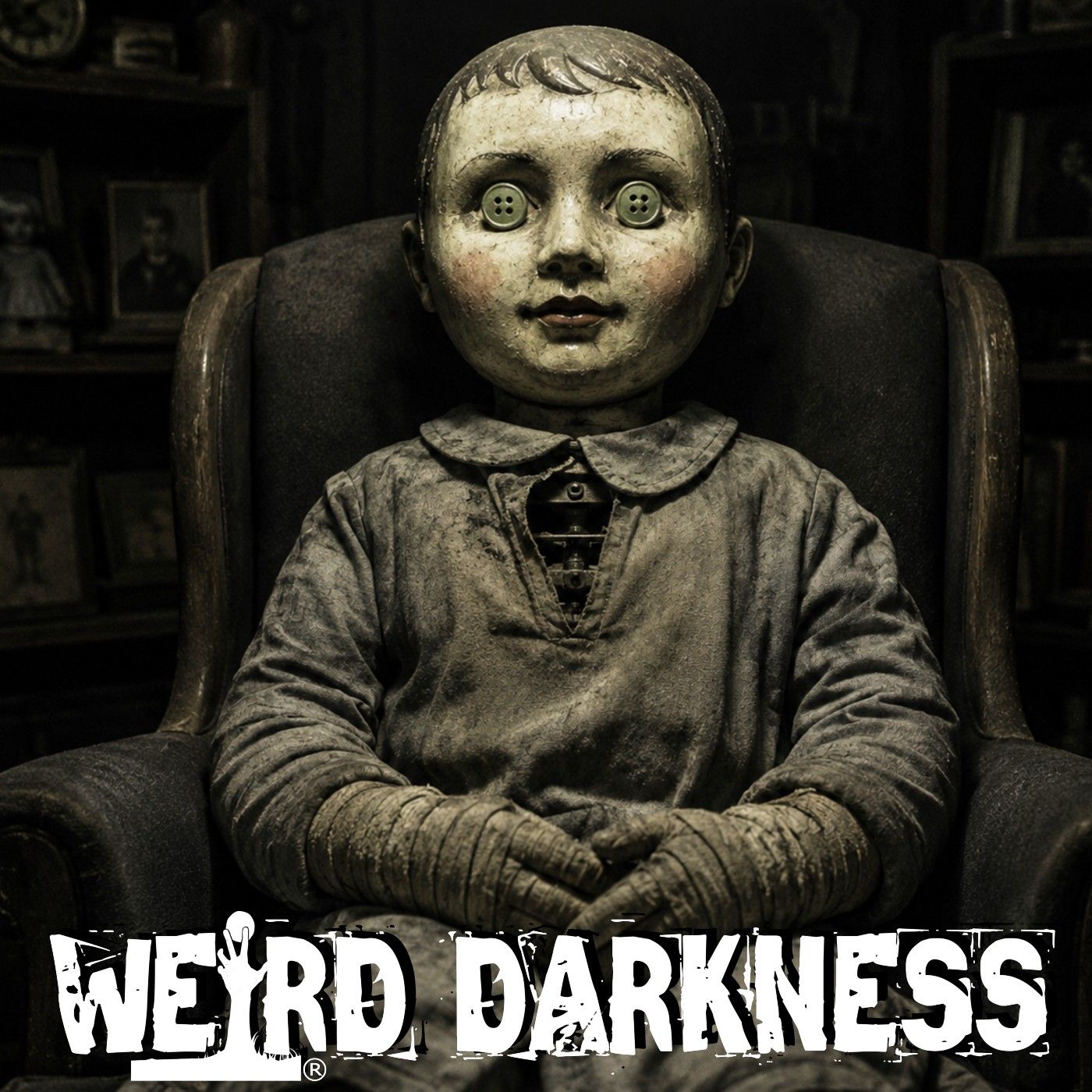
The Necropolyst: The Professor Who Kept the Dead as Dolls
Podcast: Weird Darkness: Paranormal & True Crime StoriesPublished On: Fri Jul 31 2026
Description: This episode covers real-life horror far more extreme than usual, including a Russian professor arrested in 2011 for keeping the mummified corpses of 29 women and girls in his apartment, each one fitted with a hidden music box. It also includes the story of a 19th-century whiskey heir who paid six handkerchiefs for a 10-year-old girl so he could watch cannibals kill and eat her, and the theory that Alexander the Great was declared dead nearly a week before he actually died. Content is more graphic than usual, so listener discretion is advised.EPISODE BLOG PAGE (includes sources): https://weirddarkness.com/necropolystREAD or DOWNLOAD the full transcript of this episode: https://weirddarkness.tiny.us/2p8e5emeCHAPTERS & TIME STAMPS (All Times Approximate)…00:00:00.000 = The Foreboding00:00:47.354 = Show Open00:01:58.356 = Alexander the Great00:05:52.710 = The Ravenous Beast of Gévaudan00:09:41.943 = The Rape and Burial of Jessica Lunsford ***00:11:55.911 = The Dyatlov Pass Incident00:15:29.080 = The Torture Dungeon of Leonard Lake and Charles Ng00:19:10.197 = Robert The Doll00:23:08.785 = The Disappearance and Eerie Return of Bobby Dunbar ***00:26:33.271 = Albert Fish – The Brooklyn Vampire00:30:06.498 = The Strange Disappearance of the Sodder Children00:34:28.570 = Anatoly Moskvin, The Russian Who Mummified Dead Girls00:38:41.505 = The Jameson Whiskey Cannibal ***00:42:29.572 = Show Close*** = Begins immediately after inserted ad breakLISTEN ON PODCAST APPS: Look for this podcast on Apple Podcasts, Spotify, iHeart Radio, Amazon Music, Pandora, TuneIn Radio, and other podcast apps. Get a list of free listening apps here: https://weirddarkness.com/wdapps*No AI Voices Are Used In The Narration Of This Podcast*SOURCES and RESOURCES:“Real-Life Horror Stories More Freaky Than Fiction” by Marco Margaritoff for AllThatsInteresting.com:https://weirddarkness.tiny.us/2p8p9c72(Over time links may become invalid, disappear, or have different content. I always make sure to give authors credit for the material I use whenever possible. If I somehow overlooked doing so for a story, or if a credit is incorrect, please let me know and I will rectify it in these show notes immediately. Some links included above may benefit me financially through qualifying purchases.)WeirdDarkness® is a registered trademark. Copyright ©2026, Weird Darkness.Originally aired: March 2022Weird Darkness this episode gathers real-life horror too extreme for scripted television, spanning from ancient Macedonia to the Congo basin and landing, along the way, in a Russian apartment stacked with mummified girls.It opens with Alexander the Great, who collapsed in Babylon in 323 B.C. after a 24-hour drinking binge triggered a sudden fever, a stabbing pain in his back, and creeping paralysis that eventually left him speechless; doctors pronounced him dead at 32. His body reportedly stayed "pure and fresh" for six days afterward, evidence ancient Greeks took as proof of his divinity. In 2019, Dr. Katherine Hall of New Zealand's University of Otago proposed in the Ancient History Bulletin that Alexander actually suffered from Guillain-Barré Syndrome, an autoimmune disorder that paralyzes the body while leaving the mind fully intact; since fourth-century-B.C. doctors checked for breath rather than a pulse, Hall's theory suggests Alexander may have been declared dead nearly a week before he actually died, and was buried alive.From there, the story moves to 18th-century France, where a wolf-like creature killed or mauled close to 300 people across three years in the Gévaudan region, most of them women and children. Fourteen-year-old shepherdess Jeanne Boulet was the first confirmed victim in 1764; a fifteen-year-old girl killed a month later survived long enough to describe her attacker as "a horrible beast". Militia leader Jean-Baptiste Duhamel organized a 30,000-strong hunting party, and King Louis XV eventually dispatched his own bodyguard, François Antoine, who killed a large wolf in September 1765; the attacks resumed within months regardless. A farmer named Jean Chastel is credited with killing the actual beast using silver bullets, reportedly after finding human remains inside its stomach.Next, the episode turns to the 2005 murder of nine-year-old Jessica Lunsford in Homosassa, Florida. Convicted sex offender John Evander Couey broke into her family's home, took her to his trailer, raped her over three days, sealed her inside garbage bags, and buried her alive in his yard while she still clutched a stuffed dolphin her father had won her at a state fair. Prosecutors later determined Jessica may have still been alive in the house during Couey's first police interview. Couey was convicted of first-degree murder and kidnapping in March 2007 and died on death row of natural causes in 2009.From Florida, the episode jumps to the Ural Mountains and the Dyatlov Pass incident of January 1959, when hiking leader Igor Dyatlov and eight fellow students from the Ural Polytechnic Institute died during an expedition toward Otorten Mountain. Investigators found their tent slashed open from the inside and shoeless footprints leading nearly a mile into the forest; the first bodies recovered, dressed only in underwear despite temperatures near negative 20 degrees Fahrenheit, were ruled hypothermia deaths. Two of the last four bodies found, Lyudmila Dubinina and Semyon Zolotaryov, were missing their eyeballs, Lyudmila was also missing her tongue, and both had clothing that tested positive for radioactivity. More than sixty years later, no single explanation, from avalanche to secret Soviet weapons testing, has been confirmed.The episode then moves to a cabin in California's Sierra Nevada foothills, where Leonard Lake and Charles Ng tortured and killed as many as 25 people between 1983 and 1985. Lake, a Vietnam veteran discharged for psychological reasons, built a cinderblock bunker behind a one-way mirror where he and Ng held women as sex slaves before killing them, dismembering the bodies, and dissolving the remains in acid; investigators eventually recovered twelve victims' remains along with roughly 40 pounds of charred bone. The pair was caught in June 1985 after Ng tried to shoplift a bench vise; Lake swallowed a cyanide capsule sewn into his jacket lining and died in custody before trial, while Ng was convicted of eleven murders in 1999 and remains on death row at San Quentin.Next comes Robert the Doll, manufactured by Germany's Steiff Company in 1904 and given to a Key West boy named Robert Eugene "Gene" Otto, who reportedly carried the doll everywhere and spoke of it in the first person. After Gene died in 1974, new owner Myrtle Reuter said the doll continued moving through her house with no explanation and eventually donated it to the Fort East Martello Museum, where curator Cori Convertito now oversees a steady stream of visitors who claim their cameras stop working in Robert's presence.From there, the episode circles back to 1912 Louisiana and the disappearance of four-year-old Bobby Dunbar from Swayze Lake. Eight months later, authorities found a boy matching his description traveling with a man named William Cantwell Walters, who insisted the child was Bruce Anderson, son of field hand Julia Anderson; the Dunbar family claimed the boy as their own anyway. It took until 2004, after years of research by Bobby's granddaughter Margaret Dunbar Cutwright, for a DNA test to prove the man raised as Bobby Dunbar shared no blood relation to the Dunbar family, meaning the real Bobby likely died in 1912 and the family had unknowingly raised Julia's son instead.The story turns next to Albert Fish, born in 1870 and later known as the Brooklyn Vampire, who spent decades torturing, killing, and cannibalizing children after enduring severe abuse in a New York orphanage as a boy. In 1928, posing as a farmer named Frank Howard, Fish lured ten-year-old Grace Budd away from her family and killed her; he wasn't identified until November 1934, when a letter he sent to Grace's mother describing the murder in graphic detail was traced back to him. Fish was executed in the electric chair at Sing Sing Prison on January 16th, 1936.Following that, the episode covers the unresolved 1945 Sodder children case in Fayetteville, West Virginia, where a Christmas Eve house fire killed, or apparently killed, five of George and Jennie Sodder's nine children. No bones were ever recovered from the wreckage despite a coroner attributing the deaths to the blaze, and the family spent decades chasing tips and alleged sightings after strangers had made ominous threats about the house burning down in the months before the fire. George and Jennie erected a billboard along Route 16 asking for information and died in 1968 and 1989, respectively, without ever learning their children's fate.From there, the story turns to Anatoly Moskvin, a Russian journalist and college professor fluent in thirteen languages who dubbed himself a "necropolyst" and visited 752 cemeteries around his hometown of Nizhny Novgorod. Moskvin was arrested in 2011 after police investigating the desecration of Muslim graves found him painting over photographs of the dead; a search of the apartment he shared with his parents turned up the mummified remains of 29 women and girls, dressed, made up with buttons for eyes, and fitted with music boxes inside their chests. Moskvin told investigators he dug up the bodies because he was lonely and confessed to 44 counts of abusing graves and corpses.The episode clos
The note was deleted
The note was saved
Your message was sent