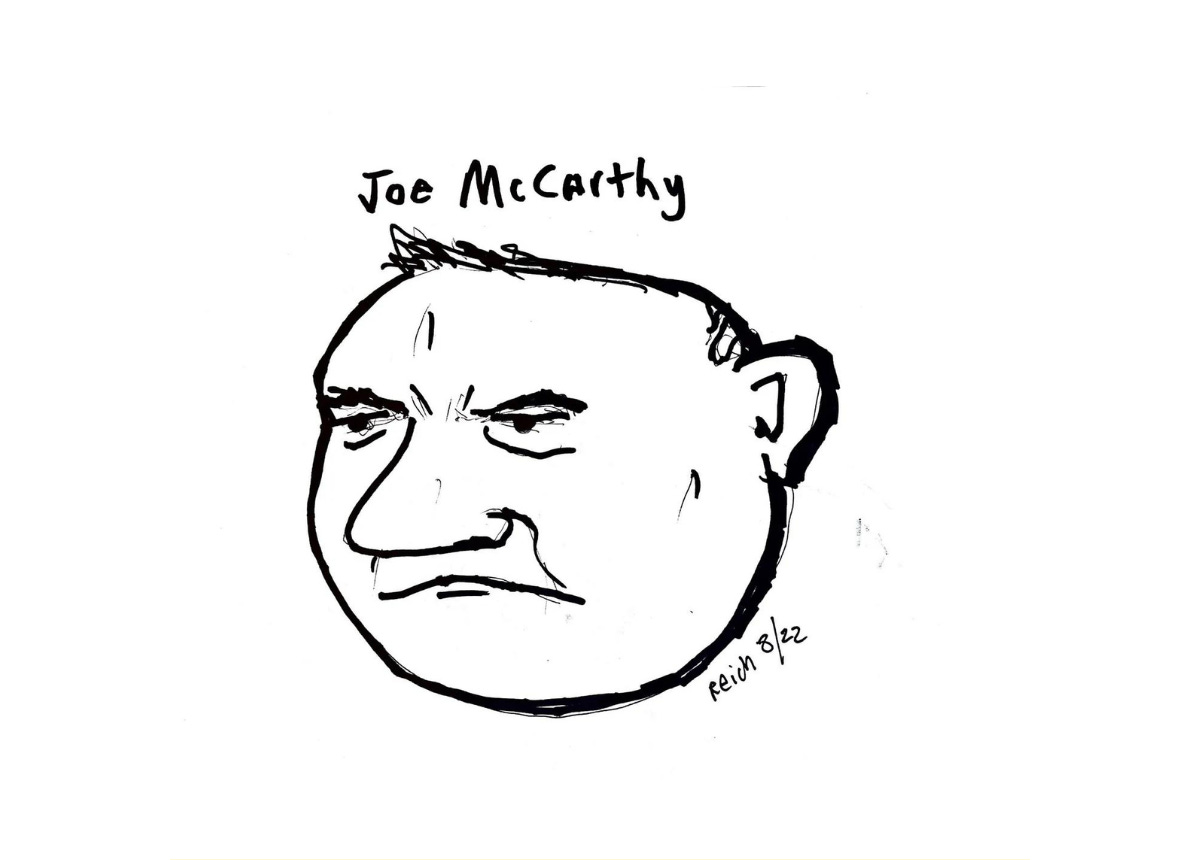
My father and Senator Joe McCarthy
Podcast: The Coffee Klatch with Robert ReichPublished On: Fri Aug 26 2022
Description: When Robert Draper of the New York Times recently asked Rose Sperry, a state committeewoman for Arizona’s G.O.P., to name the first Republican leader she ever admired, she immediately mentioned former Wisconsin senator Joe McCarthy. “I grew up during the time that Joe McCarthy was doing his talking,” Sperry said. “I was young, but I was listening. If he were here today, I would say, ‘Get him in there as president!’”I also grew up during the time Joe McCarthy was “doing his talking,” and I was young and listening, too. But I would not want Joe McCarthy to be president. Neither, let me add, did my father. Ed Reich called himself a liberal Republican, in the days when such creatures still existed. He voted for Thomas Dewey in 1948 (cancelling my mother’s vote for Harry Truman), and then for Dwight Eisenhower in 1952 and 1956 (cancelling my mother’s votes for Adlai Stevenson), and he thought highly of New York State’s Republican governor, Nelson Rockefeller, and its Republican senator, Jacob Javits — neither of whom would last a second in today’s G.O.P.But Ed Reich could not abide bullies and he detested Joe McCarthy. My father thought that anyone who had to bully someone else to feel good about himself was despicable. Bullying led to antisemitism and antisemitism had led to the holocaust. In 1947, Ed Reich moved us from Scranton to a little village in the country some sixty miles north of New York City, called South Salem, so as to be within equal driving distance of his two women’s clothing stores, in Norwalk, Connecticut, and Peekskill, New York. Soon after we arrived, a delegation of older men from the village came by to inform us that South Salem was a “Christian community” and we were not welcome there. That was the day my father decided we’d stay put in South Salem. “I’ll show those b******s,” he said. Senator Joseph McCarthy had a special place in Ed Reich’s pantheon of evil bullies. McCarthy didn’t just attack those he claimed were members of the Communist Party. He did it with malice. McCarthy’s crusade against “subversives” extended into the mainstream of America and American politics, as he ridiculed the “pitiful squealing” of “those egg-sucking phony liberals” who “would hold sacrosanct those Communists and queers.” Every time McCarthy’s image came across the six-inch screen on the Magnavox television in our living room, my father would shout “son of a B***H” so loudly it made me shudder. In Many are the Crimes: McCarthyism in America, historian Ellen Wolf Schrecker describes a movement that “punished thousands of law-abiding Americans and scared millions more into silence, destroying much of the left and seriously narrowing the political spectrum.” McCarthyism was the byproduct of the Republican Party’s postwar effort to eradicate the New Deal by linking it to communism. The G.O.P. portrayed the midterm election of 1946 as a “battle between Republicanism and communism.” The Republican National Committee chairman claimed that the federal bureaucracy was filled with “pink puppets.” According to John Nichols, in The Fight for the Soul of the Democratic Party, Southern segregationist Democrats joined the red-baiting rhetoric. Mississippi senator Theodore Bilbo, a Klansman who had filibustered to block anti-lynching legislation, described multiracial labor unions’ advocacy for civil rights as the work of “northern communists.” Representative John Elliott Rankin, a fiercely racist and antisemitic Mississippi Democrat who helped establish the House Un-American Activities Committee as a standing congressional committee, called the CIO’s Southern organizing campaign “a communist plot” and charged that it would lead to more Black voting rights. “We’re asleep at the switch,” he warned. “They’re taking over this country; we’ve got to stop them if we want this country.”The backlash was successful. In the 1946 midterms, Democrats lost control of both the Senate and the House. Wisconsin ended its era of progressive Republican La Follettes and sent Joe McCarthy to the Senate. California replaced New Dealer Jerry Voorhis with a young Republican lawyer who had already figured out how to use red-baiting as a political tool. His name was Richard Nixon. In December 1946, at the founding convention of the Progressive Citizens of America, FDR’s former vice president, Henry Wallace, saw the red scare for what it was — a tool of the most powerful economic forces in America. “We shall … repel all the attacks of the plutocrats and monopolists who will brand us as Reds,” he said. If it is traitorous to believe in peace — we are traitors. If it is communistic to believe in prosperity for all — we are communists. If it is unAmerican to believe in freedom from monopolistic dictation — we are unAmerican. We are more American than the neo-Fascists who attack us. The more we are attacked the more likely we are to succeed, provided we are ready and willing to counterattack.But there was no counterattack. The red scare continued to gain ground, encouraged by J. Edgar Hoover, the first director of the F.B.I. Soon after the release of Frank Capra’s loving ode to America, “It’s a Wonderful Life” in January 1947, the F.B.I. (using a report by an ad-hoc group that included Fountainhead writer and future Trump pin-up girl Ayn Rand) warned that the movie represented “rather obvious attempts to discredit bankers by casting Lionel Barrymore as a ‘scrooge-type’ so that he would be the most hated man in the picture.” The movie “deliberately maligned the upper class, attempting to show the people who had money were mean and despicable characters. This … is a common trick used by Communists.” The F.B.I. report compared “It’s a Wonderful Life” to a Soviet film, and alleged that Frank Capra was “associated with left-wing groups” and that screenwriters Frances Goodrich and Albert Hackett were “very close to known Communists.”President Truman succumbed to the mounting anti-communist hysteria. On March 21, 1947 he signed Executive Order 9835, the Loyalty Order that ushered in loyalty oaths and background checks, and created the Attorney General’s List of Subversive Organizations. Yet the progressive left remained silent. As the 1950 election approached, a Times headline announced that the “Left is Silent in Campaign.” Even the American Civil Liberties Union, whose roots lay in the first Red Scare of the World War I era, was reluctant to take the lead in opposing the threat to civil liberties in the second Red Scare of the 1950s. California Representative Helen Gahagan Douglas, dubbed the “Pink Lady” for her supposed communist sympathies, tried for the Senate in 1950. She survived a bitter primary battle only to be beaten in November by red-bater Richard Nixon. On June 9, 1954, I sat at my father’s side on our living room couch, watching the Army-McCarthy hearings. McCarthy had accused the U.S. Army of having poor security at a top-secret facility. Joseph Welch, a private attorney, was representing the Army. McCarthy charged that one of Welch’s young staff attorneys was a communist. “Son of a B***H,” my father shouted.As McCarthy continued his attack on Welch’s staff attorney, Welch broke in, “Until this moment, Senator, I think I never really gauged your cruelty or your recklessness.”I was spellbound. McCarthy didn’t stop. “Son of a B***H,” Ed Reich shouted ten times more loudly. The earth shook. At this point, Welch demanded that McCarthy listen to him. “Let us not assassinate this lad further, Senator,” he said. “You have done enough. Have you no sense of decency?” Almost overnight, as the Senate Historical Office recounts, “McCarthy’s immense national popularity evaporated. Censured by his Senate colleagues, ostracized by his party and ignored by the press, McCarthy died three years later, 48 years old and a broken man.”***During the Army-McCarthy hearings, McCarthy’s chief counsel was Roy Cohn. Cohn had gained prominence as the Department of Justice attorney who successfully prosecuted… This is a public episode. If you'd like to discuss this with other subscribers or get access to bonus episodes, visit robertreich.substack.com/subscribe
The note was deleted
The note was saved
Your message was sent