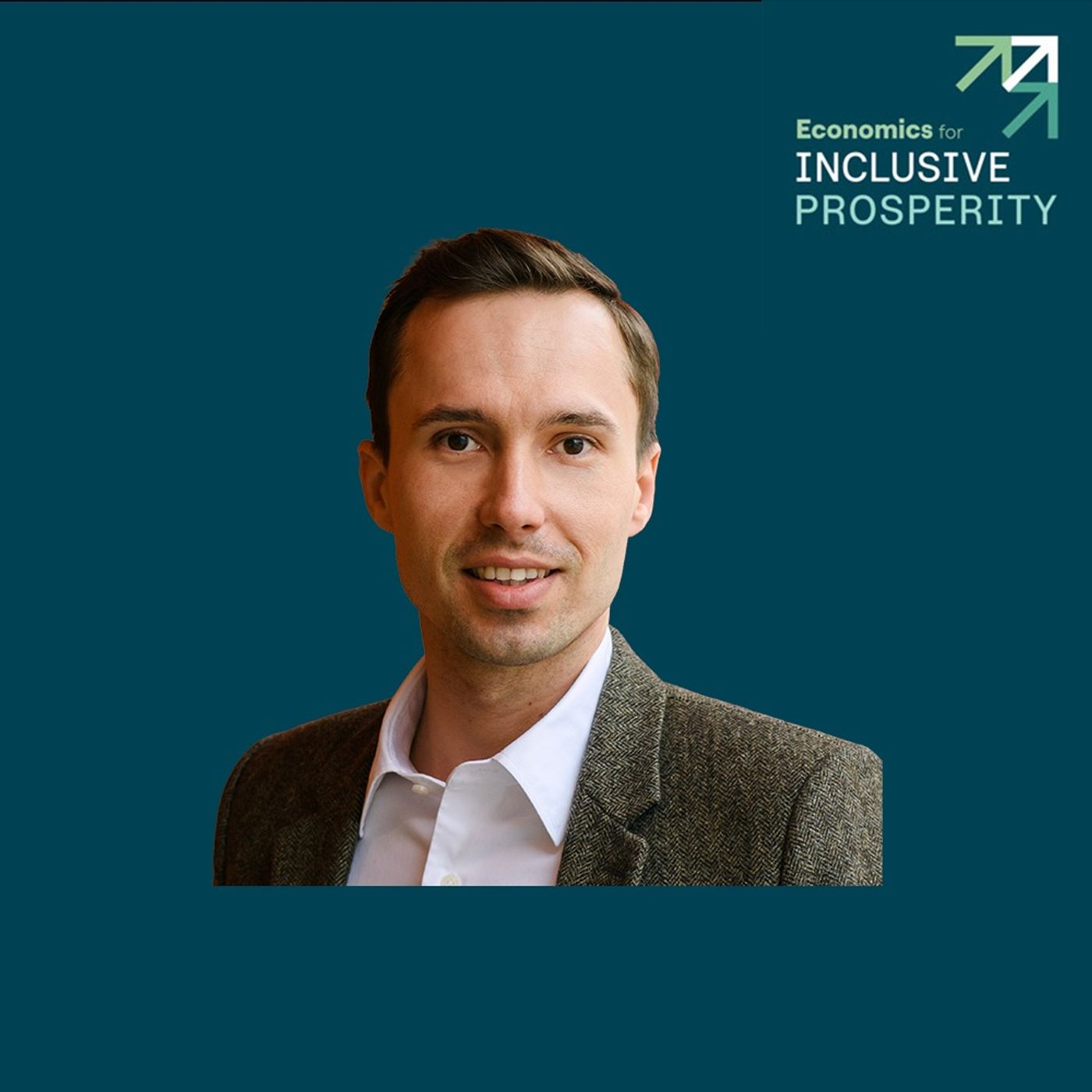
Lukas Lehner: UBI and guaranteed job programs not only work, they work better together
Podcast: Economics for Inclusive ProsperityPublished On: Wed Oct 07 2026
Description: University College London economist Lukas Lehner has been conducting real-world experiments and research into two hot topics in economic policy: job guarantee and universal basic income programs. Universal basic income UBI programs offer a guaranteed base income whether you are working or not, while job guarantee programs give work to everyone who wants it. Neither are needs-tested, meaning you don’t have to prove you need them to get them. While they’ve existed mostly on the fringes of the policy debate in recent decades and are despised by fiscal conservatives as handouts, they’ve recently been pushed more into the mainstream by rising inequality and by new dire predictions of a coming AI-related jobs wipeout. Both provide a floor to the social safety net; a buffer between people and abject poverty. But Lehner says they also level the playing field with employers, allowing workers to opt out of bad jobs and working conditions that companies would otherwise have no pressure to improve. But will people work if they don’t have to? And how can employers motivate workers to be productive when they know they have a guaranteed job waiting for them? And can UBS and job guarantees be politically viable when their costs are simple to identify, but some of their key benefits—like improved mental health, life satisfaction, and a sense of purpose—are hard to put a price on, like improved mental health, life satisfaction, and a sense of purpose. Lehner joins host Ralph Ranalli and co-host (and EFIP co-director) Suresh Naidu to share what he learned from two experiments, a job guarantee program he conducted in Austria, and a UBI program in Germany that was run by his close colleague and EFIP member Max Kasy.About our guest:Lukas Lehner is an Assistant Professor in Economics and Social Policy at University College London and an Associate Fellow at the Institute for New Economic Thinking, University of Oxford. His research focuses on economic and social policies in a changing world of work, with an emphasis on unemployment and inequality. His work appears across economics and sociology outlets including the American Economic Journal: Economic Policy, the Journal of Public Economics, and the American Sociological Review. He completed his PhD at the University of Oxford in 2024 and studied at MIT, UC Berkeley, LSE, and WU Vienna. Previously, he worked for the OECD Chief Economist and the ILO. His research was recognized by several awards including the Upjohn Institute Dissertation Prize, the LERA Best Dissertation Award, and the ESRC Prize for Outstanding Early Career Impact. About the co-host:Suresh Naidu is the Jack Wang and Echo Ren Professor of Economics and a professor of international and public affairs at Columbia University. He’s a former Alfred P. Sloan Research fellow who’s been recognized for his groundbreaking scholarship in labor economics. Naidu previously served as a Harvard Academy Junior Scholar at Harvard University, and as an instructor in economics and political economy at the University of California, Berkeley. He holds a BMath degree from University of Waterloo, an MA in economics from the University of Massachusetts, Amherst and a PhD in economics from the University of California, Berkeley. Economics for Inclusive Prosperity (EFIP) is a network of academic economists from Harvard, Princeton, Columbia, and other leading universities who are committed to an inclusive economy and society. EfIP members are working to transform their field around a new vision of prosperity—a vision that includes traditional economic metrics, but also expanded measures of wellbeing including access to health, to democratic participation and to a livable planet. They’re also highlighting the important changes in economics that are already underway. EFIP is supported by a grant from the William and Flora Hewlett Foundation. Host Ralph Ranalli is a podcaster, writer, and former journalist who specializes in conversations about public policy. Ralph formerly hosted “HKS PolicyCast,” the award-winning flagship podcast of the Harvard Kennedy School. He holds a degree in political science from UCLA and a master’s in journalism from Columbia University. The Economics for Inclusive Prosperity Podcast is recorded at the Malcolm Wiener Center for Social Policy at the John F. Kennedy School of Government at Harvard University. The EFIP co-directors are Dani Rodrik and Stefanie Stantcheva of Harvard University, Atif Mian and Ilyana Kuziemko of Princeton University, and Suresh Naidu of Columbia University.
The note was deleted
The note was saved
Your message was sent